Cardano Founder Says This Midnight Deal Could Bring Billions In TVL

bitcoinistPublished on 2026-03-26Last updated on 2026-03-26

Abstract

Cardano founder Charles Hoskinson announced a major partnership between the privacy-focused blockchain Midnight and UK-based Monument Bank, which plans to tokenize up to £250 million in retail deposits. This initial phase could expand into billions in Total Value Locked (TVL) as Monument aims to later offer tokenized investment products and Lombard-style lending. The deal is positioned as a breakthrough for regulated finance on public blockchains, using Midnight’s privacy features to balance transparency with banking confidentiality while operating within existing regulatory frameworks.

Cardano founder Charles Hoskinson says Midnight’s new partnership with Monument Bank could become one of the biggest commercial wins yet for the privacy-focused network, after the UK lender unveiled plans to put retail customer deposits on a public blockchain. In a post on X, the Cardano founder wrote:

“This is one of the largest deals we’ve ever done and could bring hundreds of millions to billions of TVL to the Midnight ecosystem. I’m extremely proud of Fahmi Syed and his team at the Midnight Foundation for the hard work they put into the negotiations with Monument. Midnight is the home of Web 2.5 ventures.”

Why The Cardano So Enthusiastic

Monument, a UK digital bank serving the mass-affluent segment, said it plans to become the first UK bank to tokenize retail customer deposits on a public blockchain, with Midnight providing the underlying network and privacy-preserving architecture.

The first phase is concrete. Monument said it is targeting up to £250 million in tokenized deposits, with each token representing a one-to-one claim on funds held at the bank. Those deposits are intended to remain interest-bearing, redeemable in pounds sterling and protected within the existing regulatory framework, including the Financial Services Compensation Scheme. Monument says it currently serves more than 100,000 clients and has over £7 billion in savings deposits, giving the project a real balance-sheet base rather than a purely experimental starting point.

That setup is central to Midnight’s pitch. The tokenized deposits are not being framed as a new synthetic asset or an offshore wrapper, but as a blockchain mirror of traditional bank deposits. According to the release, transaction data on Midnight will be shielded and visible only to Monument and its customers, an architecture aimed at preserving the confidentiality banks need while still using public-chain rails.

Midnight Foundation President Fahmi Syed used the deal to make a broader point about institutional blockchain adoption. Financial firms, he said, have struggled with the tension between openness and banking-grade confidentiality. Midnight, in his words, is designed to “represent assets on public networks” while protecting “sensitive financial information,” and Monument’s rollout is meant to show that regulated products can move on-chain without stepping outside existing compliance and consumer-protection frameworks.

The longer-term roadmap explains why Hoskinson is talking in terms of billions rather than the initial £250 million. Phase two would expand beyond tokenized deposits into tokenized investment products delivered through the Monument app, including access to private equity, commodity funds and structured products. Phase three would introduce Lombard-style lending, allowing clients to borrow against investments without selling them. Monument also said its technology affiliate aims to extend tokenized-deposit functionality to other institutions through its Banking-as-a-Service platform.

In that sense, Hoskinson’s TVL projection reads less like a claim about day-one inflows and more like a statement about the size of the pipeline if the rollout expands as planned. The hard figure disclosed so far is £250 million in the first phase. But if Monument can move from deposit tokenization into investment products, lending and third-party enablement, Midnight would be competing for balance-sheet-linked activity that is structurally different from mercenary DeFi liquidity.

For Midnight, the partnership is also a live test of its core thesis: that privacy-enhancing infrastructure can make public blockchains usable for regulated finance. If Monument executes beyond the pilot, the deal would give the Cardano-linked network something many crypto projects still lack, a banking use case tied to real deposits, real customers and a product roadmap built to stay inside the guardrails of traditional finance.

At press time, Cardano traded at $0.26.
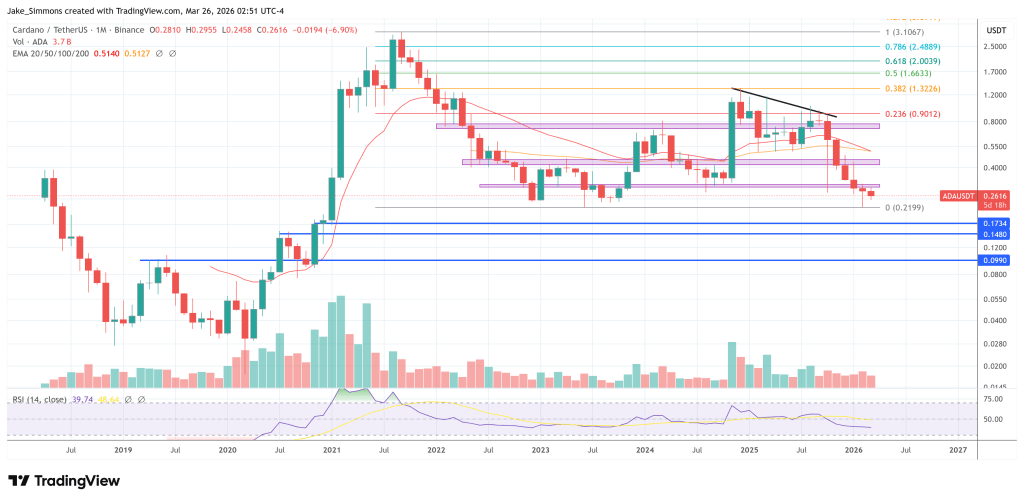
Cardano hovers below key resistance, 1-month chart | Source: ADAUSDT on TradingView.com

Related Questions

QWhat is the significance of the partnership between Midnight and Monument Bank according to Cardano founder Charles Hoskinson?

ACharles Hoskinson believes this partnership could become one of the largest deals for Midnight, potentially bringing hundreds of millions to billions in Total Value Locked (TVL) to its ecosystem.

QWhat specific service does Monument Bank plan to implement using Midnight's network?

AMonument Bank plans to become the first UK bank to tokenize retail customer deposits on a public blockchain, using Midnight's network and privacy-preserving architecture.

QWhat is the initial target amount for tokenized deposits in the first phase of the project?

AThe initial target for the first phase is up to £250 million in tokenized deposits.

QHow does Midnight's technology address the conflict between openness and confidentiality for financial institutions?

AMidnight is designed to represent assets on public networks while protecting sensitive financial information through its privacy-enhancing infrastructure, allowing transaction data to be shielded and visible only to the bank and its customers.

QWhat are the future phases of the project beyond tokenizing deposits?

APhase two will expand into tokenized investment products like private equity and commodity funds, while phase three will introduce Lombard-style lending, allowing clients to borrow against their investments without selling them.

Related Reads

AI "Transfer Station" Earning Millions Monthly? Five Questions Uncover the Truth of Token Arbitrage

The article "AI 'Transfer Station' Earns Millions Monthly? Five Questions Uncover the Truth of Token Arbitrage" explores the emerging business of API token transfer stations, which profit from global AI service price disparities and access barriers. These intermediaries purchase low-cost tokens from overseas AI providers (e.g., OpenAI, Claude) through grey-market methods—such as exploiting enterprise credits, bulk accounts, or subscription benefits—and resell them to Chinese users at a markup. Key drivers include the high cost of using top AI models (e.g., Claude Code costs ~$5 per million tokens), the performance gap between domestic and foreign models, and mismatches between subscription and API pricing. However, the practice carries significant risks: upstream token sources may be unstable or illegal; user data passing through intermediaries can be harvested or injected with hidden prompts; and models might be downgraded without disclosure. The market is evolving, with some operators now exporting cheaper Chinese models (e.g., Qwen3.5 at ~$0.11 per million tokens) to overseas users, leveraging price gaps. Yet, sustainability is low due to compliance crackdowns, instability, and reputational risks. Users are advised to employ detection methods (e.g., prompt adherence tests) and avoid sensitive data usage. The authors caution that while transfer stations offer short-term arbitrage, they lack long-term reliability and security compared to official APIs.

marsbit6m ago

AI "Transfer Station" Earning Millions Monthly? Five Questions Uncover the Truth of Token Arbitrage

marsbit6m ago

The Cost of an 11.5% Annualized Return: Will MicroStrategy's STRC Face a Moment of Reckoning?

This article analyzes the potential risks associated with MicroStrategy's (MSTR) use of structured financial products like STRC to leverage its BTC exposure. While these tools have enabled impressive returns (e.g., 11.5% annualized) and fueled significant capital inflows ($13.5B outstanding), they also create substantial annual dividend obligations (~$400M). The author argues that this structure, while effective in a bull market, could become a liability if BTC price stagnates or declines. The core risk is a potential negative feedback loop: the growing dividend burden from continued STRC issuance may eventually outweigh the benefits of increased BTC holdings. To meet these obligations, MicroStrategy might need to use new issuance proceeds for dividends instead of buying more BTC, which could disappoint equity investors. If the market capitalization (mNAV) falls below the value of its BTC holdings, the company could be forced to sell BTC instead of issuing new shares, potentially triggering a panic. The author estimates a potential inflection point in 6 months, where annual dividend costs reach $3-4B. At that stage, CEO Michael Saylor might face a difficult choice: sell BTC to meet obligations or sacrifice the credibility of the preferred shares by halting dividends. The article concludes that this financial engineering, while powerful, could ultimately "backfire" on MicroStrategy if market conditions turn.

marsbit1h ago

The Cost of an 11.5% Annualized Return: Will MicroStrategy's STRC Face a Moment of Reckoning?

marsbit1h ago

Trading

Spot
Futures

Hot Articles

Discussions

Welcome to the HTX Community. Here, you can stay informed about the latest platform developments and gain access to professional market insights. Users' opinions on the price of ADA (ADA) are presented below.

活动图片