Cardano Founder Reacts As NIGHT Token Crashes From $150 To $0.02

bitcoinistPublished on 2025-12-11Last updated on 2025-12-11

Abstract

Cardano founder Charles Hoskinson reacted to the extreme volatility of the newly launched NIGHT token, which surged to $150 before crashing to $0.02. Despite the sharp drop, Hoskinson defended the launch as Cardano’s strongest ever, highlighting its $1.5 billion fully diluted valuation and immediate listings on major exchanges like Binance Alpha and Kraken. He attributed the price plunge to speculative traders dumping tokens, not a structural failure, and emphasized that NIGHT’s retail-focused, fair launch—without VC involvement—was a return to crypto’s original principles. Hoskinson also positioned Midnight as Cardano’s first "partner chain" and a key competitive advantage for multi-ecosystem growth, aiming to expand the ecosystem to a $10 billion valuation.

Cardano founder Charles Hoskinson has hailed the launch of Midnight and its native token NIGHT as the strongest in the network’s history, arguing that it proves Cardano can now host and distribute multi-billion-dollar assets at scale.

NIGHT Token Plunges After Midnight Launch

In his December 10 livestream “Midnight Launch AAR,” Hoskinson opened with the volatile price action that dominated social media. NIGHT initially spiked to what he called an “insane” level: “It launched at almost a $150, which is just insane [...] it just went way, way, way up.” Once trading opened on Binance Alpha, the move reversed violently. “As soon as it got on Binance Alpha – oh god, why, why, oh why – all the way down to two cents. They dumped on us. That’s what they do. That’s what the DGENs over in that market do.”

He framed this as typical exchange-distribution dynamics, not a structural failure: recipients with no real connection to the ecosystem “regardless of the price, they just dump the token. They probably didn’t even know what NIGHT was.”

According to Hoskinson, such launches usually endure 48–72 hours of “high volatility” before a stable range emerges. He reiterated that he had expected NIGHT to trade in a “5 cents to 15 cents” band and said it was sitting around 6–6.5 cents with a fully diluted valuation of roughly $1.5 billion and around $150 million in trading volume. For a brand-new Cardano-native asset in current conditions, he called that “a really solid launch.”

What made the debut historically significant in his view was the combination of tier-one listings and on-chain metrics. “This is the first time in history that Cardano right out the gate can launch a $1.5 billion product, be listed on Binance Alpha and Kraken and OKX and everybody else at the start,” he said, stressing that much of the required infrastructure “wasn’t there” and had to be built during the run-up.

Cardano’s Best Launch Ever

On Cardano itself, he highlighted that Midnight immediately became the dominant token by trading activity. Citing TapTools, he said NIGHT was “sitting [at] an overwhelming level of volume, and it’s actually greater than the volume of every other Cardano native token combined,” adding that its FDV is “worth more than all the other CNTs combined as well.”

For the first time, he argued, DEXs such as Minswap and SundaeSwap carried a “meaningful percentage of trading volume [...] with respect to large exchanges,” helping “prime the pump on Cardano DEXes” and pull more stablecoins into the ecosystem.

Distribution was another focal point. Hoskinson praised the Glacier Drop mechanism and its gradual “thawing,” saying it creates “a nice steady emission and a nice steady flow for the system as opposed to a jagged thing where the insiders all dump.”

He contrasted Midnight’s retail-heavy, exchange-plus-airdrop distribution with VC-led launches elsewhere: “This is the first time since Bitcoin that a launch has been done the way that Midnight did it. It was complete retail, completely fair, and none of those damn VCs got their grubby hands on it. Instead, it went right to you, the people.”

He tied that to a broader “return to first principles,” arguing that 2026 should reward projects with fair launches and fixed-supply, deflationary monetary policies: “There’s a fixed supply NIGHT, by the way [...] it’s going to be a good year for everybody who’s betting on you, the consumer, and not betting on the banks.”

Looking forward, Hoskinson positioned Midnight as Cardano’s first “partner chain” and the “tip of the spear” for a hybrid DApp model spanning multiple ecosystems: “You talk about Midnight Cardano, Midnight Ethereum, Midnight Solana, Midnight Avalanche, Midnight Binance.” He said that after the first four phases of the roadmap, “every two months a new ecosystem gets activated,” with recurring feature drops “every six to eight weeks.”

He also cast Midnight as a competitive wedge for Cardano DApps. With tier-one integrations and privacy-preserving capabilities, he argued, “we have privacy before [Ethereum and Solana] do,” giving Cardano–Midnight hybrid apps a differentiator that can help grow TVL, MAU and transaction volume.

Hoskinson insisted that the launch pressure-tested and validated the base protocol: “Cardano network handled it. The exchanges handled it. And Midnight is here to stay.” The ambition from here is explicit. “We’re going to march Midnight up as an ecosystem to that $10 billion mark. That’s the goal. Let’s keep going. Let’s get her done,” he said, adding that “these are the best numbers we’ve ever seen in the history of Cardano” – and, in his view, only the beginning.

At press time, ADA traded at $0.4325.
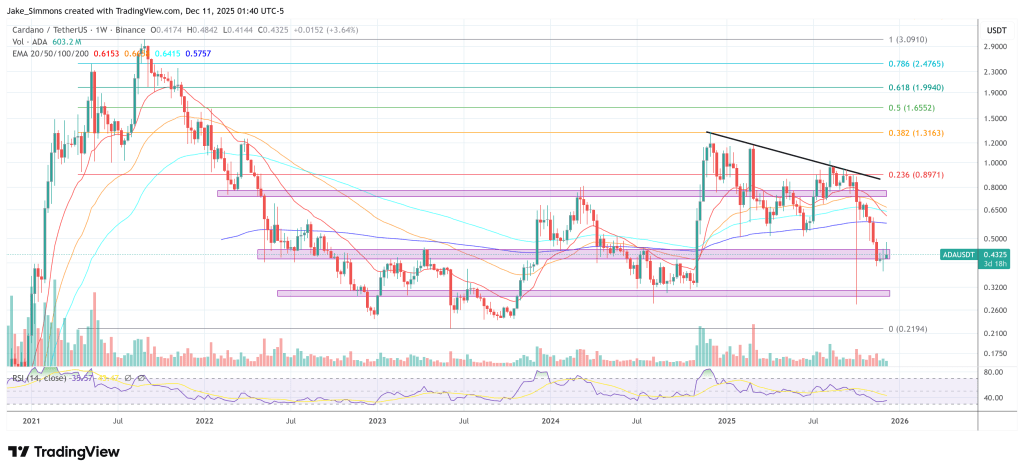
ADA bounces from key support, 1-week chart | Source: ADAUSDT on TradingView.com

Trending Cryptos

Related Reads

Former Huawei 'Genius Teen' Who Questioned DeepSeek Interview Lands in 'Crossfire' from Web3 Investor

Former Huawei "Genius Youth" Li Bojie recently drew public attention by criticizing his interview experience with DeepSeek. The controversy escalated when Du Jun, co-founder of Web3 investment firm ABCDE Capital, publicly accused Li of being "the founder with the least sense of contractual spirit" he had ever cooperated with, sparking a dispute over Li's startup project, Metagent. Li detailed a frustrating DeepSeek interview where he was accused of potential plagiarism, leading him to end the session. The spotlight then shifted to his venture, Metagent, a Web3+AI project aiming to tokenize AI agents. ABCDE invested $1.5 million, with an initial $500k disbursed. Du Jun claimed the project's progress was severely lacking, with a poor-quality demo and minimal social media activity. He alleged Li stopped communicating, deleted his Telegram, and failed to provide proper financial reporting. In response, Li argued the remaining $1 million was never received, crippling operations and forcing salary cuts. He stated he left Metagent in October 2024 due to family reasons and Web3 compliance concerns, with board approval. He claimed to have fulfilled disclosure duties and that his subsequent projects avoided conflicting fields. Other investors, including ArkStream Capital, shared negative due diligence experiences, citing unprofessional contracts and evasive answers on tokenomics. Metagent's social media went silent in June 2024, effectively stalling. Li has since moved to a new consumer AI agent platform, Pine AI (formerly Logenic AI), which has raised $25 million in Series A funding. He served as its Chief Scientist but recently left, clarifying he was not the founder and departed due to a shift in research interests.

Foresight News3m ago

Former Huawei 'Genius Teen' Who Questioned DeepSeek Interview Lands in 'Crossfire' from Web3 Investor

Foresight News3m ago

SemiAnalysis: Anthropic's Q3 Profit to Exceed $1 Billion

Research firm SemiAnalysis reveals that Anthropic is reshaping the AI commercialization landscape with profitability and growth rates far exceeding competitors. Leveraging a high-margin, API-centric business model, Anthropic has become a leader in the B2B AI market. The report projects that Anthropic will achieve a GAAP EBIT of $1 billion in Q3 2026, with a 6% margin. Its Annual Recurring Revenue (ARR) has surged from $9 billion at the end of 2025 to over $60 billion currently. If it maintains a Net New ARR (NNARR) of approximately $15 billion per month, its ARR could reach $300 billion by the end of 2027, implying a $6 trillion enterprise value and making it the world's most valuable company. Anthropic secretly filed for an IPO on June 1st. SemiAnalysis argues the timing is strategically urgent due to narrowing capital market windows as rivals like Alphabet and Meta secure major funding. The superior financials and business model suggest Anthropic should go public before OpenAI to seize the competitive initiative. The performance inflection stems from the explosive adoption of Claude Code, which now accounts for over 7% of all GitHub commits, driving monthly NNARR from $3 billion in January to $11 billion in March. Anthropic's revenue structure differs significantly from OpenAI's. Approximately 75-85% of Anthropic's ARR comes from usage-based API fees, with consumer subscriptions constituting only about 5%. In contrast, over 65% of OpenAI's Q1 2026 revenue was from subscriptions, with ~40% from consumers. The API model's key advantage is no per-user revenue cap, enabling growth within existing accounts. Anthropic's Net Revenue Retention (NRR) is an extraordinary 500%. This drives superior gross margins, now in the mid-60% range versus -94% in 2024, with API margins exceeding 80%. Core drivers are improved inference efficiency and a largely enterprise-focused model without the cost of serving hundreds of millions of free users. The report introduces "EBTIT" (Earnings Before Training & Interest & Taxes) to measure re-investment capacity, projecting Anthropic's cumulative EBTIT through 2028 will be $250 billion higher than OpenAI's. Over 65% of lab ARR currently comes from programming use cases. Cybersecurity is seen as the next major vertical, with upcoming model releases like Fable expected to further increase token pricing and expand NNARR. Indirect sales via hyperscaler platforms (AWS Bedrock, Azure Foundry) now account for 15-20% of ARR. A core constraint is compute supply. By 2030, combined unconstrained compute demand from Anthropic and OpenAI could exceed 100 GW, far outstripping projected new capacity. IPO proceeds are seen as crucial to lock in future compute resources. Key risks include potential price cuts by OpenAI, competitive pressure from Google DeepMind and Meta in coding models, potential government restrictions on frontier model releases, and margin dilution from growing indirect "Token-as-a-Service" sales. Regulatory actions that narrow the capability gap between open-source and proprietary models are highlighted as a fundamental threat to Anthropic's moat.

marsbit16m ago

SemiAnalysis: Anthropic's Q3 Profit to Exceed $1 Billion

marsbit16m ago

Trading

Spot

Hot Articles

Discussions

Welcome to the HTX Community. Here, you can stay informed about the latest platform developments and gain access to professional market insights. Users' opinions on the price of ADA (ADA) are presented below.

活动图片