Cardano Founder Hoskinson Accused Of Selling 1.5 Billion ADA In 2021 Rally

bitcoinistPublished on 2026-06-10Last updated on 2026-06-10

Abstract

Cardano founder Charles Hoskinson faces new allegations from NFT creator Masato Alexander, who claims on-chain tracing reveals large ADA transactions linked to Hoskinson during the 2021 rally. Alexander's analysis suggests a 925 million ADA transaction and nine 20 million ADA payments had a closer common ancestor to IOG's funds than previously known, reducing intermediary hops. He published transaction graphs but noted this traces funding paths, not proving control or sales. This follows prior claims Hoskinson used "genesis keys" to move ~318 million unclaimed ADA into reserves. Hoskinson and a Cardano report denied this, stating most vouchers were redeemed. Separately, Thomas Braziel raised governance questions using Isle of Man filings, inquiring about foundation control and fund allocation during Cardano's early ICO period. Both sets of claims revisit debates over Cardano's early allocation and governance transparency.

Cardano founder Charles Hoskinson is facing a new round of allegations after NFT creator Masato Alexander published additional on-chain tracing work tied to large ADA movements during the 2021 market rally. The claims add another layer to an already contentious debate over Cardano’s early allocation history, governance structure, and voucher redemption process.

Large Cardano Flows To IOG-Linked Pool Pledges

Alexander, who previously became a central figure in the Cardano ADA voucher controversy, said on X that IOG’s on-chain footprint extended beyond its original Genesis UTxO and included several stake pools operated over the years. According to him, those pools required owners and pledged ADA, creating additional paths for tracing funds through Cardano’s UTxO model.

“However, IOG had a larger onchain footprint than just their Genesis UTxO, they operated a number of stake pools over the years,” Alexander wrote. “Each pool requires an owner and pledge ADA to be put up.”

The latest allegation is framed around large ADA transactions that critics claim were linked to Hoskinson and occurred during the 2021 rally. Alexander said his updated tracing work shows that both a 925 million ADA transaction and nine 20 million ADA payments had a closer common ancestor than IOG’s original genesis ADA. In his telling, that reduces the number of intermediary hops between IOG and the transactions from roughly 40 to between one and seven transactions.

“Turns out both the 925m AND the x9 20m payments have a closer common ancestor than IOG’s genesis ADA, which cuts the # of intermediary hops between IOG and these Txs from ~40 to ~1 to 7 Txs,” Alexander wrote. “They gather up ~21 of the 64m ADA pledge’s from IOG’s private pools.”

Alexander also published a dedicated transaction graph and a broader report containing what he described as a hop-by-hop trace, an interactive flow graph, and raw identifiers linked to Cardanoscan. He presented the work cautiously, saying it was not a final adjudication of intent or legal responsibility.

“This is best effort attempt at looking into what transpired on chain, draw your own conclusions,” he wrote. “If you find any errors in the data or methodology, please feel free to reach out and i’ll update it.”

The distinction matters. The material cited by Alexander focuses on tracing transaction ancestry and common funding paths. It does not, on its own, prove who controlled every wallet, whether funds were sold on exchanges, or what contractual obligations may have applied. It does, however, revive questions about Cardano’s early distribution and the transparency of large ADA movements during one of the asset’s most significant bull-market periods.

Isle Of Man Filings Add Another Governance Question

Alexander’s renewed claims follow his earlier allegation that Hoskinson used Cardano “genesis keys” during the 2021 Allegra hard fork to alter or sweep old ICO and voucher-related UTxOs, moving roughly 318 million ADA into Cardano reserves or treasury rather than leaving them directly claimable by original voucher holders.

Hoskinson denied that allegation, saying IOG did not give itself hundreds of millions of unclaimed ADA and that most vouchers were eventually redeemed.

A later Cardano redemption transparency report said the allegations had “no basis.” According to the report, 99.2% of vouchers representing 99.7% of ADA sold through the voucher program were redeemed. It also stated that after Byron-era on-chain redemption ended, 390 vouchers representing 318 million ADA remained unredeemed and were swept into the reserve while a post-sweep redemption process continued.

The scrutiny is not limited to Alexander’s on-chain work. Thomas Braziel of 117 Partners separately said he had collected original Isle of Man filings related to Cardano’s earliest foundation structure. Braziel said the documents appeared to show an early foundation involving Hoskinson, Jeremy Wood, Ken Kodama, and a corporate services provider, while later filings showed Hoskinson serving as the foundation’s “Enforcer.”

Under Isle of Man foundation law, Braziel argued, an Enforcer is not simply a passive observer but a key oversight role meant to ensure that the council follows the foundation’s purposes and governing documents. He linked that question to the timing of Cardano’s ICO, which began in September 2015, before the Swiss Cardano Foundation was established in September 2016.

“The question is not whether development companies should be compensated,” Braziel wrote. “The question is: who negotiated those arrangements on behalf of ICO participants and the Isle of Man Foundation?”

Braziel said he was “not alleging wrongdoing” but asking for documentation on who controlled the Isle of Man Foundation, what happened to roughly 1,090 BTC historical materials indicate were allocated to it, how development agreements were negotiated, and what governance protections existed for ADA purchasers.

At press time, ADA traded at $0.16.
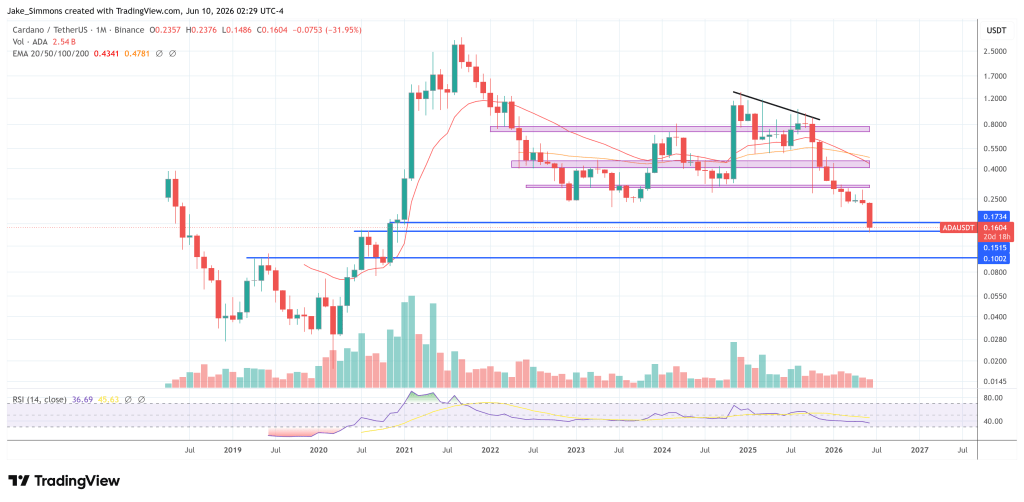
ADA hovers above key support, 1-month chart | Source: ADAUSDT on TradingView.com

Related Questions

QWho published the on-chain tracing work that forms the basis of the new allegations against Charles Hoskinson?

AThe on-chain tracing work was published by NFT creator Masato Alexander.

QAccording to the article, what was the approximate total amount of ADA transactions that Alexander's tracing work focused on from the 2021 rally?

AThe tracing work focused on a 925 million ADA transaction and nine separate 20 million ADA payments, for an approximate total of 1.105 billion ADA.

QWhat does the article state was the outcome of the 318 million ADA in unredeemed vouchers after the Byron-era redemption ended?

AAccording to a later Cardano redemption transparency report cited in the article, the 318 million ADA from 390 unredeemed vouchers was swept into the Cardano reserve, while a post-sweep redemption process continued.

QWhat role in the early Isle of Man Foundation does Thomas Braziel claim Charles Hoskinson served, according to the filings he collected?

AThomas Braziel claims that later filings show Charles Hoskinson served as the "Enforcer" of the early Isle of Man Foundation.

QWhat is the core governance question Thomas Braziel raises based on the Isle of Man foundation documents and the timing of the ICO?

AThe core governance question he raises is: "who negotiated those arrangements [development agreements] on behalf of ICO participants and the Isle of Man Foundation?" given that the ICO began before the Swiss Cardano Foundation was established.

Related Reads

12.9 Million Candidates: The First Summer of Fate in the Hands of AI

The 2026 Chinese college entrance exam, or Gaokao, saw a novel phenomenon: AI aggressively entering the college application advice arena before results were even released. Major tech companies like Alibaba, Tencent, Baidu, and others launched free AI-powered "agents" and tools designed to generate personalized university and major recommendations for over 12.9 million candidates. For years, a lucrative industry thrived on the "information gap" in college applications, with personalized consulting services costing families thousands of dollars. AI is now disrupting this by providing similar, data-driven analysis for free. These tools process standardized data—scores, rankings, historical admission trends—to create tailored application strategies, offering a form of information parity previously unavailable, especially to students from rural or less-resourced backgrounds. This shift represents more than just a marketing trend; it signifies AI's first large-scale entry into a critical, high-stakes life decision for millions of Chinese families. The Gaokao application, with its clear inputs and outputs, is an ideal scenario for AI. Its involvement begins to level the informational playing field, potentially reducing the advantage held by families with greater social capital or access to expensive consultants. However, the article raises a profound question: while AI can optimize choices for employability and financial return based on cold data, it risks promoting a homogenized, utilitarian path. It might steer a passionate student away from a less lucrative field like literature or archaeology toward supposedly "safer" options like computer science. The core dilemma remains: as AI flattens information disparities, does it also flatten the diversity of life choices and the freedom to make—and learn from—mistakes? Ultimately, 2026 may be remembered not for exam questions, but as the year AI began formally influencing the life trajectories of ordinary Chinese people. The real test lies not in the algorithm's recommendations, but in whether individuals will retain the courage to make their own choices and bear the consequences in an increasingly algorithmic age.

marsbit42m ago

12.9 Million Candidates: The First Summer of Fate in the Hands of AI

marsbit42m ago

IC3 Top Universities Collaborative Analysis: Is AI x Crypto the Real Future or Just a Narrative Bubble?

IC3 researchers from leading universities analyze the convergence of AI and crypto. They argue meaningful integration is still nascent, with hype often outstripping progress. The report frames AI as a "translation middleware" making blockchain accessible, while crypto serves as a "trust middleware" via tools like ZK proofs and TEEs for integrity, availability, and confidentiality. Two main directions are examined: 1) **Crypto x AI**: Using AI to enhance blockchain via analysis (fraud detection), algorithmic design, and AI oracles (with accuracy varying by task). New risks include AI-driven malicious smart contracts. 2) **AI x Crypto**: Using crypto to enhance AI via decentralized infrastructure (DePIN), data markets, agent micropayments, governance, and securing AI pipelines (training/federated learning, secure inference). The "Protected Pipeline" (Props) framework combines oracles and trusted computation for secure use of private data. Key challenges are highlighted: The industry must rigorously prove decentralized AI's cost competitiveness and crypto's utility for agent payments. Major research gaps include providing systemic security for autonomous agents and addressing novel threats like unstoppable AI agents. The report concludes by debunking five common misconceptions: blockchain cannot inherently detect AI content, solve algorithmic bias, grant true AI autonomy, ensure AI trustworthiness through mere transparency, or guarantee that decentralization is always cheaper for AI tasks. The field remains in an early, evidence-seeking phase.

marsbit1h ago

IC3 Top Universities Collaborative Analysis: Is AI x Crypto the Real Future or Just a Narrative Bubble?

marsbit1h ago

Anthropic Released the "Most Powerful Model," But Most People Can't Use It

In April, Anthropic launched a preview of its "Mythos" model, which was not publicly released due to its exceptional ability to autonomously discover high-risk zero-day vulnerabilities, posing a security threat if misused. It was restricted to a trusted group of security partners under "Project Glasswing." On June 10, Anthropic officially released Fable 5 and Mythos 5. They share the same underlying model but are distributed under different rules. Fable 5 is for general users, while Mythos 5 remains locked for trusted security partners. Benchmarks show Fable 5 leading in software engineering and long-task execution, with significant improvements in generating production-ready code. However, Fable 5 includes a safety classifier that automatically downgrades requests related to cybersecurity, biochemistry, or model distillation to the weaker Opus 4.8 model. This mechanism, while intended for safety, can affect the user experience and has faced criticism for being overly conservative. Pricing is another key point. Fable 5's API costs are double that of Opus 4.8. Furthermore, after a free trial period ending June 23, it will be removed from standard subscription plans, requiring users to purchase additional credits for access. This shift signals a move towards pay-as-you-go pricing for the most advanced capabilities. The strategy highlights a growing divergence in the AI industry: while some players like DeepSeek are drastically cutting prices, Anthropic is increasing them for its top-tier model, using cost as a filter for high-value users. The article suggests the AI market is stratifying, with commoditized capabilities becoming cheaper while premium, cutting-edge models command a significant price premium.

marsbit1h ago

Anthropic Released the "Most Powerful Model," But Most People Can't Use It

marsbit1h ago

Trading

Spot
Futures

Hot Articles

Discussions

Welcome to the HTX Community. Here, you can stay informed about the latest platform developments and gain access to professional market insights. Users' opinions on the price of ADA (ADA) are presented below.

活动图片