Cardano Foundation Reaches First Milestone In New Governance Roadmap

bitcoinistPublished on 2026-01-22Last updated on 2026-01-22

Abstract

Cardano Foundation has reached the first milestone in its updated governance roadmap by delegating an additional 220 million ADA to 11 community representatives (DReps) focused on Adoption and Operations. This brings the Foundation’s total delegation to community DReps to 360 million ADA. The move aims to decentralize governance by shifting voting power toward representatives with expertise in real-world adoption, business acumen, and network operations—not just technical development. The Foundation also announced it will self-delegate its remaining 171 million ADA stake instead of leaving it passive, reducing its overall voting power by 43 million ADA. The delegations were made without conditions or voting instructions, emphasizing trust in the DReps' decision-making and encouraging healthy dissent as a feature of decentralized governance.

The Cardano Foundation said it has hit the first milestone in its updated governance roadmap, expanding delegation to a new set of community representatives as the ecosystem leans further into on-chain decision-making. The move matters because it shifts meaningful voting weight toward delegated representatives (DReps) whose mandates emphasize adoption and day-to-day network operations rather than purely technical development.

Cardano Foundation Expands DRep Delegation

In a post on X and an accompanying blog update, the Foundation said it has delegated an additional 220 million ADA to 11 selected DReps, roughly 20 million ADA each, focused on the pillars of Adoption and Operations. The Foundation framed the step as a continuation of earlier delegations to “Developer & Builder DReps,” and said the new allocation brings total delegation to community DReps to 360 million ADA.

Alongside the additional community delegation, the Foundation said it is revising how it handles its remaining stake in governance. “Rather than leaving a portion of our funds on auto-abstain as initially planned, we will self-delegate the remaining balance (approximately 171 million ADA),” the Foundation wrote. “While this exceeds our initial estimate, it ensures no ADA remains passive and still results in a net reduction of our overall voting power by approximately 43 million ADA, with the clear majority of our holdings now empowering community DReps.”

The Foundation emphasized that the delegations are intended to distribute voting power without imposing direction. “This delegation is not a blind bet, rather it’s a show of trust in a proven history of sound decision-making,” it said. “As always, it’s also a show of good faith: These new delegations come without any expectation regarding voting outcomes. We will not direct these DReps on how to vote, nor will we provide a voting manual.”

That posture, explicitly accepting dissent from its own views, was positioned as a feature rather than a risk. The Foundation said it expects “differing opinions” between the newly selected DReps and the Foundation itself, describing that divergence as evidence of “a healthy, decentralized governance system.”

The Foundation’s rationale for targeting adoption and operations reads as a governance design choice: broaden the expertise mix beyond protocol engineering. “To build a resilient governance system, we need more than just technical expertise—We need business acumen and operational stability,” it wrote, arguing that Adoption DReps can represent real-world utility, onboarding, and enterprise needs, while Operations DReps reflect the practical constraints faced by stake pool operators, toolmakers, and infrastructure providers.

In the published list, the Adoption cohort includes figures tied to community growth and product-building across the ecosystem, from regional community leadership to DeFi and stablecoin infrastructure, while the Operations cohort highlights long-running infrastructure roles such as block explorer analytics, stake pool operations, and SPO tooling.

The Foundation said all eleven delegations were completed in a single on-chain transaction, linking to the Cardano Explorer entry, and noted the delegations are effective immediately. It also encouraged the broader community to “follow and interact with these DReps,” including engaging with their voting rationales and participating in governance actions.

At press time, Cardano traded at $0.3549.
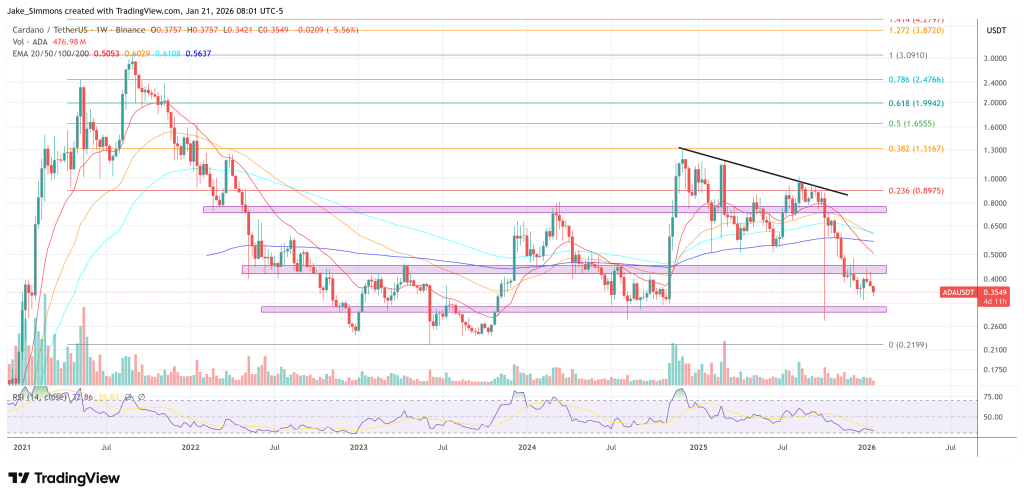
Cardano hovers below key resistance, 1-week chart | Source: ADAUSDT on TradingView.com

Related Questions

QWhat is the first milestone achieved by the Cardano Foundation in its updated governance roadmap?

AThe Cardano Foundation has expanded delegation to a new set of community representatives (DReps) focused on Adoption and Operations, shifting meaningful voting weight towards them.

QHow much ADA was delegated to the 11 selected DReps, and what was the focus of these DReps?

AThe Foundation delegated an additional 220 million ADA, roughly 20 million ADA each, to 11 DReps focused on the pillars of Adoption and Operations.

QWhat change did the Foundation make regarding its remaining stake in governance, and what was the result?

ARather than leaving a portion of funds on auto-abstain, the Foundation self-delegated its remaining balance of approximately 171 million ADA, resulting in a net reduction of its overall voting power by about 43 million ADA.

QHow does the Foundation view differing opinions between itself and the newly selected DReps?

AThe Foundation views differing opinions as evidence of a healthy, decentralized governance system, considering it a feature rather than a risk.

QWhat rationale did the Foundation provide for targeting Adoption and Operations DReps specifically?

AThe Foundation stated that building a resilient governance system requires more than technical expertise; it needs business acumen and operational stability, with Adoption DReps representing real-world utility and enterprise needs, and Operations DReps reflecting practical constraints of stake pool operators and infrastructure providers.

Related Reads

OpenAI's 'Blueprint for the Future': Making AI Beneficial for Every Person on the Planet

A new transformative technology emerges every few generations. OpenAI draws a parallel with the advent of electricity in the 1920s, which initially brought convenience but ultimately enabled unprecedented progress in medicine, engineering, and living standards by empowering people to create new possibilities. AI is poised to recreate this phenomenon. Its true significance lies not in the technology itself, but in what people can achieve with it—from understanding a medical bill or starting a business to aiding scientific discovery. OpenAI believes AI should be universally accessible, allowing everyone to use it according to their own needs. This future, however, is not guaranteed. While transformative tech can centralize power, OpenAI's philosophy is that AI must serve humanity, augmenting human capabilities and broadly distributing its benefits. The company's first commitment is to build AI for human service, aiming to empower the many rather than concentrate power in a few. Safety, alignment with human intent, and oversight are paramount. OpenAI is optimistic about AI's potential to expand human welfare but remains clear-eyed about risks. The goal is to help people achieve more, not to replace them. Full automation is not the desired future; human judgment, values, and direction will become even more critical. OpenAI outlines three core goals: 1. Build automated AI researchers to accelerate and increasingly automate the research process itself, maintaining close human collaboration. The internal projection is that by March 2028, a significant portion of their research will be conducted by AI systems working alongside human researchers. 2. Accelerate economic development by advancing science, boosting productivity, and fostering growth, while ensuring the fruits are widely shared. 3. Provide a personal AGI for everyone on Earth, allowing individuals to benefit from this transformative technology in their own way. The company is entering its third phase, moving from foundational AGI research (Phase 1) to product deployment and learning from real-world use (Phase 2). The current challenge is making advanced AI abundant, affordable, safe, practical, and usable for all individuals and organizations. OpenAI concludes that a widely distributed power structure leads to a more resilient, adaptable, and free society. A positive AI future should not be controlled by a handful of entities but built, benefited from, and owned by many. If realized correctly, AI can become a cornerstone for enhancing global productivity, creativity, scientific advancement, and economic opportunity, fulfilling the mission to ensure AGI benefits all of humanity.

marsbit33m ago

OpenAI's 'Blueprint for the Future': Making AI Beneficial for Every Person on the Planet

marsbit33m ago

Arthur Hayes' New Article: AI Bubble Nears Bursting, Crypto Market Faces Short-Term Pressure

In a new essay, Arthur Hayes argues that the AI market bubble is approaching a rupture, which will place significant short-term pressure on crypto assets. He identifies rising oil prices, a trio of massive tech IPOs (SpaceX, Anthropic, OpenAI), and potential anti-AI political rhetoric from Trump as the three key catalysts for a correction. Hayes posits that the prolonged blockage of the Strait of Hormuz will drive energy prices higher, increasing operational costs for data centers and squeezing AI company profits. Simultaneously, the market may struggle to absorb the upcoming wave of multi-trillion dollar tech IPOs. Furthermore, with high inflation hurting his election chances, Trump could pivot to attacking the AI sector with proposals for heavy taxation and regulation to win over voters, spooking the market. Hayes notes that nearly all new dollar liquidity since 2022 has flowed into the AI sector, leaving little for Bitcoin, explaining its recent underperformance. He believes an AI stock crash would trigger a broad risk-off sentiment and credit contraction, dragging down crypto in the near term. Consequently, his fund, Maelstrom, has sold all AI-related stocks and non-core cryptocurrencies, retaining only Bitcoin and Ethereum while building positions in traditional energy stocks. He anticipates Bitcoin will bottom and resume its bull run only after the AI bubble pops and a new monetary easing cycle begins.

marsbit36m ago

Arthur Hayes' New Article: AI Bubble Nears Bursting, Crypto Market Faces Short-Term Pressure

marsbit36m ago

Trading

Spot
Futures

Hot Articles

Discussions

Welcome to the HTX Community. Here, you can stay informed about the latest platform developments and gain access to professional market insights. Users' opinions on the price of ADA (ADA) are presented below.

活动图片