Capital Rotation Intensifies As Bitcoin Lags Gold and US Equities

bitcoinistPublished on 2026-01-30Last updated on 2026-01-30

Abstract

Capital rotation is intensifying as Bitcoin underperforms gold and U.S. equities, highlighting a growing divergence in global markets. While gold hits new highs and equities attract consistent inflows, Bitcoin shows signs of fatigue with weakening demand and reduced institutional participation. Key indicators, including a deeply negative Coinbase Premium Index, signal strong U.S. institutional selling and a phase of distribution rather than recovery. Additionally, stablecoin market capitalization has declined significantly, indicating capital is exiting the crypto ecosystem entirely. This reduction in liquidity limits Bitcoin’s upside potential, with near-term bias leaning bearish. Critical support levels to watch include $81,000, $70,000, and the 200-week moving average near $58,000. A sustained recovery would require prolonged consolidation and renewed capital inflows.

Gold continues to surge to new highs while Bitcoin struggles to reclaim higher price levels, reinforcing a growing divergence across global markets. According to a recent CryptoQuant report, the current investment landscape has become a tale of two worlds.

On one side, precious metals and US equities are attracting consistent inflows as investors seek assets with clearer momentum and perceived stability. On the other hand, Bitcoin is showing signs of fatigue, with on-chain data signaling that the market is losing strength rather than preparing for an immediate recovery.

CryptoQuant highlights a concerning confluence of indicators that suggests the crypto market is entering a more fragile phase. While price remains relatively elevated compared to historical bear market levels, underlying metrics point to weakening demand and diminishing participation from key market segments. This disconnect implies that Bitcoin’s struggle is not purely technical, but structural, rooted in shifting capital preferences and risk appetite.

The contrast is striking. As gold benefits from macro uncertainty and equity markets push higher on liquidity expectations, Bitcoin appears caught in consolidation, unable to attract the same conviction-driven flows. This growing divergence raises important questions about Bitcoin’s role in the current cycle and whether it can reassert itself as a competitive asset amid tightening conditions and changing investor behavior.

The report points to a clear institutional retreat that is weighing heavily on Bitcoin’s market structure. The Coinbase Premium Index, a key proxy for US institutional demand, remains deeply negative and recently reached a periodic low of -0.169%. This signals that selling pressure during US trading hours is materially stronger than the global average.

Notably, the index has turned positive only twice throughout January, reinforcing the view that institutions and high-net-worth participants are actively deleveraging rather than accumulating exposure. Historically, sustained negative premiums of this magnitude tend to coincide with phases of distribution, not early-stage recoveries.
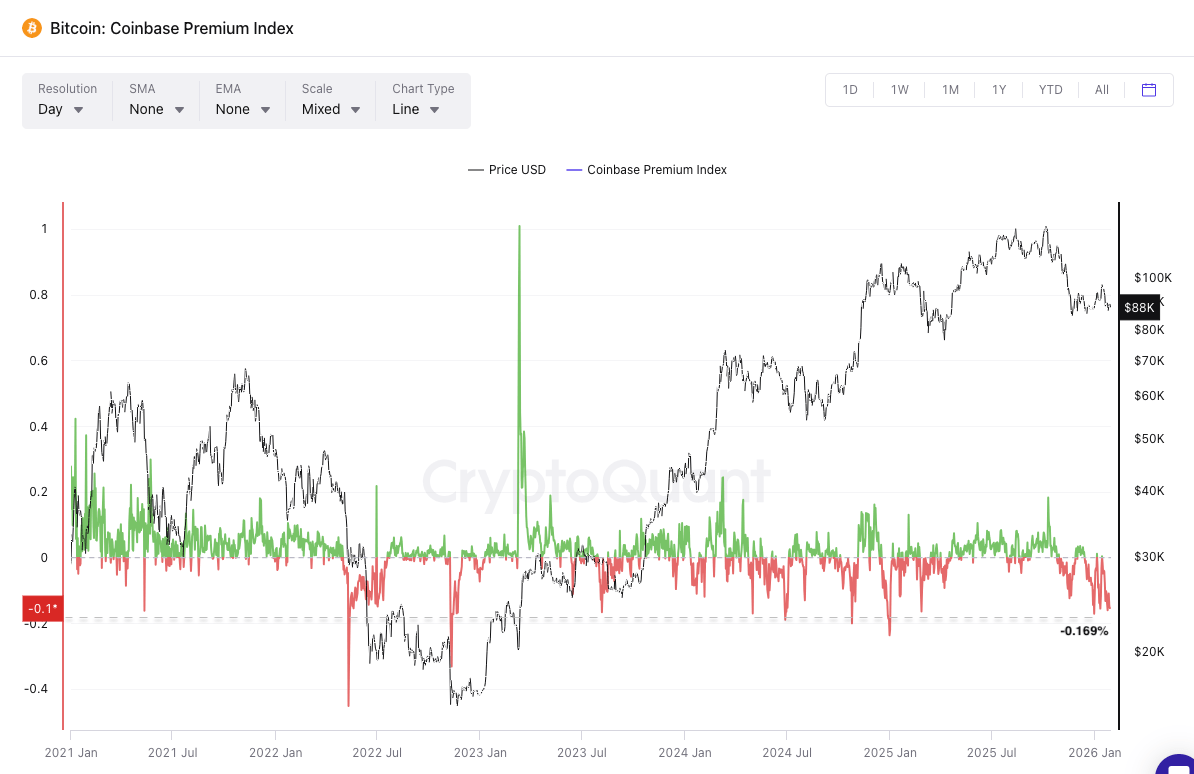
Bitcoin Coinbase Premium Index | Source: CryptoQuant

Compounding this weakness is the evaporation of market “dry powder.” The combined market capitalization of the top 12 stablecoins has contracted by $2.24 billion recently, extending a peak-to-trough decline of roughly $5.6 billion.

This behavior differs from the typical rotation into stablecoins seen ahead of dip-buying phases. Instead, it reflects a more concerning dynamic: capital exiting the crypto ecosystem entirely and moving back into fiat. Without sidelined liquidity ready to re-enter, upside reactions become structurally weaker and short-lived.

Caught between institutional selling and shrinking liquidity, Bitcoin’s near-term bias remains skewed to the downside. In a bearish scenario, key levels to monitor include the True Mean Price near $81,000, the 2024 high around $70,000, and ultimately the 200-week moving average near $58,000.

Conversely, a bullish outcome would likely require an extended period of sideways consolidation, allowing overhead supply to be absorbed while stablecoin inflows recover and fresh capital gradually returns.


Related Questions

QAccording to the CryptoQuant report, what is the current state of the Bitcoin market compared to gold and US equities?

AThe report indicates a growing divergence, with gold surging to new highs and US equities attracting consistent inflows, while Bitcoin is showing signs of fatigue and struggling to reclaim higher price levels.

QWhat does a deeply negative Coinbase Premium Index signal about institutional demand for Bitcoin?

AA deeply negative Coinbase Premium Index, which recently reached -0.169%, signals that US institutional selling pressure is materially stronger than the global average, indicating a retreat and active deleveraging by institutions and high-net-worth participants.

QHow has the stablecoin market capitalization changed, and what does this indicate about capital flow?

AThe combined market capitalization of the top 12 stablecoins has contracted by $2.24 billion recently, extending a peak-to-trough decline of roughly $5.6 billion. This indicates capital is exiting the crypto ecosystem entirely and moving back into fiat, rather than being sidelined as dry powder for future buying.

QWhat are the key bearish price levels to monitor for Bitcoin according to the article?

AThe key bearish price levels to monitor are the True Mean Price near $81,000, the 2024 high around $70,000, and the 200-week moving average near $58,000.

QWhat would a bullish outcome for Bitcoin require, based on the report's analysis?

AA bullish outcome would likely require an extended period of sideways consolidation to allow overhead supply to be absorbed, alongside a recovery in stablecoin inflows and the gradual return of fresh capital.

Related Reads

North Korean Hackers Loot $500 Million in a Single Month, Becoming the Top Threat to Crypto Security

North Korean hackers, particularly the notorious Lazarus Group and its subgroup TraderTraitor, have stolen over $500 million from cryptocurrency DeFi platforms in less than three weeks, bringing their total theft for the year to over $700 million. Recent major attacks on Drift Protocol and KelpDAO, resulting in losses of approximately $286 million and $290 million respectively, highlight a strategic shift: instead of targeting core smart contracts, attackers are now exploiting vulnerabilities in peripheral infrastructure. For instance, the KelpDAO attack involved compromising downstream RPC infrastructure used by LayerZero's decentralized validation network (DVN), allowing manipulation without breaching core cryptography. This sophisticated approach mirrors advanced corporate cyber-espionage. Additionally, North Korea has systematically infiltrated the global crypto workforce, with an estimated 100 operatives using fake identities to gain employment at blockchain companies, enabling long-term access to sensitive systems and facilitating large-scale thefts. According to Chainalysis, North Korean-linked hackers stole a record $2 billion in 2025, accounting for 60% of all global crypto theft that year. Their total historical crypto theft has reached $6.75 billion. Post-theft, they employ specialized money laundering methods, heavily relying on Chinese OTC brokers and cross-chain mixing services rather than standard decentralized exchanges. Security experts, while acknowledging the increased sophistication, emphasize that many attacks still exploit fundamental weaknesses like poor access controls and centralized operational risks. Strengthening private key management, limiting privileged access, and enhancing coordination among exchanges, analysts, and law enforcement immediately after an attack are critical to improving defense and fund recovery chances. The industry's challenge now extends beyond secure smart contracts to safeguarding operational security at the infrastructure level.

marsbit32m ago

North Korean Hackers Loot $500 Million in a Single Month, Becoming the Top Threat to Crypto Security

marsbit32m ago

Circle CEO's Seoul Visit: No Korean Won Stablecoin Issuance, But Met All Major Korean Banks

Circle CEO Jeremy Allaire's recent activities in Seoul indicate a strategic shift for the company, moving away from issuing a Korean won-backed stablecoin and instead focusing on embedding itself as a key infrastructure provider within Korea’s financial and crypto ecosystem. Despite Korea accounting for nearly 30% of global crypto trading volume—with a market characterized by high retail participation and altcoin dominance—Circle has chosen not to compete for the role of stablecoin issuer. Instead, Allaire met with major Korean banks (including Shinhan, KB, and Woori), financial groups, leading exchanges (Upbit, Bithumb, Coinone), and tech firms like Kakao. This approach reflects a broader industry transition: the core of stablecoin competition is shifting from issuance rights to systemic positioning. With Korean regulators still debating whether banks or tech companies should issue stablecoins, Circle is avoiding regulatory uncertainty by strengthening its role as a service and technology partner. The company is deepening integration with trading platforms, building connections, and promoting stablecoin infrastructure. This positions Circle to benefit regardless of which entity eventually issues a won stablecoin. Allaire also noted the potential for a Chinese yuan stablecoin in the next 3–5 years, underscoring a regional trend of stablecoins becoming more regulated and integrated with traditional finance. Ultimately, Circle’s strategy highlights that future influence in the stablecoin market will belong not necessarily to the issuers, but to the foundational infrastructure layers that enable cross-system transactions.

marsbit1h ago

Circle CEO's Seoul Visit: No Korean Won Stablecoin Issuance, But Met All Major Korean Banks

marsbit1h ago

SpaceX Ties Up with Cursor: A High-Stakes AI Gambit of 'Lock First, Acquire Later'

SpaceX has secured an option to acquire AI programming company Cursor for $60 billion, with an alternative clause requiring a $10 billion collaboration fee if the acquisition does not proceed. This structure is not merely a potential acquisition but a strategic move to control core access points in the AI era. The deal is designed as a flexible, dual-path arrangement, allowing SpaceX to either fully acquire Cursor or maintain a binding partnership through high-cost collaboration. This "option-style" approach minimizes immediate regulatory and integration risks while ensuring long-term alignment between the two companies. At its core, the transaction exchanges critical AI-era resources: SpaceX provides its Colossus supercomputing cluster—one of the world’s most powerful AI training infrastructures—while Cursor contributes its AI-native developer environment and strong product adoption. This synergy connects compute power, models, and application layers, forming a closed-loop AI capability stack. Cursor, founded in 2022, has achieved rapid growth with over $1 billion in annual revenue and widespread enterprise adoption. Its value lies in transforming software development through AI agents capable of coding, debugging, and system design—positioning it as a gateway to future software production. For SpaceX, this move is part of a broader strategy to evolve from a aerospace company into an AI infrastructure empire, integrating xAI, supercomputing, and chip manufacturing. Controlling Cursor fills a gap in its developer tooling layer, strengthening its AI narrative ahead of a potential IPO. The deal reflects a shift in AI competition from model superiority to ecosystem and entry-point control. With programming tools as a key battleground, securing developer loyalty becomes crucial for dominating the software production landscape. Risks include questions around Cursor’s valuation, technical integration challenges, and potential regulatory scrutiny. Nevertheless, the deal underscores a strategic bet: controlling both compute and software development access may redefine power dynamics in the AI-driven future.

marsbit1h ago

SpaceX Ties Up with Cursor: A High-Stakes AI Gambit of 'Lock First, Acquire Later'

marsbit1h ago

Trading

Spot
Futures

Hot Articles

What is $BITCOIN

DIGITAL GOLD ($BITCOIN): A Comprehensive Analysis Introduction to DIGITAL GOLD ($BITCOIN) DIGITAL GOLD ($BITCOIN) is a blockchain-based project operating on the Solana network, which aims to combine the characteristics of traditional precious metals with the innovation of decentralized technologies. While it shares a name with Bitcoin, often referred to as “digital gold” due to its perception as a store of value, DIGITAL GOLD is a separate token designed to create a unique ecosystem within the Web3 landscape. Its goal is to position itself as a viable alternative digital asset, although specifics regarding its applications and functionalities are still developing. What is DIGITAL GOLD ($BITCOIN)? DIGITAL GOLD ($BITCOIN) is a cryptocurrency token explicitly designed for use on the Solana blockchain. In contrast to Bitcoin, which provides a widely recognized value storage role, this token appears to focus on broader applications and characteristics. Notable aspects include: Blockchain Infrastructure: The token is built on the Solana blockchain, known for its capacity to handle high-speed and low-cost transactions. Supply Dynamics: DIGITAL GOLD has a maximum supply capped at 100 quadrillion tokens (100P $BITCOIN), although details regarding its circulating supply are currently undisclosed. Utility: While precise functionalities are not explicitly outlined, there are indications that the token could be utilized for various applications, potentially involving decentralized applications (dApps) or asset tokenization strategies. Who is the Creator of DIGITAL GOLD ($BITCOIN)? At present, the identity of the creators and development team behind DIGITAL GOLD ($BITCOIN) remains unknown. This situation is typical among many innovative projects within the blockchain space, particularly those aligning with decentralized finance and meme coin phenomena. While such anonymity may foster a community-driven culture, it intensifies concerns about governance and accountability. Who are the Investors of DIGITAL GOLD ($BITCOIN)? The available information indicates that DIGITAL GOLD ($BITCOIN) does not have any known institutional backers or prominent venture capital investments. The project seems to operate on a peer-to-peer model focused on community support and adoption rather than traditional funding routes. Its activity and liquidity are primarily situated on decentralized exchanges (DEXs), such as PumpSwap, rather than established centralized trading platforms, further highlighting its grassroots approach. How DIGITAL GOLD ($BITCOIN) Works The operational mechanics of DIGITAL GOLD ($BITCOIN) can be elaborated on based on its blockchain design and network attributes: Consensus Mechanism: By leveraging Solana’s unique proof-of-history (PoH) combined with a proof-of-stake (PoS) model, the project ensures efficient transaction validation contributing to the network's high performance. Tokenomics: While specific deflationary mechanisms have not been extensively detailed, the vast maximum token supply implies that it may cater to microtransactions or niche use cases that are still to be defined. Interoperability: There exists the potential for integration with Solana’s broader ecosystem, including various decentralized finance (DeFi) platforms. However, the details regarding specific integrations remain unspecified. Timeline of Key Events Here is a timeline that highlights significant milestones concerning DIGITAL GOLD ($BITCOIN): 2023: The initial deployment of the token occurs on the Solana blockchain, marked by its contract address. 2024: DIGITAL GOLD gains visibility as it becomes available for trading on decentralized exchanges like PumpSwap, allowing users to trade it against SOL. 2025: The project witnesses sporadic trading activity and potential interest in community-led engagements, although no noteworthy partnerships or technical advancements have been documented as of yet. Critical Analysis Strengths Scalability: The underlying Solana infrastructure supports high transaction volumes, which could enhance the utility of $BITCOIN in various transaction scenarios. Accessibility: The potential low trading price per token could attract retail investors, facilitating wider participation due to fractional ownership opportunities. Risks Lack of Transparency: The absence of publicly known backers, developers, or an audit process may yield skepticism regarding the project's sustainability and trustworthiness. Market Volatility: The trading activity is heavily reliant on speculative behavior, which can result in significant price volatility and uncertainty for investors. Conclusion DIGITAL GOLD ($BITCOIN) emerges as an intriguing yet ambiguous project within the rapidly evolving Solana ecosystem. While it attempts to leverage the “digital gold” narrative, its departure from Bitcoin's established role as a store of value underscores the need for a clearer differentiation of its intended utility and governance structure. Future acceptance and adoption will likely depend on addressing the current opacity and defining its operational and economic strategies more explicitly. Note: This report encompasses synthesised information available as of October 2023, and developments may have transpired beyond the research period.

363 Total ViewsPublished 2025.05.13Updated 2025.05.13

What is $BITCOIN

Discussions

Welcome to the HTX Community. Here, you can stay informed about the latest platform developments and gain access to professional market insights. Users' opinions on the price of BTC (BTC) are presented below.

活动图片