Bitwise Submits Second Amended Hyperliquid ETF Filing — Launch Imminent?

bitcoinistPublished on 2026-04-12Last updated on 2026-04-12

Abstract

Bitwise has filed a second amended application with the SEC for its spot Hyperliquid (HYPE) ETF, adding FalconX, Flowdesk, Nonco, and Wintermute as approved trading counterparties. This update, highlighted by Bloomberg analyst Eric Balchunas, suggests an imminent launch. Bitwise is positioned to be the first to market with a HYPE ETF, ahead of competitors 21Shares and Grayscale. The proposed fund, with ticker BHYP and a 0.67% management fee, plans to generate additional yield through staking. Meanwhile, HYPE's price has surged over 65% year-to-date, trading near $43 amid strong market performance.

According to the latest report, Bitwise has taken a step closer toward the launch of its proposed spot Hyperliquid (HYPE) exchange-traded fund (ETF) after filing a second amendment with the United States Securities and Exchange Commission.

Bitwise Updates List Of Countertrading Parties In Hyperliquid ETF Filing

On Friday, April 10th, Bitwise submitted its second amendment to its spot Hyperliquid with the SEC, introducing new names to the list of approved trading counterparties ahead of an imminent launch in the US. This latest filing included FalconX, Flowdesk, Nonco, and Wintermute as approved trading counterparties for the asset manager.

Earlier in its first amendment filing in December 2025, Bitwise revealed the fund’s BHYP ticker, an annual management fee of 0.67%, and a proposal to generate additional profit through HYPE staking. Also, the asset management fund had listed three trading counterparties at the time, including A1 (now dropped off), Nonco, and Solios (disclosed as a d/b/a of FalconX).
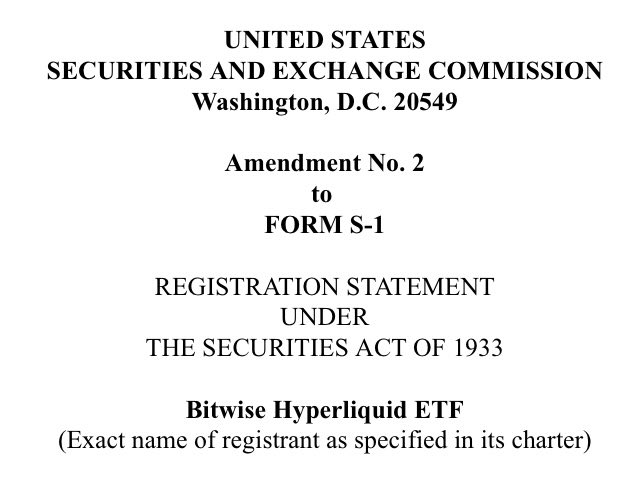
Source: @EricBalchunas on X

In a post on the social media platform, Bloomberg senior ETF analyst Eric Balchunas highlighted the second amendment filing, saying that this latest update suggests that the fund’s launch might be imminent. Despite competition from two other asset managers, Bitwise looks set to win the race for the first spot ETF linked to Hyperliquid’s native token, HYPE.

21Shares followed with an application of its own to launch a Hyperliquid ETF in October 2025, while Grayscale submitted its own filing in late March 2026. Upon approval (which looks like a matter of when rather than if), Bitwise’s HYPE ETF will debut on the NYSE Arca stock exchange and offer investors exposure to the spot price of Hyperliquid.

HYPE Price Overview

Despite the raging market uncertainty this year, Hyperliquid’s native token HYPE has been one of the best performers so far. In fact, it can be said that the decentralized perpetual futures trading protocol has been one of the major winners from the Middle East tensions, as traders looked to gain market exposure even outside of regular trading hours.

Data from CoinGecko shows that the price of HYPE is up by more than 65% year-to-date and almost 200% in the past full year. As bullish momentum returned to the cryptocurrency market his week, investors have seen the altcoin’s price reclaim the $40 mark, jumping by nearly 20% in the past week.

As of this writing, the price of HYPE sits just beneath $43, reflecting a nearly 3% jump in the past 24 hours.

The price of HYPE on the daily timeframe | Source: HYPEUSDT chart on TradingView


Related Questions

QWhat is the latest step Bitwise has taken towards launching its spot Hyperliquid ETF?

ABitwise has filed a second amended S-1 filing with the SEC, updating its list of approved trading counterparties.

QWhich new trading counterparties were added in Bitwise's second amendment for the HYPE ETF?

AThe new approved trading counterparties added are FalconX, Flowdesk, Nonco, and Wintermute.

QAccording to the article, which analyst suggested that the launch of the Bitwise HYPE ETF is imminent?

ABloomberg senior ETF analyst Eric Balchunas suggested the fund's launch might be imminent after the second amendment was submitted.

QOn which stock exchange is the Bitwise Hyperliquid ETF expected to debut upon approval?

AUpon approval, Bitwise's HYPE ETF is expected to debut on the NYSE Arca stock exchange.

QHow has the price of HYPE performed year-to-date according to CoinGecko data mentioned in the article?

AAccording to CoinGecko data, the price of HYPE is up by more than 65% year-to-date.

Related Reads

The Most Hidden AI Winners

"The Most Under-the-Radar AI Winners" While core AI giants and their direct suppliers have dominated headlines, a group of seemingly unrelated, decades-old manufacturing companies have emerged as major beneficiaries. A key example is Japan's TOTO, famous for bathroom fixtures. Its stock soared 145% in a year, driven not by its mainstay toilet business but by its nearly 40-year-old semiconductor ceramic component unit. Specifically, TOTO manufactures electrostatic chucks—critical, hard-to-replace parts for advanced chip manufacturing processes like etching and EUV lithography. This segment, though only 9% of revenue, contributed over 54% of operating profit in FY2025 with a 43% margin. High barriers to entry, including deep know-how in high-purity ceramic sintering and long supplier certification cycles (5+ years), secure its position. This pattern repeats across industries. Nitto Boseki, a 128-year-old glass fiber maker, saw its stock rise 325% due to near-monopoly supply of T-glass, an essential low-expansion material for AI chip substrates. Similarly, Ajinomoto, the global MSG leader, commands 80-95% of the market for ABF film, a vital insulating layer in chip packaging. These "hidden" segments, often born from deep materials science expertise, are now bottleneck supplies in the AI hardware chain, enjoying pricing power and high margins. In China's A-share market, the theme combines this AI-driven demand with domestic substitution. Companies like Zhongci Electronic (advancing in electrostatic chucks) and Honghe Technology & Feilihua (in high-end electronic glass fabrics) are gaining traction. The investment thesis hinges on whether these domestic players can rapidly scale qualified capacity to capture the supply gap within the critical time window. Ultimately, these cases show that in the AI supply chain, high-profit concentrations exist not only at the cutting-edge tech frontier but also in indispensable, difficult-to-replicate materials and components. Market recognition often lags behind fundamental profit shifts, creating potential for significant re-ratings as traditional industrial firms are re-evaluated as key enablers of advanced semiconductor manufacturing.

marsbit19m ago

The Most Hidden AI Winners

marsbit19m ago

The Most Secretive Winners of the AI Boom

"The Most Hidden AI Winners" An unlikely group of companies are emerging as major beneficiaries of the AI boom, not from designing chips, but from supplying critical materials and components essential for advanced semiconductor manufacturing. These 'hidden winners' are traditional manufacturers whose deep expertise in materials science has become indispensable. Japanese companies are leading this trend. Toto, globally known for bathroom fixtures, has seen its stock surge 145% over the past year, driven by its 40-year-old semiconductor ceramics business, which now contributes over half of its operating profit. Its electrostatic chucks are vital for advanced chip production and require years of expertise to manufacture. Similarly, Nittobo, a 128-year-old textile firm, controls 90% of the market for T-glass, a low-expansion glass fiber essential for AI chip substrates. Ajinomoto, the world's largest MSG producer, dominates the market (80-95% share) for ABF insulating film used in chip packaging. The core insight is that chasing "advanced" chips paradoxically increases reliance on traditional, high-precision material science where supply cannot be quickly replicated. These materials are now critical bottlenecks in the AI supply chain. This trend is mirrored in China's A股 market, framed by the theme of 'import substitution'. Companies like Zhongci Dianzi (electrostatic chucks) and Honghe Technology (ultra-thin electronic cloth) are making progress, but face the test of scaling production and matching Japanese rivals' quality. The key tension lies in the slow change of market perception. While profit structures rapidly shift towards high-margin tech components, these firms retain their traditional industry classifications, creating a valuation gap that is gradually closing as their roles in the AI ecosystem become undeniable.

链捕手26m ago

The Most Secretive Winners of the AI Boom

链捕手26m ago

DeFi Enters a Moment of Value Reassessment: Risks and Opportunities Behind the $70 Billion TVL

DeFi Enters a Moment of Value Reassessment: Peril and Opportunity Behind $70 Billion TVL On July 1st, the total value locked (TVL) across all DeFi protocols fell below $70 billion to approximately $69.358 billion, hitting its lowest point since February 2024. This decline signals a significant contraction in DeFi liquidity and marks a new adjustment phase for the industry, far from its 2021 peak of over $180 billion. The primary drivers of this TVL drop are a general decrease in crypto market risk appetite, which leads capital to exit volatile sectors like DeFi first, and the fading effectiveness of the high-yield liquidity incentive models that fueled the initial DeFi boom. Many protocols' high TVL figures were built on temporary subsidy-driven capital rather than genuine demand. Furthermore, capital is migrating to newer narratives like AI, RWA, and modular infrastructure. This cooldown exposes DeFi's growth bottlenecks: innovation has slowed with rampant protocol copycats, real yields have normalized to single digits, and poor user experience continues to hinder mass adoption beyond crypto-natives. However, the TVL decline does not spell the end for DeFi. The metric itself is limited, as it fluctuates with underlying asset prices. The industry is shifting from capital accumulation to efficiency competition, leveraging Layer 2 solutions and modular architecture to do more with less locked value. Crucially, DeFi is expanding into real-world financial use cases like the tokenization of real-world assets (RWA) and the growth of the stablecoin ecosystem, moving its value proposition from speculative token subsidies to real cash flows. In conclusion, while short-term pressures from liquidity contraction and user growth stagnation persist, the sector is undergoing a necessary value reassessment. DeFi is transitioning from a subsidy-driven, hype-based era toward a more mature, rational, and efficiency-focused phase, with long-term growth hinging on meeting real-world financial needs through RWA, stablecoins, and robust infrastructure.

marsbit45m ago

DeFi Enters a Moment of Value Reassessment: Risks and Opportunities Behind the $70 Billion TVL

marsbit45m ago

Trading

Spot
活动图片