Bitmine Deepens Ethereum Bet With $514M ETH Staking Move – Staking Exposure Reaches $5.6B

bitcoinistPublished on 2026-01-16Last updated on 2026-01-16

Abstract

Ethereum has reclaimed the $3,300 level but faces resistance at $3,400, a key short-term inflection point. Market sentiment is divided between skeptics viewing the rebound as a temporary relief rally and more constructive analysts seeing early recovery signs. Amid this uncertainty, Bitmine staked an additional 154,304 ETH (worth $514 million), bringing its total staked ETH to 1.685 million (valued at $5.62 billion). This represents nearly 80% of its total ETH holdings, signaling a long-term, yield-focused strategy and strong institutional confidence. Large-scale staking reduces liquid supply, potentially supporting prices. ETH's weekly chart shows stabilization above key moving averages, but a clear break above $3,400 is needed to confirm a bullish shift and target higher resistance levels.

Ethereum has reclaimed the $3,300 level after weeks of choppy and uncertain price action, offering bulls a brief sense of relief. However, upside momentum remains fragile, as buyers continue to struggle against the $3,400 zone, a level that has repeatedly capped recent advances. This area now stands as a clear short-term inflection point, separating a potential recovery phase from what some analysts still describe as a broader bearish structure.

Market participants remain divided. On one side, skeptics argue that the latest rebound resembles a classic relief rally, driven by short covering and temporary sentiment improvement rather than a genuine shift in trend.

From this perspective, Ethereum may still be vulnerable to renewed downside if macro conditions tighten or risk appetite fades. On the other side, more constructive analysts believe the stabilization above $3,300 could mark the early stages of a recovery, with higher levels coming into focus if resistance is convincingly reclaimed.

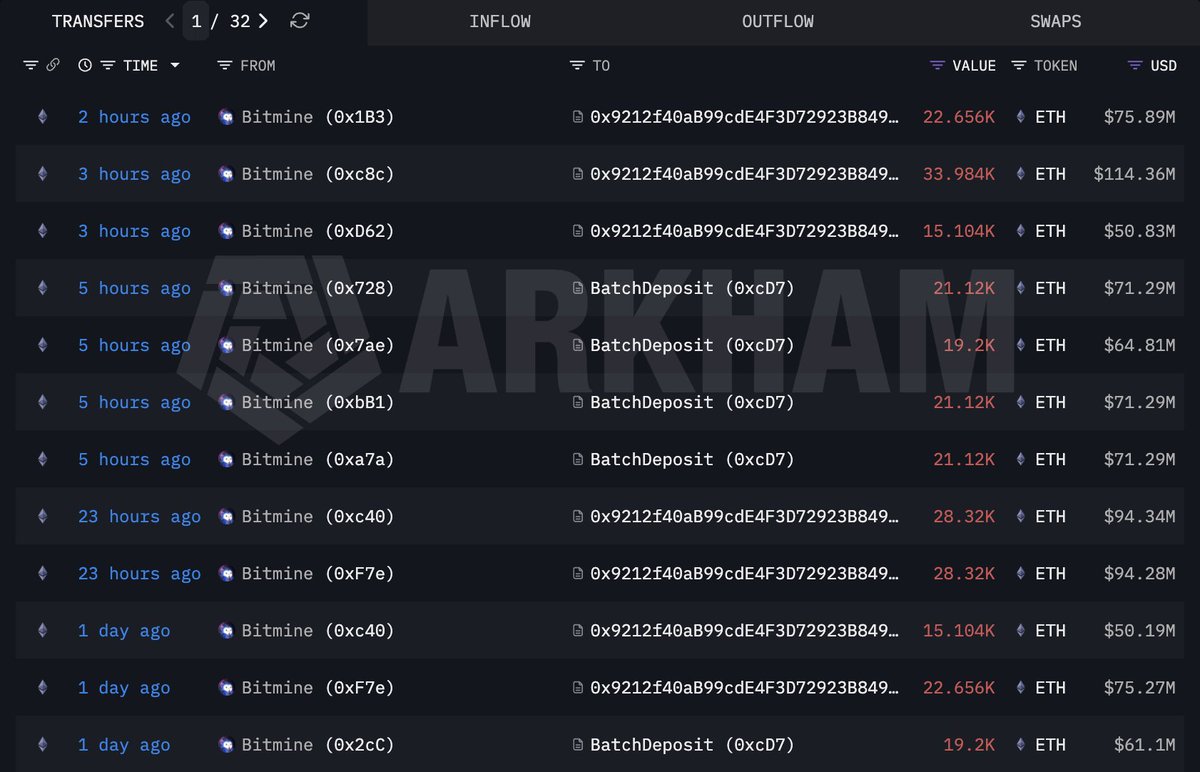
Adding complexity to the narrative, on-chain developments continue to draw attention. Just a few hours ago, Bitmine staked an additional 154,304 ETH, worth roughly $514 million, signaling sustained confidence from large players despite market uncertainty. As price compresses below resistance, Ethereum now sits at a critical juncture where conviction from both bulls and bears is being tested.

Bitmine Ethereum Transfers | Source: Arkham

According to data reported by Lookonchain, Bitmine’s Ethereum exposure has reached a notable scale. In total, the firm has now staked approximately 1,685,088 ETH, valued at around $5.62 billion at current prices. This places Bitmine among the largest single staking participants in the Ethereum ecosystem, underscoring the growing role of institutional and quasi-institutional actors in securing the network.

What makes this positioning particularly relevant is Bitmine’s overall balance. The company reportedly holds about 2.133 million ETH in total, meaning that close to 80% of its Ether reserves are actively staked rather than sitting idle. This allocation suggests a long-term, yield-oriented strategy rather than a short-term trading approach. By committing such a large portion of its holdings to staking, Bitmine is effectively signaling confidence in Ethereum’s medium- to long-term outlook, despite ongoing price volatility and macro uncertainty.

From a market perspective, large-scale staking reduces the amount of ETH that is readily liquid and available for sale. While this does not eliminate selling pressure entirely, it can contribute to a tighter circulating supply during periods of demand recovery.

At the same time, concentrated staking activity highlights how network security and yield generation are increasingly influenced by large holders. As Ethereum trades near key resistance levels, Bitmine’s positioning reinforces the narrative that some major players remain structurally committed, even as short-term price direction remains contested.

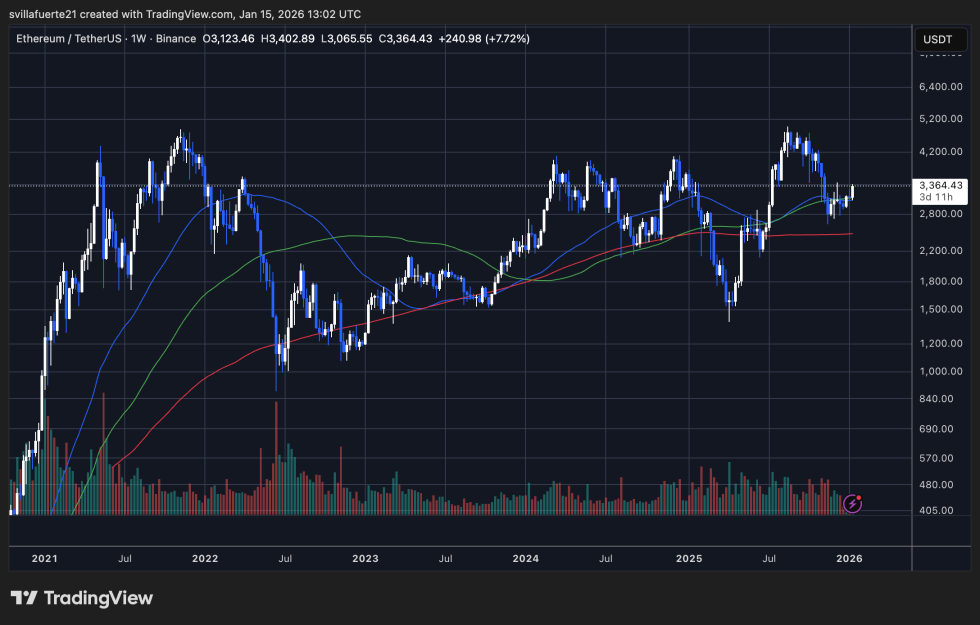
Ethereum’s price action on the weekly chart shows a market attempting to stabilize after a volatile multi-year cycle. ETH has reclaimed the $3,300 area and is now trading just below a clearly defined resistance zone near $3,400. This level has repeatedly capped upside during prior rallies, making it a critical area for bulls to reclaim with conviction.

ETH consolidates around critical liquidity level | Source: ETHUSDT chart on TradingView

From a trend perspective, Ethereum remains above its long-term moving averages, including the 200-week line, which continues to slope upward. This suggests that despite recent drawdowns, the broader structural uptrend has not been invalidated. However, price is still trading below the previous cycle highs near $4,200–$4,400, highlighting that ETH is in a recovery phase rather than a confirmed breakout.

Momentum has improved compared to late 2025, with higher lows forming after the sharp sell-off toward the $1,600–$1,800 region. Volume during the rebound has been moderate, signaling participation without clear signs of speculative excess. This supports the idea of controlled accumulation rather than euphoric chasing.

Still, the inability to cleanly break above $3,400 keeps downside risk relevant. A rejection here could lead to renewed consolidation toward the $2,800–$3,000 zone. For bullish continuation, ETH needs a sustained weekly close above resistance, which would shift market structure and open the path toward higher liquidity zones above $3,800.

Featured image from ChatGPT, chart from TradingView.com

Trending Cryptos

Related Reads

The Verdict in Choi Tae-won's Divorce Case: Revealing the Inheritance Undercurrent Behind SK Hynix's Trillion-Won Empire

SK Group Chairman Chey Tae-won's high-profile divorce case, involving a record 1.38 trillion won settlement, has drawn attention to the succession plans for Korea's second-largest conglomerate, especially its crown jewel, SK hynix. Unlike traditional chaebol scripts centered on the eldest son, Chey's three children from his marriage to former President Roh Tae-woo's daughter, Roh Soh-yeong, are carving distinct, non-traditional paths. Eldest daughter Chey Yun-jung (b. 1989) is seen as the most evident successor. With a scientific and consulting background, she holds executive roles at SK bioscience and SK Inc.'s growth support department, focusing on future strategy and biopharma. Her marriage is to an AI infrastructure entrepreneur, not a traditional business alliance. Second daughter Chey Min-jung (b. 1991) took a unique route, voluntarily serving as a South Korean naval officer, including an anti-piracy deployment. She later worked on policy and strategy for SK hynix in Washington D.C. before co-founding an AI-driven healthcare startup. She married a former U.S. Marine Corps officer, connecting her to U.S. defense and policy circles—networks crucial for a global semiconductor giant. The only son, Chey In-geun (b. 1995), who studied physics like his father, worked briefly at SK E&S before joining McKinsey. Despite fitting the traditional "heir" profile as the eldest son, he remains silent and holds no public position or shares in SK, suggesting the old succession playbook is obsolete. As SK hynix's valuation soars, becoming a geopolitical asset in the AI era, the heirs' legitimacy is no longer automatic. They must prove themselves in fields like AI biotech, global policy, and strategic consulting. Their marriages also reflect new elite networks in tech and defense, not old political alliances. Their inheritance is the complex challenge of navigating a globalized, tech-driven world, not just a corporate throne.

marsbitYesterday 09:06

The Verdict in Choi Tae-won's Divorce Case: Revealing the Inheritance Undercurrent Behind SK Hynix's Trillion-Won Empire

marsbitYesterday 09:06

From OpenSea to OpenRouter: Is Alex Atallah Repeating His 'Exit at the Peak' Playbook?

From OpenSea to OpenRouter: Is Alex Atallah Repeating His "Exit at the Peak" Playbook? According to the Wall Street Journal, payments giant Stripe is in talks to acquire the AI model aggregation platform OpenRouter in a potential deal valuing the company near $100 billion. This would mark founder Alex Atallah's second creation of a company reaching a $100 billion valuation, following his co-founding of NFT marketplace OpenSea. OpenRouter, founded just over three years ago, has grown rapidly by acting as a unified gateway for developers to access over 400 AI models. It currently has about 10 million users and processes over 200 trillion tokens monthly. While the platform's annualized revenue is around $50 million, its valuation has skyrocketed from $1.3 billion in March 2026. The potential acquisition by Stripe, a company OpenRouter's founder once likened it to, represents a major expansion into AI infrastructure for the payments leader. This move echoes Atallah's previous timing with OpenSea, where he departed before the NFT market's significant downturn. For OpenRouter, selling now may be strategic. Despite its scale, its business model—charging a 5-5.5% fee on AI inference calls—faces pressure from competition, open-source models, and potential price wars among model providers, limiting its profitability narrative for an IPO. A key asset for potential acquirers like Stripe is OpenRouter's vast repository of real-world AI usage data, which offers unique insights into model performance and developer preferences that are difficult to replicate. Whether this potential deal signifies a new valuation benchmark for AI infrastructure or another market peak signal remains to be seen.

链捕手Yesterday 08:42

From OpenSea to OpenRouter: Is Alex Atallah Repeating His 'Exit at the Peak' Playbook?

链捕手Yesterday 08:42

Trading

Spot

Hot Articles

Discussions

Welcome to the HTX Community. Here, you can stay informed about the latest platform developments and gain access to professional market insights. Users' opinions on the price of ETH (ETH) are presented below.

活动图片