Bitcoin Recovery Fails To Lift Market Sentiment From Extreme Fear

bitcoinistPublished on 2026-04-17Last updated on 2026-04-17

Abstract

Despite Bitcoin's recent recovery to around $74,800, the overall market sentiment remains in "extreme fear," according to the Crypto Fear & Greed Index. The index, which measures investor sentiment based on factors like volatility, social media, and trading volume, is at a value of 23, just inside the extreme fear zone. This marks a continued period of bearish sentiment since late 2025. Although Bitcoin's rally provided a brief uplift in mid-March, the current price movement has not been enough to shift market psychology into a more positive or greedy territory. For sentiment to improve, a sustained bullish momentum may be required.

Data shows the crypto Fear & Greed Index is still inside the extreme fear territory despite the recovery that Bitcoin and other coins have made.

Bitcoin Fear & Greed Index Is Still Pointing At ‘Extreme Fear’

The “Fear & Greed Index” is an indicator created by Alternative that tells us about the average sentiment present among traders in the Bitcoin and wider cryptocurrency markets. The index takes into account for the data of the following five factors to determine the investor mentality: trading volume, market cap dominance, volatility, social media sentiment, and Google Trends.

To represent the market sentiment, the metric makes use of a numerical scale running from zero to hundred. All values on this scale that lie below 47 correspond to a net sentiment of fear, while those above 53 suggest the dominance of greed among investors. Naturally, the values lying between these two cutoffs imply a neutral mentality.

Besides these three main zones, there are also two ‘extreme’ regions called the extreme fear (25 and under) and extreme greed (above 75). Historically, these two have held significance for the market as they have been where major tops and bottoms have tended to form.

The relationship between prices and sentiment has been an inverse one, however, with tops appearing during extreme greed and bottoms alongside extreme fear.

Recently, the crypto sector has been stuck in the latter of the two, as the below chart shows.
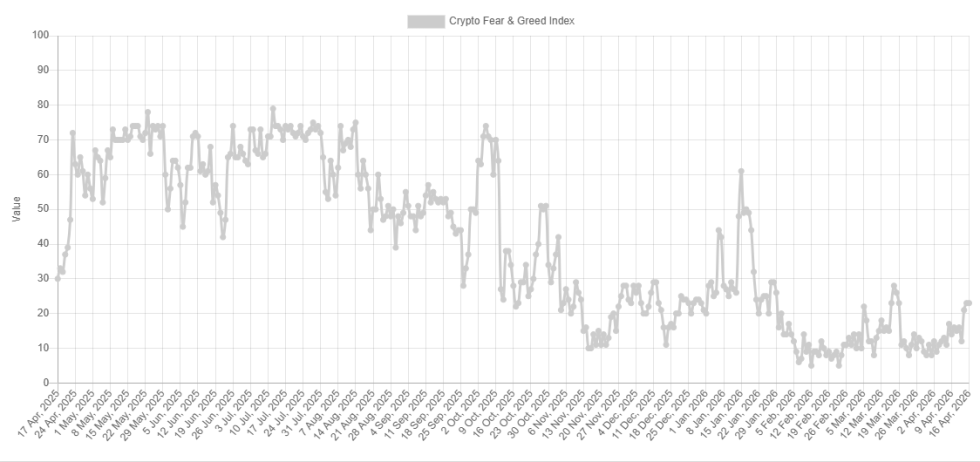
How the Fear & Greed Index has changed over the past year | Source: Alternative

The long stay in the extreme fear zone has been a consequence of the bearish action that Bitcoin and other assets have faced since Q4 2025. In mid-March, BTC’s recovery to $75,000 meant that the market saw a temporary respite from rock-bottom sentiment, with the Fear & Greed Index surging to a peak of 28. After the BTC rally fizzled out, however, the sentiment also cooled back deep into the extreme fear zone again.

From the above chart, it’s apparent that in the last few days, the metric has again made some recovery. The uplift in sentiment is due to BTC’s rally toward the $76,000 mark. Unlike the surge from mid-March, though, this one hasn’t yet been able to take the Fear & Greed Index out of the extreme fear region.

As is visible in the meter, the indicator is sitting at a value of 23 right now, which is just inside the extreme fear boundary.
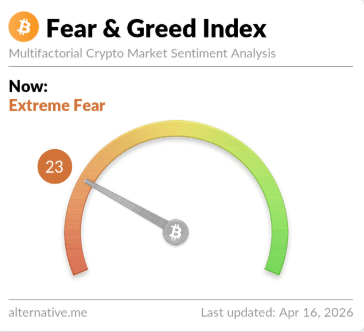
The latest value of the Fear & Greed Index | Source: Alternative

It’s possible that if bull momentum continues in the coming days, the Fear & Greed Index will escape the extreme fear zone. But for now, it seems that the market isn’t convinced about the price rally.

BTC Price

At the time of writing, Bitcoin is floating around $74,800, up nearly 5% in the last seven days.

The price of the coin seems to have been moving sideways since its upward move earlier in the week | Source: BTCUSDT on TradingView


Related Questions

QWhat is the Bitcoin Fear & Greed Index and what does it measure?

AThe Bitcoin Fear & Greed Index is an indicator created by Alternative that measures the average sentiment among traders in the Bitcoin and wider cryptocurrency markets. It uses a numerical scale from 0 to 100, taking into account five factors: trading volume, market cap dominance, volatility, social media sentiment, and Google Trends.

QWhat value on the Fear & Greed Index represents 'extreme fear' and what is its historical significance?

AValues of 25 and below on the Fear & Greed Index represent 'extreme fear.' Historically, this zone has been significant for the market as major bottoms have tended to form during periods of extreme fear.

QDespite Bitcoin's recent price recovery, what is the current reading of the Fear & Greed Index?

ADespite Bitcoin's recent rally toward $76,000, the Fear & Greed Index is currently sitting at a value of 23, which is still inside the extreme fear territory.

QWhat was the peak value the Fear & Greed Index reached during Bitcoin's mid-March recovery to $75,000?

ADuring Bitcoin's mid-March recovery to $75,000, the Fear & Greed Index surged to a peak of 28, providing a temporary respite from the rock-bottom sentiment.

QWhat is the inverse relationship between market sentiment and Bitcoin prices mentioned in the article?

AThe article states that the relationship between prices and sentiment has been inverse, with major tops in the market tending to form during periods of extreme greed, while major bottoms have typically occurred alongside extreme fear.

Related Reads

Must-Watch Events Next Week|CLARITY Act Could Face Senate Vote; SpaceX, Circle to Report Earnings (8.3-8.9)

**Summary: Key Events and Developments to Watch (August 3-9)** The upcoming week is marked by significant financial disclosures, key legislative deadlines, and notable product updates. **Major Financial Events:** Several companies are scheduled to release their Q2 2026 earnings. American Bitcoin (ABTC) will report on August 3, followed by SpaceX and Hut 8 Mining Corp. on August 4, and Circle on August 5. Notably, a significant portion of SpaceX shares (up to 12% of total shares) will be unlocked on August 6 following their earnings release. **Key Legislative Deadline:** The U.S. Senate faces an August 7 deadline to secure 60 votes for the CLARITY Act, a bipartisan bill aiming to establish a federal regulatory framework for cryptocurrencies. The Senate may hold a full vote on the bill during the week. **Economic Data:** The U.S. July Non-Farm Payrolls report will be released on August 7, providing crucial labor market data. **Technology & Product Updates:** * **Shutdowns:** DeFi portfolio tracker Zapper and wallet app Ctrl Wallet will cease operations on August 3. * **Upgrades:** LayerZero will deprecate its v1 relayers on August 3. XRP Ledger's new version 3.3.0, featuring five new functions, is expected next week. * **AI:** Elon Musk announced that the advanced Grok 4.6 AI model is set for release around August 7. * **Bitcoin:** The BIP-110 forced signaling for a potential Bitcoin network change is scheduled to begin around August 8. **Other Notable Events:** Chinese robotics firm Unitree Tech has set its preliminary price inquiry for its IPO for August 5. South Korean exchange Upbit will delist AQT and AERGO tokens on August 3.

marsbit1h ago

Must-Watch Events Next Week|CLARITY Act Could Face Senate Vote; SpaceX, Circle to Report Earnings (8.3-8.9)

marsbit1h ago

Stocks Are Plummeting More Sharply Than Cryptocurrencies. Where Has the Money Gone?

Stock Markets Plunge Deeper Than Cryptocurrencies: Where Did the Money Go? In late July, Seoul's Kospi index triggered circuit breakers for two consecutive days, plummeting over 40% from its June high. The collapse was led by heavyweight stocks like SK Hynix, whose record profits still disappointed investors, and devastating leveraged ETFs, with one major product losing over 83% of its value. This signaled a global, forced deleveraging targeting the most crowded trades. Interestingly, while stocks exhibited extreme volatility akin to crypto markets, Bitcoin rose nearly 15% in July after a prior steep drop. Analysis shows the money fleeing equities did not flow into Bitcoin. Instead, Bitcoin had already absorbed its sell-off in May-June, when U.S. spot Bitcoin ETFs saw historic outflows. The true safe-haven beneficiary was gold, whose price rose over 20% year-on-year, highlighting a decoupling between Bitcoin and gold as "digital gold." The sell-off was a targeted unwinding of leveraged positions in tech and semiconductors, accelerated by broker-dealer risk management and shifts in the AI narrative, including new competition from Chinese memory chipmakers. The retreat path was clear: from high-valuation tech stocks to cash and U.S. Treasuries, then to gold. For Bitcoin to attract sustained institutional inflows, conditions like eased global liquidity pressure, a "soft-landing" Fed rate cut, and U.S. regulatory clarity via legislation like the stalled CLARITY Act are needed. Currently, Bitcoin is not a safe haven but an already-cleared asset. Its low correlation with tech stocks, however, makes it a potential diversification play for institutional portfolios once the storm passes. The money isn't here yet, but the positioning is underway.

marsbit1h ago

Stocks Are Plummeting More Sharply Than Cryptocurrencies. Where Has the Money Gone?

marsbit1h ago

In Conversation with Ray Dalio: We Are Currently in an AI Bubble, with 1% of My Portfolio in Bitcoin

Ray Dalio, founder of Bridgewater Associates, warns in an interview that the current AI boom shows classic bubble characteristics, which could lead to significant economic downturns as seen in past cycles like 1929 or 2000. He explains that speculative enthusiasm, fueled by debt and overvaluation, often precedes a crash when rising rates or taxation force asset sales, causing widespread losses and recession. Dalio also outlines his "Big Cycle" theory, describing an approximate 80-year pattern where widening wealth gaps, massive government deficits, and shifting geopolitical power (like China's rise) create internal conflict and global instability. He emphasizes that we are in a late-cycle, transitional phase where traditional powers like the US and UK face decline. For personal wealth protection, Dalio advises diversification beyond cash into assets like stocks, bonds, real estate, and particularly gold, which he prefers over Bitcoin. While he holds about 1% of his portfolio in Bitcoin as a non-printable hard asset, he views gold as more secure from technological or governmental threats. Regarding AI's impact, Dalio believes it will disproportionately benefit capital owners, worsening inequality by replacing both physical and cognitive labor. He suggests that human intuition and emotional intelligence, combined with AI, will be key for future workers. On taxation, Dalio argues that wealth taxes are impractical and risk triggering asset sell-offs, reducing productive investment. He points to the UK as a cautionary example of debt, low productivity, and political strife. Geopolitically, Dalio foresees a more regionalized world, with the US showing weakness in prolonged conflicts like with Iran, akin to past imperial declines. The ideal outcome, he suggests, is coexisting powerful blocs (e.g., Americas, China-Asia Pacific) without major war.

marsbit5h ago

In Conversation with Ray Dalio: We Are Currently in an AI Bubble, with 1% of My Portfolio in Bitcoin

marsbit5h ago

Trading

Spot
活动图片




