Bitcoin Rebounds Near $71K Level Securing Maxi Doge Market Stability

bitcoinistPublished on 2026-02-09Last updated on 2026-02-09

Abstract

Bitcoin's rebound near $71,000 is acting as a key market stabilizer, reducing volatility and encouraging capital rotation into higher-risk, higher-reward assets. This shift in sentiment favors projects that combine meme culture with tangible utility, such as Maxi Doge ($MAXI), which has raised over $4.5 million in its presale. Positioned as the "leverage king," Maxi Doge appeals to traders seeking high-risk, high-reward opportunities through gamified features like holder-only trading competitions and dynamic staking rewards with 68% APY. The project’s gym-bro ethos and focus on aggressive growth align with current market trends, attracting smart money and retail interest. While Bitcoin’s stability sets a bullish tone, analysts caution that a deeper correction to around $34.5K remains possible if historical patterns repeat.

Trusted Editorial content, reviewed by leading industry experts and seasoned editors. Ad Disclosure

Quick Facts:

  • ➡️ Bitcoin’s rebound near $71K acts as a stabilizer, reducing volatility and encouraging capital rotation into higher-risk, higher-reward assets.
  • ➡️ The shift in market sentiment favors projects that combine viral meme culture with tangible utility, such as trading competitions and dynamic staking rewards.
  • ➡️ Maxi Doge ($MAXI) is the ‘never skip a leg day’ gym-bro seeking the high-risk high-reward plays.

Bitcoin’s recent price action offers a masterclass in market psychology. After a shaky period, it rebounded to consolidate firmly near $71K. While casual observers might see a simple recovery, veteran analysts see something else: a specific technical structure forming. This recovery saw Bitcoin gain 2.41% over a 24-hour period to trade around $70.8K on February 9, 2026.
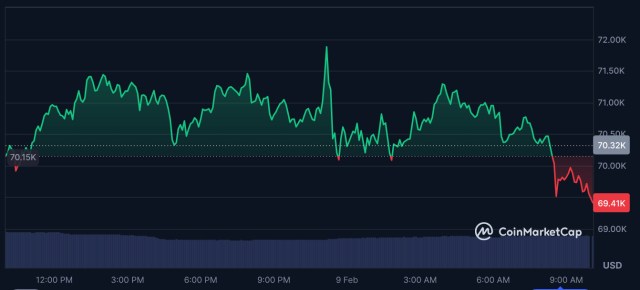
It’s a high-time-frame floor that typically precedes a major capital rotation event; however, some analysts warn that if historical patterns repeat, a test of the long-term holder realized price near $40.3K could theoretically forecast a deeper bottom toward $34.5K. The significance of Bitcoin reclaiming the $71K zone matters less for the number itself than for what it unlocks. It signals a stabilization of volatility that historically flashes the ‘risk-on’ green light for the broader ecosystem.

When the market leader establishes a defensive line, volatility dampens. The cost of capital effectively drops for retail traders. This stability allows the market to transition from ‘fear of liquidation’ to a hungry ‘search for yield.’ Current on-chain data suggests that while Bitcoin absorbs sell pressure at this key resistance-turned-support, smart money is already positioning itself further out on the risk curve.

But here’s the twist: the rotation isn’t going into legacy altcoins this cycle. Instead, it’s flowing toward assets, capturing the specific cultural zeitgeist of high-leverage trading and aggressive growth.

That dynamic creates a perfect storm for “beta” assets, tokens that amplify Bitcoin’s movements. This search for high-octane performance has led liquidity directly toward the emerging ‘leverage king’ culture of Maxi Doge ($MAXI), which has recently surged past the $4.5M milestone in its presale by catering to the high-risk appetite of traders looking for ‘1000x leverage energy’ through gamified staking and trading competitions.

Smart Money Bets on the ‘Leverage King’ Culture

Crypto markets have always favored narratives that mirror the psychological state of participants. In a cycle defined by aggressive positioning and the hunt for outsized returns, Maxi Doge has emerged as the avatar for the ‘1000x mentality.’

Unlike traditional meme coins relying on cute aesthetics, Maxi Doge taps into the gym bro trading culture. Think of it as a 240-lb canine juggernaut representing the heavy lifting required to survive a bull market. The project’s tagline, ‘Never skip leg-day, never skip a pump,’ isn’t just humor. It’s a rallying cry for retail traders feeling priced out of blue-chip assets and seeking the volatility needed to change their financial standing.
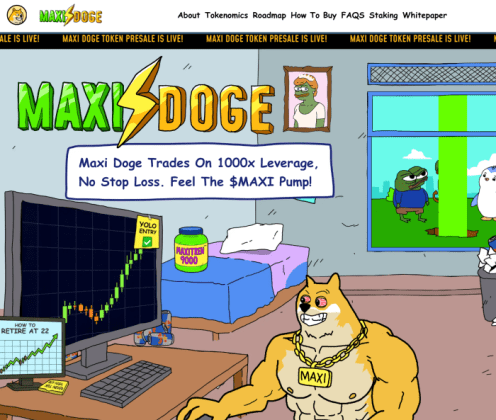
This isn’t just narrative fluff; it’s backed by significant on-chain flows. Smart money is moving with whale buys around $314K.

The project sets itself apart through “Holder-Only Trading Competitions.” It attempts to solve the retail problem of lacking capital by gamifying the experience with leaderboard rewards. By integrating viral humor with actual competitive utility, the project captures the two most potent drivers of crypto volume: the desire for entertainment and the hunger for ROI.

START SEEING THE GAINS WITH $MAXI

Presale Momentum and Dynamic Staking Rewards

While Bitcoin stabilizes the macro environment, the microeconomics of Maxi Doge are driving rapid presale adoption. The project has successfully raised over $4.5M, a signal of robust demand even before public listing. With tokens currently priced at $0.0002803, early participants are positioning themselves before the wider market catches wind of the ‘Leverage King.’ When it does catch on, we see it becoming one of the top trending crypto.

The valuation model is intriguing, too. Rather than launching with a bloated fully diluted valuation (FDV), the pricing structure seems designed to leave room for the type of parabolic discovery often seen in meme assets post-launch.

Addressing the common issue of meme coin velocity (where tokens are dumped immediately after a pump), the team implemented a robust staking mechanism. Maxi Doge employs a dynamic APY system (with current rewards of 68%), featuring planned daily automatic smart contract distributions from a 5% staking allocation pool. This encourages a ‘lift and hold’ behavior, effectively locking supply while rewarding those with the highest conviction.

Plus, the ecosystem is supported by the ‘Maxi Fund’ treasury, designed to provide liquidity and fund partnerships (including potential integrations with futures platforms). This creates a feedback loop: as the treasury grows, so does the project’s ability to market itself and sustain liquidity. That reduces the ‘rug risk’ often associated with lower-cap assets.

FIND OUT MORE ABOUT $MAXI ON ITS OFFICIAL PRESALE PAGE

The information provided in this article does not constitute investment advice, financial advice, trading advice, or any other sort of advice. You should not treat any of the article’s content as such. Crypto assets are volatile and high-risk.

Editorial Process for bitcoinist is centered on delivering thoroughly researched, accurate, and unbiased content. We uphold strict sourcing standards, and each page undergoes diligent review by our team of top technology experts and seasoned editors. This process ensures the integrity, relevance, and value of our content for our readers.

Ben Wallis

Follow

Ben is a freelance writer, and AI editor specializing in crypto developments (mainly altcoins) and the intricate ways global economics shape the digital asset space. His B.Ed. in Education provides a unique foundation for his writing, enabling him to distill complex crypto concepts and market shifts into clear, digestible insights. This skill is key to helping readers adapt and apply their understanding to the ever-evolving world of crypto investment. Passionate about making crypto accessible, Ben crafts content designed to educate a broad audience, from current market events to the essential foundational knowledge that underpins them. His goal is to empower readers through understanding. When he’s not immersed in crypto analysis and breaking down complex topics, Ben is an avid Pokémon fan and enjoys all things Disney.

Full Profile

Related Posts

CoinShares Quantum Risk Report Protects Bitcoin Hyper Network Integrity

Jack Dorsey’s Block Job Cuts Signal Operational Efficiency Push As SUBBD Token Drives Creator Economy 2.0

Crypto Alert: 2 Victims Lose Over $60M In Address Poisoning Scam

KuCoin Consensus Hong Kong 2026 Participation Benefits LiquidChain and the L3 Narrative

Las mejores criptos para comprar ahora: XRP, SOL y BTC lideran el rebote del mercado

Capital B $BTC Acquisition Strategies Strengthen The Case for $BTC Based Projects Like $HYPER

Trending Cryptos

Related Questions

QWhat is the significance of Bitcoin rebounding near the $71K level according to the article?

AThe article states that Bitcoin's rebound near $71K acts as a stabilizer, reducing market volatility and signaling a 'risk-on' environment. This stability encourages capital to rotate from Bitcoin into higher-risk, higher-reward assets.

QWhat specific cultural trend does the Maxi Doge ($MAXI) project tap into?

AMaxi Doge taps into the 'gym bro trading culture' and the 'leverage king' mentality. It represents a high-risk, high-reward ethos with a tagline of 'Never skip leg-day, never skip a pump,' catering to traders seeking aggressive growth and outsized returns.

QWhat utility features does the Maxi Doge project offer to its holders?

AMaxi Doge offers 'Holder-Only Trading Competitions' and a dynamic staking reward system with a current APY of 68%. These features are designed to gamify the experience, reward long-term holders, and lock supply by encouraging a 'lift and hold' behavior.

QHow much has the Maxi Doge ($MAXI) presale raised and what is the current token price?

AThe Maxi Doge presale has raised over $4.5 million. The tokens are currently priced at $0.0002803 during the presale phase.

QWhat is the 'Maxi Fund' treasury and what is its purpose?

AThe 'Maxi Fund' treasury is designed to provide liquidity for the project and fund partnerships, including potential integrations with futures platforms. It creates a feedback loop where a growing treasury increases the project's ability to market itself and sustain liquidity, thereby reducing 'rug risk'.

Related Reads

Wall Street's Most Famous 'Cassandra' Now Has His Sights Set on Nvidia

Michael Burry, the famed "Big Short" investor, has once again captured Wall Street's attention with a series of short positions against major tech and semiconductor stocks, most notably Nvidia. In late June and July, through his "Cassandra Unchained" newsletter, Burry disclosed short bets against Nvidia, Tesla, Applied Materials, Caterpillar, the SOXX semiconductor ETF, and later, Micron Technology. His core thesis revolves around potential distortions in the AI infrastructure boom, specifically questioning whether extended depreciation schedules (e.g., 6 years vs. a realistic 2-3 years for AI chips) by cloud giants like Microsoft and Google artificially inflate profits. He also raises concerns about possible "off-balance-sheet circular financing," where chip demand might be propped up by vendor-backed funding to clients. Nvidia's stock experienced volatility following these disclosures, briefly dipping but largely holding near Burry's reported entry points, leaving his positions roughly flat or slightly underwater as of late July. This move is part of a pattern for Burry, whose track record since his legendary 2008 bet is mixed. He has faced notable losses, such as on Tesla in 2021, while scoring on broader market turns like the 2020 pandemic crash. His methodology focuses intensely on free cash flow and scrutinizing original financial documents to spot overvaluation and structural risks, but it often struggles with timing the market. The article contrasts Burry's stance with other prominent investors. Steve Eisman, another "Big Short" figure, is not shorting Nvidia, citing strong fundamentals but expressing nervousness about sustainability. Jim Chanos agrees with the broad "accounting mismatch" concern—comparing it to the dot-com bubble—but targets financial leverage in private equity firms rather than the chip stocks themselves. While Nvidia's short interest remains relatively low at 1.3-1.4% of float, the massive stock size means absolute short losses have been significant, exceeding $5 billion earlier this year. The piece concludes that for ordinary investors, the key takeaway is not replicating specific short bets but learning from the critical frameworks these investors use: questioning rosy accounting, identifying structural vulnerabilities, and maintaining skepticism during market euphoria, even if pinpointing the exact catalyst for a downturn remains elusive.

marsbit19m ago

Wall Street's Most Famous 'Cassandra' Now Has His Sights Set on Nvidia

marsbit19m ago

Weekly Selection丨Epic Stock Market Volatility, Changxin Tech's IPO Reshapes Storage Landscape, Saylor Aims to Re-Anchor STRC Around September 8th

PANews Weekly Digest: Market Turmoil, Tech Breakthroughs, and Crypto Developments. The week saw significant volatility across global markets. South Korea's KOSPI index experienced extreme turbulence, including multiple trading halts, largely driven by sharp declines in AI hardware stocks like SK Hynix. In contrast, China's Changxin Xinqiao (CXC) achieved a landmark IPO with a market cap surpassing 4 trillion yuan, marking a major success for the domestic DRAM industry after a decade of losses. In the crypto and Web3 space, several key narratives emerged. AI is driving demand for new infrastructure, with projects like AI agent wallets and programmable payments gaining traction, attracting interest from firms like Coinbase. The Bitcoin mining sector is pivoting, with companies like MARA focusing on energy management as electricity becomes a core AI-era asset. Meanwhile, the RWA (Real World Assets) sector faces a "utilization puzzle," with hundreds of billions in on-chain assets remaining dormant. Notable market movements included a historic single-day surge of over 17% for the KOSPI index and a significant migration of $16.5 billion in staked ETH within the Lido ecosystem. Michael Saylor announced a target to re-peg the STRC stablecoin around September 8th. Other highlights include discussions on Ethereum's ambitious 2030 roadmap for scaling and privacy, analysis showing high protocol revenues not always translating to token price gains, and warnings from Citi about potential extreme commodity price shocks by late 2026.

marsbit24m ago

Weekly Selection丨Epic Stock Market Volatility, Changxin Tech's IPO Reshapes Storage Landscape, Saylor Aims to Re-Anchor STRC Around September 8th

marsbit24m ago

When the Market Begins to Question AI Capex: A Full Analysis of Q2 Earnings Reports from Five Tech Giants

In late July 2026, five major US tech giants—Alphabet, Intel, Microsoft, Meta, and Apple—released their Q2 earnings reports. While all companies exceeded revenue and profit expectations, driven by strong AI-related business growth, investor reactions diverged sharply due to concerns over escalating AI capital expenditures (capex) and their impact on free cash flow. Alphabet reported strong revenue growth and a surging cloud business, but its stock fell after announcing a doubled year-on-year capex and negative quarterly free cash flow for the first time. Intel posted its strongest revenue growth in over 15 years, but its stock experienced volatile trading after significantly raising its full-year capex guidance. Microsoft saw its stock surge after beating estimates and, crucially, lowering its capex forecast while projecting positive free cash flow. Meta faced the most severe sell-off as its profits declined despite revenue beats, with free cash flow plunging over 90% and its capex guidance raised. Apple reported record June-quarter results, but its stock plummeted after providing Q4 revenue guidance that fell short of expectations, citing supply chain constraints and forex headwinds. The overall takeaway is that the market's focus has shifted from validating AI demand to scrutinizing the timeline for returns on massive AI investments. Companies demonstrating a clearer path to managing capex and preserving free cash flow, like Microsoft, were rewarded, while those signaling continued aggressive spending faced investor skepticism.

Odaily星球日报34m ago

When the Market Begins to Question AI Capex: A Full Analysis of Q2 Earnings Reports from Five Tech Giants

Odaily星球日报34m ago

a16z: From Companies to DAOs, DUNA May Become the Next Generation Organizational Form

This article, "From Companies to DAOs: How DUNA Could Become the Next Organizational Form," traces the 500-year evolution of business collaboration. It begins with medieval structures like the *commenda* and Florentine *compagnia*, which exposed partners to personal risk. The modern corporation, exemplified by the Dutch East India Company (VOC), was a revolutionary leap, enabling large-scale, capital-intensive ventures by offering limited liability and reducing coordination costs. However, corporations introduced new challenges like principal-agent problems and bureaucratic overhead. The piece argues that software and internet-native protocols are now reducing these traditional overheads. Decentralized Autonomous Organizations (DAOs) emerged as a new model for coordination without centralized management. Yet, DAOs face a significant legal vacuum: they lack legal recognition, leaving members exposed to unlimited personal liability, and their tokens are vulnerable to being classified as securities under unclear regulations (e.g., the Howey Test). This has forced projects into suboptimal workarounds like offshore foundations. The article identifies the Decentralized Unincorporated Nonprofit Association (DUNA) as a potential solution. Recently legalized in states like Wyoming, the DUNA provides a legal wrapper for decentralized networks. It grants key protections—legal personality, limited liability, and perpetual existence—to a group without imposing a traditional hierarchical management structure. This allows token-holder communities to govern, hold assets, and contract as a single legal entity, aligning with their decentralized nature. While DUNA doesn't solve all governance challenges or magically resolve securities law questions, it represents a crucial step. It fills the legal recognition gap, offering a native legal form for internet-scale, decentralized collaboration and extending the separation of personal risk from organizational venture into a new domain.

marsbit1h ago

a16z: From Companies to DAOs, DUNA May Become the Next Generation Organizational Form

marsbit1h ago

2026 Mid-Year Report On-Chain RWA: Tokenized Stock Market Cap Doubles in a Year, But 90% of Rights Are Hollow Shells

The 2026 Mid-Year Report on On-Chain RWA highlights a significant growth in tokenized stock market capitalization, which nearly doubled from $951 million in March to $1.89 billion by July. However, the report reveals a fundamental contradiction in this "layer 2.5" ecosystem: products with the strongest legal foundation (like regulated U.S. infrastructure) lack liquidity and distribution, while freely tradable offshored wrapper products often lack substantive ownership rights. The increase is driven largely by a few products (SECZ, FGRS, STRCx) and platforms (Ondo, xStocks, Securitize collectively hold over 85% share). While distributed value across networks like Ethereum, Solana, and BNB Chain has grown, the market remains fragmented. Products referencing the same underlying asset (e.g., Apple stock) are distinct legal liabilities with different intermediaries and jurisdictional rules, offering varying degrees of legal claim. The report cautions that headline numbers are misleading, as they reflect changes in distributed token value—driven by issuance, conversions, and price movements—not pure investor inflows. True "canonical shares" with legal ownership, wide wallet distribution, institutional liquidity, and independent on-chain price discovery do not yet exist at scale. Tokenized treasuries show stronger product-market fit, and ETFs may be easier to scale than single stocks. The core takeaway is a trade-off: legal certainty versus liquidity and composability.

marsbit2h ago

2026 Mid-Year Report On-Chain RWA: Tokenized Stock Market Cap Doubles in a Year, But 90% of Rights Are Hollow Shells

marsbit2h ago

Trading

Spot

Hot Articles

What is DOGE M

Doge Matrix ($doge m): The New Breed of Community-Driven Cryptocurrency Introduction In the ever-evolving landscape of cryptocurrency, new projects constantly emerge, each aiming to capture the interest of investors and enthusiasts alike. One of the latest entrants to this domain is Doge Matrix, represented by the ticker symbol $doge m. This project has attracted attention thanks to its roots in the popular meme culture surrounding Dogecoin, establishing its place within the web3 space. This article aims to provide a comprehensive analysis of Doge Matrix, covering its overview, creator, investors, functionality, timeline, and notable aspects. What is Doge Matrix ($doge m)? Doge Matrix is a community-driven cryptocurrency project that seemingly builds upon the widespread appeal of Dogecoin, a digital currency known for its Shiba Inu mascot and its meme origins. While the overarching objectives of Doge Matrix are not extensively defined, it is characterized by a commitment to harnessing community involvement and support. Unlike traditional cryptocurrencies that often emphasize utility or intrinsic value through underlying technologies, Doge Matrix positions itself within a space that embraces the cultural phenomenon of cryptocurrencies, particularly appealing to those who resonate with the ethos of meme-based assets. Drawing on the strengths of the Dogecoin community, Doge Matrix operates as part of a broader ecosystem, inviting participation and engagement from users who share an interest in cryptocurrency and the digital landscape. Who is the Creator of Doge Matrix ($doge m)? The identity of the creator of Doge Matrix remains unknown. This lack of transparency is not an uncommon occurrence in the cryptocurrency space, where some projects are launched without revealing the identities of their founders. The absence of information regarding the founding team can raise questions among potential investors about the project’s accountability and direction. Who are the Investors of Doge Matrix ($doge m)? As it stands, there is no publicly available information detailing the investors or investment foundations that back Doge Matrix. The project appears to rely primarily on community support rather than institutional investment. This model aligns with the community-driven nature of the initiative, fostering an environment where the direction of the project is shaped by its participants rather than being dictated by a select few financial backers. How Does Doge Matrix ($doge m) Work? The specifics regarding the operational mechanisms of Doge Matrix are somewhat vague, reflecting a broader trend of projects in the meme coin space where innovative functionalities are not always clearly articulated. Nonetheless, Doge Matrix seems designed to tap into the existing cryptocurrency ecosystem by encouraging user participation while tapping into the familiar cultural references associated with Dogecoin. Its potentially unique characteristics derive from community interactions rather than technological advancements, emphasizing shared experiences and collaboration among token holders. While the exact innovations have not been explicitly outlined, the project appears to create a space where community members can engage, share ideas, and propel the project's potential forward. Timeline of Doge Matrix ($doge m) Reflecting on the project’s timeline reveals notable events that have defined its journey thus far: November 25, 2024: Doge Matrix reached its all-time high value, marking a significant milestone in its early history. January 1, 2025: Conversely, Doge Matrix hit its all-time low value, illustrating the volatility often associated with cryptocurrencies, especially in the early stages of a project's lifecycle. Ongoing: The project continues to be actively traded and supported by its community, although specific future milestones or objectives have yet to be disclosed. Key Points About Doge Matrix ($doge m) Community Focus At the heart of Doge Matrix is a commitment to community engagement. The project thrives on the premise of collaboration and shared objectives among its members, emphasizing the importance of collective effort. Unlike centralized projects that often have a defined leadership structure, Doge Matrix at present showcases a more fluid approach to governance, where every community member's voice matters. Volatility The cryptocurrency market is notorious for its volatility, and Doge Matrix is no exception. Its price history reflects significant fluctuations between high and low values, which is typical of many new cryptocurrencies but underscores the risks associated with investment in emerging tokens. Lack of Detailed Information One of the most striking features about Doge Matrix is the scarcity of detailed information regarding its technological underpinnings and operational mechanisms. This ambiguity necessitates that potential investors conduct thorough due diligence before engaging with the project. Conclusion In summary, Doge Matrix ($doge m) illustrates a new wave of cryptocurrency projects that lean heavily on community engagement and cultural relevance. While lacking in certain specifics—such as clear leadership, defined objectives, and detailed functionality—the project has managed to generate interest within the crypto community, leveraging the established appeal of meme culture. As with any investment in the cryptocurrency space, understanding the inherent risks and conducting comprehensive research is essential for potential participants. Doge Matrix stands as a reminder of the dynamic, sometimes unpredictable nature of the crypto industry, marked by constant evolution and enthusiasm for community-driven initiatives.

4.2k Total ViewsPublished 2025.02.03Updated 2025.02.03

What is DOGE M

Discussions

Welcome to the HTX Community. Here, you can stay informed about the latest platform developments and gain access to professional market insights. Users' opinions on the price of DOGE (DOGE) are presented below.

活动图片