Bitcoin is undergoing a severe stress test on institutional holdings. As the price falls below key psychological levels, approaching the cost basis of major institutional holders like MicroStrategy, concerns about liquidity among highly leveraged holders are rapidly intensifying.
Over the weekend, Bitcoin broke below the $80,000 mark, hitting its lowest level since April 7, 2025. This round of selling occurred against a backdrop of significantly thin market liquidity, further exacerbating Bitcoin's recent cumulative decline of over 30%.
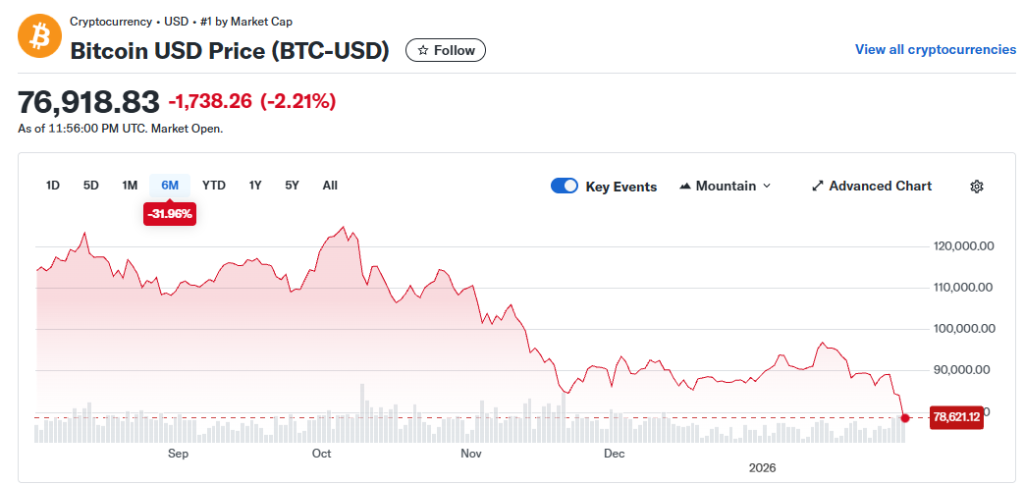
Despite the gloomy market sentiment, MicroStrategy Executive Chairman Michael Saylor still shared an image with the words "More Orange" on social media platform X on Sunday, hinting at continued accumulation. The company announced a 25 basis point increase in the dividend for its Series A Perpetual Extension Preferred Shares (STRC) to 11.25%, aiming to attract capital with high financing costs to sustain its Bitcoin acquisition strategy. However, analysts point out that if the price remains stagnant or falls below its cost basis, the high dividend payments could trigger a serious cash flow squeeze.

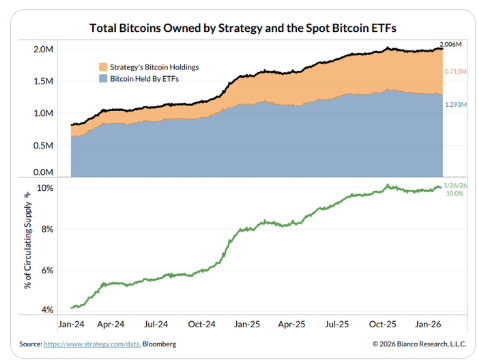
Macro strategist Jim Bianco from Bianco Research analyzed that the Bitcoin market is facing a crisis of narrative exhaustion. The current market structure is highly institutionalized, with ETF investors and MicroStrategy collectively controlling about 10% of the circulating supply, and are currently in an overall unrealized loss position. This suggests that the once market-supportive narrative of "institutional entry" could reverse into a significant source of selling pressure after being trapped at high levels.
Institutional Holdings' Unrealized Losses Worsen, ETFs See Net Outflow Wave
Jim Bianco's analysis shows that Bitcoin is becoming highly "institutionalized on the books," meaning the market can, for the first time, clearly observe the cost basis and profit/loss status of large capital holdings. Currently, MicroStrategy and the 11 spot Bitcoin ETFs collectively hold about 10% of the circulating Bitcoin supply, with a combined average purchase cost of approximately $85,360. At the current price, these institutional holdings are facing an overall unrealized loss of about $8,000 per coin, with total unrealized losses reaching approximately $7 billion.

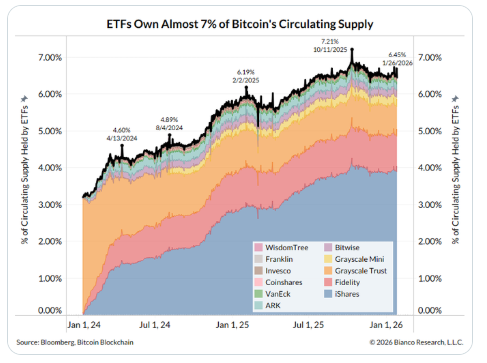
Among these, spot ETFs have become a core force influencing the supply-demand structure. Data shows that the 11 largest spot Bitcoin ETFs hold 1.29 million Bitcoins, accounting for 6.5% of the circulating supply, with a market value of about $115 billion. However, the average purchase cost for these ETF investors is as high as $90,200, and the current price is about $13,000 below their cost basis.
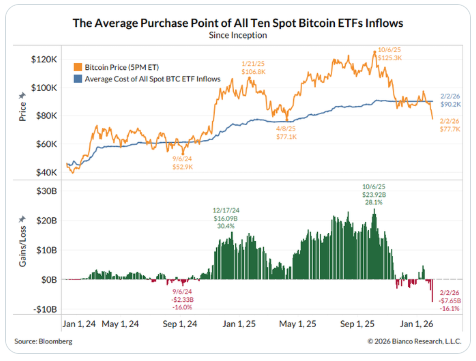
This structure of buying at high levels has led to a typical pro-cyclical effect. Bianco points out that these ETFs have seen net outflows for 10 consecutive trading days, as investors choose to redeem after buying high and facing a pullback. This capital structure is amplifying the market's downward volatility.
MicroStrategy's Safety Margin Narrows, Aggressive Financing Raises Concerns
As a benchmark for corporate Bitcoin holdings, MicroStrategy's balance sheet is facing its most severe test in months. The company currently holds 712,647 Bitcoins with an average cost of approximately $76,037. As Bitcoin trades around $78,000, the company's unrealized gains have narrowed significantly to less than 3%.
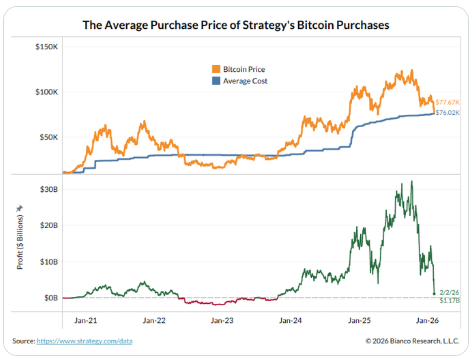
Despite the thinning safety margin, MicroStrategy shows no signs of retreating. To fund the next phase of purchases, the company adjusted the yield on its STRC product to 11.25%. This return rate represents a huge premium compared to typical corporate bonds, reflecting the company's extreme thirst for capital and the inherent volatility risk of its Bitcoin-centric model. Data shows that since the STRC product's debut in November, sales of this product alone have funded the acquisition of over 27,000 Bitcoins.
Analysis suggests that MicroStrategy is still profitable, but its margin for error has significantly shrunk. If the price falls further, the company will face an overall unrealized loss. Maintaining such high-cost dividend payments could cause cash flow strain, a risk that becomes particularly acute if the Bitcoin price falls below its $76,000 cost "waterline".
Old Narrative Fails, Market Desperately Needs New Momentum
From a macro perspective, this plunge has intensified the disappointment that has been building in the market for weeks. Jim Bianco believes the real problem Bitcoin faces is a lack of new narratives. The previously high-hoped "Boomer Adoption" story has been fully priced in and is even being disproven.
The current market structure shows that ETFs and MicroStrategy not only bought heavily and concentratedly but are also currently overall trapped. Bianco points out that as long as there is no new, sustainable buying narrative, the trend of capital outflows is likely to continue. In this scenario, the high level of institutionalized holdings, once seen as a positive, could instead turn into the market's biggest source of pressure. Bitcoin's current problem is not whether people bought in the past, but where the next batch of buyers will come from at the current price level.