Behind USDH's Acquisition by Coinbase: Hyperliquid's Interest-Driven Choice

marsbitPublished on 2026-05-15Last updated on 2026-05-15

Abstract

Coinbase announces its integration with Hyperliquid, becoming the official USDC treasury deployer on the platform. The native stablecoin USDH, issued by Native Markets, will be gradually phased out as Coinbase acquires its brand assets. Users can convert USDH to USDC or fiat without fees during the transition. The move solidifies USDC as Hyperliquid's official stablecoin and pricing asset. The arrangement is framed as a three-way win: Coinbase deepens its ties to the Hyperliquid ecosystem; Hyperliquid gains the vast majority of future USDC reserve yield revenue (estimated at up to 90%); and Native Markets exits with compensation from the asset sale. However, some community members criticize the outcome, viewing USDH's shutdown as a retreat from decentralization and arguing that the original governance vote favored internal interests over users. The partnership also sees Circle and Coinbase staking HYPE tokens to support the network's AQAv2 upgrade. Ultimately, the article suggests the resolution underscores pragmatic economic interests over earlier community-centric rhetoric.

Original | Odaily Planet Daily (@OdailyChina)

Author | Wenser (@wenser 2010)
Last September, the battle over Hyperliquid's native stablecoin USDH once became an industry focus; now, this once highly anticipated stablecoin has suddenly reached its "exit moment."

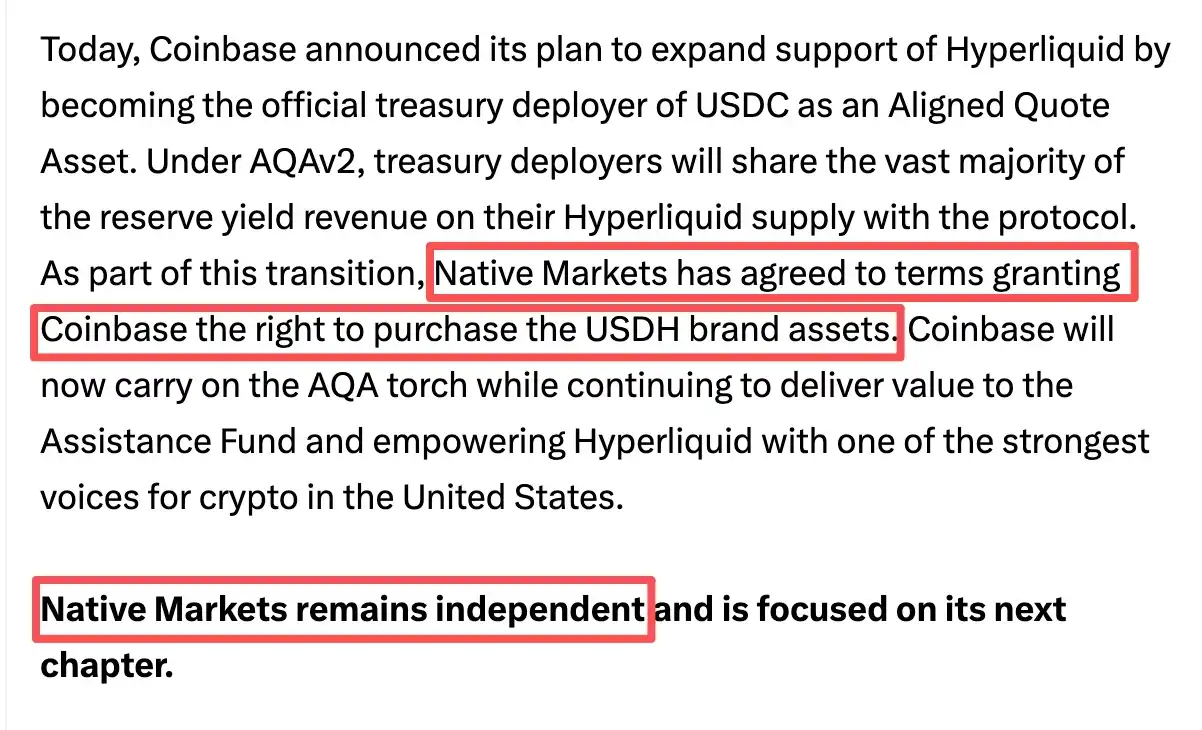
Last night, Coinbase announced it will become the official treasury deployer for USDC on Hyperliquid, while USDH issuer Native Markets granted Coinbase the rights to purchase USDH brand assets. Subsequently, the USDH market will be gradually phased out, during which users can still convert USDH to USDC or fiat currency without fees.

Thus, the once famous USDH has become an asset acquired by Coinbase, while USDC has been officially established as Hyperliquid's official stablecoin and pricing asset. Odaily Planet Daily will briefly analyze the details and subsequent impacts in this article.

USDH Exits, USDC Rises: The Economic Calculations Behind $5 Billion

The grand drama of the "Hyperliquid Ecosystem Stablecoin Battle" has concluded with a win-win-win outcome for Coinbase & Circle, Hyperliquid, and USDH issuer Native Markets.

Coinbase further deepens its ties with the Hyperliquid ecosystem; Hyperliquid gains the majority of the stablecoin reserve income from USDC within its ecosystem; Native Markets, as the ultimate winner of the past USDH era, receives its reward by "selling the USDH brand assets."

Coinbase & Circle: Deepening Integration with Hyperliquid's On-Chain Economy, Continuously Increasing HYPE Investment

Currently, the scale of USDC on Hyperliquid is approximately $5.164 billion, a two-fold year-on-year increase.

As the official partner and revenue-sharing party for USDC, Coinbase's move undoubtedly aims to deeply integrate with the Hyperliquid ecosystem.

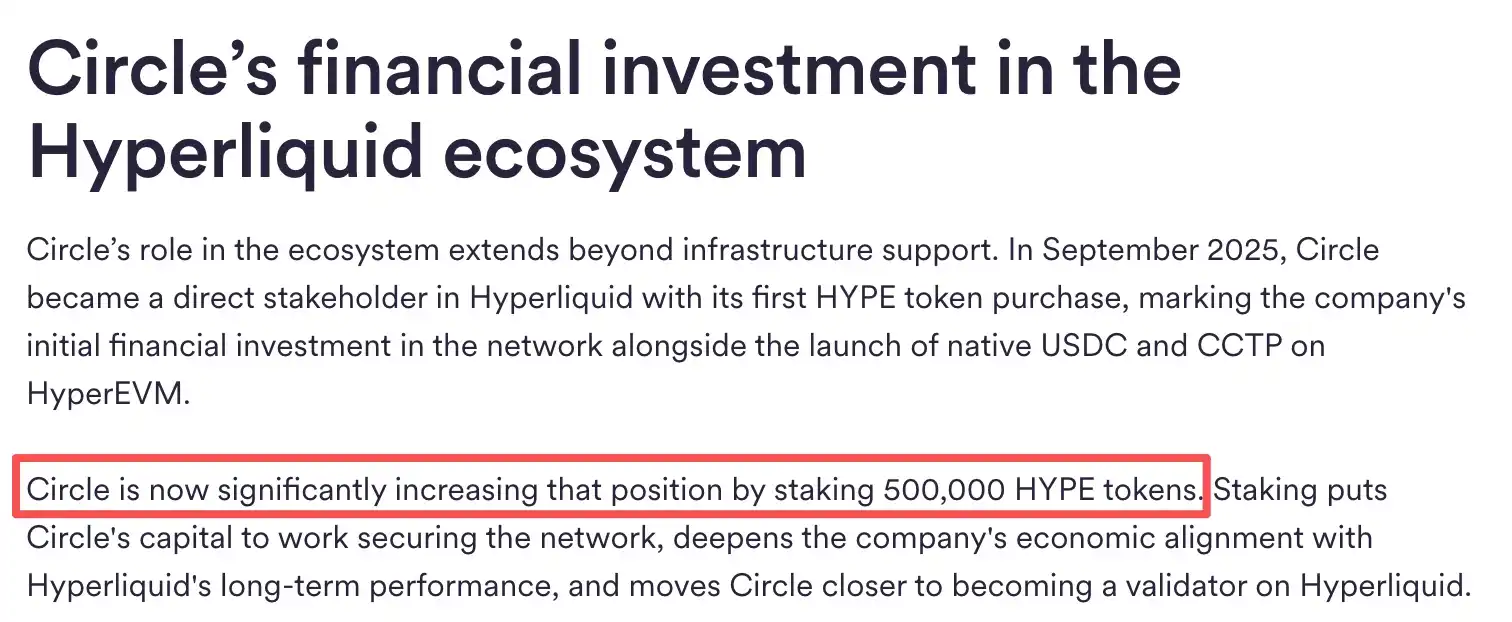
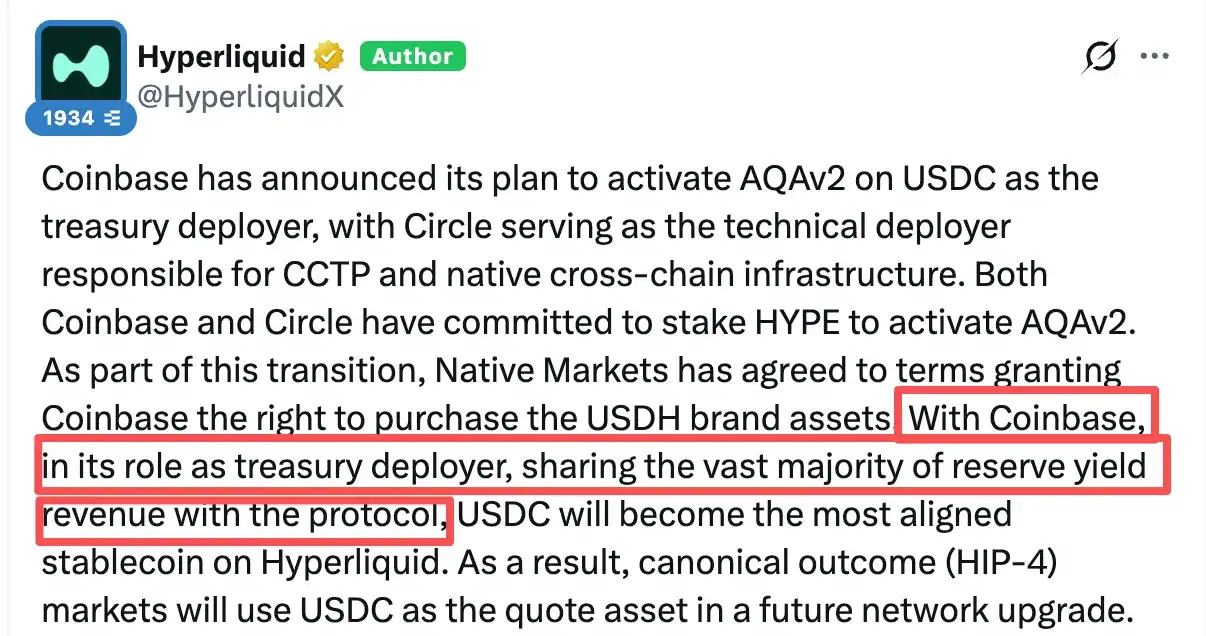
Furthermore, according to Hyperliquid's official announcement, both Coinbase (capital deployer) and Circle (responsible for technical deployment of CCTP and native cross-chain infrastructure) have committed to staking HYPE to activate AQAv2 (Aligned Quote Asset v2).

It is worth mentioning that in September last year, Circle already purchased HYPE tokens, and its current HYPE token staking scale has increased to around 500,000 tokens.
Hyperliquid: Receiving the Lion's Share of USDC Reserve Income, Benefiting from Coinbase Alliance

As for the biggest winner of this collaboration, it is undoubtedly Hyperliquid as the ecosystem foundation.

According to the official announcement, Coinbase will subsequently share the vast majority of reserve income revenue with the Hyperliquid protocol. Although the specific sharing ratio has not been disclosed, if based on the previous USDH revenue-sharing mechanism, Hyperliquid will actually receive approximately 90% of the reserve income.

Based on calculations by Hyperliquid community members, with a scale of $4.7 billion and an interest rate return of 3.8%, this corresponds to about $160 million in income; in other words, it equates to a daily $440,000 HYPE token buyback.

Moreover, with the CLARITY Act passing a vote in the US Senate Banking Committee, Hyperliquid's deep ties with Coinbase also imply that HYPE and Hyperliquid have gained a degree of support at the US regulatory level.
Native Markets: USDH's Historical Mission Accomplished

As the issuer of Hyperliquid's native stablecoin USDH, Native Markets appears to be the biggest loser in this "acquisition event," but judging from its official statement, its outcome can be considered a "successful retreat."

On one hand, USDH provided a model and template for the revenue-sharing agreement between Coinbase and the Hyperliquid protocol for USDC income; on the other hand, Coinbase likely directly acquired the USDH-related brand assets, meaning the USDH stablecoin issued by the Native Markets team was "acquired by Coinbase," thus providing the team with some economic return.

Subsequently, Native Markets also stated it would remain independent and seek development in other areas.
After USDH's Exit: In the Win-Win-Win Scenario, Only USDH Users Get Hurt

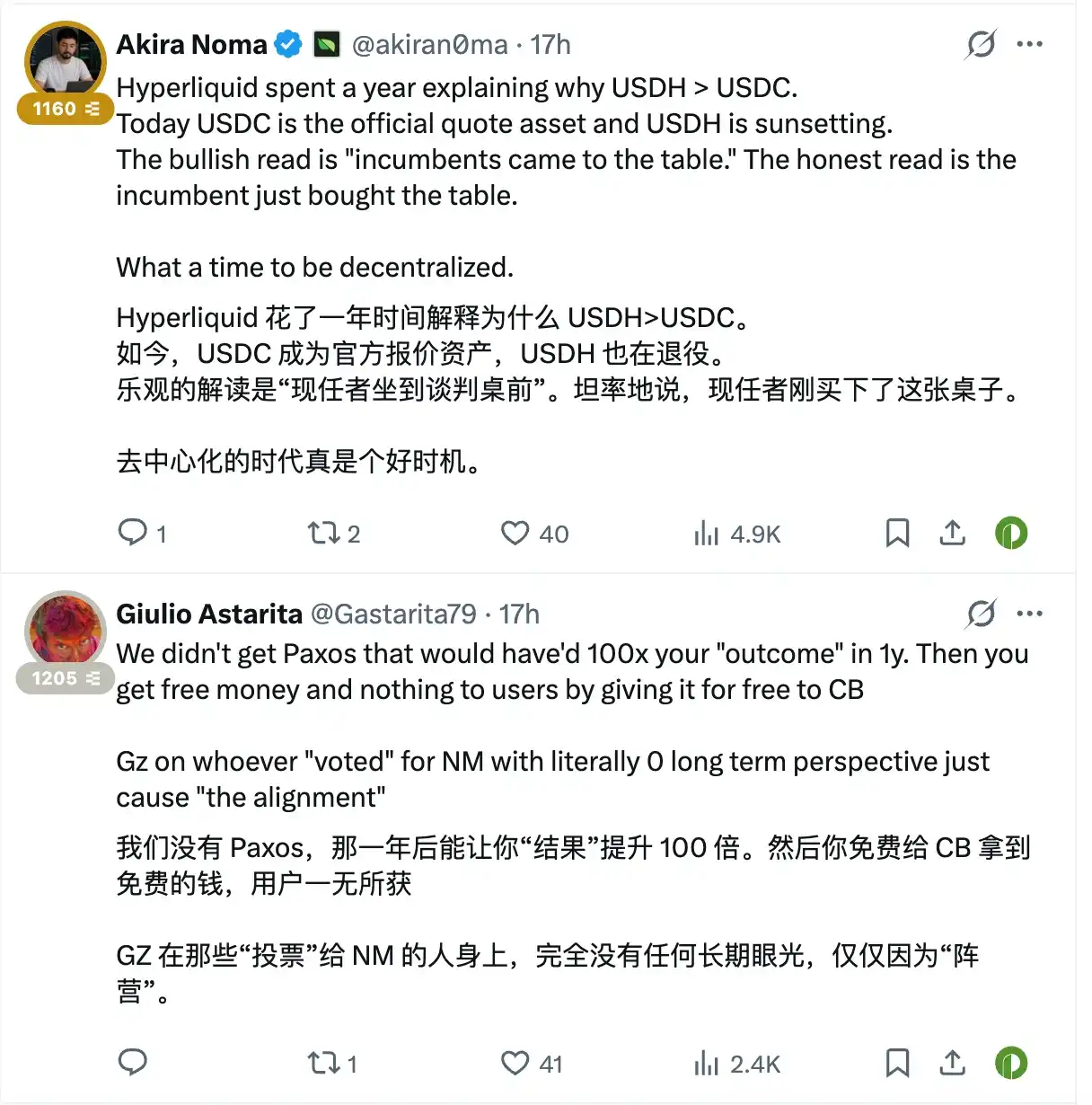
Of course, Native Markets' exit is not met with unanimous "praise." Hyperliquid community users also expressed criticism regarding its so-called "having a seat at the negotiation table" narrative.

Some believe that USDH's exit signifies a complete regression of the decentralization era;

Others pointed out that during the initial USDH stablecoin issuer vote, they should have chosen Paxos, as they at least considered users and stablecoin growth, while those who voted for Native Markets did so merely for alignment and internal interests. In the end, users gained nothing. These remarks also garnered considerable agreement and support.
Thus, the drama from a year ago, featuring "CEO romance" and "defying giants," has finally come to an end.

However, looking at the current scene of Hyperliquid "shaking hands and making peace" with Coinbase and Circle is somewhat sigh-inducing and even slightly ironic.

Everything, it turns out, was just about interest distribution, not the once-loudly chanted slogans of "for the community" or "for Hyperliquid."

Recommended Reading

Hyperliquid Stablecoin USDH Becomes "Industry Sweetheart," Giants Engage in Chaotic Distribution Rights Battle

USDH Vote in Progress: "Predetermined Script," "CEO Romance," "Retreating at the Height of Success" Take Turns on Stage


Trending Cryptos

Related Questions

QWhat major change was announced regarding the native stablecoin USDH on Hyperliquid, and who was involved in the announcement?

ACoinbase announced it will become the official treasury deployer for USDC on Hyperliquid, and the USDH issuer Native Markets granted Coinbase the right to purchase the USDH brand assets. The USDH market will be gradually shut down.

QWhat is the primary reason for Coinbase's involvement in this deal according to the article, especially regarding its relationship with Hyperliquid and HYPE tokens?

ACoinbase aims to deepen its binding with the Hyperliquid ecosystem. Both Coinbase and Circle have committed to staking HYPE tokens to activate AQAv2. Circle has already purchased HYPE tokens, increasing its stake to around 500,000 HYPE.

QHow is the Hyperliquid protocol expected to benefit financially from this new arrangement with Coinbase and the shift to USDC?

AHyperliquid is set to receive the vast majority (estimated around 90%) of the reserve yield income from the USDC deposits on its platform. Based on community calculations using $47 billion in assets and a 3.8% yield, this could amount to approximately $44 million per year, used for daily HYPE buybacks.

QWhat was the outcome for Native Markets, the issuer of USDH, in this transition, and what are its future plans?

ANative Markets received economic compensation through the sale of the USDH brand assets to Coinbase. The company considers USDH's historical mission complete and stated it will remain independent and seek development in other areas.

QWhat criticism did some Hyperliquid community members express regarding the phasing out of USDH and the original vote for its issuer?

ASome community members criticized the move as a step back for decentralization. Others argued that voters should have chosen Paxos as the USDH issuer, as they were more focused on user and stablecoin growth, while those who voted for Native Markets were motivated by factionalism and internal interests, leaving end-users with nothing.

Related Reads

Three Rounds in a Row, Shanghai Gives Birth to a $10 Billion Satellite Internet Unicorn

Shanghai-based semiconductor company Sixic has raised a new strategic investment round, securing backing from investors including Xinhuanet Venture Capital and Tongding Group, with continued support from existing investors. This marks the company's third disclosed financing this year, following a 1.5 billion RMB raise in February, officially cementing its status as a new Shanghai unicorn with a valuation exceeding 10 billion USD. The financing comes amid a dynamic period for China's commercial aerospace sector. Recent milestones include a successful controlled landing of a rocket first stage, signaling a path toward lower launch costs, and the establishment of a national Commercial Aerospace Innovation Consortium comprising 271 entities. Sixic stands out as the only 6G satellite internet baseband chip company within this consortium. The article highlights a market shift from a focus on rockets and satellites towards recognizing the value of the terminal and connectivity layer, essential for completing the commercial loop. Satellite internet, integral to 6G and commercial aerospace, is entering an industrial phase with clear policy support, including China's pioneering allocation of 6GHz spectrum for 6G R&D. Sixic specializes in 5G/6G satellite communication baseband chips, a highly complex segment. Unlike terrestrial communication, satellite chips must address challenges like high Doppler shift and signal loss. The company's technological validation is a key driver for investment. It has secured product certifications from leading global smartphone manufacturers, new energy vehicle makers, and communication module companies. A strategic partnership with ZTE was announced in March to collaborate on 6G NTN satellite internet. The company has achieved a full technical verification loop, from lab tests to in-orbit validation, including successfully demonstrating 5G NTN standard-based HD video calls via satellite in 2025. It maintains a 100% first-pass success rate for chip tape-outs and possesses full-stack in-house R&D capabilities. Sixic's strategy focuses on ASIC development for future commercial-scale, power-efficient consumer devices like smartphones. Its early and deep involvement in industry standards and constellation planning creates a significant competitive barrier. Looking ahead, Sixic's opportunity extends beyond chips into modules and terminal ecosystems. It has developed a full range of baseband SoC solutions and provides reference designs to help partners launch products quickly. The recent release of the CM7620 broadband satellite communication module at MWC Shanghai completes its "chip-module-terminal" portfolio. This latest funding round represents a strategic bet on the foundational communication capabilities that will underpin the next generation of 6G and satellite internet value chains.

marsbit38m ago

Three Rounds in a Row, Shanghai Gives Birth to a $10 Billion Satellite Internet Unicorn

marsbit38m ago

Is the iPhone Moment for Embodied AI Coming Soon?

Is the "iPhone moment" for embodied AI approaching? This article, based on a roundtable discussion, presents expert insights on the current state and future of embodied AI. The consensus is that the pivotal "iPhone moment" is still distant. The field is likened to the "brick phone" era, with technology paths—such as VLA and world models—not yet converging. While robotic "motor skills" (e.g., walking) have matured, the "brain" (decision-making, generalization) remains far from commercial readiness. A major bottleneck is data: an estimated tens of millions of data points are needed for a breakthrough, but only around 500,000 currently exist globally. Currently, cost remains prohibitive for widespread labor replacement, making the economic case challenging. However, experts see a three-tiered market potential: a billion-level market for emotional companionship (e.g., entertainment, basic care), a trillion-level market for commercial services (e.g., guides, receptionists), and a massive, long-term opportunity for physical labor in factories and homes. The discussion suggests that while humanoid robots face hurdles, non-humanoid embodied AI applications (like existing service robots) can be deployed sooner. The ultimate vision is for AI to operate seamlessly in the physical world, not just behind screens. Regarding AI tools, participants noted their widespread use for boosting efficiency in coding, research, and teaching. However, they warned against over-reliance due to risks of AI "deception" and the erosion of critical thinking, emphasizing that core judgment must remain with humans. In summary, embodied AI holds immense promise but requires significant progress in brain models, data collection, and cost reduction before achieving its transformative potential. Its development is expected to be gradual, advancing through specific use cases rather than a single explosive moment.

marsbit55m ago

Is the iPhone Moment for Embodied AI Coming Soon?

marsbit55m ago

Wall Street Morning Report: U.S. Stocks Suffer Collective Setback, Apple Hits New High Against the Trend, Tonight's CPI and Waller's Hearing to Determine Interest Rate Path

Wall Street Morning Report: U.S. stocks fell collectively, while Apple hit a new record high. Key events including tonight's CPI data and Fed Chair Walsh's testimony will set the direction for interest rates. Markets experienced a sharp "risk-off" move due to escalating Middle East tensions and unexpected hawkish signals from the Federal Reserve. Major indices declined, with the Nasdaq Composite leading losses, down 1.55%. The VIX fear index surged over 14%. Geopolitical tensions spiked as the U.S. conducted consecutive airstrikes on Iran and announced a maritime blockade of Iranian ports, set to begin on July 15. This triggered a panic-driven rally in oil, with WTI crude soaring over 9% to breach $80 per barrel. Safe-haven flows bolstered the U.S. dollar and Treasury yields, while gold plunged nearly 3%, losing its $4,000 level. Rate markets now price a nearly 50% chance of a Fed rate hike in July, up significantly from prior expectations, following hawkish commentary from Fed Governor Waller. The tech sector, particularly AI-related stocks, faced intense selling pressure. The Philadelphia Semiconductor Index plunged 4%. Notable decliners included SK Hynix (down 9% on its second trading day as an ADR), Nvidia, AMD, and Intel. In contrast, Apple shares rose 0.63% to a record high, viewed as a stable haven away from the costly AI data center arms race. Key events to watch include the U.S. June CPI inflation data and Fed Chair Walsh's Congressional testimony tonight, which will critically influence the Fed's policy path. Major bank earnings also begin today. The formal implementation of the U.S. maritime blockade against Iran on July 15 and upcoming events like TSMC's Q2 earnings and a SpaceX Starship test flight remain in focus.

marsbit1h ago

Wall Street Morning Report: U.S. Stocks Suffer Collective Setback, Apple Hits New High Against the Trend, Tonight's CPI and Waller's Hearing to Determine Interest Rate Path

marsbit1h ago

Crude Oil Surges 10% in Intraday Trading! US Military Restores Blockade on Iran, Trump Warns of 'Heavy Blows' Tonight and Tomorrow, Imposes 20% Fee on Strait Shipping

Crude oil prices surged up to 10% intraday as tensions between the US and Iran escalated sharply. President Trump announced the reinstatement of a maritime blockade against Iran, targeting its ships and their customers, while stating the Strait of Hormuz would remain open to all other nations. He further declared that the US, as the "guardian" of the strait, would impose a 20% fee on all cargo transiting the strategic waterway to compensate for security costs. The US Central Command confirmed the naval blockade would commence on July 14 (GMT). Following Trump's statements, reports emerged of explosions near Iran's Larak Island and the port of Bandar Abbas, though Iranian authorities did not confirm their nature. Iran's Foreign Minister criticized the proposed 20% fee as excessive, asserting Iran's role as the guardian of the strait. An Iranian military spokesperson warned of a strong response to any unauthorized US interference in the waterway. The United Nations' International Maritime Organization (IMO) expressed opposition to charging tolls for passage through international straits, stating such measures lack legal foundation. Market reactions were pronounced, with Brent crude briefly surpassing $83 and WTI above $78. The situation intensified as Trump notified Congress of renewed hostilities with Iran, following US airstrikes on Iranian targets.

marsbit1h ago

Crude Oil Surges 10% in Intraday Trading! US Military Restores Blockade on Iran, Trump Warns of 'Heavy Blows' Tonight and Tomorrow, Imposes 20% Fee on Strait Shipping

marsbit1h ago

Trading

Spot

Hot Articles

Discussions

Welcome to the HTX Community. Here, you can stay informed about the latest platform developments and gain access to professional market insights. Users' opinions on the price of S (S) are presented below.

活动图片