Behind the $53.4 Billion Proposal to Acquire PayPal: Stripe's Ambitions in Crypto Payments

Foresight NewsPublished on 2026-07-20Last updated on 2026-07-20

Abstract

Payment giant Stripe, reportedly alongside private equity firm Advent International, has made a $53.4 billion acquisition offer for PayPal. This potential deal, the largest in fintech history, is seen as a strategic move to advance Stripe's ambitions in the crypto payments sector. Stripe has been quietly building a comprehensive stablecoin ecosystem, acquiring infrastructure like stablecoin issuer Bridge and wallet service Privy, co-incubating the Tempo blockchain for payments, and backing the new Open USD (OUSD) stablecoin. However, it lacks direct access to a mass consumer base—a gap that PayPal, with its hundreds of millions of active accounts, Venmo app, and own PYUSD stablecoin, perfectly fills. The core motivation for the acquisition is speculated to be securing a massive distribution channel for Stripe’s stablecoin infrastructure. The integration could create a closed-loop system: Stripe serving merchants, PayPal/Venmo reaching consumers, and stablecoins facilitating low-cost, direct settlements, bypassing traditional card networks. This signals a strategic shift in the crypto industry, where competition is moving from building superior payment rails to capturing user-facing traffic portals. Key unresolved questions remain, including the future of PYUSD and Venmo's potential role as a front-end for the Tempo blockchain. While the deal's success is uncertain and faces challenges like cost-control priorities from Advent, its mere proposal underscores Stripe's long-ter...


By: William M. Peaster

Compiled by: Saoirse, Foresight News


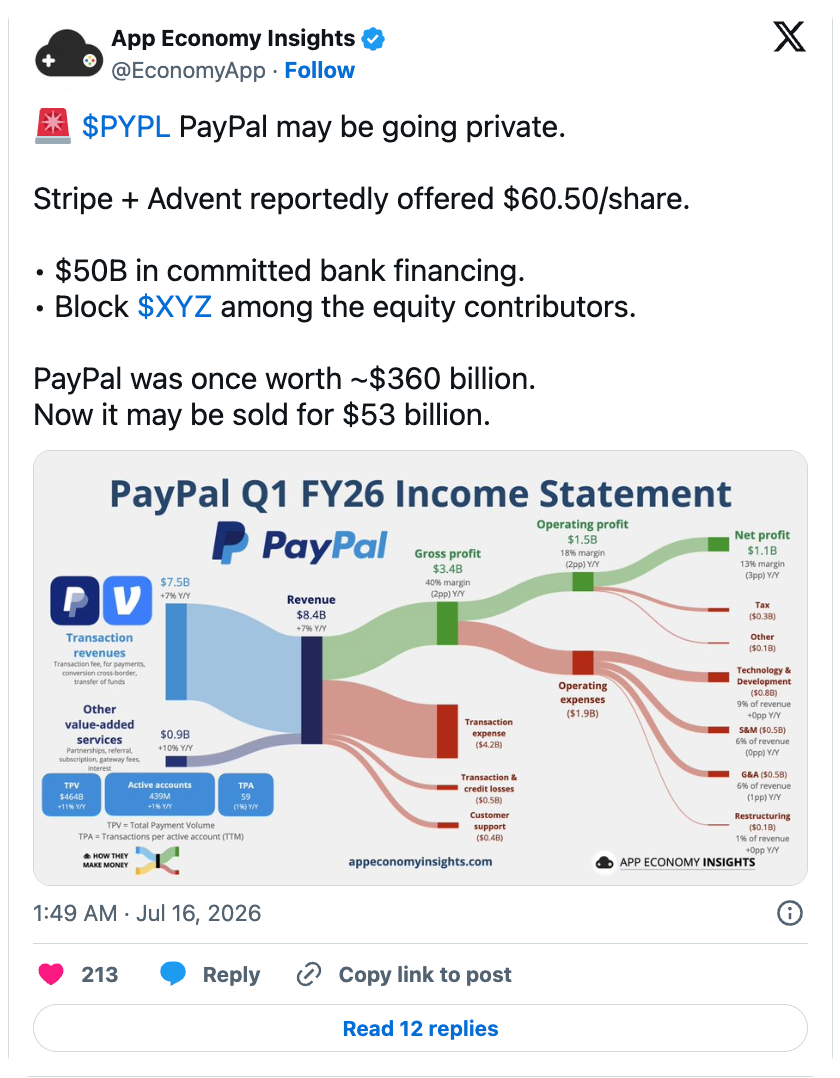
According to sources, payments giant Stripe is teaming up with private equity firm Advent International to launch an acquisition offer, bidding $60.5 per share with a total transaction value of $53.4 billion. PayPal's board of directors is expected to meet as early as this week to review the acquisition proposal.


Nothing is finalized yet, and whether this acquisition will materialize remains unknown. If the board does not reject it outright, it will likely demand a higher offer.


However, if the deal goes through smoothly, it would become the largest fintech acquisition in history. The crypto industry layout behind this transaction is even more worthy of in-depth exploration.
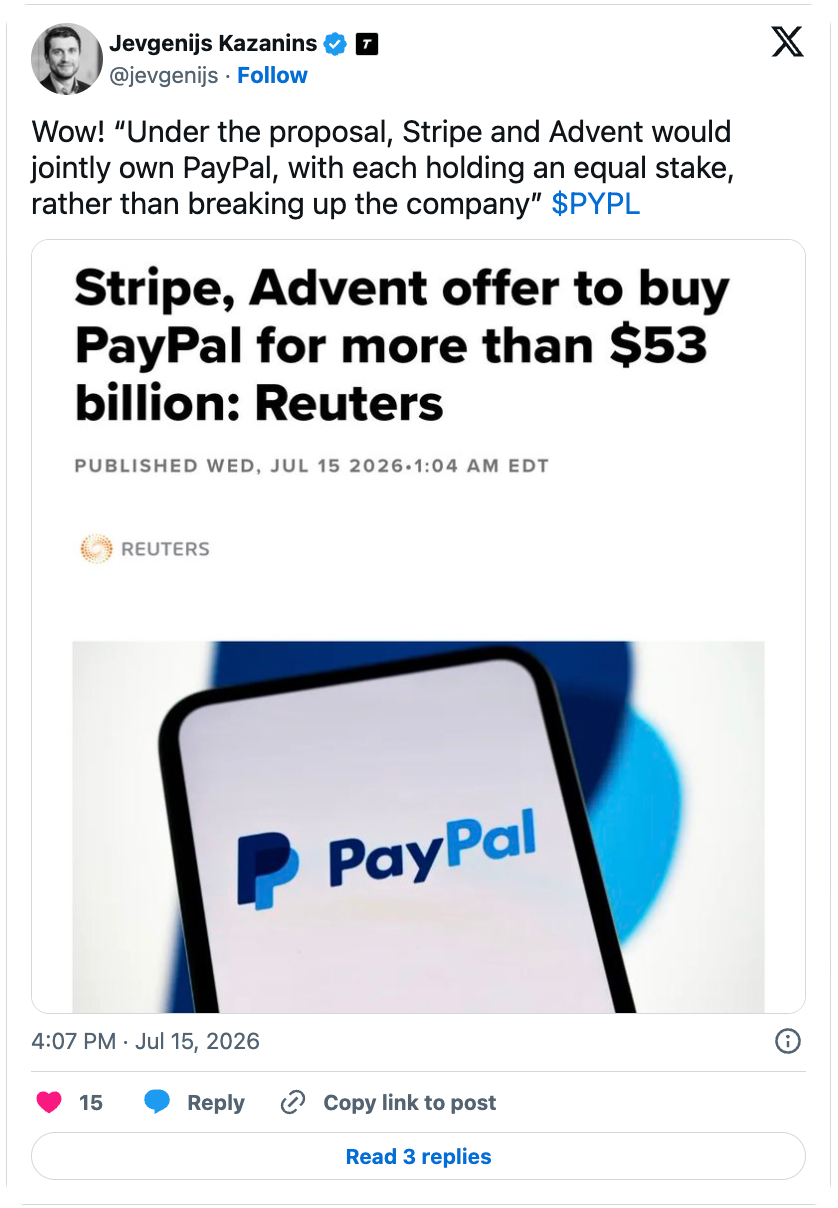


Reviewing its moves in recent years, it is not difficult to see that Stripe has been quietly building a complete stablecoin ecosystem: investing approximately $1.1 billion to acquire the stablecoin issuance platform Bridge; acquiring top-tier embedded wallet service provider Privy; collaborating with Paradigm to incubate the payment-focused layer-1 blockchain Tempo; and recently joining forces with hundreds of enterprises to support the new alliance stablecoin Open USD (OUSD). This stablecoin's design is quite distinctive, planning to distribute yields generated from reserve assets to channel distributors, rather than the token issuer.


This infrastructure layout is only missing one piece: end-users. For a long time, Stripe has only focused on B2B business, providing underlying payment infrastructure for merchants and developers. It does not have consumer-facing products nor does it control mass user traffic.


In contrast, PayPal holds hundreds of millions of active accounts, owns the popular payment app Venmo, and launched its own compliant stablecoin PYUSD in 2023.


All current acquisition-related news comes from Reuters citing anonymous industry insiders. Stripe has not publicly disclosed the core rationale behind this acquisition. However, the outside world cannot help but wonder: Could acquiring PayPal be to secure a mass distribution channel for its entire stablecoin infrastructure suite? This might be one of the core motivations behind this acquisition.


Stablecoins have become a flagship application in the crypto industry, sparking a round of infrastructure arms race with projects like Tempo, Circle's Arc, and Plasma entering the fray. Previously, it was widely assumed that whoever had the stronger underlying payment channel performance would capture the market. But Stripe's acquisition move conveys a completely different industry judgment: the construction of underlying payment channels is nearing completion, and the main battlefield for industry competition has shifted to user-facing traffic entry points.


Let's envision the business闭环 formed after the acquisition: Stripe interfaces with the merchant side, PayPal and Venmo reach a massive number of consumers, and adding the stablecoin settlement layer completes the full fund flow pathway. Funds can move directly from user wallets to merchants, bypassing card clearing networks like Visa and Mastercard entirely, saving high transaction fees. The existence of stablecoins would further reduce overall settlement costs, achieving vertical integration across the entire industry chain.


However, this merger still faces many unresolved questions: Will PYUSD, currently with a market cap of $2.8 billion and issued by Paxos, migrate to the Tempo blockchain in the future? Once OUSD officially launches, will PYUSD be integrated into that alliance stablecoin system? Could Venmo become the dedicated mass-market wallet for the Tempo blockchain?


Looking at PYUSD alone, its size is less than one-twentieth of Circle's USDC, offering limited appeal. What's truly valuable in this acquisition is the massive number of user accounts within the PayPal app that hold crypto assets — the huge user base, extensive market coverage, and deeply ingrained brand recognition are the core value.


Furthermore, even if the acquisition goes through, it may not necessarily bring explosive growth to Tempo. Advent International will hold an equal equity stake, and the core operation of private equity firms is to maximize cash flow returns. The restructured PayPal would likely tightly control costs, and on-chain crypto-related businesses might be deprioritized.


There is another intriguing detail in this acquisition: Jack Dorsey's Block company (parent of Cash App, a direct competitor to Venmo) also participated in the $17 billion equity financing portion of this acquisition. It is currently completely unclear what benefits Block's involvement might yield, and developments need to be watched.


It is worth mentioning that this acquisition offer surfaced amidst multiple industry shifts: the Robinhood blockchain is rapidly rising, aggressively expanding into the retail user market; Coinbase's Base blockchain continues to ramp up global financial business; and the Solana ecosystem remains highly active. If Stripe successfully acquires PayPal, it would not only have a profound impact on the traditional finance industry but also, once Venmo becomes the front-end entry point for the masses for Tempo, Tempo's competitive advantage in the blockchain race would significantly increase, pushing this payments blockchain into the mainstream public eye.


This is currently one of the most critical storylines worth watching in the entire industry, and the development of this entire matter is quite dramatic. PayPal once aimed to create a native internet currency in its early years but ultimately became a middleman for traditional bank card payment systems. Now, Stripe's $53.4 billion acquisition offer, in a way, seeks to fulfill PayPal's unrealized vision by leveraging the crypto stablecoin payment system.


Of course, this acquisition could completely fall through next week; it could also pass approval after a price increase. But regardless of the final outcome, this acquisition offer alone is enough to glimpse Stripe's long-term布局, and this layout will极大 alter the future development prospects of the Tempo payments blockchain.


So, front-end relying on PayPal, back-end relying on Tempo? Only time will tell the answer. Regardless of the acquisition's success or failure, from Stripe's continuous series of strategic moves, it's clear that its stablecoin commercial empire has only just begun.


Trending Cryptos

Related Questions

QWhat is the potential significance of Stripe's proposed acquisition of PayPal, according to the article?

AThe article suggests that if successful, the $53.4 billion acquisition would be the largest fintech deal ever. More significantly, it is seen as a strategic move for Stripe to gain access to PayPal's massive consumer user base and popular Venmo app, which could serve as a distribution channel for Stripe's growing ecosystem of crypto payment infrastructure, including stablecoins, the Tempo blockchain, and embedded wallets.

QHow has Stripe been building its stablecoin ecosystem, and what key piece is it reportedly missing?

AStripe has been quietly building a comprehensive stablecoin ecosystem through several key moves: acquiring stablecoin issuance platform Bridge for about $1.1 billion, purchasing embedded wallet provider Privy, incubating the Tempo payment-focused layer-1 blockchain with Paradigm, and supporting the new alliance stablecoin Open USD (OUSD). The article states that this infrastructure is missing one crucial element: a direct channel to end-users, as Stripe has historically focused only on B2B services.

QWhat is the author's view on the current state of competition in the crypto payments industry, as indicated by this potential deal?

AThe author interprets Stripe's move to acquire PayPal as signaling a shift in the industry's competitive landscape. Previously, the focus was an 'infrastructure arms race' to build superior underlying payment channels. This deal suggests that the primary battleground has now shifted to competing for the 'user-facing traffic portals' or distribution channels to reach a mass consumer audience.

QWhat potential challenges or uncertainties does the article highlight regarding the proposed acquisition?

AThe article highlights several uncertainties: The deal might not happen or could require a higher bid. If successful, it's unclear what would happen to PayPal's existing stablecoin, PYUSD (whether it migrates to Tempo or merges with OUSD). Furthermore, co-investor Advent International, a private equity firm focused on cash flow, might deprioritize crypto-related chain businesses post-acquisition. The role of Jack Dorsey's Block, which also participated in the equity funding, is also unclear.

QWhat historical irony does the author point out regarding Stripe's potential acquisition of PayPal?

AThe author points out a historical irony: PayPal originally aspired to create a 'native internet currency' but ultimately became an intermediary for traditional card payment networks. Stripe's $53.4 billion bid is, in a way, an attempt to fulfill PayPal's original unfulfilled vision by leveraging a crypto-based stablecoin payment system.

Related Reads

Who Captures Value in Web 2.5?

Title: Who Captures Value in Web 2.5? Summary: For most of financial history, moving money was difficult and slow. Cryptocurrencies and stablecoins promised faster, cheaper transfers. However, their true potential is realized not by replacing traditional finance but by acting as an efficient, invisible settlement layer beneath it—a hybrid model called "Web 2.5." This fusion combines the regulation and familiar interfaces of traditional finance with the low-cost, programmable, always-on settlement of crypto. The critical question is: where does value accumulate in this new system? The answer lies in the coordination or "translation" layer that bridges the two financial worlds. History shows that the middleman connecting systems often captures immense value, as seen with Visa or SWIFT. This layer controls the flow of funds and can extract fees, collect float interest, and wield significant power (e.g., sanctions). Now, four main models are competing to become this dominant translation layer: protocols (like Chainlink), market utilities, banking cooperatives, and central bank clubs. For instance, Chainlink, in partnership with a consortium of banks, is piloting real-time FX settlement. SWIFT is building its own blockchain-based ledger layer. The Bank for International Settlements is testing tokenized central bank reserves. Ultimately, Web 2.5 is more promising than a purely decentralized utopia because it doesn't require abandoning existing systems. Instead, crypto becomes a commoditized, hidden infrastructure enabling faster, cheaper transactions within the traditional financial framework. The winning coordination layer will hold the power and capture the economic value in this new landscape.

链捕手5h ago

Who Captures Value in Web 2.5?

链捕手5h ago

Trading

Spot

Hot Articles

Discussions

Welcome to the HTX Community. Here, you can stay informed about the latest platform developments and gain access to professional market insights. Users' opinions on the price of S (S) are presented below.

活动图片