Behind OpenAI's $110 Billion Financing: The Game Between Amazon and Microsoft

Odaily星球日报Published on 2026-02-28Last updated on 2026-02-28

Abstract

OpenAI has secured $110 billion in new funding at a $730 billion pre-money valuation, with major investments from Amazon ($50 billion), Nvidia ($30 billion), and SoftBank ($30 billion). Notably, CEO Sam Altman’s public acknowledgment included Microsoft—an existing investor and partner—immediately after Amazon, signaling strategic alignment shifts. A key insight lies in two technical distinctions: “Stateless API” and “Stateful Runtime Environment.” Stateless API, the current mainstream model, handles single-request tasks without retaining context, but faces commoditization and margin pressure. In contrast, Stateful Runtime Environment supports persistent, autonomous AI agents capable of complex multi-step workflows, representing the future of enterprise AI adoption. Microsoft’s existing agreement ensures Azure remains the exclusive cloud provider for OpenAI’s Stateless API, securing present-day revenue streams. Meanwhile, Amazon’s expanded $100 billion partnership with OpenAI focuses on co-developing Stateful Runtime Environments via AWS Bedrock, positioning AWS as the infrastructure backbone for next-generation AI agents. This dual-cloud strategy enhances OpenAI’s leverage, reducing dependency on Microsoft while pitting Amazon and Microsoft in competition for future AI dominance. OpenAI gains negotiating power by diversifying its infrastructure partnerships and aligning each cloud giant with distinct—yet complementary—AI futures.

Original | Odaily Planet Daily (@OdailyChina)

Author | Azuma (@azuma_eth)

On the evening of February 27, OpenAI announced the completion of its latest funding round of $110 billion at a pre-money valuation of $730 billion.

The funding for this round came from three giants: Amazon invested $50 billion (an initial investment of $15 billion, with the remaining $35 billion to be delivered over the coming months upon meeting specific conditions), NVIDIA invested $30 billion (which will be recouped through the procurement of a total of 5 GW of computing power), and SoftBank also invested $30 billion.

After the funding was completed, OpenAI founder Sam Altman expressed his thanks to the three investors on his personal X account. Notably, Sam Altman's order of thanks was Amazon, Microsoft, NVIDIA, SoftBank — the name of Microsoft, the "old" shareholder and important partner who did not contribute in this round, was mentioned immediately after Amazon, which committed the most funding.
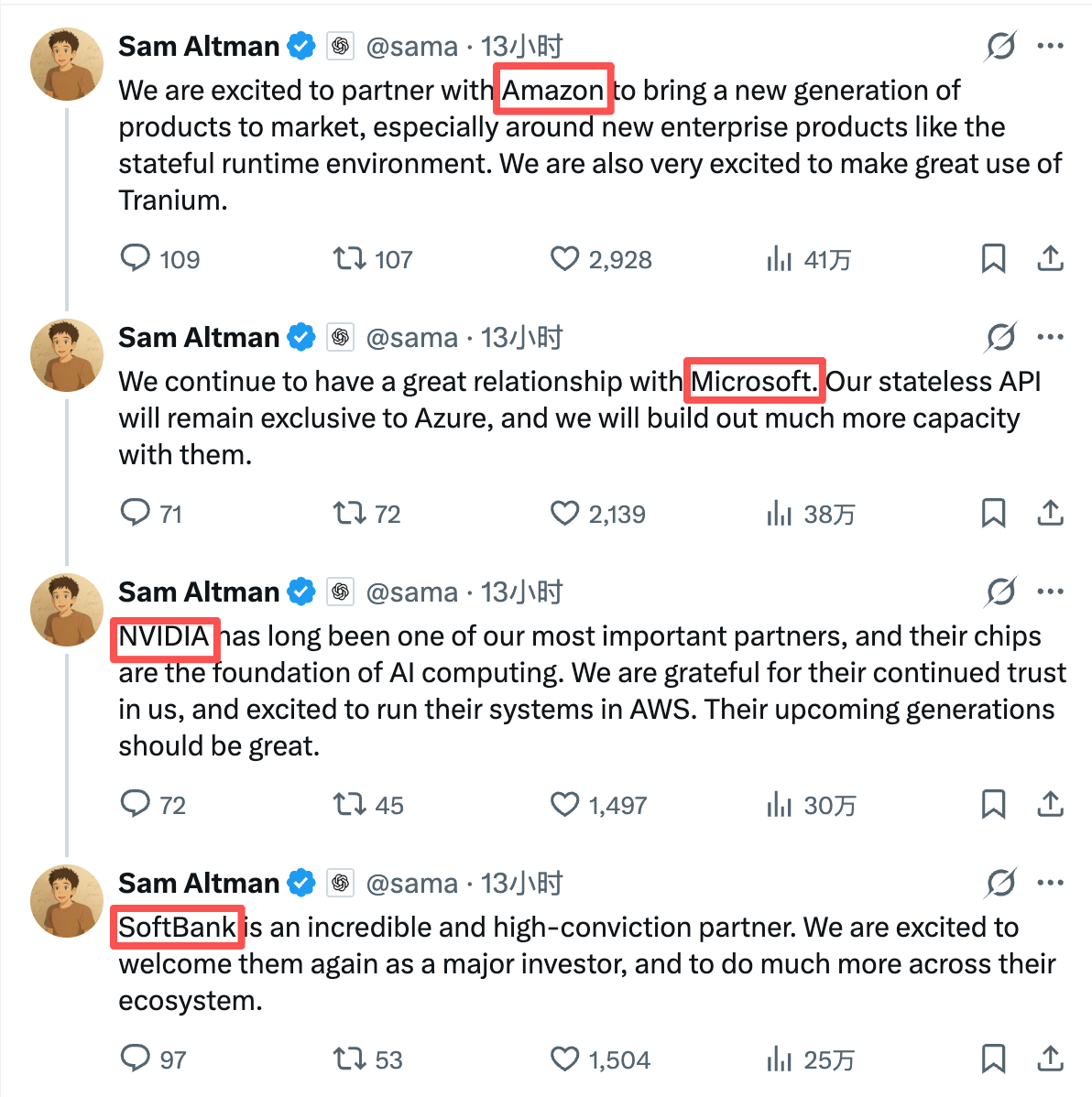
Aakash Gupta, an overseas blogger who has long followed the AI sector, pointed out that while most people are focused on the astronomical figure of $110 billion, the most critical piece of information in Sam Altman's statement lies in two overlooked technical terms: "Stateless API" and "Stateful Runtime Environment," which were attributed to Microsoft and Amazon, respectively.

Behind the Technical Terms: The Present and Future of AI

The core difference between Stateless API and Stateful Runtime Environment lies in the two words: "Stateless" and "Stateful".

The "Stateless" nature of a Stateless API means that the server does not maintain persistent state across requests — one call completes one inference; you ask a question, the AI answers, and after the lifecycle of this request ends, the system does not retain context or continue running. The "Stateful" nature of a Runtime Environment, on the other hand, implies a persistent execution environment — the Agent has historical memory, can persist, collaborate across tasks, and perform tasks over the long term.

Stateless API is currently the mainstream form of LLM commercialization. Industries such as finance, retail, manufacturing, and healthcare mostly integrate AI in this form to embed it into existing systems (e.g., various Q&A assistants, document summarization, search enhancement, etc.). The advantage of this model is that enterprises can quickly overlay AI capabilities into their existing architecture with minimal friction, achieving functional optimization without significant restructuring of organization and processes. However, as model capabilities converge, computing power costs continue to decrease, and price competition intensifies, the token-based billing of Stateless APIs is more likely to become standardized and commoditized, with marginal profits facing ongoing compression.

In contrast, Stateful Runtime Environment currently has limited commercial scale, but it represents not just simple "functional optimization" but a shift in business paradigm — it is not only able to answer questions but can also be seen as a digital workforce to concretely execute tasks. This means that the budget it touches will extend from mere interface call fees to automation, process management, and even part of the labor costs. Because of this, the market's expectations for Stateful Runtime Environment are far higher than its current scale.

Aakash Gupta also stated on this matter that in 2026 and 2027, almost all enterprise roadmaps will revolve around "autonomous agent workflows," not one-off API calls. Companies that invest heavily in AI in the future will increasingly tend to purchase systems that can run sustainably, collaborate across tools, and maintain context over the long term.

To put it in the simplest terms: Stateless API represents the present, while Stateful Runtime Environment represents the future.

What Did Microsoft and Amazon Take, Respectively?

On the day the funding was completed, Microsoft and Amazon each announced their latest cooperation agreements with OpenAI.

Microsoft stated in its announcement that the terms of the partnership jointly announced by Microsoft and OpenAI in October 2025 would remain unchanged (the terms include OpenAI purchasing $250 billion worth of Azure services). Azure remains the exclusive cloud provider for OpenAI's Stateless API; any Stateless API calls to OpenAI models generated through cooperation with any third party (including Amazon) will be hosted on Azure; OpenAI's first-party products, including Frontier, will also continue to be hosted on Azure.

Amazon stated in its announcement that AWS and OpenAI will jointly build a Stateful Runtime Environment powered by OpenAI models and provide services to AWS customers through Amazon Bedrock, helping enterprises build generative AI applications and Agents at production scale; AWS will also become the exclusive third-party cloud distribution service provider for OpenAI Frontier; the existing $38 billion multi-year cooperation agreement between AWS and OpenAI will be expanded to $100 billion, with a term of 8 years. OpenAI will consume 2 GW of Trainium computing power through AWS infrastructure to support the needs of Stateful Runtime Environment, Frontier, and other advanced workloads; OpenAI and Amazon will also develop customized models that can be used to support Amazon's customer-facing applications.

Comparing the two announcements, the current situation becomes clear.

Microsoft, with its $250 billion agreement and exclusive service rights, has locked in the current traffic engine. As long as OpenAI's Stateless API is called, Azure will bill behind the scenes — regardless of who the customer is or where the channel is, the traffic will ultimately return to Azure. This is a highly certain cash flow, but the problem lies in the trend of shrinking profit margins for Stateless APIs; call volume may continue to grow, but actual profits may not necessarily remain stable in the long run.

On the other hand, Amazon, with its $50 billion in real money and a $100 billion expanded agreement, has secured the underlying hosting rights for the AI Agent era for AWS. Once Agents become the core carriers of enterprise productivity, the resources that are truly consumed over the long term — computing power, storage, scheduling systems, workflow orchestration, and cross-tool collaboration — will all be deposited on AWS's runtime environment.

One controls the current cash flow; the other bets on the future structure of productivity.

OpenAI's Diversified Bet

Before the future truly arrives, no one knows whether Microsoft's or Amazon's choice is correct. But what is certain is that under these two clearly defined cooperation agreements with explicit interest divisions, OpenAI's initiative is significantly increasing.

Over the past few years, OpenAI has been highly dependent on Microsoft for cloud infrastructure. Microsoft is not only a major shareholder holding 27% of the shares but also the controller of the infrastructure. This binding brought effective early-stage resource advantages to OpenAI, but it also meant that the balance of bargaining power would naturally tilt toward Microsoft. With Amazon's strong entry, it and Microsoft are bound to engage in direct competition to seize the future service rights of OpenAI.

For OpenAI, this is a typical diversified betting strategy — not deeply binding with any single cloud service provider, not letting future growth be entirely constrained by one party, and using future business as a bargaining chip to obtain better terms.

Neither Microsoft nor Amazon can afford to give up OpenAI at present. When neither can leave the table, bargaining power naturally returns to OpenAI's hands.


Related Questions

QWhat is the core difference between Stateless API and Stateful Runtime Environment in the context of AI?

AStateless API refers to a server-side service that does not retain persistent state across requests—each call completes one inference, and the system does not retain context or continue running after the request lifecycle ends. Stateful Runtime Environment, on the other hand, involves a persistent execution environment where AI agents have historical memory, can exist continuously, collaborate across tasks, and perform long-term tasks.

QWhich companies invested in OpenAI's latest $110 billion funding round, and what were their respective contributions?

AAmazon invested $50 billion ($15 billion initially, with the remaining $35 billion to be delivered over the coming months upon meeting specific conditions), Nvidia invested $30 billion (which will be recouped through the procurement of a total of 5 GW of computing power), and SoftBank also invested $30 billion.

QWhat did Microsoft secure in its agreement with OpenAI regarding Stateless API?

AMicrosoft secured Azure as the exclusive cloud provider for OpenAI's Stateless API. Any Stateless API calls to OpenAI models generated through cooperation with any third party, including Amazon, will be hosted on Azure. OpenAI's first-party products, including Frontier, will also continue to be hosted on Azure.

QWhat did Amazon obtain through its expanded agreement with OpenAI, particularly in relation to Stateful Runtime Environment?

AAmazon obtained a partnership with OpenAI to jointly build a Stateful Runtime Environment powered by OpenAI models, which will be provided to AWS customers via Amazon Bedrock. AWS also became the exclusive third-party cloud distribution service provider for OpenAI Frontier. The existing $38 billion multi-year cooperation agreement was expanded to $100 billion over 8 years, with OpenAI consuming 2 GW of Trainium computing power through AWS infrastructure to support Stateful Runtime Environment, Frontier, and other advanced workloads.

QHow does OpenAI's strategy of engaging with both Microsoft and Amazon reflect its approach to future growth and bargaining power?

AOpenAI's strategy reflects a分散押注 (diversified betting) approach. By not deeply binding with any single cloud service provider and avoiding complete dependence on one party for future growth, OpenAI uses its future business as a bargaining chip to secure more favorable terms. As both Microsoft and Amazon are unwilling to withdraw from the partnership, bargaining power naturally returns to OpenAI.

Related Reads

Coinbase Vice President: The Wars Over Cryptocurrency Regulation Are Over

Coinbase's new Vice President, Ryan VanGrak, declared that regulatory wars in the cryptocurrency sector are over. Since taking office on July 9, 2026, he has shifted the company's approach from litigation and sanctions to focusing on growth and innovation. The industry can now concentrate on development rather than fighting for its right to exist. He highlighted that the Digital Asset Market Clarity Act (CLARITY Act), which aims to establish a clear federal regulatory framework dividing oversight between the SEC and CFTC, has gained significant momentum. This framework is intended to provide proper supervision, investor protection, and maintain U.S. leadership in digital assets. VanGrak's appointment marks a strategic shift from a "wartime" to a "peacetime" advisor, replacing former Chief Legal Officer Paul Grewal, who oversaw major litigation, including a dismissed 2023 SEC lawsuit. With his background at Citadel Securities and the SEC, VanGrak brings deep regulatory and institutional finance expertise as Coinbase expands beyond a simple exchange into a broader financial services provider, offering stocks, futures, prediction markets, and AI tools. For investors, bipartisan support for crypto legislation like the CLARITY Act represents a major shift from the enforcement-focused environment of 2023-2024. Lawmakers are now focused on *how* to regulate crypto, not *if* it should exist. However, risks remain, as the bill's passage is not yet guaranteed.

cryptonews.ru37m ago

Coinbase Vice President: The Wars Over Cryptocurrency Regulation Are Over

cryptonews.ru37m ago

Deep Dive into FWA: An Intriguing Experiment Turning NFTs into "On-Chain Gachapon"

A Deep Dive into FWA: The “On-Chain Gacha” Experiment for NFTs Fake World Assets (FWA), created by TokenWorks, introduces an innovative “NFT gacha machine” fully operating on-chain. Users can deposit eligible NFTs paired with ETH (called Backing) to create a Position, acting as a prize pool. Others can then pay a uniform Acquisition Price for a chance to win a random NFT from the pool. The core mechanism features a reverse probability system: Positions with lower Backing have a higher chance of being selected, serving as common prizes, while high-Backing Positions are rare “jackpots.” The acquisition price is calculated based on the harmonic mean of all Backings, keeping entry costs low. When a Position is won, the purchaser must choose: keep the NFT or accept the Standing Bid (85% of the Backing, claimable in ETH or $FWA tokens), returning the NFT to the original depositor. The protocol involves two main roles. Depositors provide liquidity (NFT + ETH), earning a share of fees from each draw, distributed equally per active Position, plus potential $FWA rewards. Purchasers pay to spin the gacha, receiving $FWA rewards for participation. A special “Crown” reward goes to the Position with the highest Backing. The $FWA token has a fixed supply and is initially obtainable only through protocol participation (depositing or purchasing), with external buying disabled early on to reduce sell pressure. Its value is supported by a built-in buy pressure: when purchasers opt for the $FWA settlement on a Standing Bid, the protocol uses the backing ETH to buy $FWA from the market. Revenue for the protocol comes from a 1% fee on each draw, a 1% settlement fee when an NFT is kept, and the 15% discount from Standing Bid settlements (currently allocated to the protocol). The design cleverly blends Uniswap-style liquidity provision, gacha mechanics, and tokenomics to create a novel, self-regulating marketplace for NFT liquidity and engagement.

marsbit51m ago

Deep Dive into FWA: An Intriguing Experiment Turning NFTs into "On-Chain Gachapon"

marsbit51m ago

10,000 Scientists Get 1 Year of Free Access: OpenAI Brings the Scientific Research Pipeline into ChatGPT

OpenAI has launched the "ChatGPT for Academic Researchers" program, offering free one-year access to its flagship models for 100,000 university researchers globally, with 10,000 spots available this summer. Selected institutions include prestigious centers like ENS Paris and the IAS at Princeton. The initiative provides an integrated research workspace within ChatGPT, bundling tools like ChatGPT, ChatGPT Work, and Codex, along with expanded Deep Research capabilities, higher usage limits, and specialized tools for life sciences. The suite connects to platforms like Zotero and GitHub, aiming to streamline the entire research workflow from literature review and coding to data analysis and manuscript drafting. OpenAI notes that about 1.3 million people already use ChatGPT weekly for advanced science and math. The program targets building long-term user dependency by embedding these tools into daily research habits. However, access comes with limitations: it does not include API credits or model weights, and eligibility is restricted to verified academic researchers from supported countries. This approach contrasts with Anthropic's "AI for Science" program, which offers API credits but not an integrated workspace. Both companies emphasize preventing misuse by withholding model weights, a point of contention for AI researchers seeking transparency. The core strategy remains clear: provide a powerful, integrated environment to foster user reliance ahead of the post-free period.

marsbit56m ago

10,000 Scientists Get 1 Year of Free Access: OpenAI Brings the Scientific Research Pipeline into ChatGPT

marsbit56m ago

What's Going On with Gigadevice? Major Shareholder Cashes Out 44 Billion, Then Announces 20 Billion Buyback

Gigadevice Innovation, a leading Chinese memory chip company, has executed a controversial financial maneuver. The company's controlling shareholder and chairman, Zhu Yiming, sold approximately 44 billion RMB worth of his shares between early May and mid-June 2026, capitalizing on a soaring stock price that peaked at 846.66 RMB on June 29th. Following a subsequent stock crash—plummeting to around 350 RMB in 22 trading days and erasing over 330 billion RMB in market value—Zhu announced a combined "market rescue" plan on July 29th. This plan includes his personal commitment to buy back at least 1 billion RMB in shares and a company proposal to repurchase 1 to 2 billion RMB worth of stock. This sequence of high-selling followed by a low-buying plan has confused and unsettled many of the company's 240,000 retail investors. The stock's dramatic decline was attributed to several factors: the successful IPO of its sister company, Changxin Technologies, which ended Gigadevice's status as a primary investment proxy for the domestic memory sector; a Morgan Stanley report warning of a potential peak in the memory chip cycle; and a severe loss of market confidence triggered by the chairman's massive sell-off. While the sell-off was procedurally compliant, its timing has been criticized. The company's fundamentals appear strong, with preliminary H1 2026 results showing revenue up 177% year-on-year to 11.5 billion RMB and net profit skyrocketing 1099% to 6.9 billion RMB, driven by a boom in memory chips and MCU demand. However, a significant portion (2.05 billion RMB) of this profit came from non-recurring gains like securities investment, and the memory industry is notoriously cyclical. Analysts highlight the company's role in the domestic substitution of niche DRAM and NOR Flash memory, with some maintaining bullish price targets. Yet, the recent events underscore key risks: its fabless model creates dependency on foundries like Changxin, and the chairman's actions have raised serious questions about management's alignment with minority shareholders. The promised buybacks cannot commence until December 13th due to a mandatory six-month cooling-off period following an insider sale, leaving the stock vulnerable in the interim.

marsbit56m ago

What's Going On with Gigadevice? Major Shareholder Cashes Out 44 Billion, Then Announces 20 Billion Buyback

marsbit56m ago

Trading

Spot
活动图片