Before Buying the Dip, Understand the Two Types of Market Drawdowns

比推Published on 2026-02-13Last updated on 2026-02-13

Abstract

The article distinguishes between two types of stock drawdowns: systemic (market-driven) and idiosyncratic (company-specific). Systemic drawdowns, like the 2008 financial crisis, affect the entire market and can be navigated with behavioral advantages such as patience, as markets tend to recover. Idiosyncratic drawdowns, such as the recent AI-driven sell-off in software stocks, require analytical advantages—investors must accurately assess whether a company’s long-term prospects remain intact despite market pessimism. Using FactSet as an example, the author emphasizes that investors must differentiate between temporary panic and fundamental erosion of a company’s competitive moat. Relying solely on behavioral strategies for idiosyncratic risks is inadequate; deep analysis is essential to avoid mistaking arrogance for conviction.

Author: Todd Wenning

Compiled by: Deep Tide TechFlow

Original title: Before Buying the Dip, Understand the Two Types of Market Drawdowns


Deep Tide Introduction: Academic financial theory categorizes risk into systemic risk and idiosyncratic risk. Similarly, stock drawdowns can also be divided into two types: market-driven systemic drawdowns (such as the 2008 financial crisis) and company-specific idiosyncratic drawdowns (such as the current AI-induced software stock crash).

Todd Wenning uses FactSet as an example to point out: during systemic drawdowns, you can leverage behavioral advantages (patiently waiting for the market to recover); but during idiosyncratic drawdowns, you need analytical advantages—having a more accurate vision of the company's future a decade from now than the market does.

Amid the current AI impact on software stocks, investors must distinguish: is this a temporary market panic, or is the moat truly collapsing?

Do not use a blunt behavioral solution to solve a problem that requires nuanced analysis.

Full text below:

Academic financial theory posits two types of risk: systemic and idiosyncratic.

  • Systemic risk is unavoidable market risk. It cannot be eliminated through diversification, and it is the only type of risk for which you are compensated.

  • On the other hand, idiosyncratic risk is company-specific risk. Because you can cheaply purchase a diversified portfolio of uncorrelated businesses, you are not compensated for taking on this risk.

We can discuss Modern Portfolio Theory another day, but the systemic-idiosyncratic framework is very helpful for understanding different types of drawdowns (the percentage decline from peak to trough of an investment) and how we as investors should evaluate opportunities.

From the moment we picked up our first value investing book, we were taught to take advantage of a despondent Mr. Market when stocks are being sold off. If we remain calm while he loses his senses, we will prove ourselves to be stoic value investors.

But not all drawdowns are the same. Some are market-driven (systemic), while others are company-specific (idiosyncratic). Before you make a move, you need to know which type you are looking at.
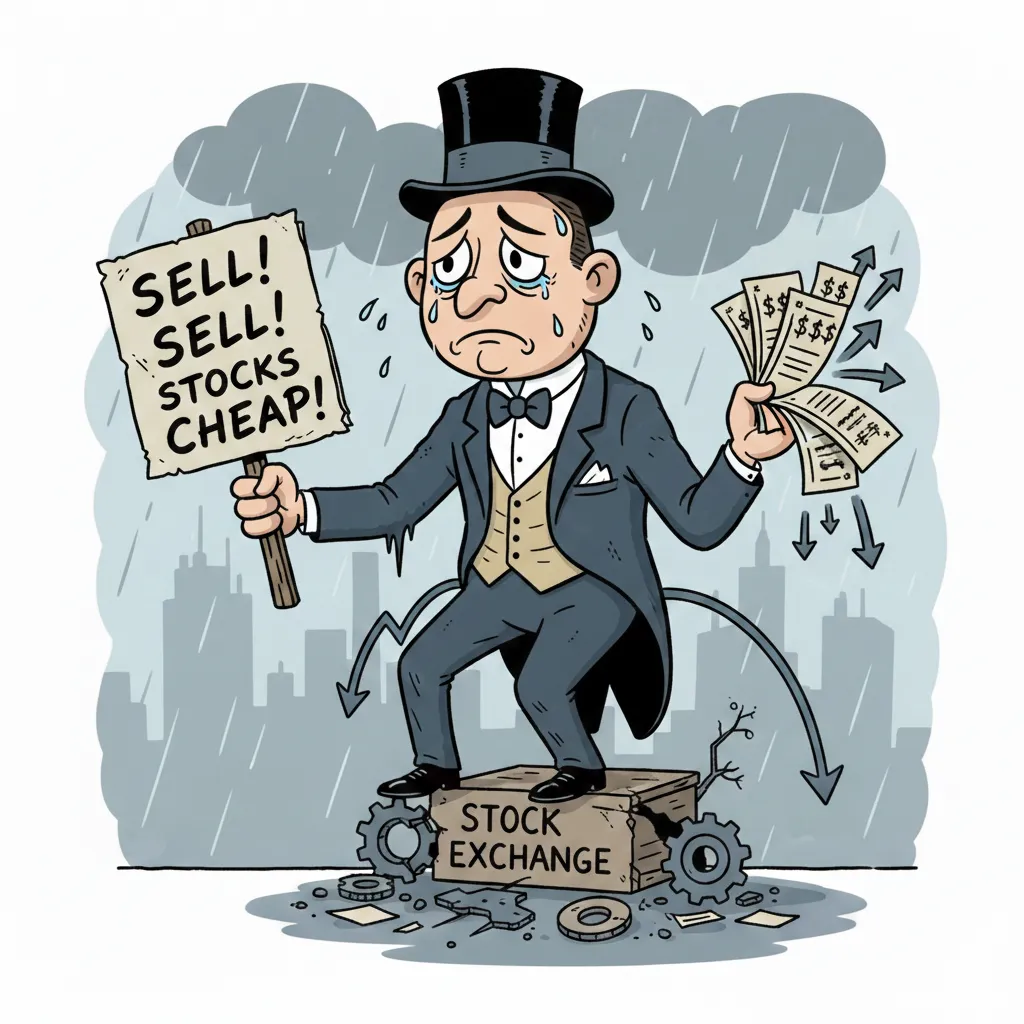
Generated by Gemini

The recent sell-off in software stocks due to AI concerns illustrates this point. Let's look at the 20-year drawdown history between FactSet (FDS, blue) and the S&P 500 (measured via the SPY ETF, orange).
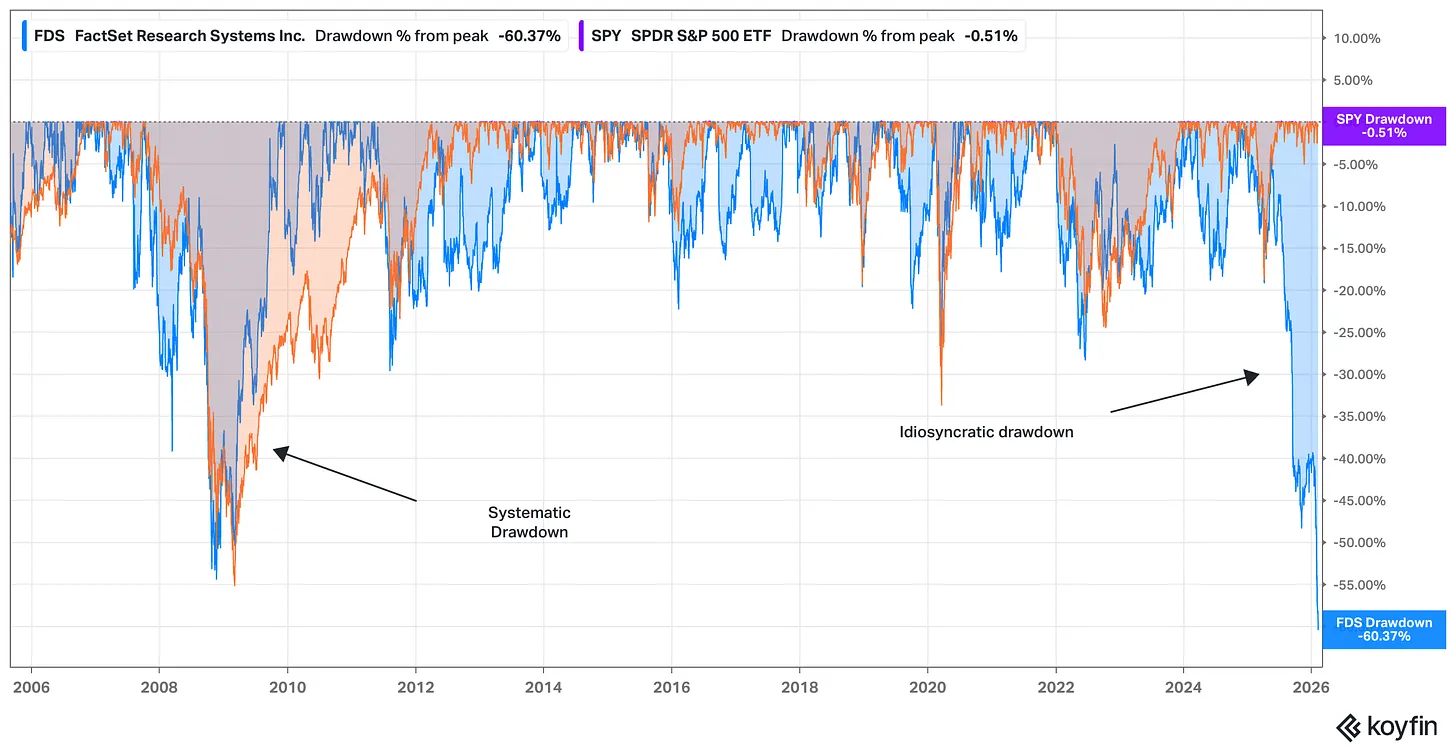
Source: Koyfin, as of February 12, 2026

FactSet's drawdown during the financial crisis was primarily systemic. In 2008/09, the entire market was worried about the durability of the financial system, and FactSet could not be immune to these concerns, especially since it sells products to financial professionals.

At that time, the stock's drawdown had less to do with FactSet's economic moat and more to do with whether that moat would matter if the financial system collapsed.

The 2025/26 FactSet drawdown is the opposite case. Here, the concerns are almost entirely focused on FactSet's moat and growth potential, along with widespread worries about accelerating AI capabilities disrupting pricing power in the software industry.

In systemic drawdowns, you can more reasonably make time arbitrage bets. History shows that markets tend to rebound, and companies with strong moats may emerge even stronger than before. So, if you are willing and able to remain patient while others panic, you can leverage a strong appetite to exploit behavioral advantages.

Photo by Walker Fenton on Unsplash

However, in idiosyncratic drawdowns, the market is telling you that something is wrong with the business itself. Specifically, it suggests increasing uncertainty about the business's terminal value.

Therefore, if you hope to take advantage of an idiosyncratic drawdown, you need analytical advantages in addition to behavioral ones.

To succeed, you need to have a more accurate vision of what the company will look like a decade from now than what the current market price implies.

Even if you know a company well, this is not easy to do. Stocks don't typically fall 50% relative to the market for no reason. Many once-stable holders—even some investors you respect for their deep research—had to capitulate for this to happen.

If you are going to step in as a buyer during an idiosyncratic drawdown, you need to have an answer for why these otherwise well-informed and thoughtful investors who sold were wrong, and why your vision is correct.

There is a fine line between conviction and arrogance.

Whether you are holding a stock in a drawdown or looking to initiate a new position in one, it's important that you understand what type of bet you are making.

Idiosyncratic drawdowns can tempt value investors to start looking for opportunities. Before you venture in, make sure you are not using a blunt behavioral solution to solve a problem that requires nuanced analysis.

Stay patient, stay focused.

Todd


Twitter:https://twitter.com/BitpushNewsCN

BitPush TG Discussion Group:https://t.me/BitPushCommunity

BitPush TG Subscription: https://t.me/bitpush

Original article link:https://www.bitpush.news/articles/7611840

Related Questions

QWhat are the two types of risk identified in academic financial theory, and how do they differ?

AThe two types of risk are systemic risk and idiosyncratic risk. Systemic risk is unavoidable market risk that cannot be eliminated through diversification and is the only type of risk for which investors are compensated. Idiosyncratic risk is company-specific risk that can be mitigated through a diversified portfolio of uncorrelated businesses, and investors are not compensated for taking on this risk.

QHow should an investor approach a systemic drawdown versus an idiosyncratic drawdown?

AIn a systemic drawdown, an investor can leverage a behavioral advantage by being patient and waiting for the market to recover, as history shows markets tend to rebound. In an idiosyncratic drawdown, an investor needs an analytical advantage—a more accurate vision of what the company will look like in ten years than what the market currently implies—because the issue is specific to the company's fundamentals.

QWhat example does Todd Wenning use to illustrate the difference between systemic and idiosyncratic drawdowns?

ATodd Wenning uses FactSet (FDS) as an example. The drawdown during the 2008/09 financial crisis was primarily systemic, driven by broad market fears about the financial system. The drawdown in 2025/26 was idiosyncratic, caused by specific concerns about FactSet's moat and growth potential due to AI disrupting the software industry.

QWhat is the author's warning about using behavioral solutions for idiosyncratic drawdowns?

AThe author warns against using a blunt behavioral solution, like simply buying during a sell-off, to address an idiosyncratic drawdown, which requires nuanced analysis. Investors must ensure they have a clear analytical edge and understand why informed sellers are wrong, rather than relying solely on patience or market recovery.

QAccording to the article, what must an investor have to successfully capitalize on an idiosyncratic drawdown?

ATo successfully capitalize on an idiosyncratic drawdown, an investor needs an analytical advantage—a well-reasoned vision of the company's future that is more accurate than the market's current assessment. They must also understand why other informed investors sold and be able to justify why their perspective is correct, balancing conviction without crossing into arrogance.

Related Reads

AI "Transfer Station" Earning Millions Monthly? Five Questions Uncover the Truth of Token Arbitrage

The article "AI 'Transfer Station' Earns Millions Monthly? Five Questions Uncover the Truth of Token Arbitrage" explores the emerging business of API token transfer stations, which profit from global AI service price disparities and access barriers. These intermediaries purchase low-cost tokens from overseas AI providers (e.g., OpenAI, Claude) through grey-market methods—such as exploiting enterprise credits, bulk accounts, or subscription benefits—and resell them to Chinese users at a markup. Key drivers include the high cost of using top AI models (e.g., Claude Code costs ~$5 per million tokens), the performance gap between domestic and foreign models, and mismatches between subscription and API pricing. However, the practice carries significant risks: upstream token sources may be unstable or illegal; user data passing through intermediaries can be harvested or injected with hidden prompts; and models might be downgraded without disclosure. The market is evolving, with some operators now exporting cheaper Chinese models (e.g., Qwen3.5 at ~$0.11 per million tokens) to overseas users, leveraging price gaps. Yet, sustainability is low due to compliance crackdowns, instability, and reputational risks. Users are advised to employ detection methods (e.g., prompt adherence tests) and avoid sensitive data usage. The authors caution that while transfer stations offer short-term arbitrage, they lack long-term reliability and security compared to official APIs.

marsbit9m ago

AI "Transfer Station" Earning Millions Monthly? Five Questions Uncover the Truth of Token Arbitrage

marsbit9m ago

The Cost of an 11.5% Annualized Return: Will MicroStrategy's STRC Face a Moment of Reckoning?

This article analyzes the potential risks associated with MicroStrategy's (MSTR) use of structured financial products like STRC to leverage its BTC exposure. While these tools have enabled impressive returns (e.g., 11.5% annualized) and fueled significant capital inflows ($13.5B outstanding), they also create substantial annual dividend obligations (~$400M). The author argues that this structure, while effective in a bull market, could become a liability if BTC price stagnates or declines. The core risk is a potential negative feedback loop: the growing dividend burden from continued STRC issuance may eventually outweigh the benefits of increased BTC holdings. To meet these obligations, MicroStrategy might need to use new issuance proceeds for dividends instead of buying more BTC, which could disappoint equity investors. If the market capitalization (mNAV) falls below the value of its BTC holdings, the company could be forced to sell BTC instead of issuing new shares, potentially triggering a panic. The author estimates a potential inflection point in 6 months, where annual dividend costs reach $3-4B. At that stage, CEO Michael Saylor might face a difficult choice: sell BTC to meet obligations or sacrifice the credibility of the preferred shares by halting dividends. The article concludes that this financial engineering, while powerful, could ultimately "backfire" on MicroStrategy if market conditions turn.

marsbit1h ago

The Cost of an 11.5% Annualized Return: Will MicroStrategy's STRC Face a Moment of Reckoning?

marsbit1h ago

Trading

Spot
Futures
活动图片