Beaten SK Hynix Employees in China: Year-end Bonus Less Than 5% of Korean Staff's

链捕手Published on 2026-05-11Last updated on 2026-05-11

Abstract

"SK Hynix Chinese Staff Hit Hard: Bonuses Less Than 5% of Korean Counterparts" Driven by the AI boom, South Korea's SK Hynix is experiencing record performance, with media reports predicting massive year-end bonuses for its employees, making them highly desirable in the matchmaking market. However, this prosperity starkly contrasts with the situation for the company's Chinese employees. According to reports, SK Hynix operates under a rule allocating 10% of operating profit for employee bonuses. While projections suggest Korean employees could receive bonuses reaching millions of RMB, a Chinese employee with over a decade of technical experience revealed the disparity: "If they get 3 million, Chinese staff get less than 5% of that." After adjustments based on KPI ratings, this employee's highest bonus was slightly over 100,000 RMB. Bonuses are paid annually in Korea but semi-annually in China. During the industry downturn in 2023-2024, Chinese employees received no bonus at all. The gap extends beyond bonuses. Recruitment posts for SK Hynix's Chinese factories (in Wuxi, Dalian, Chongqing) show engineer monthly salaries ranging from 10,000 to 35,000 RMB, with a 13th-month salary promised. Chinese employees also receive standard benefits like annual leave but lack stock incentives, which are reportedly unavailable to them. Furthermore, management positions in China are predominantly held by Korean personnel, though industry observers note a gradual increase in local middle ma...

Original Text by Su Yang

Edited by Xu Qingyang

The market capitalization keeps hitting new highs at SK Hynix, with "year-end bonus predictions" adding another layer of drama to the red-hot memory chip industry.

Recently, reports suggest that driven by surging AI-fueled memory demand, SK Hynix, a core memory supplier from South Korea, could see its operating profit ceiling potentially reach 250 trillion won in 2026. Following a 10% profit-sharing rule, the maximum per capita year-end bonus could exceed 3 million RMB.
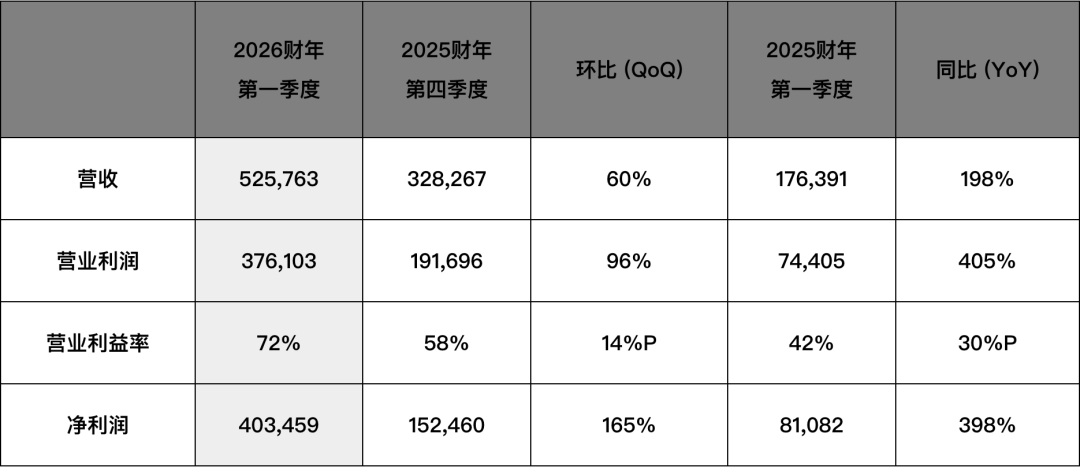
SK Hynix Performance Data

South Korean media, citing matchmaking agencies, claim that "SK Hynix employees are now unconditionally matched with 'A-grade' partners in the blind date market." Variety shows even joke that SK Hynix's company vests are "stuffed with gold."

Investment bank Macquarie Securities predicts that SK Hynix's operating profit could reach 447 trillion won in 2027. If the profit-sharing rule remains unchanged, per capita bonuses distributed in 2027 could be around 1.29 billion won, nearly 6.1 million RMB.

In its response to *First Finance*, SK Hynix confirmed the authenticity of the 10% profit-sharing rule, while emphasizing that as the 2026 and next year's annual performances are not yet finalized, the bonus scale cannot be predicted, tactfully denying the accuracy of the 6.1 million RMB bonus package.

The high year-end bonus predictions may not be entirely accurate, but a significant disparity in bonuses between Chinese and Korean employees does exist.

"We have removed the bonus cap, but domestic bonuses just don't go up," said a Chinese employee of SK Hynix. "Korean staff have one settlement per year, while in China it's twice a year."

The employee revealed that if Korean staff receive a 3 million RMB bonus, Chinese employees get less than 5% of that, roughly translating to 150,000 RMB. "It's not that every one of us gets 150,000. The bonus is adjusted based on KPI ratings. The higher the rating, the higher the bonus. At best, I've received a little over 100,000."

This employee has been with SK Hynix for over a decade and has a technical background.

In the memory chip industry's super cycle, the expectation of huge year-end bonuses has sparked media reports that memory chip jobs have surpassed doctors and lawyers as the most favored profession by mothers-in-law in South Korea's blind date market.

However, compared to the current fervor, the memory industry downturn was a completely different story.

In fiscal year 2023, during the global semiconductor industry's "winter," SK Hynix's total annual revenue fell approximately 27% to 32.77 trillion won, with a net loss of 9.14 trillion won. "The lowest point was around 2023 and 2024. There was no bonus; it was zero," disclosed the aforementioned Chinese SK Hynix employee.

Regarding the trending topic of "3 million+ and 6 million+ per capita year-end bonuses," multiple industry insiders have raised doubts, emphasizing that the per capita figure is not a good reference.

"It's possible as an average, but definitely not 3 million for everyone. Executives get more, engineers get tens of thousands, and factory workers getting 100,000 RMB is already good," said a semiconductor industry professional. "Take TSMC engineers as an example; it's possible to earn around 1 million RMB a year in total."

"I just look at my income, then look at what's being posted online. The numbers are way too far apart," the Chinese SK Hynix employee explained the difference in year-end bonuses between Chinese and Korean staff: "Their (Korean staff) monthly salaries are high, and bonuses are distributed as a percentage of their 12-month salary."

Currently, SK Hynix mainly has three factories in mainland China, located in Wuxi, Dalian, and Chongqing. The Wuxi factory focuses on DRAM business; the Dalian factory was formed after acquiring Intel's assets and is now Solidigm's NAND factory; and the Chongqing factory is a packaging and testing base. Sales companies providing technical support are also present in Shenzhen, Beijing, and Shanghai.
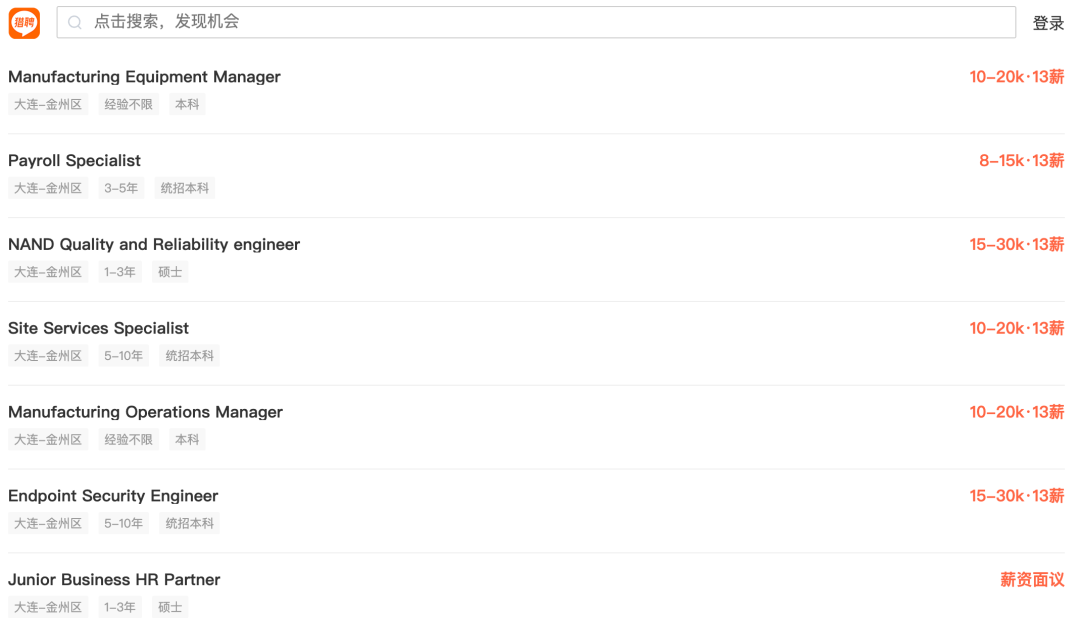
According to recruitment information for the Dalian factory posted on Liepin.com, related engineer positions generally offer monthly salaries in the 10,000 to 30,000 RMB range, promising a 13th-month salary, while senior engineer positions can go up to 35,000 RMB per month.

Besides salary, SK Hynix also provides standard benefits like annual leave for Chinese employees; for instance, support roles like sales don't require overtime work, but stock-based incentives are not offered.

"Management staff have it, but they are all Koreans. Chinese cannot be in management," emphasized the Chinese SK Hynix employee.

Several former employees of Korean companies stated that their firms basically do not offer stock incentives to Chinese employees. In the view of a former Samsung employee, the Chinese entity is more like a sales arm, similar to a national-level agency concept.

"Now there are also mainland Chinese entering middle management. TSMC is the same," said Wu Zihao, former TSMC plant construction expert and CEO of Ronghe Semiconductor Consulting. "It's normal for Korean factories to have more Koreans and prioritize their use. As operations in mainland China continue, local management personnel will also emerge; it's not that absolute."

Judging from industry and corporate forecasts, memory will remain a hot topic for the next 2-3 years, with "marriage jokes" and "work vest jokes" continuing to appear.

At the Q1 earnings call, SK Hynix's CFO indicated that for the next three years, demand represented by HBM will likely continue to outstrip supply, and growth will revolve around B2B demand, a signal also reflected in SK Hynix's official press release.

SK Hynix stated: "Despite the first quarter typically being a seasonally slow period, strong market demand continued, driven by expanding investments in artificial intelligence (AI) infrastructure. By expanding sales of high value-added products such as High Bandwidth Memory (HBM), high-capacity server DRAM modules, and enterprise solid-state drives (eSSD), the company sustained its upward performance momentum."

In summary, these are all typical B2B customer demands.

This implies that if memory makers like SK Hynix do not increase capacity support for consumer-grade products, the previously discussed topic of memory price hikes will continue to impact consumer products, driving a wave of price increases, and "electronic gold" will continue to trouble PC enthusiasts.


Trending Cryptos

Related Questions

QWhat is the rumored maximum year-end bonus for SK Hynix Korean employees in 2027 according to the article?

AThe article states that based on predictions by Macquarie Securities, if SK Hynix's operating profit reaches 447 trillion won in 2027 with the 10% dividend rule unchanged, the per capita bonus could be about 12.9 billion won, which is close to 6.1 million RMB.

QHow does the year-end bonus for Chinese employees of SK Hynix reportedly compare to that of their Korean counterparts?

AAccording to a Chinese employee cited in the article, the bonus for Chinese employees is less than 5% of what Korean employees receive. For example, if Korean employees receive a 3 million RMB bonus, Chinese employees would get less than 150,000 RMB, adjusted based on their KPI ratings.

QWhat are the main reasons given in the article for the disparity in bonuses between Chinese and Korean SK Hynix employees?

AThe article mentions two main structural differences: Korean employees receive their bonus once a year based on 12 months of salary, while Chinese employees receive it twice a year. Additionally, Korean employees typically have higher base salaries, which forms the basis for the bonus calculation.

QWhat was the financial performance of SK Hynix during the semiconductor industry's 'winter period' in the 2023 fiscal year?

AIn the 2023 fiscal year, SK Hynix's total annual revenue decreased by approximately 27% to 32.77 trillion won, and the company reported a net loss of 9.14 trillion won. During this downturn, some employees reportedly received no bonus.

QAccording to the article, what is SK Hynix's outlook for the HBM (High Bandwidth Memory) market in the coming years?

ABased on statements from SK Hynix's CFO in a quarterly earnings meeting, the company believes that for the next 2-3 years, demand for HBM and related products will likely continue to exceed supply. This growth is expected to be driven primarily by business-to-business (to B) demand, such as from AI infrastructure investments.

Related Reads

Fixed Supply + Institutional Frenzy, After Bitcoin's 50% Plunge, Will It Replicate Gold's 'Explosive' Run from 20 Years Ago?

"Fixed Supply & Institutional Craze: Bitcoin's Potential to Mirror Gold's 'Explosive' Price Rally of Two Decades Ago After a 50% Crash?" Despite a challenging period in 2026 where Bitcoin fell over 50% from its late 2025 peak above $126,000, analysts see potential for a turnaround, drawing parallels to gold's performance after the launch of its ETFs. Bloomberg Intelligence senior ETF analyst Eric Balchunas suggests Bitcoin ETFs could follow a "roadmap" similar to gold ETFs over the past 22 years. Since their 2004 debut, gold ETFs have seen dramatic surges, painful drawdowns, and recoveries, ultimately driving gold's market capitalization near $28 trillion. Both assets are non-yielding stores of value driven purely by investor sentiment. Spot Bitcoin ETFs, launched in early 2024, rapidly became among the fastest-growing ETFs ever, marking Bitcoin's move into mainstream finance. However, this also introduced significant volatility, with concerns about potential large-scale ETF outflows interrupting rebounds. For instance, BlackRock's IBIT, a leading Bitcoin ETF, has sold nearly 100,000 Bitcoin recently to meet redemptions, though it still holds over 733,000. The core parallel lies in fixed supply meeting surging, albeit fickle, institutional demand. Balchunas notes that both gold and Bitcoin experienced explosive price moves when demand concentrated, but such demand often comes in waves. Industry observers believe Bitcoin's "digital gold" narrative, bolstered by halving cycles and growing institutional adoption through ETFs, supports long-term bullish prospects. While the path will be volatile, if Bitcoin captures even a fraction of gold's role as a store of value, its upside potential remains substantial.

marsbit4m ago

Fixed Supply + Institutional Frenzy, After Bitcoin's 50% Plunge, Will It Replicate Gold's 'Explosive' Run from 20 Years Ago?

marsbit4m ago

Starknet Launches Privacy-First Bitcoin strkBTC, Targeting Institutional On-Chain Finance

Starknet introduces strkBTC, a privacy-focused version of Bitcoin designed for institutional on-chain finance. As digital assets face increased scrutiny, two major challenges emerge: the public visibility of all transactions and the looming threat of quantum computing to current cryptographic signatures. Bitcoin, representing over 56% of the crypto market, highlights these issues most clearly. strkBTC, built on Starknet’s STRK20 privacy framework, allows Bitcoin to be used privately on-chain while maintaining compliance. It operates in two modes: a public mode like standard ERC-20 tokens, and a shielded mode that hides balances and transactions from public view. This addresses the need for confidentiality in institutional finance, similar to traditional markets’ private trading venues. A third-party auditor, Financial Privacy Inc, holds view keys for regulatory access when necessary. Additionally, Starknet is positioned ahead in quantum resistance. Its STARK-based proof system relies on hash functions rather than elliptic-curve cryptography, making it less vulnerable to quantum attacks. Starknet’s native account abstraction also allows easier migration to quantum-resistant signatures without protocol-level forks. The team has outlined a roadmap to achieve end-to-end quantum security before “Q-day,” though dependencies on Ethereum’s own migration remain. While strkBTC currently uses a trusted bridge consortium, Starknet plans to transition toward more trustless, Bitcoin-native verification over time. The initiative underscores a shift in on-chain finance beyond yield—prioritizing privacy, compliance, and long-term security for institutional adoption.

marsbit11m ago

Starknet Launches Privacy-First Bitcoin strkBTC, Targeting Institutional On-Chain Finance

marsbit11m ago

Bank of America Quietly Positions: Could $6 Trillion in Bank Deposits Flow into Stablecoins?

Bank of America has quietly made leadership appointments to accelerate its digital asset strategy, sparking discussion about a potential large-scale migration of bank deposits to stablecoins. Reports highlighted the bank naming Sonali Theisen, Kevin Milsom, and Adam Dixon to lead its global digital asset and AI platform, focusing on stablecoins, tokenized deposits, custody, and crypto settlement. This move revived a claim that $6 trillion in bank deposits could flow into stablecoins, a figure originally cited by Bank of America's CEO Brian Moynihan in January. However, he conditioned this shift on stablecoins being allowed to pay interest—a feature not permitted under the current GENIUS Act. The legislation's final rules are delayed, pushing its effective date to January 2027. Major banks are not waiting. JPMorgan and Citigroup are already piloting tokenized deposit services, and a consortium including Bank of America is building a shared tokenized deposit network targeting a 2027 launch. While some, like Pacemakers.io's Alessandro Hatami, remain skeptical of rapid bank collaboration, data shows significant institutional adoption. Stablecoin settlement volume hit $33 trillion in 2025, and analysts project the market could surpass $1 trillion by 2026. Despite a recent dip in crypto prices and stablecoin supply, the institutional push for real-world use cases continues. The race is on for January 2027, when the GENIUS Act takes effect, potentially reshaping the competition between traditional finance and digital assets.

Foresight News29m ago

Bank of America Quietly Positions: Could $6 Trillion in Bank Deposits Flow into Stablecoins?

Foresight News29m ago

Trading

Spot

Hot Articles

Discussions

Welcome to the HTX Community. Here, you can stay informed about the latest platform developments and gain access to professional market insights. Users' opinions on the price of S (S) are presented below.

活动图片