Based on a16z's Annual Predictions, Which Crypto Projects Are Worth Watching?

marsbitPublished on 2026-01-04Last updated on 2026-01-04

Abstract

Based on a16z's 2026 predictions, several key crypto sectors and projects are worth watching. 1. **Payments & Stablecoins**: Stablecoins are becoming the internet's settlement layer. Key projects include Circle (USDC) for regulatory compliance, m0 for zero-fee USDC issuance, Ether_fi and Plasma as crypto-native neobanks, and x402 for agent-native programmable payments. 2. **RWA & On-Chain Credit**: The focus shifts from tokenization to native on-chain credit origination for efficiency. Projects to watch: Centrifuge, Blackrock's BUIDL, Maple, Plume, Pendle, Ondo, and Backed. 3. **AI Agents & Payments**: As autonomous AI agents transact, payments must become internet-native, instant, and programmable. Key players: Catena (KYA standards), Nevermined (data markets), KiteAI, ASI, EigenCloud, Fetch, and x402 implementations. 4. **Privacy**: Privacy creates user lock-in and becomes a key moat. Projects: Aztec, Nillion, Arcium, Aleo, Walrus/Seal (Sui), Payy_link, Zcash, and Monero. 5. **Security**: The shift from "code is law" to "spec is law" requires runtime enforcement and continuous monitoring. Leaders: OpenZeppelin, Trailofbits, SpearbitDAO, Cyfrin, and Immunefi. 6. **Prediction Markets**: Evolving from niche betting to real-time information infrastructure. Top platforms: Polymarket, Kalshi, FractionAI, Opinion, and Myriad Markets. 7. **zkVMs & Verifiable Computation**: zkVMs are making verifiable computation a viable systems primitive. Key projects: RiscZero, Succinct, ...

Source: Stacy Muur

Compiled by: Ken, ChainCatcher

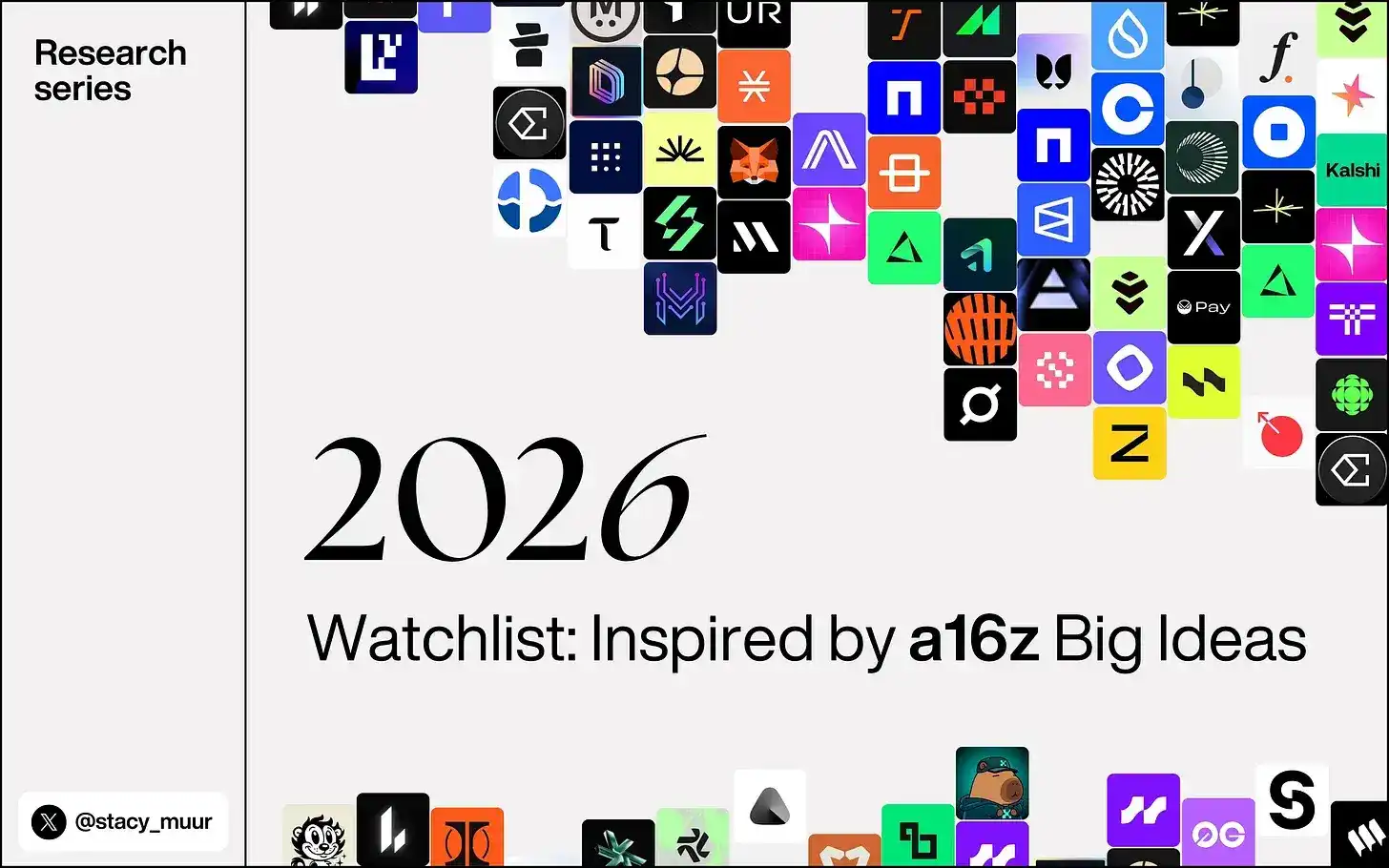
In mid-December, a16z released its annual "Big Ideas for 2026." Below is a watchlist organized according to the main theses in their vision.

1. Payments, Stablecoins, and the Reshaping of Financial Rails

Thesis: Stablecoins will become the settlement layer for the internet, not just for cryptocurrency.

The stablecoin story has moved past the proof-of-concept stage. Today, their annual transaction volume has reached trillions of dollars. The question is no longer whether stablecoins work, but whether they can integrate seamlessly with the real-world financial system.
Trending Cryptos

Related Questions

QAccording to a16z's 2026 predictions, what is the key argument regarding stablecoins and their role in the financial system?

AThe key argument is that stablecoins will become the settlement layer for the internet, not just for cryptocurrencies. They are seen as an upgrade to ledgers, offering real-time settlement, programmability, and global reach, which allows banks and fintech companies to integrate them without rewriting legacy software. The focus shifts from issuing stablecoins to distribution, compliance, and integration.

QWhat is the core insight from a16z regarding Real World Assets (RWA) and the next wave of adoption?

AThe core insight is that merely tokenizing existing off-chain assets is not enough. True efficiency gains come from moving the origination of assets on-chain. When loans are initiated on-chain, underwriting logic becomes programmable, servicing costs drop significantly, and risk can be priced and monitored in real-time. This transforms crypto from a distribution channel into financial infrastructure itself.

QHow does a16z's prediction frame the relationship between AI agents and payments on the internet?

AThe prediction argues that as AI agents begin to transact autonomously, payments can no longer be an external system bolted onto applications. They must be native to the internet: instant, programmable, and fully automated. The shift is from user-driven execution to intent-driven execution, where agents identify conditions, fulfill obligations, and trigger operations autonomously, making value transfer function like network traffic.

QWhy does a16z consider privacy to be a major moat in the context of public blockchains?

Aa16z's core insight is that block space has become commoditized, but confidentiality has not. If everything is public, users can migrate freely and liquidity can be bridged instantly, leading to applications competing in a zero-profit environment. Privacy breaks this symmetry. Once users or applications commit sensitive data to a privacy-preserving environment, switching costs are created, forming a 'privacy network effect' where the more activity there is in a private domain, the more value is locked in, making it riskier to leave due to potential information leakage.

QWhat is the fundamental shift in security philosophy that a16z predicts for 2026, moving away from 'code is law'?

Aa16z predicts a shift from 'code is law' to 'specification is law.' The new security philosophy moves beyond static audits to runtime enforcement of system-level invariants. Protocols will formally define rules that must always hold (e.g., collateral limits, value conservation, solvency conditions) and continuously enforce these properties, not just at deployment. This is achieved through runtime guards, formal specifications, AI-assisted verification, and continuous monitoring.

Related Reads

Intern, Earning 120,000 Monthly

An article titled "Intern, Monthly Income of 120,000 RMB" discusses the intense competition for top AI talent in China, highlighted by a viral social media post. A Tsinghua University student from the prestigious Yao Class reportedly received a staggering internship offer from the AI company DeepSeek with a daily salary of 5,500 RMB (pre-tax), translating to over 120,000 RMB per month. This case exemplifies the fierce "talent war" raging among major tech firms. Companies like DeepSeek, Huawei, Tencent, and ByteDance are aggressively recruiting interns and fresh graduates with unprecedented compensation packages, high conversion rates to full-time positions, and even company stock options for top performers like those in Moonshot AI's "Time Travel Plan." The trend shows recruitment starting earlier, even targeting high school students. The driving force is the belief that a few exceptional individuals can be pivotal in the AI race. Salaries for elite AI researchers have skyrocketed from around one million RMB annually to tens of millions. Young, highly-educated talents from top schools, seen as adaptable "AI Natives," are being placed at the forefront of core projects. Examples include Tencent appointing a 27-year-old former OpenAI researcher as its Chief AI Scientist. In essence, the competition is shifting from just models and computing power to a battle for talent density. A new generation of young experts is rapidly rising to central roles, poised to reshape the future AI landscape.

marsbit5h ago

Intern, Earning 120,000 Monthly

marsbit5h ago

Trading

Spot

Hot Articles

Discussions

Welcome to the HTX Community. Here, you can stay informed about the latest platform developments and gain access to professional market insights. Users' opinions on the price of S (S) are presented below.

活动图片