Australian regulator eases rules for stablecoins and wrapped tokens

cointelegraphPublished on 2025-12-11Last updated on 2025-12-11

Abstract

Australia's securities regulator ASIC has finalized exemptions allowing businesses to more easily distribute stablecoins and wrapped tokens without requiring separate Australian Financial Services (AFS) licenses. The new rules permit intermediaries to use omnibus accounts with proper record-keeping, reducing compliance costs and fostering innovation. Industry leaders welcomed the move, noting it levels the playing field and provides regulatory clarity while maintaining safeguards. The stablecoin market has grown 48% in 2025, reaching over $300 billion, with Tether maintaining a 63% market share.

Australia’s securities regulator has finalized exemptions that will make it easier for businesses to distribute stablecoins and wrapped tokens.

The Australian Securities and Investments Commission (ASIC) announced the new measures on Tuesday, aimed at fostering innovation and growth in the digital assets and payment sectors.

It stated that it was “granting class relief” for intermediaries engaging in the secondary distribution of certain stablecoins and wrapped tokens.

This means that companies no longer need separate, and often expensive, licenses to act as intermediaries in these markets, and they can now use “omnibus accounts” with proper record-keeping.

The new exemptions extend the earlier stablecoin relief by removing the requirement for intermediaries to hold separate Australian Financial Services (AFS) licenses when providing services related to stablecoins or wrapped tokens.

Leveling the playing field for stablecoin issuers

The regulator stated that these omnibus structures were widely used in the industry, offering efficiencies in speed and transaction costs, and helping some entities manage risk and cybersecurity.

“ASIC’s announcement helps level the playing field for stablecoin innovation in Australia,” said Drew Bradford, CEO of Australian stablecoin issuer Macropod.

“By giving both new and established players a clearer, more flexible framework, particularly around reserve and asset-management requirements, it removes friction and gives the sector confidence to build,” he continued.

Related: Australia risks ‘missed opportunity’ by shirking tokenization: top regulator

The old licensing requirements were costly and created compliance headaches, particularly for an industry awaiting broader digital asset reforms.

“This kind of measured clarity is essential for scaling real-world use cases, payments, treasury management, cross-border flows, and onchain settlement,” added Bradford.

“It signals that Australia intends to be competitive globally, while still maintaining the regulatory guardrails that institutions and consumers expect.”

Angela Ang, head of policy and strategic partnerships at TRM Labs, also welcomed the development, stating, “Things are looking up for Australia, and we look forward to digital assets regulation crystallizing further in the coming year – bringing greater clarity to the sector and driving growth and innovation.”

Global stablecoin growth surges

Total stablecoin market capitalization is at a record high of just over $300 billion, according to RWA.xyz.

It has grown by 48% since the beginning of this year, and Tether remains the dominant issuer with a 63% market share.
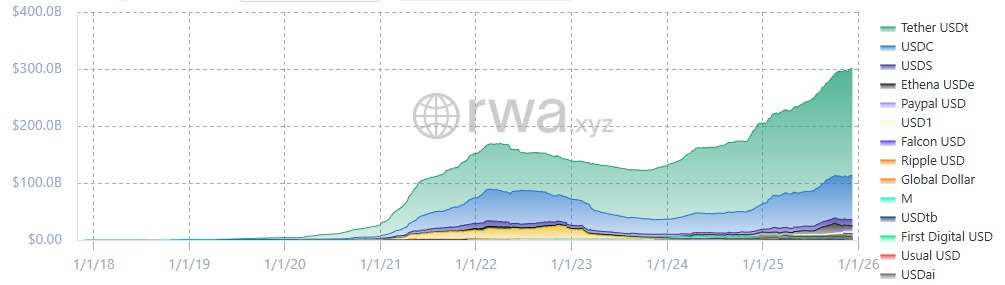
Stablecoin markets have surged in 2025, and Tether remains dominant. Source: RWA.xyz

Magazine: XRP’s ‘now or never’ moment, Kalshi taps Solana: Hodler’s Digest

Trending Cryptos

Related Reads

Altcoin Hacked, Leading to Sharp Price Drop! Also Listed on Major Exchanges!

The price of the NES token plummeted significantly following suspicious activity and large sell-offs detected on the network. Blockchain observers suggested that one wallet minted approximately $55 million worth of NES tokens and began selling them on decentralized exchanges. This selling pressure caused the price of NES to drop by up to 40%. According to the data, the address in question still holds around $18 million worth of NES, indicating that market sell-off pressure may continue. Prior to the incident, it was reported that about $12.35 million worth (62.9 million NES tokens) were transferred to the Ethereum mainnet in the morning (Turkish time), with claims that liquidity was withdrawn and tokens were sold on the market later that evening. However, data regarding the $55 million token mint and the transfer of 62.9 million NES tokens has not been independently confirmed. The NESA team confirmed in a statement that they detected malicious activity exploiting a vulnerability in their Layer 1 network originating from Cosmos EVM. They stated they are working to contain the impact, responded promptly, and will restore services after implementing a software patch and additional measures to ensure secure network operation. Nesa also notified all cryptocurrency exchanges and stated deposit operations will resume after necessary work is completed. The article includes a chart showing the NES price decline following the exploit and concludes with a standard disclaimer that this is not investment advice.

cryptonews.ru2h ago

Altcoin Hacked, Leading to Sharp Price Drop! Also Listed on Major Exchanges!

cryptonews.ru2h ago

PeaqOS and World ID Integrate ZK Proofs into Autonomous Robots

The integration of PeaqOS and World ID now allows autonomous machines to verify they are interacting with real, unique individuals without collecting names, photos, or other personal data. This update, available via robotic.sh, enables connected devices to directly request and verify World ID proofs. The system leverages zero-knowledge technology, letting a person prove they are human while maintaining the privacy of their identity. This addresses a key challenge for operators of delivery robots, shared machines, and autonomous systems: how to authenticate a user as genuine without relying on insecure PINs, pickup codes, or traditional identity checks that require personal data collection. Instead of obtaining identifying information, a device receives a cryptographic proof that the user is a real person. PeaqOS acts as a coordination layer, allowing devices to utilize World ID via decentralized identifiers and a device marketplace. A robot can request verification, receive a zero-knowledge proof, and register an auditable record of the interaction—all without exposing underlying personal data. The system also supports uniqueness verification, enabling machines to enforce rules like "one item per person" without maintaining user identity databases. A demonstrated use case involves autonomous medicine delivery: a patient verifies via the World App when placing an order, a pharmacist verifies before loading the medication, and the patient verifies again upon delivery so the robot can confirm the recipient is linked to the order before unlocking the compartment. Similarly, promotional robots could ensure one item per person, and shared vending machines could grant access to verified individuals without requiring accounts or personal data. This integration for PeaqOS-powered robots and devices minimizes the identity information collected or stored while allowing autonomous systems to confirm they are interacting with real humans.

cryptonews.ru3h ago

PeaqOS and World ID Integrate ZK Proofs into Autonomous Robots

cryptonews.ru3h ago

Trading

Spot

Hot Articles

Discussions

Welcome to the HTX Community. Here, you can stay informed about the latest platform developments and gain access to professional market insights. Users' opinions on the price of S (S) are presented below.

活动图片