Australia Interest Rate Hike Fears Influence $BMIC Macro Investment Tones

bitcoinistPublished on 2026-02-09Last updated on 2026-02-09

Abstract

The Reserve Bank of Australia (RBA) has raised the cash rate by 25 basis points to 3.85%, signaling a hawkish stance amid persistent inflation and a tight labor market. This contrasts with other major central banks and reflects a 'higher for longer' interest rate environment. The tightening monetary policy is driving investors toward secure, utility-focused assets rather than speculative ones. A key emerging risk is the 'Harvest Now, Decrypt Later' threat, where encrypted data is collected now to be decrypted later using quantum computing. This has increased interest in quantum-resistant cryptographic infrastructure. BMIC ($BMIC) is highlighted as a project offering a post-quantum financial stack that eliminates public key exposure risks, using AI-enhanced threat detection and ERC-4337 Smart Accounts. The project has raised over $444K in its presale, indicating investor confidence in quantum-proof blockchain solutions as essential future-proof infrastructure.

Trusted Editorial content, reviewed by leading industry experts and seasoned editors. Ad Disclosure

Quick Facts:

  • ➡️ The RBA’s hawkish stance creates a high-rate environment that forces investors to prioritize utility and security over speculative assets.
  • ➡️ ‘Harvest Now, Decrypt Later’ threats are driving capital toward infrastructure that can withstand future quantum computing attacks.
  • ➡️ The shift from legacy encryption to quantum-proof standards represents a critical infrastructure upgrade for the entire blockchain industry.
  • ➡️ BMIC ($BMIC) offers a post-quantum financial stack that eliminates public key exposure risks.

The Reserve Bank of Australia (RBA) has solidified its position as a global hawkish outlier by raising the cash rate by 25 basis points to 3.85%. This decision marks the first increase since 2023, driven by heightened concerns over a resurgence in inflation and a consistently tight labor market.

While peers like the Federal Reserve and European Central Bank explored easing cycles earlier in the year, the RBA’s latest move signals a ‘higher for longer’ regime, with market pricing now implying two additional hikes may follow before the end of 2026.

Global Market Divergence and Capital Flight

This domestic tightening arrives amidst significant global volatility. While the RBA pivots toward further restrictions, other major economies present a mixed bag of resilience and risk:

  • Central bank disparity: The ECB held its deposit rate at 2.00% as eurozone inflation dipped to 1.7%, while the Bank of England maintained rates at 3.75% despite downward growth revisions.
  • Equity market turmoil: US software stocks faced a brutal 7.5% weekly decline due to fears of AI disruption from next-gen agents like Claude Cowork, dragging the Nasdaq 100 down by 1.9%.
  • Asian retreat: The Hang Seng Index retreated 3.0% as investors reassessed stretched valuations in the chipmaking and tech sectors.

This mixed bag makes investors want security. As legacy cryptographic standards show fragility under macro stress, sophisticated investors are rotating toward infrastructure plays that address systemic security threats. The thesis is moving rapidly from raw accumulation to asset preservation, highlighting the value of protocols like BMIC ($BMIC) and its quantum-secure financial stack as a sanctuary for smart money seeking technological utility over pure speculation.

Hawkish Policy Drives Demand For Quantum-Proof Infrastructure

Connecting Australian interest rates to quantum security might sound like a stretch (at first glance), but the logic is rooted in cold, hard risk management. When central banks tighten the screws, the margin for error in investment portfolios vanishes. Institutional and enterprise-grade investors begin to price in ‘tail risks,’ those low-probability, high-impact nightmares that could wipe out value instantly.

Right now, the biggest unpriced risk in the market is the ‘Harvest Now, Decrypt Later’ threat. State actors and malicious entities are vacuuming up encrypted blockchain data today, just waiting for quantum computers to mature enough to break the standard elliptic curve cryptography (ECC) protecting nearly every wallet. The RBA’s restrictive policy forces capital efficiency; there is simply no room for assets that could become obsolete or vulnerable within the decade. It’s this that makes $BMIC one of the best crypto to watch. 

BMIC tackles this head-on. It deploys the only platform offering wallet, staking, and payments protected by post-quantum cryptography. Unlike legacy wallets that rely on key generation that could eventually be cracked, BMIC uses zero public-key exposure and AI-enhanced threat detection.
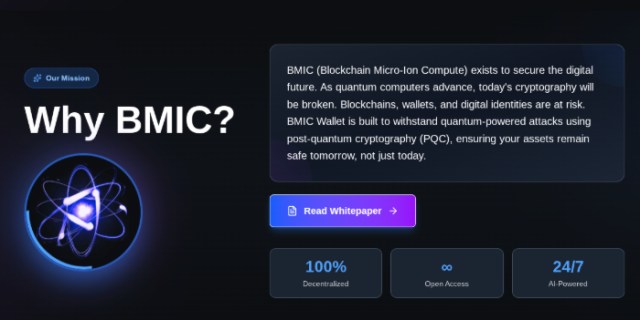
For investors navigating a tightening macro environment, this represents an infrastructure hedge. It suggests that while market volatility fluctuates with rate announcements, the fundamental need for a Quantum Meta-Cloud that secures digital sovereignty is interest-rate agnostic. Plus, the project’s use of ERC-4337 Smart Accounts cements this utility, allowing for a user experience that bridges the gap between complex security protocols and everyday usability.

EXPLORE THE BMIC SECURITY PACKAGE

Smart Money Rotation Visible In $433k Presale Data

While broader market sentiment remains jittery due to macro headwinds, capital flows into the BMIC ecosystem tell a different story. According to live commercial data, the project has successfully raised $444K, with the token currently priced at $0.049474.

This capital injection during a liquidity crunch is significant. It suggests investors are distinguishing between speculative vaporware and necessary infrastructure. The presale metrics indicate early positioning before the ‘quantum threat’ narrative hits the mainstream financial news cycle.

The tokenomics structure supports this long-term view: $BMIC isn’t just a speculative vehicle; it serves as ecosystem fuel for the Quantum Meta-Cloud, offering utility in governance and ‘burn-to-compute’ mechanics.

Pricing at roughly five cents represents a specific entry point for those betting on the inevitable migration from legacy encryption to quantum-resistant standards. Just as the internet migrated from HTTP to HTTPS to secure data, the blockchain is poised for a migration to post-quantum standards. The amount raised implies that a cohort of forward-thinking investors is already locking in their stake in this transition.

By solving the problem of public key exposure, BMIC is positioning itself as the ‘https’ moment for Web3, offering a value proposition that remains compelling whether the RBA hikes or cuts rates in the coming quarter.

CHECK OUT THE $BMIC PRESALE

The content provided in this article is for informational purposes only and does not constitute financial advice. Cryptocurrency investments are volatile and high-risk. Always conduct your own due diligence before investing.

Editorial Process for bitcoinist is centered on delivering thoroughly researched, accurate, and unbiased content. We uphold strict sourcing standards, and each page undergoes diligent review by our team of top technology experts and seasoned editors. This process ensures the integrity, relevance, and value of our content for our readers.

Ben Wallis

Follow

Ben is a freelance writer, and AI editor specializing in crypto developments (mainly altcoins) and the intricate ways global economics shape the digital asset space. His B.Ed. in Education provides a unique foundation for his writing, enabling him to distill complex crypto concepts and market shifts into clear, digestible insights. This skill is key to helping readers adapt and apply their understanding to the ever-evolving world of crypto investment. Passionate about making crypto accessible, Ben crafts content designed to educate a broad audience, from current market events to the essential foundational knowledge that underpins them. His goal is to empower readers through understanding. When he’s not immersed in crypto analysis and breaking down complex topics, Ben is an avid Pokémon fan and enjoys all things Disney.

Full Profile

Related Posts

Super Bowl Karaoke: Coinbase Ad Sparks Mixed Reactions

Arthur Hayes Puts $100K On Hyperliquid (HYPE) Outrunning Every $1B+ Altcoin

CoinShares Quantum Risk Report Protects Bitcoin Hyper Network Integrity

Jack Dorsey’s Block Job Cuts Signal Operational Efficiency Push As SUBBD Token Drives Creator Economy 2.0

Bitcoin Rebounds Near $71K Level Securing Maxi Doge Market Stability

Crypto Alert: 2 Victims Lose Over $60M In Address Poisoning Scam

Related Questions

QWhat was the Reserve Bank of Australia's (RBA) latest interest rate decision and why was it significant?

AThe RBA raised the cash rate by 25 basis points to 3.85%, marking its first increase since 2023. This was significant because it solidified the RBA's position as a global hawkish outlier, driven by concerns over a resurgence in inflation and a tight labor market, signaling a 'higher for longer' interest rate regime.

QWhat is the 'Harvest Now, Decrypt Later' threat mentioned in the article?

AThe 'Harvest Now, Decrypt Later' threat refers to a strategy where state actors and malicious entities collect and store encrypted blockchain data today, with the future intention of decrypting it once quantum computers become powerful enough to break the current standard elliptic curve cryptography (ECC) that protects digital wallets.

QHow does the BMIC ($BMIC) project address quantum computing security threats?

ABMIC offers a post-quantum financial stack that eliminates public key exposure risks. It provides a wallet, staking, and payments platform protected by post-quantum cryptography and AI-enhanced threat detection, positioning itself as a quantum-secure infrastructure for the blockchain industry.

QWhat was the total amount raised in the $BMIC presale and what does this indicate about investor sentiment?

AThe $BMIC presale successfully raised $444,000. This capital injection during a period of macroeconomic uncertainty and liquidity crunch indicates that investors are distinguishing between speculative assets and necessary infrastructure, positioning themselves early for the anticipated migration to quantum-resistant encryption standards.

QAccording to the article, how does a hawkish monetary policy from the RBA influence investment behavior towards cryptocurrencies?

AA hawkish RBA policy creates a high-interest-rate environment that forces investors to prioritize utility and security over pure speculation. It reduces the margin for error, driving demand for assets that offer technological utility and act as a hedge against systemic risks, such as quantum computing threats to cryptographic security.

Related Reads

$292 Million KelpDAO Cross-Chain Bridge Hack: Who Should Foot the Bill?

On April 18, 2026, an attacker stole 116,500 rsETH (worth ~$292M) from KelpDAO’s cross-chain bridge in 46 minutes—the largest DeFi exploit of 2026. The stolen assets were deposited into Aave V3 as collateral, causing $177–200M in bad debt and triggering a cascade of losses across nine DeFi protocols. Aave’s TVL dropped by ~$6B overnight. This legal analysis argues that KelpDAO and LayerZero Labs share concurrent liability, with fault apportioned 60%/40%. KelpDAO negligently configured its bridge with a 1-of-1 decentralized verifier network (DVN)—a single point of failure—despite LayerZero’s explicit recommendation of a 2-of-3 setup. LayerZero, which operated the compromised DVN, failed to secure its RPC infrastructure against a known poisoning attack vector. Both protocols’ terms of service cap liability at $200 (KelpDAO) or $50 (LayerZero), but these limits are likely unenforceable due to unconscionability, gross negligence exceptions, and potential securities law invalidation (if rsETH is deemed a security under the Howey test). Aave’s governance also faces fiduciary duty claims for raising rsETH’s loan-to-value ratio to 93%—far above competitors’ 72–75%—without adequately assessing bridge risks, amplifying the systemic fallout. Practical recovery targets include LayerZero Labs (a registered Canadian entity), KelpDAO’s founders, auditors, and identifiable Aave governance delegates. The incident underscores escalating legal risks for DeFi protocols, infrastructure providers, and governance participants.

marsbit5m ago

$292 Million KelpDAO Cross-Chain Bridge Hack: Who Should Foot the Bill?

marsbit5m ago

Insider Trading in War: 5 People Involved, the Highest Earner Was Arrested

On April 24, the U.S. Department of Justice arrested U.S. Army Special Forces Staff Sergeant Gannon Ken Van Dyke for insider trading related to the capture of Venezuelan President Nicolás Maduro on January 3. Van Dyke allegedly profited over $400,000 by placing bets on a prediction market, Polymarket, using insider knowledge of the covert operation. According to the indictment, Van Dyke registered an account (0x31a5) on December 26 and made a series of bets predicting Maduro’s capture and U.S. military involvement in Venezuela. He withdrew most of his funds on the day of the operation and attempted to obscure his tracks by transferring assets through crypto and brokerage accounts. This case marks the first time the DOJ has prosecuted insider trading on Polymarket. PolyBeats had previously identified five suspicious accounts, including Van Dyke’s—the highest earner—in January. The other accounts, with profits ranging from $34,000 to $145,000, remain under unofficial scrutiny but have not been charged. Their lower profits, indirect access to information, and unclear legal boundaries may complicate prosecution. Polymarket has since strengthened its market integrity rules, explicitly prohibiting trading based on confidential or insider information. Van Dyke’s arrest, nearly four months after his trades, signals increased regulatory attention and the persistent traceability of blockchain-based transactions.

marsbit7m ago

Insider Trading in War: 5 People Involved, the Highest Earner Was Arrested

marsbit7m ago

Bitwise: Bullish on Bitcoin's Performance in the Second Half of the Year, AI and Regulation Will Spark a New Altcoin Season

Bitwise CIO Matt Hougan and Research Lead Ryan Rasmussen express strong bullish sentiment on Bitcoin's long-term prospects, suggesting that its $1 million price target may be too conservative. They argue Bitcoin serves a dual role: as digital gold and a potential global settlement asset, especially amid declining trust in traditional monetary systems. Despite a weak Q1 2026 where nearly all crypto assets and prices saw double-digit declines, the analysts remain optimistic due to strong forward-looking catalysts, including institutional adoption via Bitcoin ETFs from major firms like Morgan Stanley and Goldman Sachs. Geopolitical instability, such as Iran’s mention of using Bitcoin for international payments, increases the value of Bitcoin’s “out-of-the-money call option” as a non-political, global settlement currency. This enhances its appeal beyond a mere store of value. . Additionally, Hougan highlights that a clearer regulatory token framework under current SEC leadership, combined with AI efficiency gains and high-performance blockchains, could fuel a new “altseason” by late 2026. This may lead to a wave of legitimate, value-capturing token projects, unlike the earlier ICO boom. . Bitwise also announced an Avalanche ETF, citing its unique architecture and rapid growth in real-world asset (RWA) tokenization, which has surged 10x to nearly $30 billion in two years. The firm believes Layer 1 blockchains are still early in their growth cycle, with significant potential ahead.

marsbit53m ago

Bitwise: Bullish on Bitcoin's Performance in the Second Half of the Year, AI and Regulation Will Spark a New Altcoin Season

marsbit53m ago

Trading

Spot
Futures
活动图片