ASTER vs. Hyperliquid: Can USD1’s 34.3% growth shift market leadership?

ambcryptoPublished on 2026-04-08Last updated on 2026-04-08

Abstract

The market is shifting toward DeFi, with stablecoins acting as a key bridge between traditional and decentralized finance. In this context, Aster’s [ASTER] partnership with WorldLibertyFinancial [WLFI] positions WLFI’s native stablecoin, USD1, as the base layer for ASTER’s perpetual markets and real-world asset (RWA) initiatives. USD1’s market cap grew 34.3% this year, reflecting strong demand for structured, real-world assets. Despite broader market headwinds, the partnership aims to strengthen ASTER’s liquidity and competitiveness. While Hyperliquid [HYPE] dominated Q1 perpetual volume with $620 billion (compared to ASTER’s $318 billion) and saw its token rise 43%, ASTER declined 3.32%. The integration of USD1 could help ASTER narrow the gap with Hyperliquid and expand its presence in both trading and RWA markets.

The market is clearly shifting toward DeFi, and as a result, Layer 1s are rethinking how to stay ahead.

Consequently, it’s no surprise that most strategic partnerships are now centered around stablecoins. By acting as a bridge between TradFi and DeFi, they not only move capital on-chain more efficiently but also reduce friction and unlock access to key growth areas such as RWAs, AI, and NFTs.

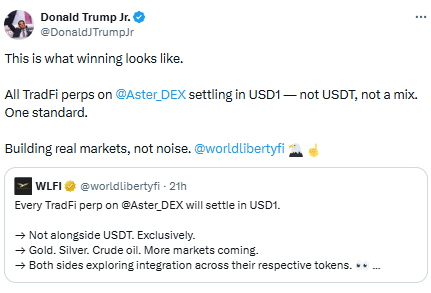
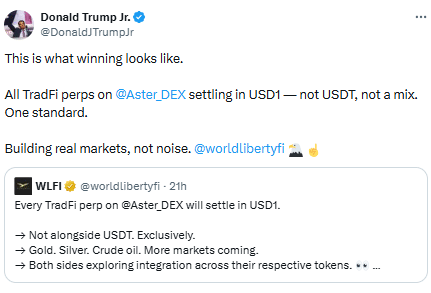
In this context, Aster’s [ASTER] partnership with WorldLibertyFinancial [WLFI] fits perfectly. Under this deal, WLFI’s native stablecoin, USD1, becomes the base layer for ASTER’s perpetual markets and RWA initiatives, further reinforcing the broader trend of connecting traditional finance more closely with DeFi via stablecoins.
Source: X

Unsurprisingly, the market reacted quickly. The most buzzed-about response came from Donald Trump Jr. on X, calling the partnership a major “win” for both networks. That said, when we look at the technical positioning, it’s clear this move is about more than just strengthening fundamentals.

On the charts, both ASTER and WLFI have been impacted by ongoing macro FUD, closing near critical support levels that could soon be tested. At the same time, on the longer timeframe, these assets still have a significant way to go before reclaiming early-October price levels.

Naturally, the key question becomes, can this partnership actually drive meaningful price gains? That’s especially relevant when you consider that other DEX tokens like Hyperliquid [HYPE] have managed to stay relatively bullish despite the same macro headwinds.

ASTER bets on USD1 to reclaim ground

When you think of stablecoins, USDT usually comes to mind first.

That said, its technical setup doesn’t always tell the full story. So far this year, USDT’s market cap has only grown about 1.6%. Considering that this period overlaps with roughly a 20% correction across the broader crypto market, it’s clear that USDT flows still influence wider price action.

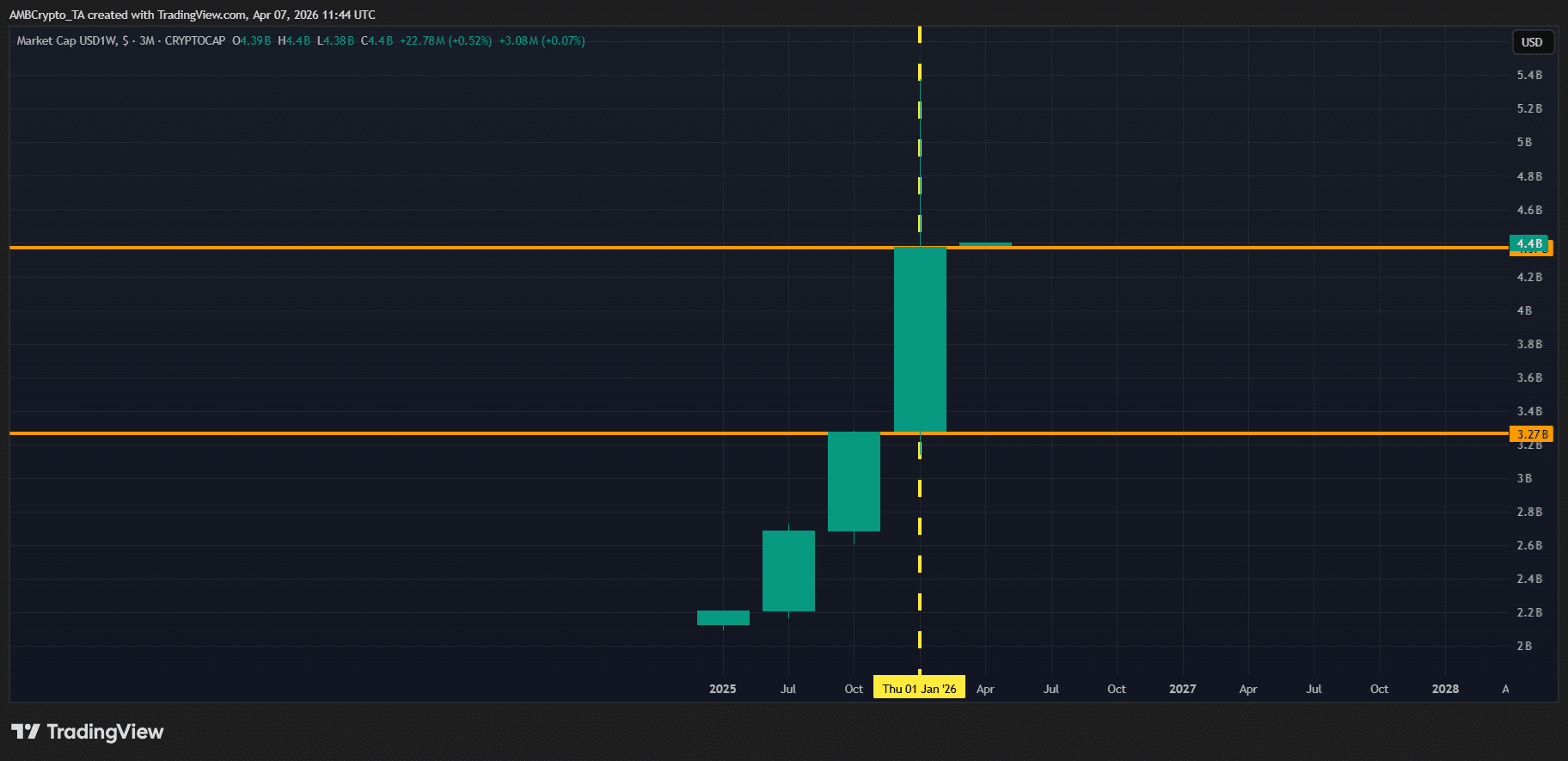
But capital isn’t just chasing speculation anymore. The RWA market, for example, has grown 35% this year, showing that money is moving into more structured, real-world assets. In this context, USD1’s 34.3% jump in market cap highlights how well-positioned stablecoins are driving real growth, making the ASTER-WLFI partnership a clearly strategic play.
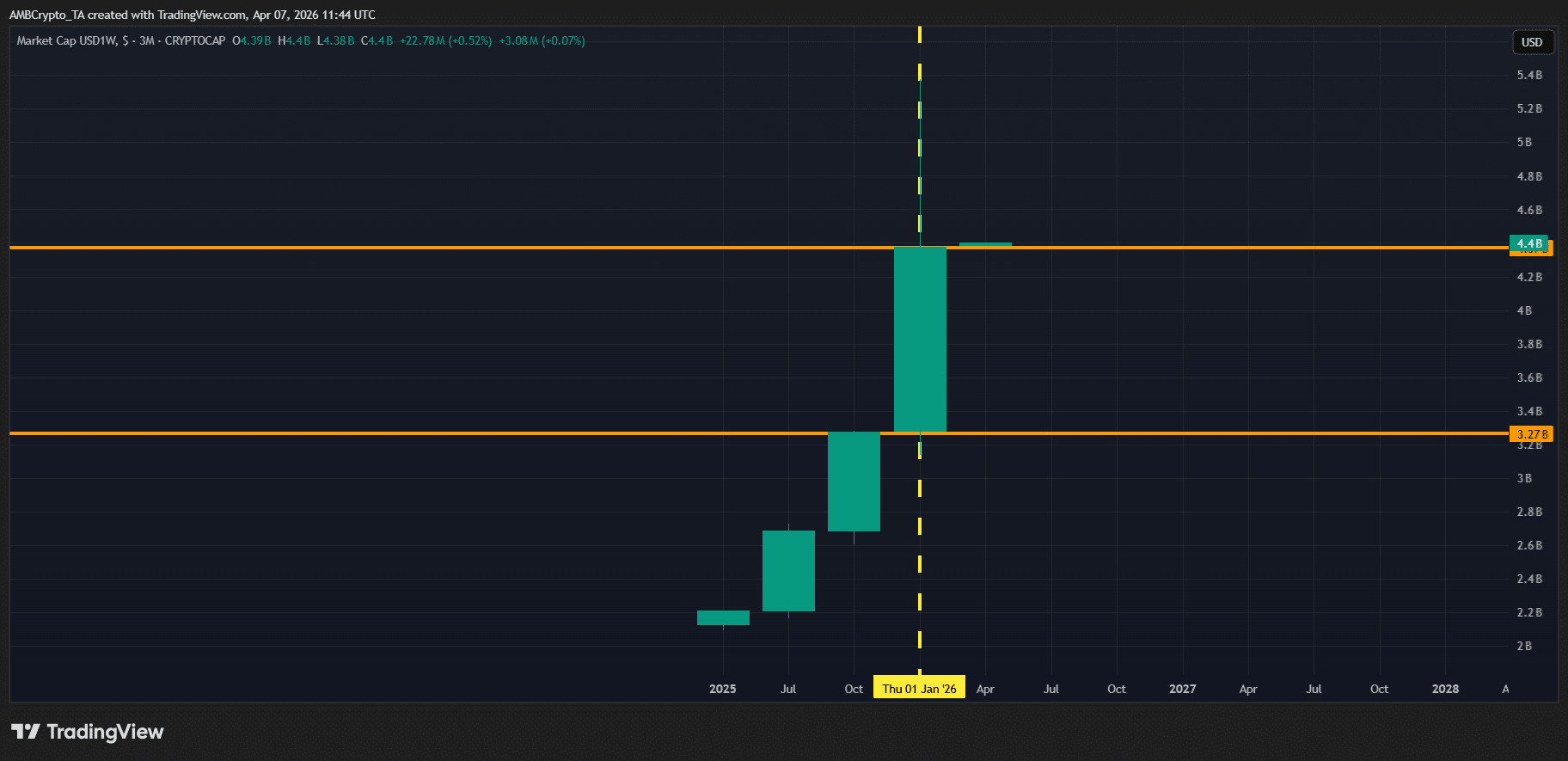
Source: TradingView (USD1)

Meanwhile, a similar divergence is visible in perpetual volume, which has cooled overall. Yet, on a chain-by-chain basis, Hyperliquid still dominates, reporting $620 billion in perp volume in Q1. Oil trading, in particular, has been a key driver, keeping Hyperliquid firmly in the lead even as broader market activity slows.

By comparison, ASTER posted $318 billion over the same period. Technically, that’s almost half of Hyperliquid’s volume. The impact shows in price action too, with HYPE ending Q1 up 43%, while ASTER slipped 3.32%. That said, the WLFI partnership puts ASTER in a position to strengthen its liquidity, potentially improving its competitiveness in the DEX perpetual market.

The main catalyst? USD1. Serving as the base layer for ASTER’s perpetual markets and RWA initiatives, it could be the lever that helps ASTER close the gap with Hyperliquid, creating a stronger presence across both trading and real-world asset markets.


Final Summary

  • USD1 now serves as the base layer for ASTER’s perpetual markets and RWA initiatives, strengthening liquidity.
  • While HYPE dominates perp volume, ASTER’s USD1 integration positions it to narrow the gap and expand its presence in both trading and real-world asset markets.


Trending Cryptos

Related Questions

QWhat is the main focus of the strategic partnership between Aster (ASTER) and WorldLibertyFinancial (WLFI)?

AThe partnership centers on WLFI's native stablecoin, USD1, becoming the base layer for ASTER's perpetual markets and Real-World Asset (RWA) initiatives, aiming to bridge traditional finance with DeFi and strengthen liquidity.

QHow did the market cap growth of USD1 compare to that of USDT, and what does this signify?

AUSD1's market cap grew by 34.3%, significantly outperforming USDT's 1.6% growth. This highlights how well-positioned stablecoins like USD1 are driving real growth, particularly in structured areas like RWA, as opposed to just speculation.

QHow did the trading volume and price performance of ASTER compare to Hyperliquid (HYPE) in Q1?

AIn Q1, Hyperliquid dominated with $620 billion in perpetual volume and its token HYPE ended the quarter up 43%. In comparison, ASTER posted $318 billion in volume (about half of HYPE's) and its token price slipped by 3.32%.

QWhat key advantage does the article suggest the USD1 integration could bring to ASTER?

AThe integration of USD1 as a base layer could serve as a lever to help ASTER strengthen its liquidity, improve its competitiveness in the perpetual markets, and narrow the gap with market leaders like Hyperliquid.

QBeyond speculation, what broader market trend is capital moving into, as evidenced by the growth of USD1?

ACapital is moving into more structured, real-world assets (RWA). The RWA market itself grew 35% this year, and USD1's significant growth is a reflection of this trend towards connecting traditional finance with DeFi.

Related Reads

Bank of America Quietly Positions: Could $6 Trillion in Bank Deposits Flow into Stablecoins?

Bank of America has quietly made leadership appointments to accelerate its digital asset strategy, sparking discussion about a potential large-scale migration of bank deposits to stablecoins. Reports highlighted the bank naming Sonali Theisen, Kevin Milsom, and Adam Dixon to lead its global digital asset and AI platform, focusing on stablecoins, tokenized deposits, custody, and crypto settlement. This move revived a claim that $6 trillion in bank deposits could flow into stablecoins, a figure originally cited by Bank of America's CEO Brian Moynihan in January. However, he conditioned this shift on stablecoins being allowed to pay interest—a feature not permitted under the current GENIUS Act. The legislation's final rules are delayed, pushing its effective date to January 2027. Major banks are not waiting. JPMorgan and Citigroup are already piloting tokenized deposit services, and a consortium including Bank of America is building a shared tokenized deposit network targeting a 2027 launch. While some, like Pacemakers.io's Alessandro Hatami, remain skeptical of rapid bank collaboration, data shows significant institutional adoption. Stablecoin settlement volume hit $33 trillion in 2025, and analysts project the market could surpass $1 trillion by 2026. Despite a recent dip in crypto prices and stablecoin supply, the institutional push for real-world use cases continues. The race is on for January 2027, when the GENIUS Act takes effect, potentially reshaping the competition between traditional finance and digital assets.

Foresight News2m ago

Bank of America Quietly Positions: Could $6 Trillion in Bank Deposits Flow into Stablecoins?

Foresight News2m ago

US Treasury Secretary Bement Claims: The US Will Soon Control 80% of Global Computing Power

U.S. Treasury Secretary Ben Sent proclaimed that America is poised to control 80% of the world's computing power, positioning compute dominance as a core pillar of U.S. economic strategy. Speaking on the Mike Rowe show, he stated the U.S. currently holds 50-60% of global compute share, with expectations to reach 80% soon. He framed this as a strategic competition the U.S. "cannot afford to lose," warning that a rival's lead would grant "unacceptable" strategic leverage, while asserting a current one-year AI lead. This high-level policy endorsement is seen as a direct boost for AI infrastructure investment, benefiting chipmakers like NVIDIA and cloud providers' capex cycles. Sent positioned AI compute, semiconductors, and quantum computing as three pillars of national economic strength and security. He defended AI's societal impact, citing historical tech shifts, and argued AI empowers small businesses without causing net job loss so far. He highlighted government efforts to deepen public-private AI cybersecurity cooperation. For investors, the statement signals sustained U.S. policy support for AI infrastructure. However, analysts urge caution, noting "compute share" lacks a standard public metric; the 80% figure is a forecast, not audited data. They recommend focusing on tangible indicators like physical capacity expansion and power infrastructure, with future semiconductor and cloud reports providing key verification data.

marsbit13m ago

US Treasury Secretary Bement Claims: The US Will Soon Control 80% of Global Computing Power

marsbit13m ago

Trading

Spot

Hot Articles

How to Buy ASTER

Welcome to HTX.com! We've made purchasing Aster (ASTER) simple and convenient. Follow our step-by-step guide to embark on your crypto journey.Step 1: Create Your HTX AccountUse your email or phone number to sign up for a free account on HTX. Experience a hassle-free registration journey and unlock all features.Get My AccountStep 2: Go to Buy Crypto and Choose Your Payment MethodCredit/Debit Card: Use your Visa or Mastercard to buy Aster (ASTER) instantly.Balance: Use funds from your HTX account balance to trade seamlessly.Third Parties: We've added popular payment methods such as Google Pay and Apple Pay to enhance convenience.P2P: Trade directly with other users on HTX.Over-the-Counter (OTC): We offer tailor-made services and competitive exchange rates for traders.Step 3: Store Your Aster (ASTER)After purchasing your Aster (ASTER), store it in your HTX account. Alternatively, you can send it elsewhere via blockchain transfer or use it to trade other cryptocurrencies.Step 4: Trade Aster (ASTER)Easily trade Aster (ASTER) on HTX's spot market. Simply access your account, select your trading pair, execute your trades, and monitor in real-time. We offer a user-friendly experience for both beginners and seasoned traders.

7.3k Total ViewsPublished 2025.09.19Updated 2026.06.02

How to Buy ASTER

Discussions

Welcome to the HTX Community. Here, you can stay informed about the latest platform developments and gain access to professional market insights. Users' opinions on the price of ASTER (ASTER) are presented below.

活动图片