Anthropic Issues DMCA Takedown Notices, Massively Removes 8,100 Source Code Repositories

marsbitPublished on 2026-04-01Last updated on 2026-04-01

Abstract

AI giant Anthropic has issued multiple DMCA takedown notices to GitHub in response to a major source code leak. The company is targeting illegally hosted repositories containing the code for Claude Code. As a result, GitHub has removed the main repository along with over 8,100 forked repositories, marking one of the largest code copyright clean-up operations in the AI industry. Contrary to initial reports of employee error, an internal investigation revealed the leak was caused by a bug in an internal packaging tool. This bug mistakenly included sensitive files and full TypeScript source code, which should have remained private, into a production build. While this finding shifts blame from employee misconduct, it highlights a critical security flaw in Anthropic's automated workflow. Despite the takedown, the code had already been downloaded by thousands of developers within 48 hours and widely shared on platforms like Telegram, cloud storage, and private Git servers, making complete eradication nearly impossible. The leaked code, which includes implementation logic and internal model fine-tuning instructions, continues to be actively analyzed by developers.

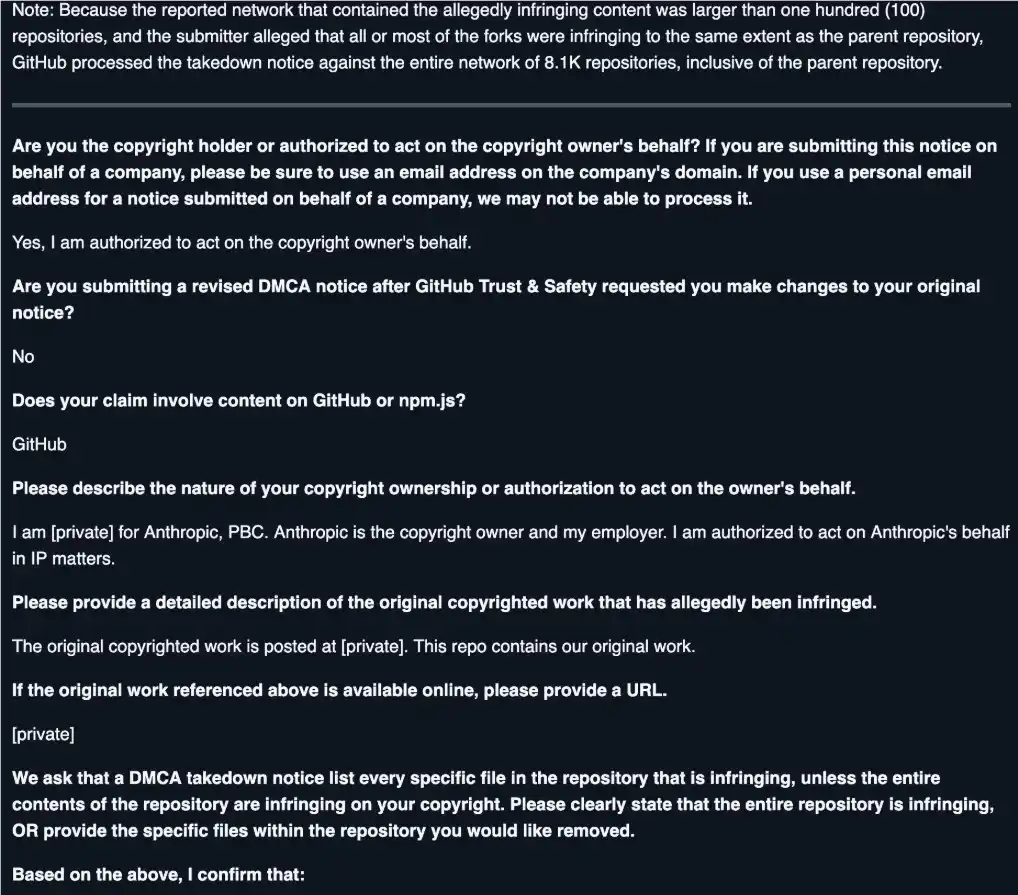
In response to the recent source code leak incident, AI giant Anthropic has officially launched a legal counterattack. According to the latest news, the company has submitted multiple DMCA (Digital Millennium Copyright Act) takedown notices to GitHub, demanding the removal of all illegally hosted Claude Code source code repositories on the platform.

As a result, GitHub adopted a "wholesale" approach, not only deleting the reported main repository but also simultaneously taking down over 8,100 related forked repositories. This marks one of the largest code copyright cleanup operations in the AI industry in recent years.
Leak Cause Reversed: Not "Human Error," but a Tool BUG

Public opinion previously widely believed the leak was due to employee operational error, but the latest investigation report reveals that the real culprit may be an underlying BUG in a certain packaging tool used internally by Anthropic.

This BUG caused the system to mistakenly include sensitive files and complete TypeScript source code, which should have remained private, when building the production environment package. The exposure of this technical detail somewhat alleviates external doubts about the professional competence of Anthropic employees but also reveals serious security vulnerabilities in their automated workflow.

Although GitHub cooperated by taking down 8,100 repositories, it is nearly impossible to completely erase this data, as the source code has been downloaded, cloned, and disseminated by tens of thousands of developers worldwide over the past 48 hours, spreading to Telegram, cloud storage, and private Git platforms.

Currently, a large number of developers within the community are conducting "archaeological" research on this code. The leaked source code not only reveals the implementation logic of Claude Code but also contains a wealth of internal instructions regarding model behavior fine-tuning.

Related Questions

QWhat legal action did Anthropic take in response to the source code leak?

AAnthropic submitted multiple DMCA (Digital Millennium Copyright Act) takedown notices to GitHub to remove illegally hosted Claude Code source code repositories.

QHow many repositories were affected by GitHub's takedown in response to Anthropic's DMCA notices?

AGitHub took down over 8,100 related fork repositories in addition to the main reported repository.

QWhat was the actual cause of the source code leak, according to the latest investigation?

AThe leak was caused by a bug in an internal packaging tool used by Anthropic, which mistakenly included sensitive files and full TypeScript source code that should have remained private when building the production environment package.

QWhy is it nearly impossible to completely remove the leaked source code from circulation?

AIt is nearly impossible because the source code was downloaded, cloned, and spread by tens of thousands of developers worldwide within 48 hours, and it has been disseminated to platforms like Telegram, cloud storage, and private Git platforms.

QWhat does the leaked source code reveal about Claude Code?

AThe leaked source code reveals the implementation logic of Claude Code and contains a large number of internal instructions related to model behavior fine-tuning.

Related Reads

Pi Network Price Forecast for August 2026: Will the August 11th Deadline Become a Catalyst for PI's Recovery?

Pi Network Price Forecast for August 2026: Will the August 11 Deadline Catalyze a Recovery? Pi Network (PI) traded at $0.0830 on July 30, up 1.13%, attempting to stabilize above its all-time low. The price is rebounding from the lower Bollinger Band around $0.07172. All key EMAs (20, 50, 100, 200-day) remain in a downtrend above the current price, with the 20-day EMA at $0.08810 acting as the first significant resistance level to confirm a recovery. August presents two key narratives. First, the Pi Core Team launched Protocol 26 with a hard deadline of August 11 for all node operators to upgrade; failure to do so results in disconnection. This is the final precursor to Protocol 27, a major technical upgrade planned for 2026. Second, a community debate challenges the widespread "GCV" (Global Consensus Value) concept, with a member stating there is no official GCV mechanism and that Mainnet apps price services independently. This could pressure price if holders selling on disillusionment. The 10-day price forecast table suggests a range of $0.072-$0.095 for early August amid Protocol 26 deadline pressure, $0.080-$0.110 in mid-August post-deadline clarity, and $0.085-$0.125 in late August, pending broader crypto market direction. The bullish case requires smooth Protocol 26 migration, clear Protocol 27 announcement, resolution of the GCV debate without major holder exits, and a close above the 20-day EMA. The bearish scenario involves node upgrade difficulties, GCV-related selling pressure, continued supply pressure from 775.8 million PI scheduled to unlock by December, and a fall back to or below the $0.07172 support zone.

cryptonews.ru4m ago

Pi Network Price Forecast for August 2026: Will the August 11th Deadline Become a Catalyst for PI's Recovery?

cryptonews.ru4m ago

Brale Claims New Protocol Can Eliminate a Major Obstacle to Scaling Custom Tokens

Stablecoin infrastructure firm Brale is launching a compatibility protocol, called ION, designed to solve a key bottleneck in the industry: moving the rapidly growing number of custom-branded stablecoins across different blockchains. The protocol allows participating stablecoins to move between blockchains by burning tokens on one network and minting an equivalent amount on another. Unlike most blockchain bridges, this model does not require pre-funded liquidity pools in each supported chain. While the $300 billion stablecoin market is dominated by Tether (USDT) and Circle’s USDC, a wave of new entrants—including banks, fintechs, crypto firms, and asset managers—are issuing their own tokens for payments, settlements, and tokenized assets. Over 350 such asset-pegged coins are already tracked, highlighting the need for infrastructure to connect this increasingly fragmented ecosystem. Brale, which supports over 100 stablecoin programs across more than 30 blockchains, argues that current interoperability models relying on liquidity pools or wrapped tokens are not scalable. These models require locking up capital in every supported network, creating an unsustainable capital requirement as the number of stablecoins and blockchains grows. Brale's founder and CEO, Ben Miln, stated that "liquidity between stablecoin programs is the No. 1 barrier to scaling individual stablecoins," noting there isn't enough capital in the world to solve the problem via liquidity pools. ION's burn-and-mint approach, similar to Circle's Cross-Chain Transfer Protocol (CCTP) but extended to any participating issuer, aims to provide a scalable alternative. The protocol will debut initially on testnet with partners including Monad, Rain, Coinflow, Turnkey, Etherfuse, Spark, and Canton.

cryptonews.ru14m ago

Brale Claims New Protocol Can Eliminate a Major Obstacle to Scaling Custom Tokens

cryptonews.ru14m ago

Trading

Spot
活动图片