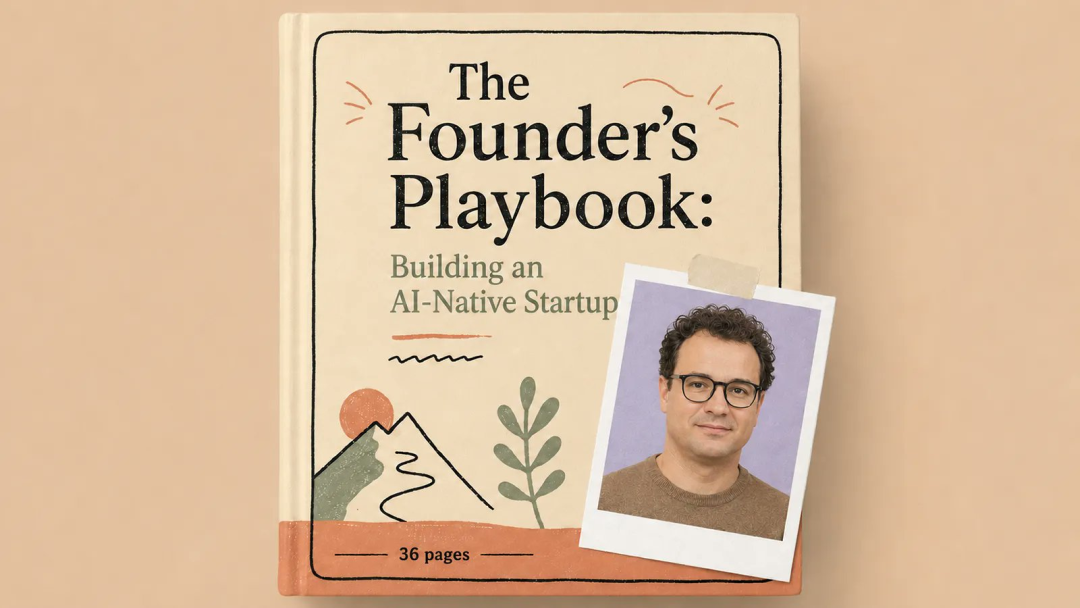
Yesterday, Anthropic released "The Founder's Handbook: How to Build an AI-Native Company."
Based on AI capabilities projected to be achievable by 2026, itreorganizes the four stages of a startup's lifecycle: Ideation, MVP, Launch, and Scale. Each stage corresponds to goals, exit criteria, common failure modes, and specific exercises that can be completed with AI.
By its title, it's a startup guide for founders. But what it really aims to convey:AI is changing how a person transforms an idea into reality.
In the past, there were many hurdles between an idea and its implementation. Understanding technology, finding people to write code, conducting research, writing a business plan, setting up processes, managing operations. Many things weren't unthinkable, but there was a lack of people, money, or time. So opportunities largely belonged to companies, to those with engineers and funding.
Now, AI can write and deploy code, conduct research, analyze competitors, draft business plans, and run operations. Work that once required a team can now be done by two or three people, sometimes just one knowledgeable person.
So the question changes: When AI fills in the execution capabilities, who is still qualified to build products? Who can organize complex work? Who can quickly turn a real-world problem in an industry into a verifiable, operational, and iterable system?
Startups are just the first scenario being transformed. The bigger change is that the boundaries between individual capability, team capability, and company capability are being redrawn.
Today, we'll clarify the core substance of the handbook for you.
I. Founders are No Longer Just Founders, But Orchestrators of Agents
One judgment in this handbook is crucial:
The founder's role is shifting from individual contributor to orchestrator of agents.
This statement is more important than "AI improves startup efficiency."
In the past, technical founders wrote code, non-technical founders ran the business. There was a wall between them. People who couldn't code, if they wanted to build a product, had to either find a technical co-founder, outsource, or raise funds to build a team.
Now, this wall is weakening. A person with industry experience, customer understanding, and business judgment can use AI to complete prototyping, product documentation, code development, user research, and operational processes.Technical ability is no longer the absolute barrier to entry in the startup game.
This leads to a very direct change:The profile of founders for AI-native companies will become more diverse.
In the future, some competitive AI companies may not come from the traditional technical elite. They could come from doctors, lawyers, teachers, salespeople, finance professionals, operations, manufacturing practitioners. Because when AI can supplement execution capabilities, what becomes truly scarce is domain judgment.
Whoever better understands the real problems within an industry has a better chance of turning AI into a product.
II. AI Lowers Execution Barriers, Not Judgment Barriers
Conversely, Anthropic reminds founders that AI makes prototyping too easy.A functioning product can easily be mistaken for evidence of "validated demand."
But it isn't!
In the past, a startup idea went through much friction to materialize: finding people, writing code, designing, building systems, running tests. Although slow, this process constantly exposed problems. Today, AI can compress that friction, allowing you to quickly get a seemingly complete product.
The problem is,the easier it is to build a product, the easier it is for people to skip validation.
This is a counter-intuitive aspect of the AI era:
The stronger the building capability, the higher the potential cost of going in the wrong direction.
Because AI doesn't inherently help you judge whether a problem is worth solving. It executes your premises very efficiently. If the premise is wrong, it will execute that wrong premise beautifully.
This is why the handbook repeatedly emphasizes that the focus in the ideation stage is not building, but validating.
In the AI era, the greatest danger is not failing to build a product.
It's building a product nobody needs, too quickly.
III. Small Teams Are Gaining Capabilities Previously Held by Large Companies
This handbook also has a clear tendency:It posits that AI will enable small teams to possess organizational capabilities previously reserved for large teams.
An AI-native team can use AI for code development, document generation, market research, sales materials, customer support, internal process automation. Tasks that once required coordination across multiple departments may now be handled by a few people with a set of tools.
This changes our understanding of "company scale": In the past, judging a company's maturity often looked at headcount, departments, management layers. More people meant more complex business; complete departments meant organizational maturity.
But AI-native companies may not grow this way.
They may stay small for a long time, yet possess fairly comprehensive product, operations, sales, and support capabilities.They are not in a hurry to expand the organization, but first use AI to run the processes.
This is an opportunity for startups, and pressure for large companies.
Because one of the advantages of large companies is precisely their organizational resources. They have engineering teams, marketing teams, legal teams, sales teams, customer success teams.Now, if AI allows small teams to mobilize similar capabilities, the organizational barriers of large companies are weakened.
In the future, the competitive difference may no longer be "who has more people," but "whose people are better at directing AI."
IV. Moats Are No Longer Just About Model Capability
If AI tools are accessible to everyone, where is the moat for an AI-native company?
The handbook offers several answers: domain knowledge, user data flywheel, workflow lock-in.
First, domain knowledge becomes more important.
General models can answer many questions, but they don't necessarily understand the tacit rules within specific industries. Healthcare, law, finance, education, manufacturing, government—each industry has a wealth of unwritten experience. Whoever can productize this experience can build something difficult for general models to replace.
Second, user data becomes a time-based asset.
How users operate within a product, where they pause, how they modify AI outputs, which suggestions are accepted, which are rejected—this behavioral data is not something competitors can directly buy. It comes from real usage, from accumulated time.
There's a precise sentence in the handbook:You cannot buy the behavioral fingerprints left by thousands of users repeatedly refining workflows within a product.
Third, workflow lock-in will be stronger than feature lock-in.
If an AI product only provides a certain function, users can switch anytime. But if it's embedded in a team's daily workflow, connected to data sources, carries automation rules, and trains employees' usage habits,then the switching cost is no longer "changing a tool," but "rebuilding a way of working."
This is the real moat for AI-native companies.
Not the model itself, but the system formed from the long-term combination of the model and specific business.
Conclusion: What This Handbook Really Indicates
Therefore, Anthropic's handbook is not just an operational guide for founders.
It's more like a signal: AI companies are entering the next phase.
Phase One: People cared about model capabilities. Whose model is stronger, whose context window is longer, whose reasoning is better.
Phase Two: People cared about application explosion. AI writing, AI programming, AI search, AI office tools, AI video—various products rapidly emerged.
Now, the question becomes:What kind of organization can truly use AI to redo a company?
This is also the most discussable aspect of the concept "AI-native startup."
It doesn't mean a company uses AI tools, or that its product integrates a large model API. A true AI-native company is one that, from the outset, assumes AI participates in R&D, operations, sales, management, and decision-making processes.
Its team structure is different, its product iteration method is different, its growth method is different, and its moat is different.
In other words, AI-native is not a feature label, but a company morphology.
AI is not only changing products.
It is also changing the company itself.
Original handbook address: https://claude.com/blog/the-founders-playbook