Analyzing if FET can hold its make-or-break level or drop to $0.20

ambcryptoPublished on 2026-03-31Last updated on 2026-03-31

Abstract

FET is trading near a critical support level of $0.2270 after declining over 8%, with analysts warning of a potential further drop to $0.20 or even $0.1737 if this level breaks. Short-term bearish sentiment is reinforced by derivatives data, showing stronger short positions and a descending triangle pattern on the chart. However, the long-term outlook may still be bullish, as the top 100 wallet addresses increased their holdings by 2.04% in the past week, suggesting accumulation. The Average Directional Index (ADX) indicates weak momentum, meaning the asset may struggle before any significant downward move.

Artificial Superintelligence Alliance [FET] has fallen over 8% and was trading near $0.229 at press time, a level that appears to be a make-or-break point for the asset. Moreover, strengthening derivatives’ metrics alongside expert commentary further reinforces and potentially confirms that FET could continue its downside move.

As the broader market struggles, CoinGlass data show intraday traders closely tracking the trend and betting on further declines.

According to the FET exchange liquidation map, traders have shown strong interest around $0.224 on the downside and $0.238 on the upside. At these levels, they have built approximately $294K worth of long-leveraged positions and $794K worth of short-leveraged positions.

These bets indicate that bears are currently dominating the asset in the short term, while bulls appear to be exhausted.
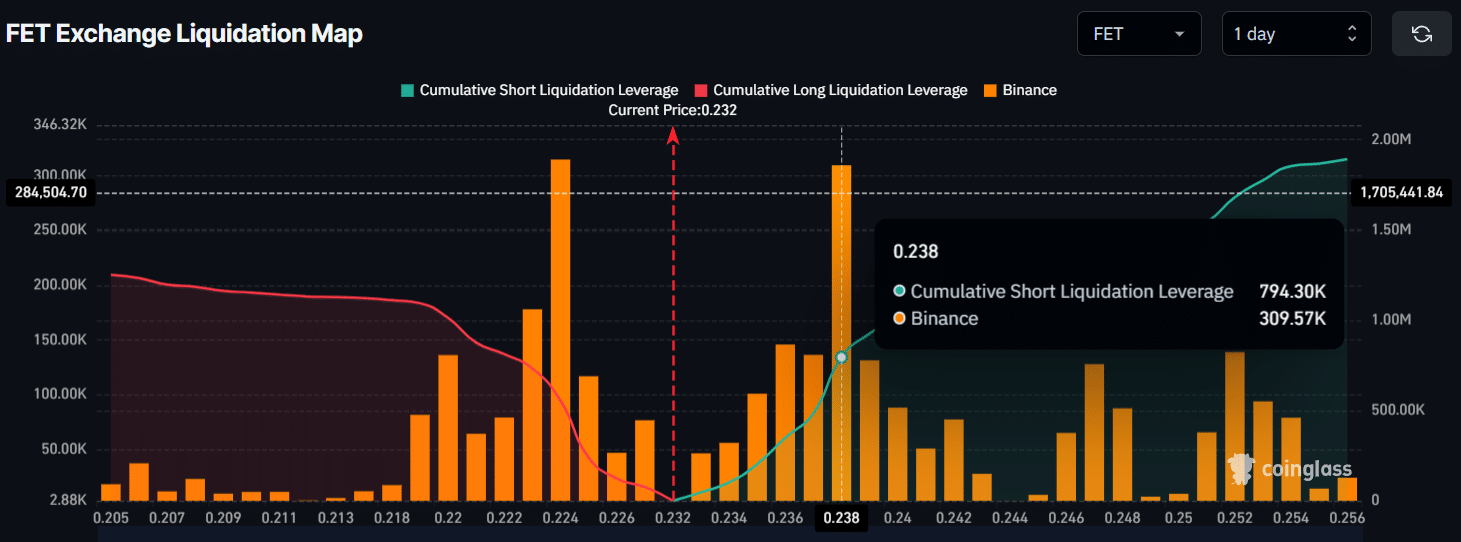
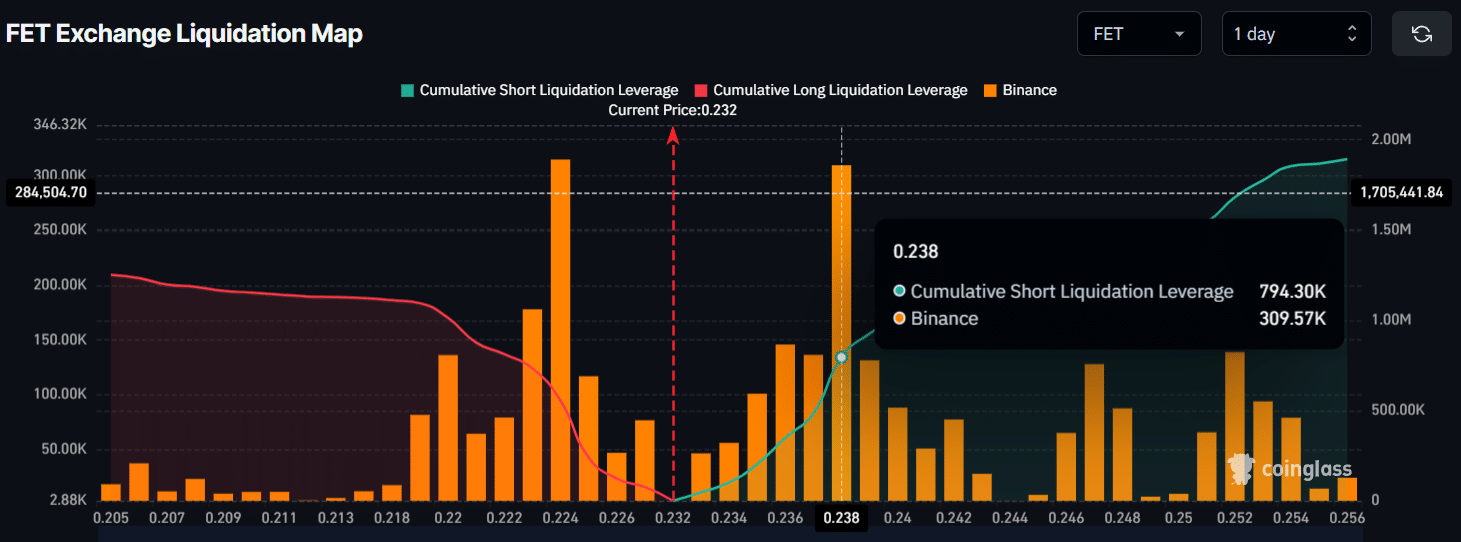
Source: CoinGlass

In fact, a crypto analyst recently echoed a similar outlook on FET’s price. In a post on X, the analyst explained that the asset was retracing into a supply zone and showing clear signs of exhaustion. Moreover, FET appears positioned to grab liquidity before turning lower. For this potential decline, the expert outlined target levels, noting that FET could drop to $0.20 and $0.1737.

FET price action and key levels to watch

On the four-hour chart, FET appears bearish, as the token’s drop has brought the price to a make-or-break level, a level the asset has consistently held since the 26th of March 2026. In fact, the chart suggests that FET has formed a descending triangle pattern and is now poised for a breakdown.
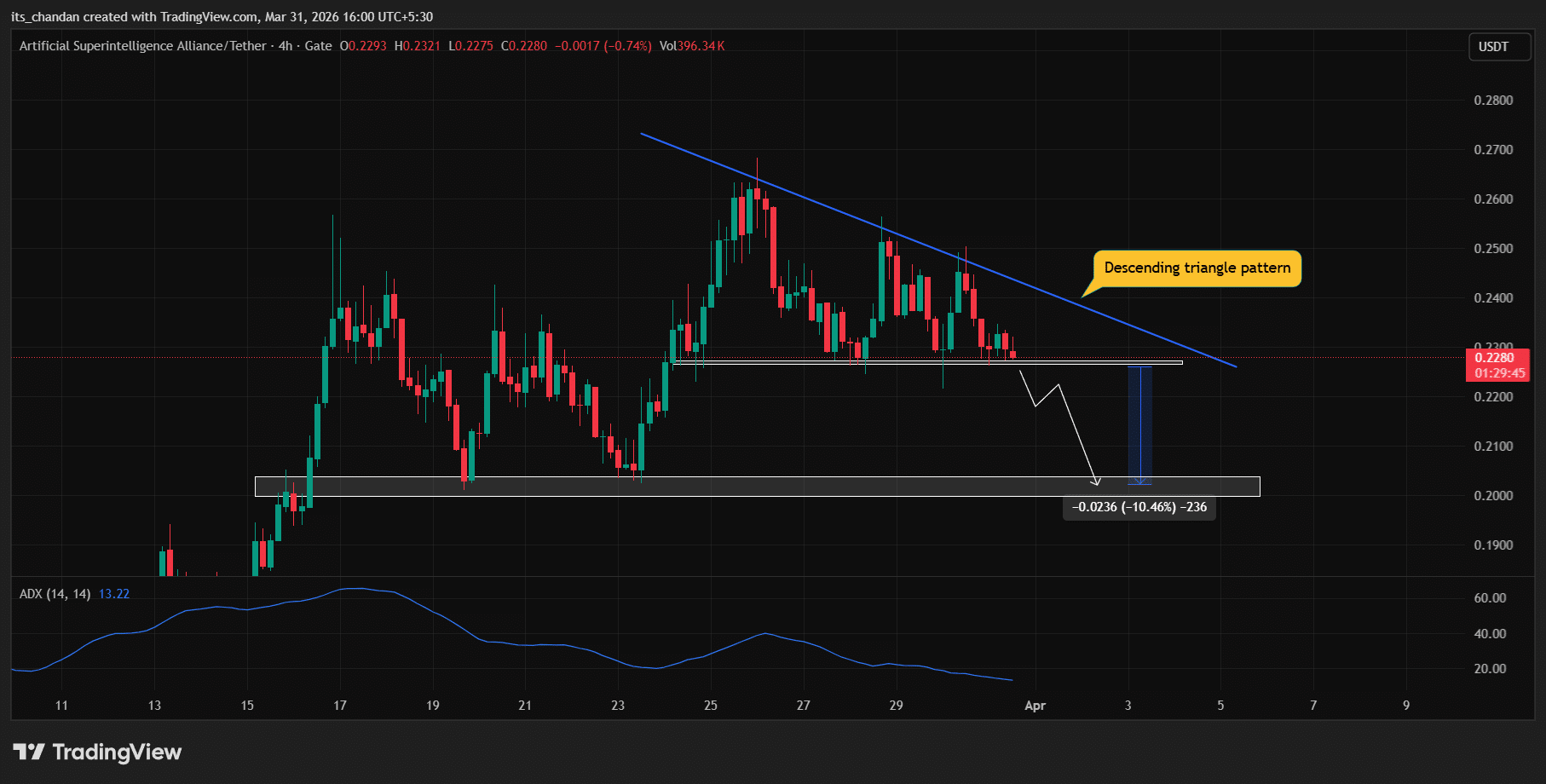
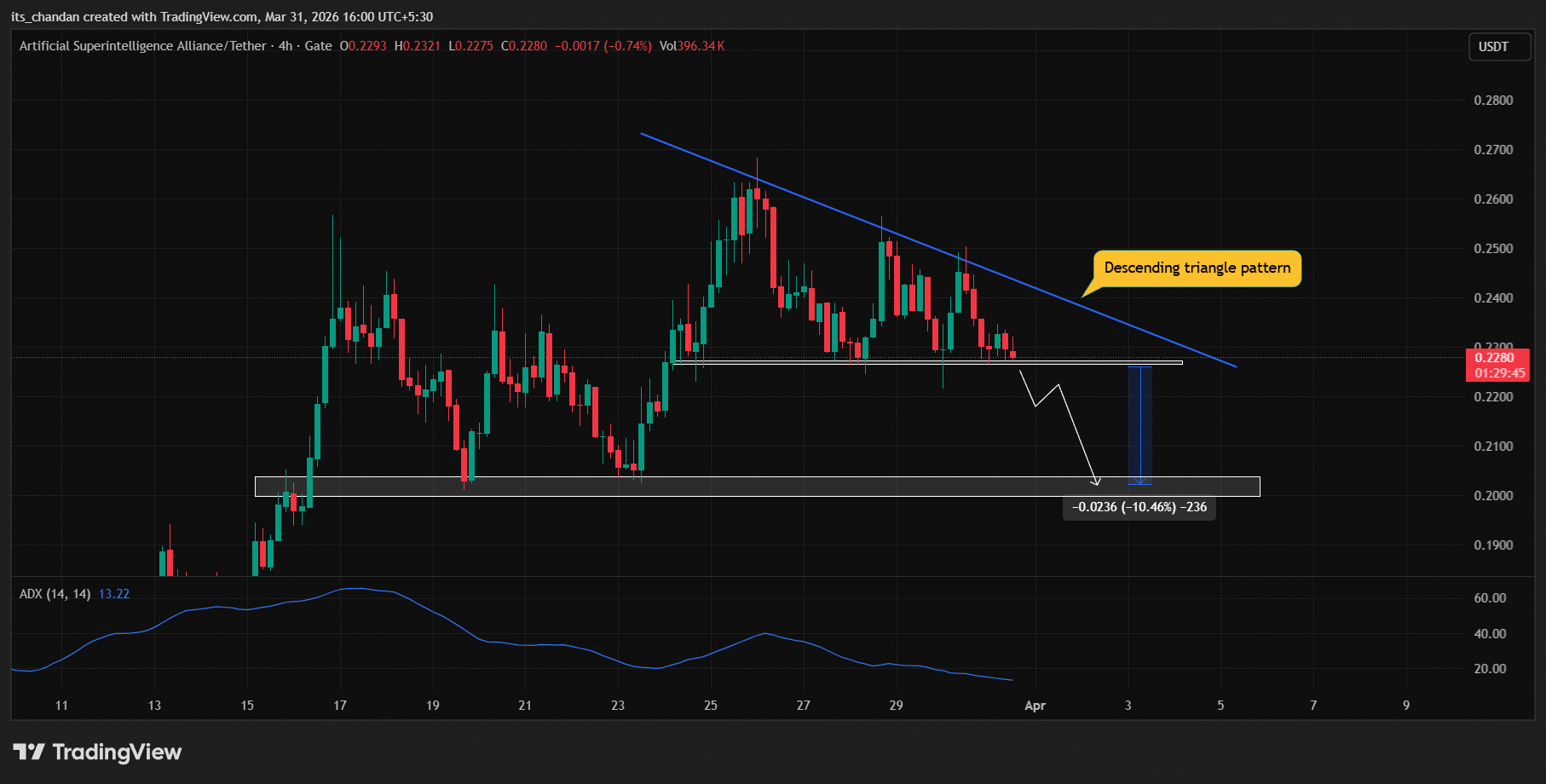
Source: TradingView

Based on the current price action, if FET fails to hold its key support level of $0.2270 and closes a four-hour candle below it, the price could potentially decline by another 10%, reaching the $0.20 level in the coming days.

However, a reversal is also possible if the price remains above the $0.2270 level. An upside move would likely only begin if FET breaks out above the descending trendline of the pattern.

Alongside this, the technical indicator Average Directional Index (ADX) stood at 13.22, below the key threshold of 25, indicating weak directional momentum. This suggests that the asset may struggle before continuing its downward move.

Top 100 addresses increase holdings

Despite all these bearish developments over the past 24 hours, analytics tool Nansen indicates that FET’s long-term outlook remains bullish.

The data shows that the top 100 wallet addresses have increased their holdings by 2.04% over the past week, signaling potential accumulation. Meanwhile, Exchange Reserves have declined by 1.40% during the same period, further suggesting accumulation by long-term holders.
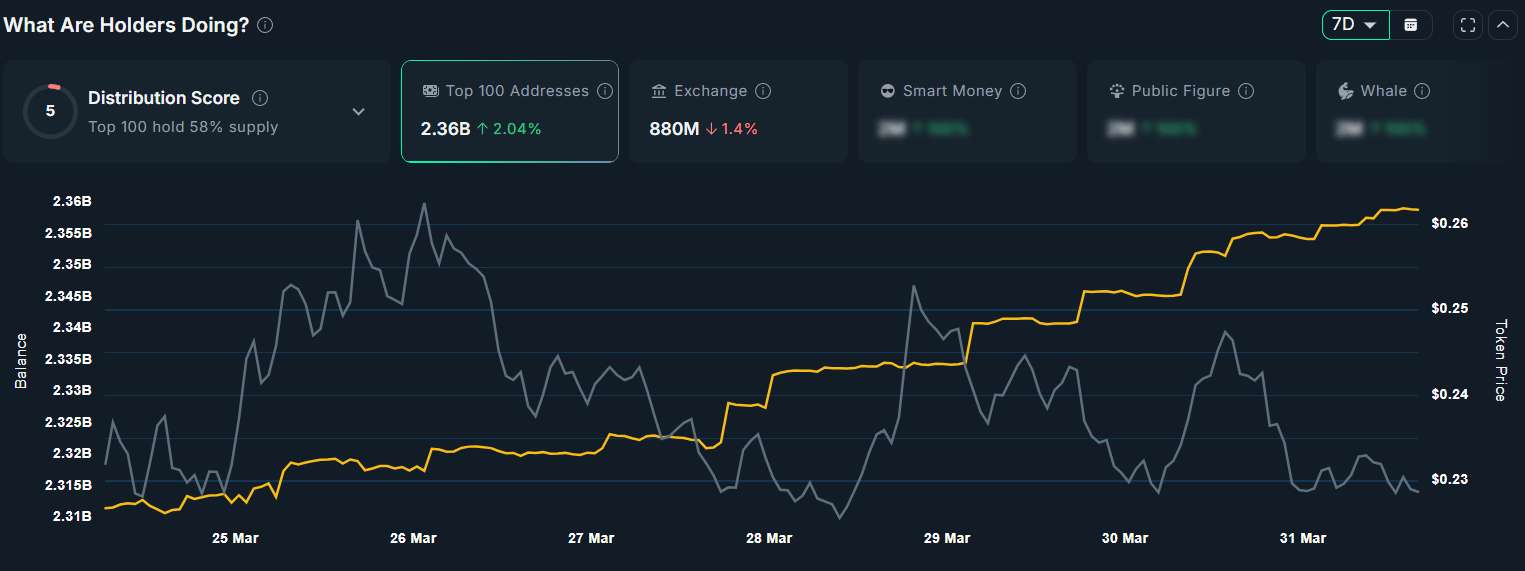
Source: Nansen

Final Summary

  • FET has declined over 8%, and its price action hints at a potential 10% drop if it falls below the $0.2270 level.
  • An expert has outlined a bearish outlook for the asset, eyeing downside targets of $0.20 and $0.1737.


Related Questions

QWhat is the current price of FET and why is it considered a make-or-break level?

AFET is trading near $0.229 at press time, which is considered a make-or-break level because it's a key support level that the asset has consistently held since March 26, 2026. A break below this level could lead to further significant declines.

QAccording to the CoinGlass data, what do the liquidation levels and leveraged positions indicate about market sentiment?

AThe CoinGlass data shows strong trader interest at $0.224 (downside) and $0.238 (upside), with approximately $294K in long-leveraged positions and $794K in short-leveraged positions. This indicates that bears are currently dominating in the short term, while bulls appear exhausted.

QWhat specific price targets did the crypto analyst outline for FET's potential decline?

AThe crypto analyst outlined two specific downside targets for FET: $0.20 and $0.1737, suggesting these are potential levels the asset could drop to if the bearish scenario plays out.

QWhat technical pattern has FET formed on the four-hour chart and what does it suggest?

AFET has formed a descending triangle pattern on the four-hour chart, which is typically considered a bearish pattern and suggests the asset is poised for a potential breakdown if it fails to hold its key support level.

QDespite the bearish short-term outlook, what data from Nansen suggests a potentially bullish long-term perspective?

ANansen data shows that the top 100 wallet addresses have increased their FET holdings by 2.04% over the past week, while Exchange Reserves have declined by 1.40%, suggesting accumulation by long-term holders and indicating a potentially bullish long-term outlook.

Related Reads

Microsoft is Afraid of Being Marginalized by AI Giants

Microsoft, once the defining force of the PC era, now faces a familiar challenge in the AI age: the risk of being relegated to a profitable but invisible infrastructure provider. This anxiety was laid bare at Build 2026, where CEO Satya Nadella unveiled a major strategic pivot. The catalyst was a quiet April agreement that dissolved Microsoft's exclusive licensing and cloud-hosting deal with OpenAI, its once-vital partner. This erased Microsoft's key AI moat. With OpenAI and Anthropic defining AI applications and gaining enterprise traction—even within Microsoft's own ranks—Nadella had to answer: without exclusivity, what is Microsoft's role? The answer was a suite of seven in-house AI models, a developer-focused AI workstation (Surface RTX Spark Dev Box), and, most crucially, the Agent 365 platform for enterprise AI governance. The models, notably targeting Anthropic's strengths in coding and enterprise, signal a defensive move. However, the broader strategy is to make the models themselves less decisive. Financially, Microsoft's AI revenue is strong, driven largely by Azure running others' models. Yet its user-facing products like Copilot show weak penetration and engagement. Microsoft earns infrastructure money but lacks direct user mindshare. Nadella's core fear is being "hollowed out." As OpenAI and Anthropic prepare for IPOs and gain financial independence, they may build their own infrastructure, threatening Azure's lucrative AI revenue stream. Microsoft's window is to entrench itself deeper: not as the model creator, but as the indispensable platform for securely deploying, managing, and governing all AI models within the enterprise through Agent 365. Build 2026 revealed Microsoft's bet: in the AI era, the ultimate power lies not in any single model, but in the enterprise "operating system" that controls them. Nadella is determined to ensure Microsoft is the driver of this new era, not just a passenger.

marsbit13m ago

Microsoft is Afraid of Being Marginalized by AI Giants

marsbit13m ago

CPU, Quietly Returning to the Center of the AI Computing Power Stage

Over the past three years, AI computing power narratives have been dominated by GPUs. However, starting in 2026, this story began to shift. While training large models remains GPU-intensive, the rapid growth of inference and AI agent workloads, which require high levels of task orchestration, concurrency, and data flow management, has highlighted a renewed critical role for CPUs. These are tasks GPUs are not designed to handle. Intel's recent launch of the Xeon 6+ processor, built on its Intel 18A process and featuring up to 288 efficiency cores (E-cores), exemplifies this strategic pivot. It is positioned not as a mere companion to GPUs but as the essential "control plane" for AI infrastructure, optimized for high-density, energy-efficient, and high-throughput workloads characteristic of AI agents and inference. This "CPU resurgence" is not about CPUs outperforming GPUs in raw computation. It reflects a systemic bottleneck: as AI scales from training single models to deploying countless intelligent agents, the demand for coordination and data handling surges. Major cloud providers are also developing their own high-density ARM-based server CPUs for similar workloads. However, Intel's success with this strategy faces significant challenges. Competition includes NVIDIA's integrated CPU-GPU solutions, the expanding adoption of cloud vendors' in-house ARM CPUs, and the crucial market test of Intel's 18A manufacturing process against rivals like TSMC's N2. In conclusion, CPUs are indeed reclaiming a central, though redefined, role in AI compute—managing the complex orchestration that enables massive-scale AI deployment. While the trend is clear, which company will ultimately lead this CPU resurgence remains an open question to be decided in the data centers of 2027 and beyond.

marsbit34m ago

CPU, Quietly Returning to the Center of the AI Computing Power Stage

marsbit34m ago

Trading

Spot
Futures

Hot Articles

How to Buy FET

Welcome to HTX.com! We've made purchasing FETCH.ai (FET) simple and convenient. Follow our step-by-step guide to embark on your crypto journey.Step 1: Create Your HTX AccountUse your email or phone number to sign up for a free account on HTX. Experience a hassle-free registration journey and unlock all features.Get My AccountStep 2: Go to Buy Crypto and Choose Your Payment MethodCredit/Debit Card: Use your Visa or Mastercard to buy FETCH.ai (FET) instantly.Balance: Use funds from your HTX account balance to trade seamlessly.Third Parties: We've added popular payment methods such as Google Pay and Apple Pay to enhance convenience.P2P: Trade directly with other users on HTX.Over-the-Counter (OTC): We offer tailor-made services and competitive exchange rates for traders.Step 3: Store Your FETCH.ai (FET)After purchasing your FETCH.ai (FET), store it in your HTX account. Alternatively, you can send it elsewhere via blockchain transfer or use it to trade other cryptocurrencies.Step 4: Trade FETCH.ai (FET)Easily trade FETCH.ai (FET) on HTX's spot market. Simply access your account, select your trading pair, execute your trades, and monitor in real-time. We offer a user-friendly experience for both beginners and seasoned traders.

2.5k Total ViewsPublished 2024.03.29Updated 2026.06.02

How to Buy FET

Discussions

Welcome to the HTX Community. Here, you can stay informed about the latest platform developments and gain access to professional market insights. Users' opinions on the price of FET (FET) are presented below.

活动图片













