Analyst’s Bitcoin Price Crash Prediction From May 2025 Resurfaces And It Says The Bottom Is Not In

bitcoinistPublished on 2026-02-09Last updated on 2026-02-09

Abstract

A previously published Bitcoin price crash projection from analyst KillaXBT, dating back to May 13, 2025, has regained attention for accurately predicting the current market downturn. The model uses rotational market mathematics to identify cycle stages—accumulation, distribution, and breakdown—and signaled that Bitcoin had not yet reached a macro bottom. The analysis highlighted key levels, including accumulation phases that fueled the rally and distribution zones near $115,000–$120,000 where exhaustion signals emerged. The chart correctly anticipated rejections at highs, fading momentum, and eventual breakdowns, with Bitcoin transitioning into mid-range consolidation around $100,000 before falling further. Currently, Bitcoin is trading in a lower distribution band near $70,000, with the model suggesting extended bearish consolidation. Relief rallies lack strength, and volatility remains high on declines. The projection indicates a potential capitulation toward $50,000 to complete the distribution phase, concluding that the true market bottom has not yet been established.

A previously published Bitcoin price crash projection from May 13, 2025, has re-entered market discourse after several prominent crypto traders on X recirculated the chart and commended the foresight behind the analysis from KillaXBT. The model mapped Bitcoin’s full cycle structure — from accumulation to distribution and breakdown — long before the current correction unfolded. Now, the same framework is signaling that Bitcoin has yet to establish a macro bottom.

Chart Signals That Nailed The Bitcoin Price Crash

KillaXBT’s framework is built on rotational market mathematics, measuring how many times price cycles are within a range before exhaustion. The analyst segmented Bitcoin’s structure into consolidation blocks and assigned swing counts to identify when liquidity had been fully absorbed.

In the early phase, accumulation rotations labeled “(2×2)+1 = 5” and “(5×2)+1 = 11” defined the base that ultimately fueled Bitcoin’s impulsive rally. These counts indicated that internal liquidity cycling was complete, clearing the path for expansion. Once that move matured, the price transitioned into a high-range consolidation beneath the cycle peak.

Inside the 115,000–120,000 distribution zone, the chart identified overlapping exhaustion clusters marked “(2×5)+1 = 9” and “(3×2)+1 = 7.” For traders, stacked counts at highs typically signal supply absorption. Although Bitcoin printed marginal higher highs, momentum was fading — a textbook late-stage distribution signal.
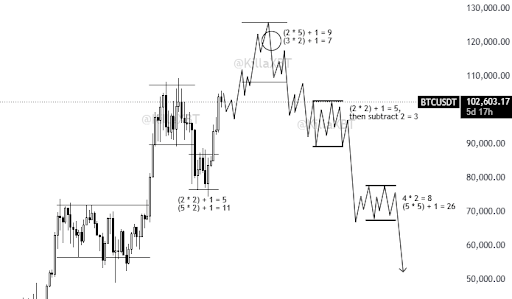
Source: Chart from KillaXBT on X

Market behavior followed that roadmap. Bitcoin formed repeated rejection wicks near the highs, upside momentum slowed, and breakout attempts failed to secure acceptance above resistance. Volume compression reinforced the distribution thesis. Instead of continuation, the price rolled over.

The model then mapped a transition into mid-range consolidation around the 100,000 psychological level, with BTCUSDT referenced near 102,603. Annotated “(2×2)+1 = 5, then subtract 2 = 3,” the structure signaled weakening bounce capacity. Price action mirrored the setup: multiple support tests, lower highs, and eventual breakdown — completing the crash phase outlined in the May 2025 forecast.

Bitcoin Price Could Drop Further Before Hitting Bottom

The resurfaced chart’s larger significance lies in its forward projection. After the six-figure range failed, the model guided Bitcoin into a lower distribution band around 70,000. This zone carried heavier rotational counts — “4×2 = 8” and “(5×5)+1 = 26” — implying extended consolidation within a bearish continuation framework.

Current market behavior continues to align with that structure. Bitcoin has already rotated into lower support territory following the 100K breakdown, while volatility has expanded on selloffs rather than recoveries. Relief rallies remain corrective, lacking the impulsive follow-through required to confirm bottom formation.

The chart’s final stage shows a potential capitulation toward the $50,000 area, marked by a sharp move below the lower range. Structurally, this is an unfinished downside that completes the current distribution phase.

The sequence is straightforward: accumulation pushed prices higher, the rise led to distribution, and now distribution is causing further breakdowns. Because no consolidation has shown the expansion profile typical of a macro base, the model maintains that the true bottom is not yet in.

BTC trading at $69,162 on the 1D chart | Source: BTCUSDT on Tradingview.com

Related Questions

QWhat is the main prediction of the resurfaced Bitcoin price analysis from May 2025?

AThe analysis predicts that the Bitcoin price crash is not over yet and that the true macro bottom has not been established, with a potential further drop toward the $50,000 area.

QWho created the Bitcoin price projection model that is being discussed?

AThe model was created by an analyst known as KillaXBT.

QWhat key mathematical concept does KillaXBT's framework use to analyze Bitcoin's price action?

AThe framework is built on rotational market mathematics, measuring how many times price cycles are within a range before exhaustion, using formulas like (2x2)+1=5 to identify liquidity absorption and exhaustion clusters.

QAccording to the model, what was the significance of the distribution zone between $115,000 and $120,000?

AThis zone was identified as a high-range distribution area with overlapping exhaustion clusters, signaling supply absorption and marking a late-stage distribution phase before the price rolled over.

QWhat is the model's final projected stage for the current Bitcoin price cycle?

AThe model's final projected stage is a potential capitulation event, involving a sharp move below the lower consolidation range toward the $50,000 area to complete the current distribution phase.

Related Reads

55TB to 28TB? The Rumor and Panic Behind Rubin's Memory Being Halved

Title: 55TB to 28TB? The Rumor and Panic Behind the Potential Halving of Rubin's Memory. On June 4th, a report from SemiAnalysis suggested NVIDIA's next-gen Vera Rubin NVL72 AI rack may ship with roughly 28TB of SOCAMM DRAM per rack instead of the anticipated 55TB, primarily using 96GB modules. This sparked a market panic, causing Micron's stock to drop over 10% on fears of halved memory demand. However, the article argues this panic is misguided for several key reasons. First, SOCAMM modules are socketed and upgradeable, not soldered. Lower initial configuration doesn't mean permanent demand loss. Second, the primary driver is a severe 2026 LPDDR5X supply shortage, not diminished need. NVIDIA is likely prioritizing rack shipments with available components. Third, with fixed total LPDDR5X supply, using less per rack could allow NVIDIA to ship *more* racks, not necessarily reducing overall memory orders. Micron's sharp drop was also attributed to a broader semiconductor sell-off triggered by Broadcom's earnings, with the SemiAnalysis report providing a convenient narrative for profit-taking after Micron's massive rally. In summary: the report on lower default configurations is likely accurate, but interpreting it as a demand collapse is wrong. The real risk for Micron lies in its reportedly minimal HBM4 share for Rubin, not in potentially flexible SOCAMM demand. The sell-off appears more like a correction amplified by coinciding negative catalysts.

marsbit17m ago

55TB to 28TB? The Rumor and Panic Behind Rubin's Memory Being Halved

marsbit17m ago

Exclusive from Yingke | Tang Wenbin's 'Yuanli Lingji' Merges with Logistics Robotics Company, and Secures Investment from Zhipu, SenseTime, Jieyue, and Others

Exclusive report: Embodied AI company "Yuanli Lingji" recently completed a new round of financing from major AI model firms including Zhipu AI, Stepfun, and SenseTime, alongside continued investments from industrial backers like Huaqin and SAIC Hengxu. Founded in March 2025 by Tang Wenbin, former co-founder and CTO of Megvii, Yuanli Lingji is a general-purpose embodied AI model company. In a notable move, the company has merged with logistics robotics firm "Atomix" (formerly known as Yuanli Juhe) through a share acquisition. Atomix, which originated from Megvii's logistics robotics business led by Tang in 2016 and was spun off in July 2024, has grown to become the world's second-largest supplier of pallet shuttle robots, with annual revenue nearing 1 billion RMB and over 500 projects globally for clients like Uniqlo and CATL. This merger aims to break the industry's "data deadlock" by combining Atomix's extensive real-world operational data from more than 20 countries with Yuanli Lingji's model training capabilities. The company's embodied AI model "DM0" utilizes a cross-domain training approach, integrating internet semantics, autonomous driving rules, and robotics data to achieve hardware-agnostic, precise manipulation even with a compact 2.4B parameter size. The collective investment from key AI players and the strategic merger signal a shift in the competitive landscape, as major model companies pivot from language tokens to physical actions ("from Token to Action"). The industry is entering a consolidation phase where hardware, AI models, data, and application scenarios converge to scale embodied intelligence, a trend mirrored by recent moves from giants like ByteDance and Skild AI.

marsbit25m ago

Exclusive from Yingke | Tang Wenbin's 'Yuanli Lingji' Merges with Logistics Robotics Company, and Secures Investment from Zhipu, SenseTime, Jieyue, and Others

marsbit25m ago

U.S. Stock Market Trends: Dow Hits New High, Nasdaq Falls, Whom Did Broadcom's Slap Wake Up?

U.S. Stocks Split: Dow Hits Record High as Nasdaq Slips; Broadcom's Plunge Sparks Rotation On June 4, the U.S. stock market saw a sharp divergence. The Dow Jones surged 875 points (+1.73%) to a record high of 51,561.93, while the Nasdaq Composite edged down 0.09%. The S&P 500 rose 0.41%. The primary catalyst was a sharp sell-off in AI-related chip stocks, led by Broadcom (AVGO). Despite reporting a 143% year-over-year jump in AI semiconductor revenue to $10.8 billion, the company's shares plunged about 14%. This was triggered by its maintained long-term AI revenue target, which failed to meet heightened expectations for a stock that had gained 55% this quarter and traded at a high P/E ratio. The slide dragged down the broader semiconductor sector and the technology板块. Conversely, money rotated into sectors like Healthcare (+3.14%), Financials (+2.67%), and Real Estate (+1.87%). UnitedHealth and Goldman Sachs were major contributors to the Dow's gains. The rotation was attributed to a search for value outside overheated tech names and a slight dip in Treasury yields. In other major news, SpaceX confirmed its IPO for June 12, targeting a record $75 billion raise at a ~$1.75 trillion valuation. Additionally, initial jobless claims rose to a four-month high, adding nuance to the labor market narrative ahead of the key May non-farm payrolls report. The day's action signaled that while the AI growth story remains intact, excessive valuations are prompting a market reassessment. Funds are moving, at least temporarily, from high-flying tech to more defensive and value-oriented sectors. The sustainability of this rotation hinges on upcoming economic data, particularly the jobs report, and the market's absorption of the massive SpaceX IPO.

marsbit28m ago

U.S. Stock Market Trends: Dow Hits New High, Nasdaq Falls, Whom Did Broadcom's Slap Wake Up?

marsbit28m ago

From 'Old Dogs' to 'New Darlings': How AI is Revaluing Old Infrastructure, from Dell to Nokia

"Old Dogs" Become AI's New Darlings: Revaluing Legacy Infrastructure The AI investment narrative is shifting. Beyond the spotlight on core chipmakers like Nvidia, a new wave of interest is rising for legacy tech companies—Dell, HPE, Nokia, Cisco, Corning, Western Digital—once labeled as slow-growth, outdated stories. This resurgence stems from AI's evolution from model development to real-world deployment, creating massive demand for physical infrastructure. As AI moves into data center construction and enterprise adoption, the focus turns to who can actually build and deliver complex systems. These established players hold decades of experience in supply chains, integration, networking, and enterprise delivery—assets now critical for scaling AI. The revaluation can be grouped into three key infrastructure areas: 1. **Servers & Integration (e.g., Dell, HPE):** They are becoming essential system integrators, transforming GPUs into full-scale AI servers with networking, power, and cooling, then delivering them to clients. Strong recent earnings and AI-specific revenue/order growth for Dell and HPE underscore this shift. 2. **Networking & Connectivity (e.g., Corning, Nokia, Cisco):** As AI clusters grow, high-speed data transfer becomes paramount. Corning benefits from fiber demand for data center links, Nokia is exploring AI-integrated wireless networks (AI-RAN), and Cisco sees surging orders for data center switches—all critical for efficient AI operations. 3. **Storage (e.g., Western Digital, Seagate):** The AI data explosion requires vast capacity. Beyond high-speed memory (HBM), there's growing need for high-capacity HDDs to store training data, logs, video, and cold/archival data cost-effectively. This revaluation, however, is not a blanket endorsement. True reassessment requires concrete proof: AI-driven orders and revenue growth, upward revisions to company guidance, and sustainable improvements in profit quality, not just top-line sales. In essence, AI is not turning all old tech firms into high-growth stocks; it is selectively re-pricing the "old assets" of companies that are mission-critical for building the new AI infrastructure, transforming their legacy capabilities into renewed growth engines.

marsbit37m ago

From 'Old Dogs' to 'New Darlings': How AI is Revaluing Old Infrastructure, from Dell to Nokia

marsbit37m ago

Trading

Spot
Futures
活动图片





