Author: Gu Yu, ChainCatcher
On June 26, tokenized financial settlement network Metal announced the completion of its seed funding round, led by cross-border payments giant Airwallex and its fund, Capital49.
This investment is noteworthy not only because Airwallex is a major fintech company in the global cross-border payments sector but also because its founder, Jack Zhang, was one of the most vocal critics of stablecoins just a year ago.
In June of last year, Jack Zhang publicly stated that stablecoins could not reduce the cost of remittances between major currencies and that cryptocurrencies had not demonstrated clear real-world use cases over the past 15 years. In his view, if users ultimately still need to receive euros, pounds, or other fiat currencies in their bank accounts, the cost of swapping from stablecoins into the local currency might be higher than that of the traditional interbank forex market. This sparked intense debate among leaders in the crypto industry.
The stark contrast between his "detached observation" a year ago and his "heavy investment" today precisely reflects the underlying consensus that global traditional financial giants have reached in 2026 when facing Crypto infiltration: you can be bearish on speculative narratives, but you cannot refuse the generational revolution in settlement efficiency brought by stablecoins and tokenization networks.
I. What is Metal?
To understand Jack Zhang's change in attitude, we first need to understand what Metal aims to do.
According to public information, Metal is a global settlement network and Layer-1 blockchain for tokenized finance, natively supporting AI agent trading, with built-in identity verification (KYC) and permission authorization systems, featuring institutional-grade compliance and privacy.
Its target is not limited to stablecoin payments but extends to supporting the tokenized settlement of all financial products like stocks, bonds, and funds, aiming to capture a trillion-dollar institutional trading market.
In terms of the team, Metal co-founder Loong Wang was the founder of the well-known cross-chain protocol Ren Protocol, possessing deep technical expertise in distributed systems and on-chain settlement. The other co-founder, Catherine Porter, previously served as the Global Partnerships Lead for Meta's globally impactful Libra (later renamed Diem) project.
Through this investment, Airwallex will introduce tokenized financial products to its payment network, including not only stablecoins but also a series of assets such as tokenized bank deposits, money markets, and securities.
Airwallex's core capabilities are global accounts, local collection, foreign exchange, enterprise payments, and cross-border settlement. If Metal provides the on-chain settlement layer, Airwallex can offer fiat channels, corporate clients, compliance interfaces, and global payment scenarios.
Just this month, Airwallex announced the completion of its Series H funding round of $320 million, with its valuation soaring to $11 billion. With ample capital, it plans to build an AI-native financial operating system.
This is indeed a win-win strategic investment and cooperation, common in the business world, but its special nature lies in the fact that Airwallex's founder was criticizing cryptocurrencies and stablecoins just a year ago.
II. Jack Zhang Still Remains Stubborn
In June 2025, Jack Zhang posted on platform X: "Investors are always asking me about stablecoins and how they can reduce forex fees; but if you are sending from USD to EUR, and the recipient still requires to receive EUR in a bank account, then I really don't see how stablecoins can lower costs — the cost of swapping out of stablecoins into the receiving currency is much higher than the traditional interbank forex market."
"Cryptocurrency is an area I've never been able to understand. Over the past 15 years, I still haven't seen where cryptocurrencies have actually been helpful. Even stablecoins have less volatility, I don't see the benefits they bring to B2B transactions, unless used in some very niche currency markets, but the liquidity in these markets is inherently very low," Jack Zhang continued.
This sparked debate among many industry leaders in the crypto field, who continuously promoted the practical application scenarios and value of stablecoins, but Jack Zhang was not convinced and maintained his views. At the time, most opinions categorized him as "old financial vested interests defending their turf" — Airwallex's core moat was precisely its licenses in various countries and global funding pools, and the rise of stablecoins naturally threatened its business model.
Now, Jack Zhang is showing everyone through action that his views on stablecoins are changing. However, facing the influx of ridicule from crypto users, he specifically emphasized that his attitude towards cryptocurrencies has not changed, and that stablecoins are not cryptocurrencies.
"Stablecoins are currencies that tokenize fiat money onto the blockchain, different from cryptocurrencies; they are backed 1:1 by underlying reserve assets, so they are fundamentally different from unsupported crypto tokens," Jack Zhang responded today to Dragonfly investor Omar Kanji's sarcastic remarks.
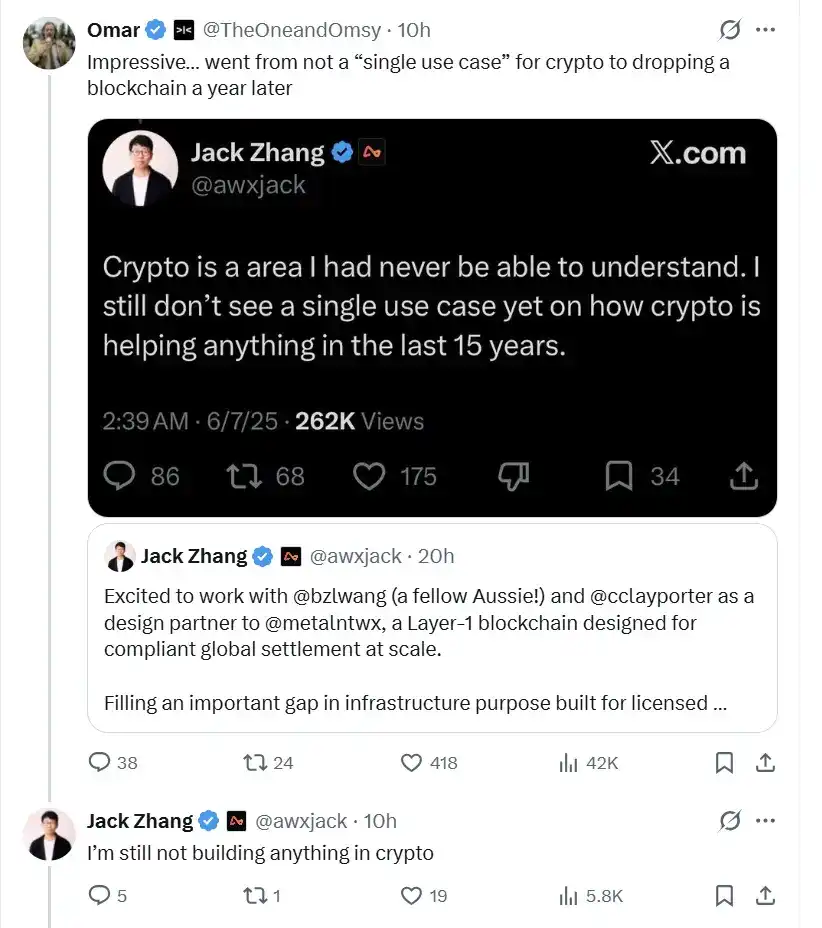
Nevertheless, this is still good news for the stablecoin and crypto payments sector.
III. Stablecoins and Crypto Payments Are Being Rapidly Adopted by the Mainstream System
Airwallex's investment in Metal is not an isolated case; the traditional financial system has been competing to layout in the stablecoin payments field over the past year.
Stripe successively acquired Bridge and Privy, supplementing its stablecoin payment and wallet infrastructure; Mastercard acquired BVNK to enter stablecoin enterprise payments; Large banks like JPMorgan, Citi, Bank of America, and Wells Fargo have also reportedly planned to launch tokenization networks to compete with crypto companies on 24/7 settlement. a16z views these moves as signals that the migration of finance on-chain has passed a tipping point.
Simultaneously, the rhetoric of traditional financial leaders is also changing.
JPMorgan CEO Jamie Dimon has long been skeptical of crypto, but after JPMorgan launched the institutional payment-focused dollar deposit token JPMD, he acknowledged that stablecoins "are real" and stated that JPMorgan must participate to understand their development.
Visa's crypto head, Cuy Sheffield, has a judgment closer to Jack Zhang's revised view: stablecoins may not disrupt card networks in U.S. domestic retail payments, but in emerging markets like Latin America, Africa, and Asia-Pacific, stablecoins can provide access to dollars and modern financial tools.
These cases collectively illustrate that stablecoins are being redefined by traditional finance. They are no longer just dollar substitutes in exchanges but a common interface for corporate finance, cross-border payments, on-chain assets, bank deposits, and dollar liquidity.
For Airwallex, stablecoins are no longer just a theoretical question of "whether they are useful," but a strategic question of "whether to secure a position."
If stablecoins continue to develop, future enterprise clients may need not only traditional multi-currency accounts but also stablecoin accounts; not only local bank collection but also on-chain dollar settlement.
This will change the competitive boundaries of payment companies. In the past, payment companies competed on licenses, local banking networks, forex costs, and API capabilities. In the future, they will also need to compete on stablecoin settlement, on-chain compliance, wallet infrastructure, on-chain liquidity management, etc.
So, Airwallex's investment in Metal is not a sudden "belief in crypto" but an advance purchase of an entry ticket to a new gaming table. It can continue to question the cost-effectiveness of stablecoins in G10 currency corridors, but it cannot ignore the structural opportunities stablecoins present in emerging markets, corporate finance, and on-chain settlement.
A year ago, Jack Zhang asked: What exactly are stablecoins good for?
A year later, Airwallex leading the investment in Metal provides the answer: At the very least, it's worth investing in, and one shouldn't stand on the sidelines watching.