AI Jargon Dictionary (March 2026 Edition), Recommended to Bookmark

Odaily星球日报Published on 2026-03-11Last updated on 2026-03-11

Abstract

The "AI Jargon Dictionary (March 2026 Edition)" is a practical guide for those new to the AI field, especially crypto enthusiasts looking to stay relevant. It covers essential and advanced AI terms to help readers understand key concepts and avoid confusion in industry discussions. The dictionary is divided into two parts: **Basic Vocabulary (12 terms):** - Core concepts like LLM (Large Language Model), AI Agent (intelligent systems that execute tasks), Multimodal (handling multiple data types), and Prompt (user instructions). - Key technical terms: Token (processing unit), Context Window (token capacity), Memory (retaining user data), Training vs. Inference (learning vs. execution), and Tool Use (calling external tools). - Generative AI (AIGC) and API (integration interface) are also explained. **Advanced Vocabulary (18 terms):** - Technical foundations: Transformer architecture, Attention mechanism, and Parameters (model scale). - Emerging trends: Agentic Workflow (autonomous systems), Subagents, Skills (reusable modules), and Vibe Coding (AI-assisted programming). - Challenges: Hallucination (incorrect outputs), Latency (response time), Guardrails (safety controls). - Optimization techniques: Fine-tuning, Distillation (model compression), RAG (Retrieval-Augmented Generation), Grounding (fact-based responses), Embedding (vector encoding), and Benchmark (performance evaluation). The article emphasizes practicality, urging readers to learn these term...

Original | Odaily Planet Daily (@OdailyChina)

Author | Golem (@web 3_golem)

Now, if people in the crypto circle don't pay attention to AI, they are easily ridiculed (yes, my friend, think about why you clicked in).

Are you completely clueless about the basic concepts of AI, asking Doubao what every abbreviation in a sentence means? Or are you confused by various technical terms at AI offline events, pretending you haven't lost track?

Although it's unrealistic to jump into the AI industry overnight, knowing the high-frequency basic vocabulary of the AI industry is always beneficial. Fortunately, the following article is prepared for you↓ Sincerely recommend that you read it thoroughly and bookmark it.

Basic Vocabulary (12)

LLM (Large Language Model)

LLM is essentially a deep learning model trained on massive amounts of data, excelling at understanding and generating language. It processes text and is increasingly capable of handling other types of content.

In contrast, there is SLM (Small Language Model)—typically emphasizing lower cost, lighter deployment, and more convenient localization of language models.

AI Agent (AI Intelligent Agent)

AI Agent refers not just to "a model that can chat," but to a system that can understand goals, call tools, execute tasks step by step, and even plan and verify when necessary. Google defines an agent as software that can reason based on multimodal inputs and perform actions on behalf of the user.

Multimodal (Multimodal)

Such AI models don't just read text; they can simultaneously process and generate various types of input and output, including text, images, audio, and video. Google explicitly defines multimodality as the ability to process and generate different types of content.

Prompt (Prompt)

The instruction input by the user to the model, which is the most basic form of human-computer interaction.

Generative AI (Generative AI / AIGC)

Emphasizes AI's ability to "generate" rather than merely classify or predict. Generative models can generate text, code, images, memes, videos, and other content based on prompts.

Token (Token)

This is one of the concepts in the AI circle most similar to a "Gas unit." Models don't understand content by "word count" but process input and output by tokens. Billing, context length, and response speed are often strongly related to tokens.

Context Window (Context Window / Context Length)

Refers to the total number of tokens a model can "see" and utilize at once. It can also be described as the number of tokens the model can consider or "remember" during a single processing instance.

Memory (Memory)

Allows the model or Agent to retain user preferences, task context, and historical states.

Training (Training)

The process by which the model learns parameters from data.

Inference (Inference Execution)

Opposite of training, it refers to the process where the model receives input and generates output after deployment. The industry often says, "Training is expensive, but inference is even more costly," because many costs during the actual commercialization phase occur during inference. The distinction between training and inference is also a fundamental framework in discussions about deployment costs among major vendors.

Tool Use / Tool Calling (Tool Calling)

Means the model doesn't just output text but can also call tools such as search, code execution, databases, and external APIs. This is already considered one of the key capabilities of an Agent.

API (Interface)

The infrastructure used when AI products, applications, or Agents connect to third-party services.

Advanced Vocabulary (18)

Transformer (Transformer Architecture)

A model architecture that enables AI to better understand contextual relationships. It is the technical foundation for most large language models today. Its biggest feature is the ability to simultaneously consider the relationships between every word in an entire segment of content.

Attention (Attention Mechanism)

It is the most critical core mechanism of the Transformer. Its role is to allow the model to automatically determine "which words are most worth focusing on" when reading a sentence.

Agentic / Agentic Workflow (Agentic / Agentic Workflow)

This is a very hot term recently. It means a system is no longer just "question and answer" but has a certain degree of autonomy to break down tasks, decide next steps, and call external capabilities. Many vendors see it as a sign of "moving from Chatbot to an executable system."

Subagents (Sub-agents)

An Agent further breaks down into multiple specialized smaller Agents to handle sub-tasks.

Skills (Reusable Capability Modules)

With the popularity of OpenClaw, this term has become noticeably more common recently. These are installable, reusable, and composable capability units/operation manuals for AI Agents. However, there are specific warnings about tool misuse and data exposure risks.

Hallucination (Machine Hallucination)

Refers to the model speaking nonsense with a straight face, "perceiving patterns that do not exist" and thus generating erroneous or absurd outputs. It is the model's seemingly reasonable but actually wrong overconfident output.

Latency (Latency)

The time it takes for the model to output results after receiving a request. It is one of the most common engineering jargon terms and frequently appears in discussions about implementation and productization.

Guardrails (Guardrails)

Used to restrict what the model/Agent can do, when to stop, and what content cannot be output.

Vibe Coding (Vibe Coding)

This term is also one of the most popular AI jargons today. It means users directly express requirements through conversation, and the AI writes the code, while the user doesn't need to specifically understand how to code.

Parameters (Parameters)

The internal numerical scale of the model used to store capabilities and knowledge. It is often used as a rough measure of the model's size. "Billions of parameters" and "trillions of parameters" are among the most common intimidating phrases in the AI circle.

Reasoning Model (Strong Reasoning Model)

It typically refers to models that are better at multi-step reasoning, planning, verification, and complex task execution.

MCP (Model Context Protocol)

This is a very hot new jargon in the past year. Its role is similar to establishing a universal interface between the model and external tools/data sources.

Fine-tuning / Tuning (Fine-tuning)

Continuing training on a base model to make it more adapted to specific tasks, styles, or domains. Google's terminology list directly treats tuning and fine-tuning as related concepts.

Distillation (Distillation)

Compressing the capabilities of a large model into a smaller model as much as possible, akin to having a "teacher" teach a "student."

RAG (Retrieval-Augmented Generation)

This has almost become a basic configuration for enterprise AI. Microsoft defines it as a "search + LLM" pattern, using external data to ground the answers, solving problems like outdated training data and lack of knowledge about private knowledge bases. The goal is to base answers on real documents and private knowledge, rather than relying solely on the model's own memory.

Grounding (Fact Alignment)

Often appears together with RAG. It means making the model's answers based on external sources like documents, databases, web pages, etc., rather than just relying on parameter memory for "free play." Microsoft explicitly lists grounding as a core value in its RAG documentation.

Embedding (Vector Embedding / Semantic Vector)

Encoding text, images, audio, and other content into high-dimensional numerical vectors to calculate semantic similarity.

Benchmark (Benchmark Test)

A evaluation method that uses a unified set of standards to test model capabilities. It is also the language of leaderboards that various vendors love to use to "prove they are strong."


Trending Cryptos

Related Questions

QWhat is the core function of a Large Language Model (LLM) according to the article?

AThe core function of an LLM is to be a deep learning model trained on massive amounts of data, excelling at understanding and generating language. It primarily processes text and is increasingly capable of handling other types of content.

QWhat key ability defines an AI Agent beyond just being a 'chatty model'?

AAn AI Agent is defined by its ability to understand goals, call upon tools, execute tasks step-by-step, and perform planning and verification when necessary. It's a system that can reason based on multimodal input and perform actions on behalf of the user.

QWhat does the term 'Token' represent in the context of AI models, and what is it compared to?

AA 'Token' is a unit of processing for AI models, similar to how 'Gas' is a unit in some blockchain systems. It's how the model understands content, not by word count. Fees, context length, and response speed are all strongly related to token usage.

QWhat is the purpose of 'RAG' (Retrieval-Augmented Generation) as described in the article?

AThe purpose of RAG is to combine search with a Large Language Model (LLM). It uses external data to ground the model's answers, solving problems like outdated training data and a lack of knowledge about private databases. The goal is to base answers on real documents and private knowledge rather than relying solely on the model's internal memory.

QWhat does the term 'Hallucination' mean in relation to AI models?

A'Hallucination' refers to the phenomenon where an AI model confidently produces incorrect or nonsensical outputs, 'perceiving patterns that do not exist'. It is the model's seemingly reasonable but actually erroneous overconfident output.

Related Reads

Low Investment Isn't Apple's Immunity Pass

While Meta and Google face investor scrutiny over ballooning AI capital expenditures, Apple's minimal AI investment has paradoxically become a strength. Its market cap recently reclaimed the global top spot, surpassing $5 trillion. The irony is deep: Apple's own AI efforts have lagged, with "Apple Intelligence" delayed and core talent lost, forcing reliance on partners like Google Gemini and Alibaba's Qianwen. Its Q3 FY2026 (Q2 CY) earnings initially seemed stellar. Revenue hit $109.4B (up 16% YoY), with iPhone and Mac sales, growing 22% and 29% respectively, driving most of the growth. However, the stock fell over 8% post-earnings. The primary concern was a weaker Q4 revenue growth forecast of 9-11%, below expectations, due to looming supply chain constraints. Apple is feeling the indirect cost of the AI boom. Soaring memory and chip prices, fueled by massive data center investments from Microsoft, Amazon, and others, are forcing Apple to raise Mac and iPad prices significantly. The upcoming iPhone launch is also expected to see substantial price hikes. Despite avoiding heavy AI infrastructure spending—its capital expenditures are actually down 28%—Apple cannot escape the industry-wide supply and cost pressures. While Apple's operating cash flow remains robust, its substantial R&D spending (up 32% YoY) has yet to yield major AI breakthroughs. As Tim Cook prepares to step down as CEO, Apple faces a challenging transition: balancing its premium hardware success against the strategic and cost pressures of the AI era it has so far cautiously navigated.

marsbit18m ago

Low Investment Isn't Apple's Immunity Pass

marsbit18m ago

PA Graphics Explanation | One Chart to Understand the Major Web3 Events in August 2026

**PANews Crypto Calendar: Key Web3 Events in August 2026** PANews introduces its revamped crypto calendar, featuring comprehensive coverage, flexible filtering, and easy export options. The market in August will be shaped by multiple key events across macroeconomics, regulation, tokenomics, and project developments: * **Macro & Policy:** Key US economic data releases (July Non-Farm Payrolls, CPI), the Federal Reserve meeting minutes, and the Jackson Hole Economic Symposium will be in focus. On the regulatory front, the US Senate plans to release a new draft of the *CLARITY Act*, while the EU's expanded crypto ban against Belarus comes into effect. * **Token Unlocks:** Significant token unlocks are scheduled for assets including ENA, AVAX, CONX, ZRO, and KAITO, which may influence market volatility. * **Project Updates & Shutdowns:** Several services, including Exchange Art, Ctrl Wallet, Zapper, NFTfi, and Summer.fi, are set to cease operations or undergo major adjustments. Users are advised to manage their assets accordingly. * **Corporate Activity:** Q2 earnings reports from companies like SpaceX, Circle, and Nvidia are due. Unitree Robotics will initiate its IPO subscription on the STAR Market, and Moonshot AI plans to begin a Pre-IPO financing round. * **Industry Events:** Major conferences such as Bitcoin Asia 2026 and the 2026 Digital Expo will take place. The overarching market narrative for August will revolve around macroeconomic expectations, regulatory developments, token unlock schedules, and ongoing industry consolidation.

marsbit29m ago

PA Graphics Explanation | One Chart to Understand the Major Web3 Events in August 2026

marsbit29m ago

Wall Street's Most Famous 'Cassandra' Now Has His Sights Set on Nvidia

Michael Burry, the famed "Big Short" investor, has once again captured Wall Street's attention with a series of short positions against major tech and semiconductor stocks, most notably Nvidia. In late June and July, through his "Cassandra Unchained" newsletter, Burry disclosed short bets against Nvidia, Tesla, Applied Materials, Caterpillar, the SOXX semiconductor ETF, and later, Micron Technology. His core thesis revolves around potential distortions in the AI infrastructure boom, specifically questioning whether extended depreciation schedules (e.g., 6 years vs. a realistic 2-3 years for AI chips) by cloud giants like Microsoft and Google artificially inflate profits. He also raises concerns about possible "off-balance-sheet circular financing," where chip demand might be propped up by vendor-backed funding to clients. Nvidia's stock experienced volatility following these disclosures, briefly dipping but largely holding near Burry's reported entry points, leaving his positions roughly flat or slightly underwater as of late July. This move is part of a pattern for Burry, whose track record since his legendary 2008 bet is mixed. He has faced notable losses, such as on Tesla in 2021, while scoring on broader market turns like the 2020 pandemic crash. His methodology focuses intensely on free cash flow and scrutinizing original financial documents to spot overvaluation and structural risks, but it often struggles with timing the market. The article contrasts Burry's stance with other prominent investors. Steve Eisman, another "Big Short" figure, is not shorting Nvidia, citing strong fundamentals but expressing nervousness about sustainability. Jim Chanos agrees with the broad "accounting mismatch" concern—comparing it to the dot-com bubble—but targets financial leverage in private equity firms rather than the chip stocks themselves. While Nvidia's short interest remains relatively low at 1.3-1.4% of float, the massive stock size means absolute short losses have been significant, exceeding $5 billion earlier this year. The piece concludes that for ordinary investors, the key takeaway is not replicating specific short bets but learning from the critical frameworks these investors use: questioning rosy accounting, identifying structural vulnerabilities, and maintaining skepticism during market euphoria, even if pinpointing the exact catalyst for a downturn remains elusive.

marsbit53m ago

Wall Street's Most Famous 'Cassandra' Now Has His Sights Set on Nvidia

marsbit53m ago

Weekly Selection丨Epic Stock Market Volatility, Changxin Tech's IPO Reshapes Storage Landscape, Saylor Aims to Re-Anchor STRC Around September 8th

PANews Weekly Digest: Market Turmoil, Tech Breakthroughs, and Crypto Developments. The week saw significant volatility across global markets. South Korea's KOSPI index experienced extreme turbulence, including multiple trading halts, largely driven by sharp declines in AI hardware stocks like SK Hynix. In contrast, China's Changxin Xinqiao (CXC) achieved a landmark IPO with a market cap surpassing 4 trillion yuan, marking a major success for the domestic DRAM industry after a decade of losses. In the crypto and Web3 space, several key narratives emerged. AI is driving demand for new infrastructure, with projects like AI agent wallets and programmable payments gaining traction, attracting interest from firms like Coinbase. The Bitcoin mining sector is pivoting, with companies like MARA focusing on energy management as electricity becomes a core AI-era asset. Meanwhile, the RWA (Real World Assets) sector faces a "utilization puzzle," with hundreds of billions in on-chain assets remaining dormant. Notable market movements included a historic single-day surge of over 17% for the KOSPI index and a significant migration of $16.5 billion in staked ETH within the Lido ecosystem. Michael Saylor announced a target to re-peg the STRC stablecoin around September 8th. Other highlights include discussions on Ethereum's ambitious 2030 roadmap for scaling and privacy, analysis showing high protocol revenues not always translating to token price gains, and warnings from Citi about potential extreme commodity price shocks by late 2026.

marsbit59m ago

Weekly Selection丨Epic Stock Market Volatility, Changxin Tech's IPO Reshapes Storage Landscape, Saylor Aims to Re-Anchor STRC Around September 8th

marsbit59m ago

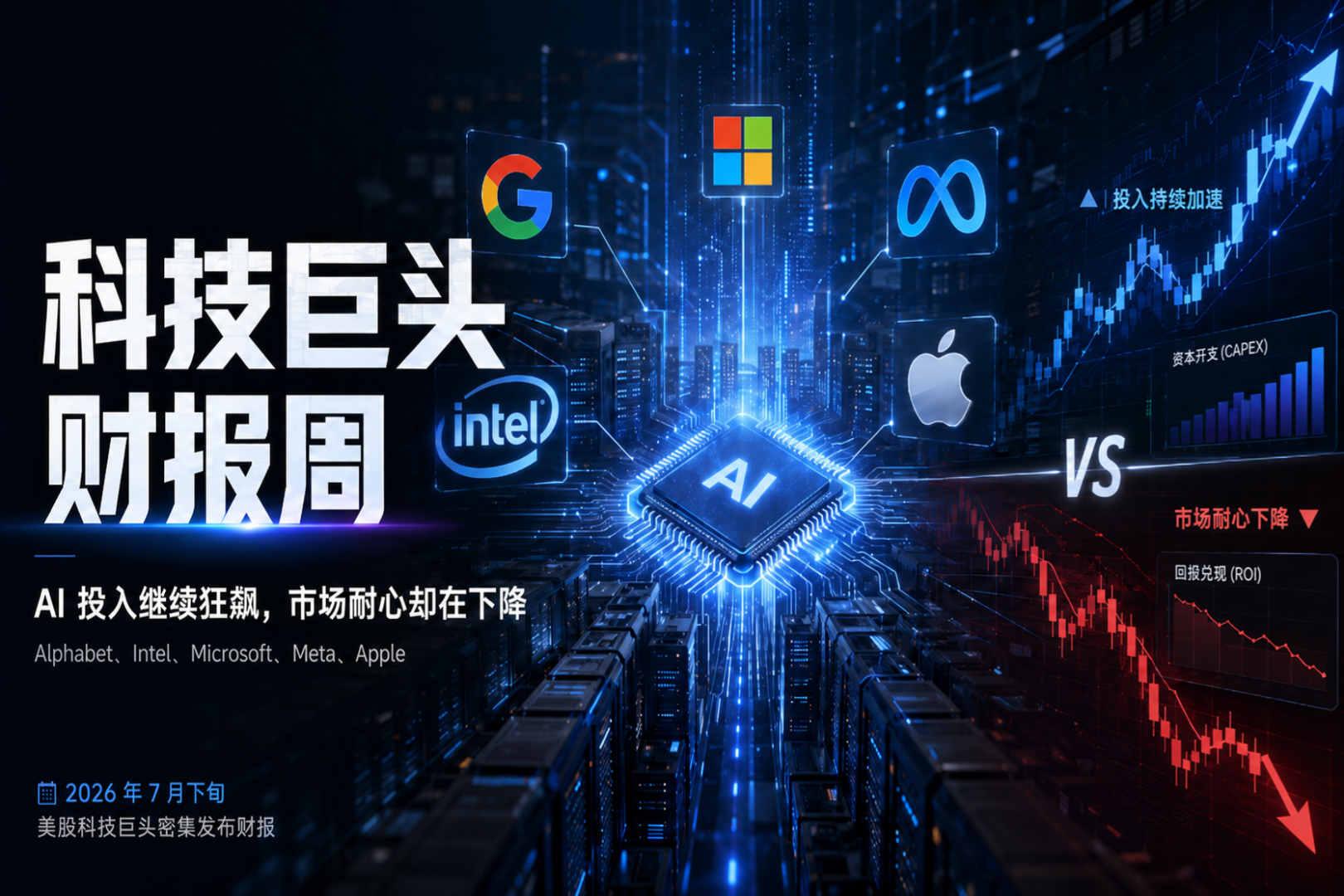
When the Market Begins to Question AI Capex: A Full Analysis of Q2 Earnings Reports from Five Tech Giants

In late July 2026, five major US tech giants—Alphabet, Intel, Microsoft, Meta, and Apple—released their Q2 earnings reports. While all companies exceeded revenue and profit expectations, driven by strong AI-related business growth, investor reactions diverged sharply due to concerns over escalating AI capital expenditures (capex) and their impact on free cash flow. Alphabet reported strong revenue growth and a surging cloud business, but its stock fell after announcing a doubled year-on-year capex and negative quarterly free cash flow for the first time. Intel posted its strongest revenue growth in over 15 years, but its stock experienced volatile trading after significantly raising its full-year capex guidance. Microsoft saw its stock surge after beating estimates and, crucially, lowering its capex forecast while projecting positive free cash flow. Meta faced the most severe sell-off as its profits declined despite revenue beats, with free cash flow plunging over 90% and its capex guidance raised. Apple reported record June-quarter results, but its stock plummeted after providing Q4 revenue guidance that fell short of expectations, citing supply chain constraints and forex headwinds. The overall takeaway is that the market's focus has shifted from validating AI demand to scrutinizing the timeline for returns on massive AI investments. Companies demonstrating a clearer path to managing capex and preserving free cash flow, like Microsoft, were rewarded, while those signaling continued aggressive spending faced investor skepticism.

Odaily星球日报1h ago

When the Market Begins to Question AI Capex: A Full Analysis of Q2 Earnings Reports from Five Tech Giants

Odaily星球日报1h ago

Trading

Spot

Hot Articles

Discussions

Welcome to the HTX Community. Here, you can stay informed about the latest platform developments and gain access to professional market insights. Users' opinions on the price of AI (AI) are presented below.

活动图片