AI Agents Are About to Take Market Share from Visa

marsbitPublished on 2026-03-31Last updated on 2026-03-31

Abstract

Artificial intelligence agents are poised to disrupt Visa's business model by bypassing the traditional credit card interchange fee structure. Unlike humans, AI agents are purely rational: they don't accumulate rewards, seek fraud protection, or desire premium cards. Their sole objective is to complete transactions at the lowest cost, fastest speed, and with minimal fees. This shift threatens the 2-3% interchange fees that underpin Visa’s $500 billion valuation, as these fees essentially tax human irrationality—something agents lack. Recent developments, such as the launch of Tempo (a high-volume stablecoin settlement blockchain), the Machine Payment Protocol (enabling autonomous micro-payments), and Visa’s own command-line payment tool for AI, indicate a rapid move toward agent-driven commerce. While current transaction volumes remain small, infrastructure is being built to support machine-to-machine payments that avoid card networks. Major players like Stripe, Mastercard, and Circle are investing heavily in this space. Visa network’s distribution advantage relies on human behavior—consumer trust and merchant acceptance—a cycle that doesn’t apply to agents. They optimize for efficiency, not brand loyalty. Although widespread consumer adoption is still emerging, the infrastructure for agent-commerce is advancing quickly, starting with micro-payments for AI services. The fundamental challenge is that interchange fees are a tax on human psychology, and agents are purely ratio...

Article Author: Thejaswini M A

Article Translation: Block unicorn


Preface

Visa's entire business model is a bet on human behavior. It's about human consumption and psychology. The reward points you accumulate, the fraud protection you rely on, the Centurion card you dream of, and the zero-liability policy that makes you feel secure when swiping your card at an ATM abroad—all of these exist not because transferring funds is difficult, but because humans are anxious, status-seeking, and not good at reading terms and conditions. Visa has exploited this cognitive gap to build a $500 billion company.

However, AI agents do not possess these traits.

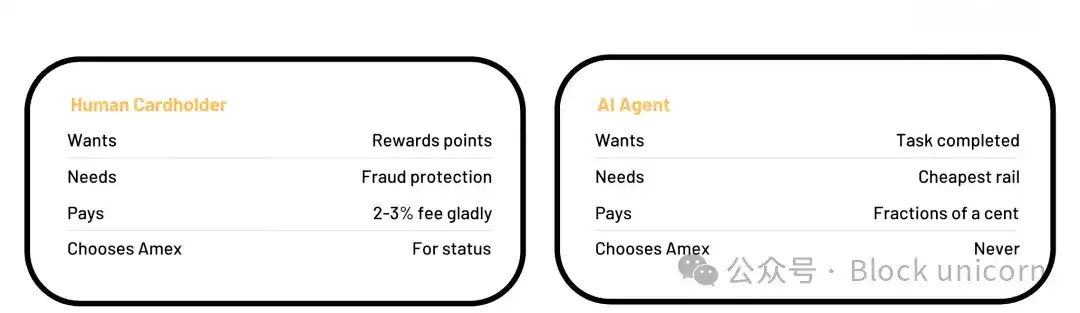
They do not accumulate points, do not seek fraud protection, and do not desire a black card. They have only one instruction: complete the task. And when the task involves payment, the agent performs complex calculations that humans would never bother with: the cheapest path, the fastest settlement, the lowest fees. Every time, automatically, without any emotion.

Last month, an article on SubStack titled "The 2028 Global Intelligence Crisis" caused Visa's stock to plummet 4% in a single day, Mastercard to fall 6%, and American Express to drop 12%. The report was labeled a "scenario analysis," not a "prediction" (原文如此). But the market didn't buy it. The technical arguments were also irrelevant. The point is that by 2027, agents will bypass transaction centers and use stablecoins for settlement. Visa spent fifty years perfecting its product, and now its customer base is being replaced.

In machine-to-machine commerce, a 2-3% interchange fee is clearly a target. This argument from Citrini Research is its core thesis. This does not mean that AI will destroy Visa tomorrow. Rather, the fee structure upon which Visa built its commercial empire is essentially a tax on human irrational behavior, and the transactors themselves are completely rational. This is the very reason for Visa's existence.


What is Visa Selling?

To understand why this matters, you must know what interchange fees are actually used for.

When you use a credit card to make a purchase, the merchant pays a 2-3% fee to the credit card network and your issuing bank. This fee pays for your reward points, fraud protection, purchase insurance, and dispute resolution services. The entire consumer value proposition of the credit card is borne by the merchant, who ultimately passes the cost on to the consumer through slightly higher prices. This is a well-established and stable system that has worked for fifty years because the consumer in the transaction is willing to bear all these costs, albeit not directly.

AI agent does not need these. It will not dispute charges or request refunds. The justification for charging this fee is that it protects against human error, fraud, and impulsive behavior. If there is no human involved in the transaction, this fee becomes completely meaningless.

American Express is the most典型 example of this problem. Its customers are high-income, high-spending, and aspirational premium cardholders. Its annual fee is higher than Visa's or Mastercard's precisely because its customers are willing to pay for status and privilege. This model presupposes that purchasing behavior is human-driven, that customers choose Amex over Visa because lounge access is worth it. An agent will not actively choose Amex; they will only look for the cheapest option to complete the transaction. In a world where software controls credit cards, premium membership tiers do not exist.
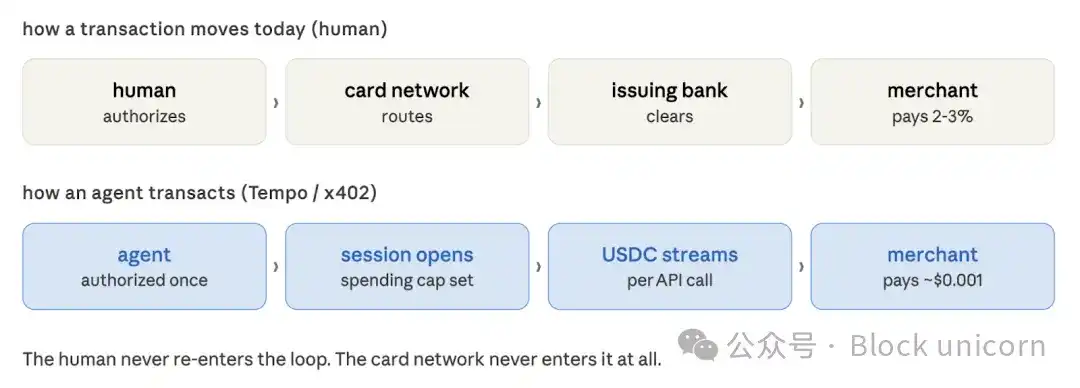
An agent-led commercial routing model that bypasses interchange fees poses a greater risk to credit card banks and mono-line issuers that rely heavily on 2-3% fee revenue and have built their entire business segments around merchant-subsidized reward programs. Visa and Mastercard have network businesses that can adapt. Those issuers who have built their entire P&L model around interchange fees and reward programs have nowhere to retreat.


The Week Everyone Shipped at Once

The Citrini report and infrastructure project launches happened to be released within the same three weeks.

Tempo officially launched its mainnet last Wednesday. The payment blockchain jointly developed by Stripe and Paradigm, designed for high-volume stablecoin settlement, was launched同步ously with the Machine Payable Protocol (MPP). MPP is an open standard that allows AI agents to autonomously pay for services without manual approval for each transaction. The protocol introduces session mechanics. An agent authorizes a spending limit once and can then make continuous micropayments for services like data consumption, computation, or API calls. Funds are paid using OAuth authentication. The user authorizes a budget, and the agent spends. The entire process does not require a bank card at every step.

Anthropic, DoorDash, Mastercard, Nubank, OpenAI, Ramp, Revolut, Shopify, Standard Chartered, and Visa are listed as design partners for Tempo. The entire payment and e-commerce ecosystem has acknowledged this structural change.

On the same day Tempo launched, Visa's cryptocurrency division launched a command-line interface tool for AI agents to make payments through the terminal, without API keys, without accounts, and without human authorization. Visa calls this "command-line commerce"—machines transacting without human intervention.

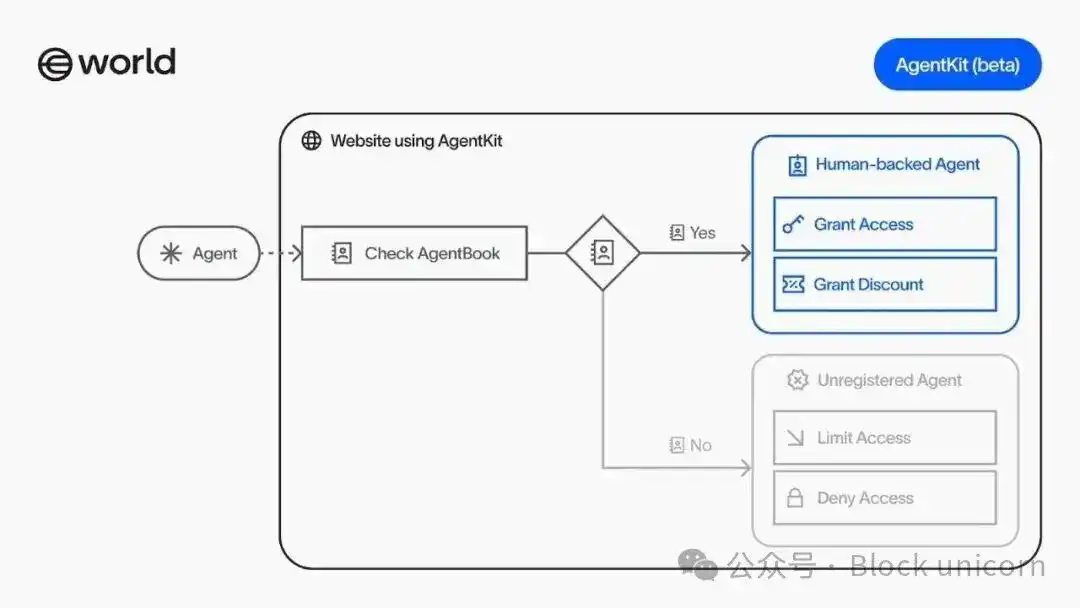
Mastercard agreed to acquire stablecoin infrastructure startup BVNK for $1.8 billion. Circle launched Nanopayments on the testnet, a sub-cent, gas-free USDC transaction designed for agents using pay-per-use APIs without accounts or credentials. Sam Altman's World project launched AgentKit, allowing agents to carry cryptographic proofs to demonstrate they represent a real person; the toolkit integrates directly into Coinbase's payment system, enabling platforms to verify agent identity without hindering legitimate transactions.
极速

What happened last week, in my view, is that companies are racing to become the new Visa, lest Visa realizes what it has lost.


The Obvious Paradox

Let's be perfectly clear: Visa is not standing still.

It is involved in the development of Tempo's Machine Payable Protocol (MPP), has launched Visa Crypto Labs, and its head of cryptocurrency wrote an article in Fortune explaining how agents can use bank card payments through new standards. Mastercard is investing $1.8 billion in stablecoin infrastructure. Stripe acquired Bridge and Privy. The incumbents are aware of this shift and are preparing before the new infrastructure fully arrives.

Visa's argument is that it can extend its rails to agent-driven commerce before agent-driven commerce builds rails that make Visa irrelevant.
This argument is not entirely wrong. Stripe processed $1.9 trillion in payment volume in 2025, a 34% year-on-year increase. These companies are not shrinking. The network distribution advantages of card organizations are difficult to replicate. I admit I am reluctant to say this publicly because historically, as soon as someone makes this argument, a new product is launched that makes them look foolish.

So, here is the flaw in the argument: Visa's distribution advantage is built on relationships with merchants and consumer trust. Merchants accept Visa because consumers hold Visa; consumers hold Visa because merchants accept Visa. The entire flywheel runs on people. Once agents become the primary buyers in a significant area of commerce, this flywheel slows down. Agents have neither brand loyalty nor wallets. They only have budgets and instructions. Whichever route is cheapest and fastest wins their business, with zero switching costs.

I want to be precise about where we are because the narrative is currently moving faster than the data.

Although the ecosystem around x402 is valued at approximately $7 billion, on-chain data shows that the protocol's daily transaction volume last week was only around $28,000, most of which came from testing rather than actual transactions. This figure is a world away from Visa's daily transaction volume.
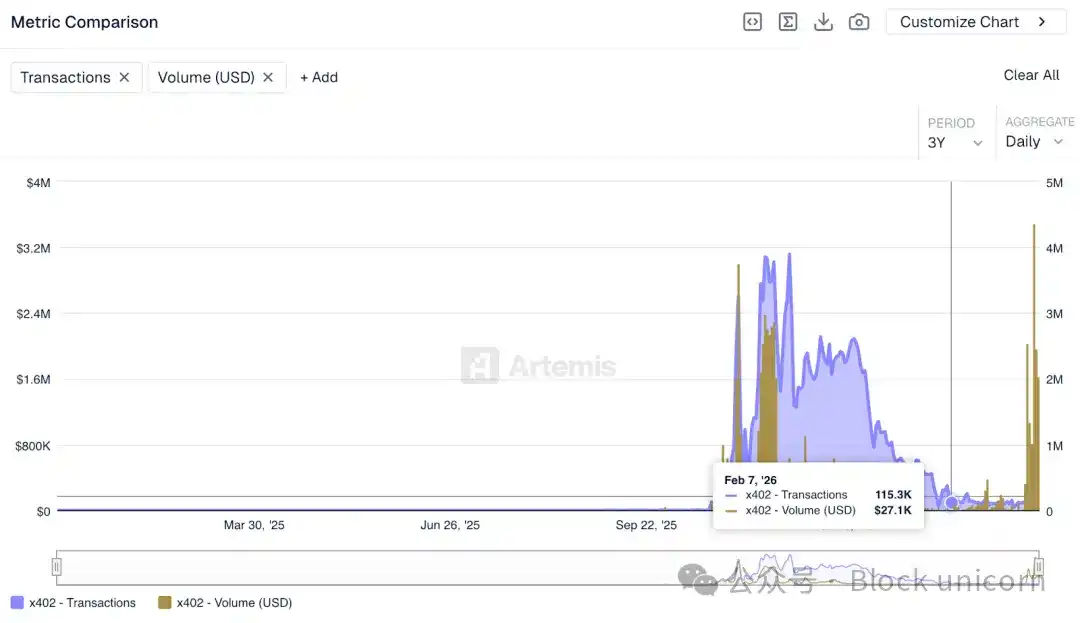
x402's transaction count has exceeded 50 million. Although the amount per transaction is small, the number of transactions indicates that the infrastructure is being used. Developers are building on it. The merchant-side services that accept agent payments are also growing. This is how payment networks start.

McKinsey estimates that by 2030, AI agents could facilitate $3 trillion to $5 trillion in global consumer transactions. This estimate may be correct or overly optimistic. But it is indisputable that agent-driven business models are not yet widespread at scale. The merchants building native agent services, the businesses using agents as primary buyers, and the transaction volumes that can truly test the economics are still developing.

The Citrini report caused market panic because it模拟ulated a series of credible events. Mastercard's Q1 2027 earnings report will not attribute a slowdown in transaction volume to "agent-led price optimization." At least not yet.

The first to be affected will be micropayments for AI infrastructure, not consumer commerce.

An agent completing a research task calls specialized data APIs hundreds of times per session. Each call costs a fraction of a cent. Over a week, these calls could generate $40 in revenue for the developer operating the service. Credit card networks cannot handle this. The economics of minimum transaction amounts don't work. The merchant onboarding process doesn't work. The fee structure doesn't work. This type of business model is destined not to work within Visa's framework. It requires a completely new model, and x402, Nanopayments, and Tempo are building it.

As Citrini's model shows, the disruption of consumer commerce, if it happens, will come later. It requires agents to handle a significant portion of discretionary spending, which in turn requires consumers to trust agents enough to let them make purchasing decisions that they currently make themselves.

Visa is being冲击ed by better customers. These customers no longer need the elements upon which Visa's success was built. The 2-3% interchange fee is not a transaction tax; it is a tax on the irrationality of human nature. And agents are perfectly rational.

How do I know this matters? Because Visa spent $1.8 billion last week to ensure it is not left out of the answer.


Related Questions

QWhy does the article argue that AI agents pose a threat to Visa's business model?

AThe article argues that Visa's business model is built on human psychology—rewards, fraud protection, status symbols, and anxiety. AI agents are purely rational, don't care about rewards or status, and will always seek the cheapest, most efficient payment path, bypassing Visa's 2-3% interchange fees, which are essentially a 'tax on human irrationality'.

QWhat is the core argument of the Citrini Research report mentioned in the article?

AThe core argument of the Citrini Research report is that by 2027, AI agents will bypass traditional transaction networks like Visa and use stablecoins for settlement, directly threatening the interchange fee-based revenue model that underpins these companies.

QWhat new infrastructure and standards are being developed to facilitate AI agent payments?

ANew infrastructure includes Tempo, a payment blockchain for high-volume stablecoin settlements; the Machine Payment Protocol (MPP) for autonomous micro-payments; Visa's command-line interface for agent payments; Circle's Nanopayments for sub-cent USDC transactions; and Sam Altman's World project with AgentKit for identity verification.

QHow are established companies like Visa and Mastercard responding to this potential disruption?

AThey are actively adapting by investing in new infrastructure. For example, Visa is involved in developing the MPP standard and its crypto division launched tools for agent payments. Mastercard acquired stablecoin infrastructure company BVNK for $1.8 billion. They are trying to extend their networks into the agent-driven economy before being made irrelevant.

QAccording to the article, which sector will be disrupted first by AI agent payments, and why?

AThe AI infrastructure and micro-payments sector will be disrupted first. This is because AI agents make hundreds of tiny API calls costing fractions of a cent, a model that is economically unfeasible with credit card networks due to minimum transaction fees and complex merchant onboarding. Consumer commerce will be affected later, once agents handle a significant portion of discretionary spending.

Related Reads

Is AI Creating a New Class of 'Information Poor'?

AI is generating a new kind of "information poverty." The core issue isn't that AI denies answers to the poor; it's that it provides abundant, cheap, and plausible-sounding answers to everyone. This availability shifts the true scarcity from obtaining answers to possessing the **judgment to evaluate them** and the access to turn them into real-world opportunities. New information poverty thus describes those who have AI tools and outputs, but lack the complementary skills, authorization, and contextual experience to critically assess and act on them. Research reveals a multi-layered divide: access to AI is stratified by income and platform design (e.g., premium vs. free, embedded tools). In workplaces, usage heavily favors higher-paid, more experienced, or formally trained employees, with AI often automating entry-level tasks that were traditional stepping stones. Crucially, the heaviest users are often mid-career professionals whose existing expertise allows them to effectively judge and leverage AI outputs, while novices risk over-relying on them without building judgment. While controlled experiments show AI can significantly boost low-skilled workers' performance, real-world adoption and benefit are constrained by unequal social and organizational structures. Historically, general-purpose technologies first reward those with existing complementary capital. AI, by affecting judgment-based work, may accelerate and deepen this initial inequality gap, even if it narrows over decades. The danger lies in the illusion of competence it creates, potentially stunting the very critical thinking needed in an era where judgment is paramount.

marsbit19m ago

Is AI Creating a New Class of 'Information Poor'?

marsbit19m ago

Jensen Huang 'Saves' South Korean Stock Market: Locks In SK Hynix Memory, Chip Shortage to Continue

On June 5th, South Korea's stock market experienced a sharp decline, with major chipmakers like Samsung and SK Hynix dropping nearly 10%. Amidst the turmoil, NVIDIA CEO Jensen Huang's visit to Seoul played a dramatic role in boosting market sentiment. Following a dinner meeting with SK Group Chairman Chey Tae-won and SK Hynix CEO Kwak Noh-Jung, Huang confirmed that NVIDIA's new Vera CPU will utilize SK Hynix DRAM. The companies announced a multi-year technical partnership to co-develop next-generation memory for NVIDIA's AI infrastructure, covering products from data centers to personal AI and robotics. This collaboration extends beyond memory supply. SK Hynix is integrating NVIDIA's AI and Omniverse platform into its own semiconductor design and manufacturing processes, including computational lithography and creating digital twins of its fabrication plants for autonomous operation. While strengthening ties with SK Hynix, NVIDIA is diversifying its supply chain for the upcoming HBM4 memory, with Samsung, SK Hynix, and Micron all certified as suppliers for its Vera Rubin platform. Despite this, Huang warned that the global chip shortage, driven by relentless demand from AI factory construction, is expected to persist for several years across the entire supply chain. His visit underscores NVIDIA's systematic effort to deepen integration with South Korea's broader tech industry.

marsbit1h ago

Jensen Huang 'Saves' South Korean Stock Market: Locks In SK Hynix Memory, Chip Shortage to Continue

marsbit1h ago

Nasdaq Plunges 4.2% in a Single Day: Does "Black Friday" Burst the U.S. Stock Market Bubble?

The Nasdaq plunged 4.18% on June 5, 2026, its worst single-day drop in over a year, as a much stronger-than-expected US jobs report triggered fears of economic overheating and delayed Federal Reserve interest rate cuts. The selloff, centered on high-valuation tech and AI stocks like Nvidia and Broadcom, spread across major indices. The article examines whether this signals a market top. The strong May non-farm payrolls data, nearly double expectations, pushed bond yields higher, directly hurting rate-sensitive tech stocks. This exposed vulnerabilities in the crowded AI trade, where valuations had soared on narratives of infinite growth, despite emerging signs of slowing order momentum and corporate AI monetization challenges. Prior to the drop, market indicators flashed warning signs: historically high valuations (e.g., Shiller CAPE ratio near 39.5), extreme bullish sentiment, and high levels of leverage. Technical charts showed key support levels being breached. Wall Street is divided on the outlook. Bears, citing risks of "stagflation" and AI bubble comparisons to the dot-com era, warn of a potential significant correction. Bulls view the drop as a healthy correction within a bull market, underpinned by a strong economy and expected corporate earnings growth of around 7% in 2026. The immediate future hinges on upcoming key events: the May CPI inflation data and the mid-June FOMC meeting. Their outcomes will critically shape market expectations for the Fed's rate path. The article concludes that conditions for a major market top are aligning, marking a fragile transition from narrative-driven gains to a phase demanding validation from macroeconomic data and corporate fundamentals. Caution is advised.

marsbit1h ago

Nasdaq Plunges 4.2% in a Single Day: Does "Black Friday" Burst the U.S. Stock Market Bubble?

marsbit1h ago

Nasdaq Plunges 4.2% in a Single Day, Did 'Black Friday' Pop the U.S. Stock Bubble?

The Nasdaq Composite plummeted 4.18% on June 5, its biggest single-day drop since April 2025, triggering widespread debate over whether the U.S. stock market has peaked. The sell-off was sparked by a stronger-than-expected U.S. non-farm payrolls report, which fueled fears of economic overheating and pushed back market expectations for Federal Reserve rate cuts, leading to a sharp rise in Treasury yields. The AI sector, the primary driver of the recent bull market, suffered severe losses, with the Philadelphia Semiconductor Index crashing over 10%. Stocks like Nvidia, Broadcom, and Micron led the decline. Concerns are mounting about the sustainability of AI capital expenditures and high valuations, with signs of order cuts for next-generation chips emerging. Analyses point to several warning signs: historically high market valuations (e.g., elevated Shiller CAPE ratio, Buffett Indicator), extreme bullish sentiment indicators, and significant insider selling. The sell-off also caused a key technical breakdown, with the S&P 500 breaking below its short-term moving average and testing its 200-day moving average. Wall Street is divided on the outlook. Bears warn this could be the start of a bubble deflation or a "stagflation" scenario, while bulls view it as a healthy, overdue correction within a bull market driven by solid corporate earnings growth. A more moderate view suggests the easy liquidity-driven rally is over, and markets are entering a phase of fundamental stock-picking with potential for consolidation. The immediate future hinges on key upcoming events: the May CPI report and the mid-June FOMC meeting. Their outcomes will be critical in determining whether this is a temporary pullback or the beginning of a more significant trend reversal. The consensus is that the era of one-directional market gains may be ending, requiring increased investor caution.

Odaily星球日报1h ago

Nasdaq Plunges 4.2% in a Single Day, Did 'Black Friday' Pop the U.S. Stock Bubble?

Odaily星球日报1h ago

The First Case on AI Agents: What Was Adjudicated?

"The First 'Agent' Ruling: What Was Decided?" On April 30, the Guangzhou Internet Court issued a ruling—China's first behavior preservation order in the intelligent agent (AI agent) field. The defendant, an open-source AI agent software, was ordered to stop downloads, cease actions that bypassed a platform's technical protection measures, and delete related tutorials and data. The core issue: the software used the operating system's "accessibility service" permissions to automate user interactions within other apps without those platforms' authorization. This mirrors a recent US case where Amazon sued Perplexity for similar reasons—bypassing Amazon's API to directly scrape and interact with its pages—and won a preliminary injunction. Both rulings establish a crucial legal boundary for the AI agent era: agents cannot operate unchecked. The article argues the fundamental legal principle emerging is one of **dual authorization**. An AI agent requires both **user consent** AND **platform consent** to operate legitimately within that platform's ecosystem. Bypassing platform rules through system-level permissions, even with user permission, undermines platform responsibilities for content moderation, data security, and user privacy, creating liability issues. The piece uses the evolution of "Doubao Phone" (an AI-integrated smartphone) as a case study. Its initial, aggressive version that bypassed platform controls faced roadblocks. Its upcoming 2.0 version is reportedly pivoting to negotiate API access and authorization deals with major platforms (like Alibaba's ecosystem), seen as a strategic adaptation to the new regulatory reality. A global trend is identified: the era of unregulated, "wild west" growth for AI agents is ending, replaced by a **compliance race**. This raises barriers to entry, as securing platform authorizations becomes a new cost. Open-source status is also not a legal shield if the code facilitates bypassing technical protections. In conclusion, these first rulings target not the largest, but the most **aggressive and representative** cases. By setting precedent with them, regulators are efficiently steering the entire industry towards a new, more regulated operating paradigm defined by dual authorization and platform cooperation.

marsbit1h ago

The First Case on AI Agents: What Was Adjudicated?

marsbit1h ago

Trading

Spot
Futures

Hot Articles

Discussions

Welcome to the HTX Community. Here, you can stay informed about the latest platform developments and gain access to professional market insights. Users' opinions on the price of AI (AI) are presented below.

活动图片