After the UFO Files Are Made Public, Prediction Markets Only Price the Probability of Alien Existence at 20%?

Odaily星球日报Published on 2026-05-09Last updated on 2026-05-09

Abstract

The U.S. Department of Defense has launched a website declassifying UFO/UAP files, releasing an initial batch of over 160 documents. These include videos, photos, mission logs, sighting reports, and communications from agencies like NASA and the FBI, featuring unexplained incidents such as anomalous lights near Apollo missions and a "jellyfish"-shaped object over the UAE. Despite widespread public discussion, the prediction market predict.fun shows only a 20% probability that the U.S. government will officially confirm the existence of extraterrestrial life or technology by December 31, 2026. The market's focus is not on whether aliens exist, but on whether U.S. authorities will make a definitive, binding statement before the deadline. Analysts note the file release provides transparency and fuels debate but does not constitute an official confirmation. The 20% odds reflect a time-discounted assessment, acknowledging the possibility of future evidence while doubting a conclusive governmental stance within the current year. This event highlights how prediction markets translate speculative narratives into tradable contracts based on verifiable outcomes and specific timelines.

Original | Odaily Planet Daily (@OdailyChina)

Author | Asher(@Asher_ 0210)

Last night, the U.S. Department of Defense officially launched the UFO Archive Disclosure website, releasing the first batch of government documents related to UAPs, unidentified flying objects, and suspected extraterrestrial life. According to public reports, this initial release comprises over 160 documents, including videos, photos, mission records, sighting reports, communication logs, and historical archives from multiple U.S. federal agencies such as NASA, the FBI, and the Department of Defense.

These documents are not just abstract government reports; they contain a large amount of specific imagery and historical records. Among them, the Apollo mission spacecraft once captured three anomalous light points hovering above the Moon, and Apollo 17 communication logs also contain discussions among astronauts about mysterious objects approaching the spacecraft. Another batch of materials shows that unexplained objects have appeared in places like the United Arab Emirates, Greece, and Iraq.

Even more viral are those unresolved cases in the files with visual details. A jellyfish-shaped object appeared over the UAE, some materials record unidentified flying objects resembling luminous spheres and objects with an octagonal star-like shape, and the FBI has also captured anomalous targets near U.S. military aircraft. An image released by the U.S. Department of Defense also shows an unidentified object appearing over the western United States in September 2025.
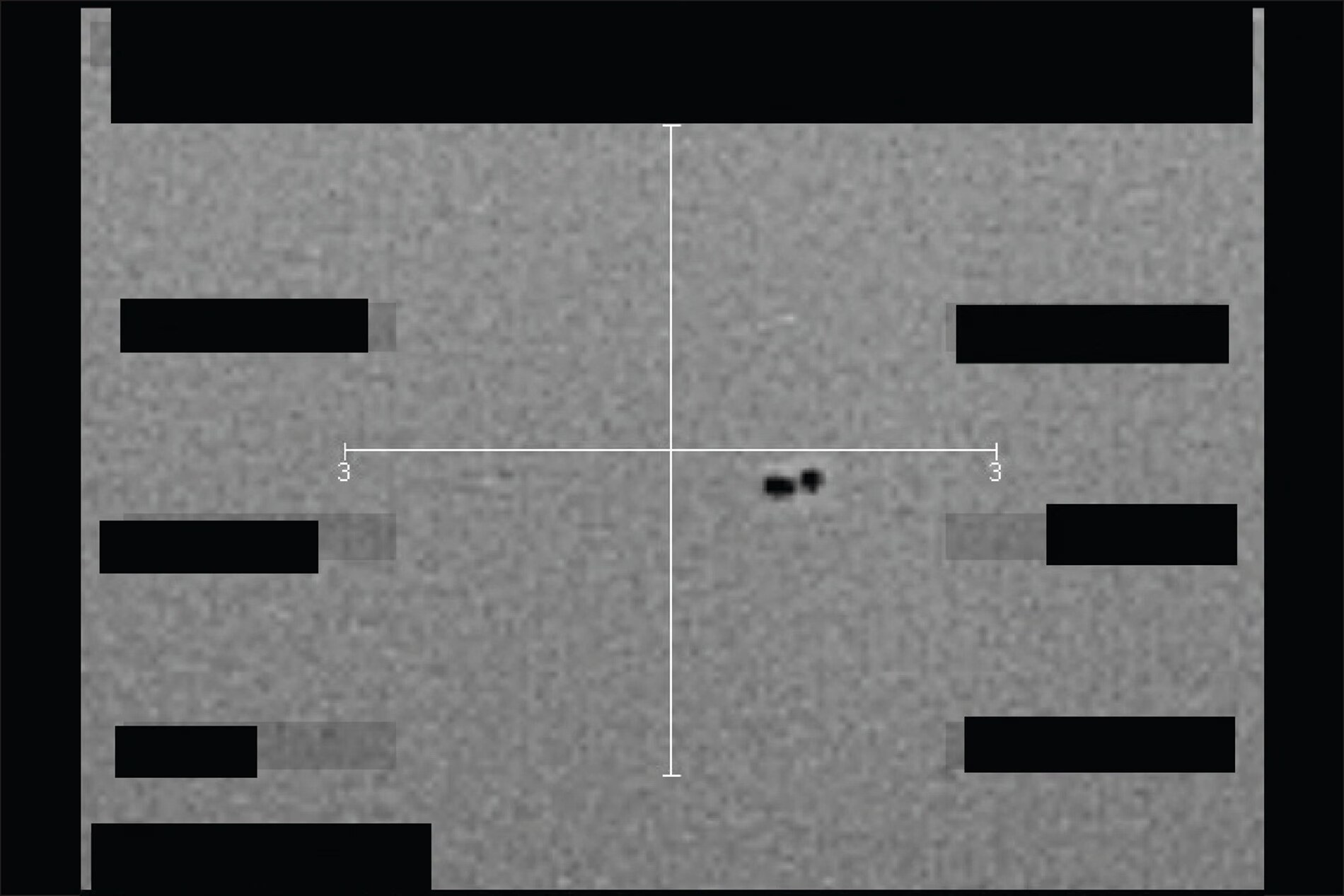
An image released by the U.S. Department of Defense claims to show an unidentified object appearing over the western United States in September 2025 (Source: U.S. Department of Defense)

Compared to mere text reports, this imagery and eyewitness testimony is more likely to cause UFO discussions to spread rapidly, making this disclosure seem more like a concentrated exhibition of "declassified archives."

However, the answer from prediction markets is much more restrained than that of social media. After the first batch of UFO files was made public, the probability for the event "Will the US confirm that aliens exist before 2026-12-31 23:59:59 ET" on the prediction market predict.fun did not surge significantly because of this explosive news. The market did not directly interpret this disclosure as "the U.S. is about to confirm alien existence," and the probability remains at only 20%.
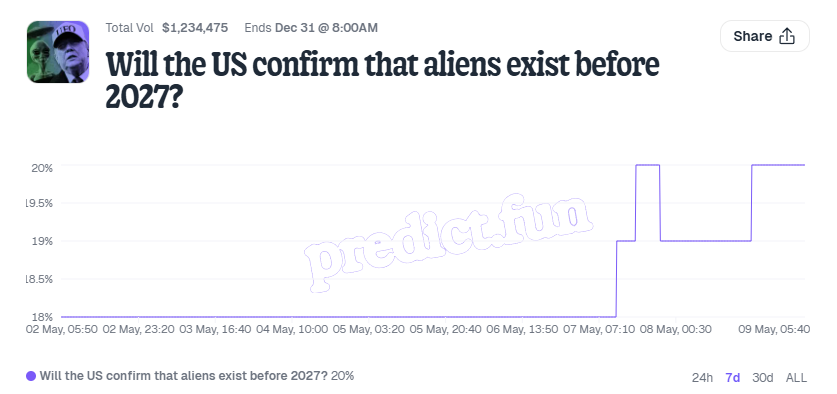
Source: https://predict.fun/market/will-the-us-confirm-that-aliens-exist-before-2027

So, why hasn't this UFO file disclosure significantly changed the judgment of the prediction markets?

Prediction Markets Are Not Betting on Whether Aliens Exist, But on Whether the U.S. Government Will Acknowledge It

Many people, upon seeing a 20% probability, might first think that the prediction market believes the probability of aliens existing is only 20%. But this actually misunderstands the market itself.

Markets like predict.fun are not truly trading on whether extraterrestrial life exists in the universe, but on whether the U.S. government will explicitly confirm the existence of extraterrestrial life or alien technology before 23:59 ET on December 31, 2026. According to the market's settlement rules, only if the U.S. President, a Cabinet member, a member of the Joint Chiefs of Staff, or a U.S. federal agency explicitly makes such a statement will the market settle as Yes; otherwise, it will settle as No. The primary settlement source is official U.S. government information, also referencing consensus formed by credible media reports.

This rule is crucial. It means that a video of an unidentified flying object is not enough, a blurry photo is not enough, an astronaut communication log is not enough, and the military admitting that some phenomena are temporarily unexplainable is also not enough. What can truly trigger a Yes is the U.S. government stating clearly enough, acknowledging that extraterrestrial life or alien technology indeed exists.

Disclosing files is merely placing more material before the public, while official confirmation means the government is backing a conclusion. The former generates discussion; the latter triggers settlement. Between them lies a line that is very difficult to cross.

Archive Disclosure Is Not an Answer Announcement

This UFO file disclosure is indeed not an ordinary information update. The U.S. Department of Defense released related materials in a centralized manner through a dedicated website and stated that more files will be released in batches continuously in the future. For the public, this means that UFO and UAP materials previously scattered across different agencies, eras, and archival systems are being reorganized into an official portal. It makes discussion more focused and makes it easier for the outside world to track what materials the U.S. government actually possesses.

However, judging from the currently disclosed content, this batch of files appears more like presenting historical sightings, anomalous imagery, mission records, and old archives to the public, rather than providing a unified explanation for these materials. The U.S. Department of Defense is not directly telling the world "what this is," but is releasing more unresolved cases, leaving the judgment space to the public.

This also puts this disclosure in a delicate position. It increases transparency but does not change the nature of the events. UFO discussions have thus gained more material, but this material primarily serves to expand the questions themselves rather than advancing unexplained phenomena to extraterrestrial confirmation.

For prediction markets, this file disclosure is more like a new starting point for observation, rather than evidence sufficient to rewrite the odds. It brings the UFO topic back to center stage and gives subsequent file updates transaction value; but the initial batch of materials still consists mainly of historical records, sighting reports, and unresolved imagery. What the market is truly waiting for is a higher-level, harder-to-ignore, and more official key signal.

Is 20% an Underestimation or an Overestimation?

From an emotional perspective, 20% might seem low. After all, UFO file disclosure has entered an official rhythm, and subsequent materials will continue to be released. If clearer military videos, higher-level internal records, or more direct assessments from federal agencies emerge in the future, the Yes price could still be rapidly revalued.

But from a market pricing perspective, 20% is not low. Because this market is not trading an open-ended question, but a question with a clear deadline. The market needs to judge not just whether the U.S. will confirm the existence of extraterrestrial life or alien technology, but also whether such confirmation will happen before the end of 2026.

Time itself is a barrier. Even if files continue to be released, even if more unresolved cases enter the public view, it does not mean the U.S. government will complete evidence review, internal coordination, political assessment, and provide a sufficiently clear conclusion within a few months. For an official system, continuing to disclose material is one thing; reaching a definitive conclusion in a short time is another.

Therefore, the current 20% probability is more like a tail-end pricing with a time discount. It does not deny that subsequent files may continue to create volatility, but it also shows that the market does not believe the initial disclosure has fundamentally changed the assessment of the event. For traders, the disclosure of files itself is not scarce; what is truly scarce is the key signal that could drive official confirmation before the end of this year. Before such a signal appears, the Yes price will find it difficult to be pushed higher solely by archival updates.

When UFOs Enter Prediction Markets, Truth Begins to Have a Price

The most noteworthy aspect of this event is no longer just a certain photo, a certain video, or a jellyfish-shaped object. UFO discussions have long remained in the realm of emotion, belief, and conspiracy narratives. Believers see more clues in every file disclosure, while skeptics continue to emphasize insufficient evidence, misidentification, and technical noise. Both sides have debated for years but find it hard to truly convince each other because they are often not discussing the same question.

Prediction markets pull this question one step closer to reality. They do not attempt to answer whether other life exists in the universe, but narrow the question down to a more specific level—will the U.S. government explicitly acknowledge the existence of extraterrestrial life or alien technology before the end of this year. They turn a previously hard-to-grasp imagination into an event that can be traded, settled, and constantly adjusted as information changes.

Therefore, this roughly 20% probability is not a final judgment on whether alien life exists, but the market's judgment on whether the U.S. government will concede by the end of this year. It truly reflects traders' comprehensive judgment of the evidence chain, official statements, and the time window.

When humanity's oldest puzzle enters prediction markets, truth is no longer just something to be awaited and discussed; it also begins to be priced. UFOs may still hang in the sky, but when they will be officially confirmed, when they will transition from unexplained phenomena to factual conclusions, has already landed in the market.


Related Questions

QWhat is the specific event being traded on predict.fun related to the UFO file release, and what is its current market probability?

AThe event being traded is whether the U.S. government will officially confirm the existence of extraterrestrial life or alien technology before 11:59 PM ET on December 31, 2026. Following the release of the UFO files, the current market probability for this event is approximately 20%.

QAccording to the article, why didn't the UFO file release significantly increase the market probability on predict.fun?

AThe file release did not significantly increase the probability because the market is trading on a specific event: an official U.S. government confirmation. The released files primarily present historical records, sightings, and unexplained materials without providing an official government conclusion or confirmation of extraterrestrial existence. The market views this as expanding the discussion, not as definitive evidence that will force an official acknowledgment within the given timeframe.

QWhat types of materials were included in the first batch of UFO files released by the U.S. Department of Defense?

AThe first batch included approximately 160 documents comprising videos, photos, mission logs, eyewitness reports, communication records, and historical archives. Examples include footage of three anomalous lights from the Apollo mission, communication from Apollo 17 discussing a mysterious object, records of jellyfish-shaped objects over the UAE, and images of unexplained objects over the western U.S. in September 2025.

QFrom a market pricing perspective, why does the article suggest the 20% probability is 'not low'?

AThe 20% probability is considered 'not low' because the market event has a strict deadline (end of 2026). This time constraint adds significant pressure. Even with ongoing file releases, the market judges it unlikely that the U.S. government will complete the necessary evidence review, internal coordination, and political assessment to make a definitive public confirmation within just a few months. The probability reflects a 'time-discounted' assessment of a low-probability, high-impact event.

QHow does the article describe the fundamental shift that prediction markets bring to the UFO discussion?

AThe article states that prediction markets shift the UFO discussion from abstract debates about belief, emotion, and conspiracy theories into a concrete, tradable event. Instead of arguing about whether aliens exist in the universe, the market prices the likelihood of a specific, verifiable action: the U.S. government officially confirming their existence by a set date. This means truth is no longer just waited for or discussed; it is given a price and continuously re-evaluated based on new information.

Related Reads

HIP-3 Perpetual Futures Arbitrage in Action: SK Hynix ADR Premium Trading Opportunity

HIP-3 Perpetual Futures Arbitrage in Practice: The SK Hynix ADR Premium Trade Following its Nasdaq listing, a significant price gap emerged between SK Hynix's ADR (SKHY) and its underlying share (SKHX). During this period, the HIP-3 builder TradeXYZ launched perpetual futures markets for both on Hyperliquid. The divergent funding rates between these two markets offer a clear case study on the capabilities and limitations of stock perpetuals. The premium, which soared to 51% on July 14th, was primarily driven by closed arbitrage channels. The new ADR issuance did not involve depositing existing shares, and conversion between the underlying share and the ADR is not permitted until after July 29th. With strong US institutional demand facing constrained supply, the price gap widened. On Hyperliquid, the funding rates for SKHX and SKHY moved in opposite directions, revealing traders executing a pairs trade to bet on the premium narrowing—buying SKHX (underlying) and shorting SKHY (ADR). This highlights key insights: 1. **Ability to bypass traditional market friction:** The trade can be executed with USDC on a single platform, avoiding complexities like currency conversion, foreign accounts, and ADR borrowing. 2. **Missing tools to separate funding costs:** The trade inherently carries the cost of funding rate payments/receipts, as perpetuals reflect but do not force convergence between the two underlying indices. Instruments to hedge this variable cost are not yet available for HIP-3 stocks. 3. **Function as a leading indicator:** The SKHY pre-IPO market accurately predicted the Nasdaq opening price, and SKHX trades during KRX closures, providing price discovery. 4. **Inverse relationship with accessibility:** The SKHX perpetual, serving a market with fewer native hedging tools, sees much higher volume and sustained funding rates than the SKHY perpetual, which exists alongside a deep spot and options market. The focus now shifts to July 29th, when share conversion may partially open, though structural limits on creating new ADRs may persist. Regardless of the premium's path, Hyperliquid remains the primary venue to express a view on this spread via perpetual futures.

Foresight News7m ago

HIP-3 Perpetual Futures Arbitrage in Action: SK Hynix ADR Premium Trading Opportunity

Foresight News7m ago

AI Claims Erdős's $100 Bounty, Solves in One Page What a 44-Page Top Journal Paper Couldn't

An AI, in collaboration with a mathematician, has produced a one-page proof for a long-standing Erdős problem (#119), claiming the $100 bounty originally offered by Paul Erdős. The problem concerns the maximum modulus of polynomials with zeros on the unit circle. The new result, generated with the help of GPT-5.6 Sol and posted on the erdosproblems.com forum, is notably simpler than a famous 44-page proof by József Beck published in the Annals of Mathematics in 1991, which addressed a related but distinct part of the problem. Thomas Bloom, a mathematician and the maintainer of the Erdős problems website, stated that the AI's proof uses straightforward harmonic analysis techniques and contains "interesting ideas," suggesting the problem was less inherently difficult than previously believed. This follows other recent AI-assisted proofs, such as for the Cycle Double Cover conjecture. The development has sparked debate within the mathematical community. While some argue AI has hit a wall in pure mathematics, others point to incremental but genuine progress on tough problems, indicating that AI's relentless, non-intuitive exploration can uncover overlooked paths that human mathematicians might dismiss after initial failures. This event highlights a potential shift: some "open" problems may persist not due to sheer difficulty, but due to the limits of human patience in exploring all possible avenues.

marsbit10m ago

AI Claims Erdős's $100 Bounty, Solves in One Page What a 44-Page Top Journal Paper Couldn't

marsbit10m ago

1.2 Million in Line for Margin Calls: The Collapse of South Korea's National "Gamble" by Retail Investors

In July 2026, the South Korean stock market, fueled by a national "all-in" bet on semiconductor stocks, experienced a catastrophic meltdown. The KOSPI index plummeted from record highs, triggering seven market-wide trading halts in the first half of the year—more than half the total since the mechanism's inception in 2000. The crisis stemmed from the market's extreme concentration on two giants: Samsung Electronics and SK Hynix, which accounted for 60% of the KOSPI index. Amid an AI-driven boom, rampant retail speculation, particularly among young investors seeking to overcome high living costs and social immobility, led to a surge in leveraged trading. In a pivotal move, regulators allowed the launch of 2x leveraged ETFs tied solely to these two stocks in May 2026. This set the stage for disaster. When signs of an HBM chip glut emerged in July, prices for Samsung and SK Hynix fell. The leveraged ETFs' mandatory daily rebalancing mechanism forced them to sell shares aggressively to maintain their leverage ratios. This triggered a vicious cycle: ETF selling drove prices down further, which triggered margin calls and forced liquidations of retail investors' leveraged positions, leading to more selling. The market entered a self-reinforcing "death spiral" of cascading liquidations. The aftermath was devastating. Over 1.2 million retail margin accounts faced liquidation warnings, with an estimated 320,000 to 460,000 accounts completely wiped out, many left owing money to their brokers. Approximately 62% of these affected investors were in their 20s and 30s. Total losses from leveraged positions were estimated at around 2.15 trillion won (~$1.6 billion USD). Regulators later expressed regret for approving the high-risk ETFs, highlighting the dangers of financial innovation outpacing proper risk controls and investor protection. The episode serves as a stark warning: when market frenzy, structural fragility, and complex leverage products converge, the outcome can be a rapid and brutal wealth destruction, disproportionately impacting the most vulnerable participants.

marsbit1h ago

1.2 Million in Line for Margin Calls: The Collapse of South Korea's National "Gamble" by Retail Investors

marsbit1h ago

Trading

Spot
活动图片