After the $250 Million Acquisition, Polygon's Long-Term Strategy Emerges

Odaily星球日报Published on 2026-01-14Last updated on 2026-01-14

Abstract

Polygon Labs has announced the acquisition of crypto startups Coinme and Sequence for a total of over $250 million. The deals are part of Polygon's strategic push into the stablecoin sector and broader financial infrastructure. Coinme, a US-based financial services company holding multiple state money transmitter licenses, will provide crucial regulatory compliance for Polygon to enter the US market. It will continue operating its existing crypto exchange, wallet, and service offerings. Sequence, a wallet and developer infrastructure provider, is intended to bolster the user-facing entry point for Polygon's ecosystem. These acquisitions represent a clear "upstream and downstream" strategy: securing regulatory pathways on one end and user infrastructure on the other. This aggressive, counter-cyclical move aims to transition Polygon from a crypto infrastructure project into a regulated financial infrastructure provider amid a tightening regulatory environment. Despite a broader market downturn, Polygon has shown resilience in on-chain revenue, recently ranking seventh among blockchains. A significant short-term driver of this growth is Polymarket, a prediction market platform whose high transaction volume has substantially increased network fees. This activity has accelerated the burn of POL tokens, creating a deflationary effect that currently outpaces staking rewards. In summary, while short-term fee growth is largely fueled by Polymarket, Polygon's long-term strategy is...

Original | Odaily Planet Daily (@OdailyChina)

Author | DingDang (@XiaMiPP)
On January 13, Polygon Labs announced the completion of its acquisition of cryptocurrency startups Coinme and Sequence, with a total acquisition price exceeding $250 million. However, Polygon Labs declined to disclose the specific purchase price for each company and did not specify whether the transactions were conducted in cash, equity, or a combination of both. Based on the information currently disclosed, the deals will be executed in phases: the Sequence-related transaction is expected to be finalized within this month, while the Coinme acquisition awaits regulatory approval and is projected to be completed by the second quarter of 2026 at the earliest.

"Counter-Cyclical Moves" During a Downturn

Polygon Labs CEO Marc Boiron and Polygon Foundation founder Sandeep Nailwal stated that these acquisitions aim to support the network's stablecoin strategy. Specifically, Polygon has been actively promoting the adoption of stablecoins but lacks localized regulatory infrastructure. The acquisition of Coinme is intended to fill this gap. As a U.S.-based crypto financial company, Coinme holds money transmitter licenses across multiple states and operates a Bitcoin ATM network. This means Polygon can leverage Coinme's existing compliance framework to bypass lengthy approval processes and directly enter the highly regulated U.S. market. Coinme will continue to operate its existing businesses, including its crypto exchange, wallet, and Crypto-as-a-Service offerings, as a wholly-owned subsidiary of Polygon Labs.

The value of Sequence lies more in blockchain wallet and developer infrastructure. In the Web3 context, wallets are not just asset storage tools but also the gateway for users to enter the entire on-chain world. Their security, usability, and scalability directly determine whether the network can support larger-scale users and capital. Polygon's acquisition of Sequence is, in a way, pre-building the "user-side" infrastructure for its stablecoin strategy.

From this perspective, these two acquisitions by Polygon represent upstream and downstream布局布局 (bùjú - layout/arrangement)围绕 the same goal: one end is the compliance channel, and the other is the user entry point.

Zooming out to the broader industry, amidst the continued contraction of the L2 ecosystem and a sluggish market, Polygon has chosen to be proactive and self-rescue, continuously investing resources in integration and expansion. Behind these counter-cyclical moves lies a core principle of "compliance first," attempting to complete the transition from "crypto infrastructure" to "financial infrastructure" ahead of others in the increasingly stringent global regulatory environment, thereby attracting more traditional capital and institutional users and solidifying its moat.

On-Chain Data: Not All L2s Are in Decline

Beyond strategic布局布局 (bùjú - layout/arrangement), Polygon's on-chain data performance is also strong. According to defillama.com's public chain revenue data for the past 30 days, Polygon ranks seventh, maintaining a certain resilience in the fiercely competitive public chain赛道 (sàidào - track/field).
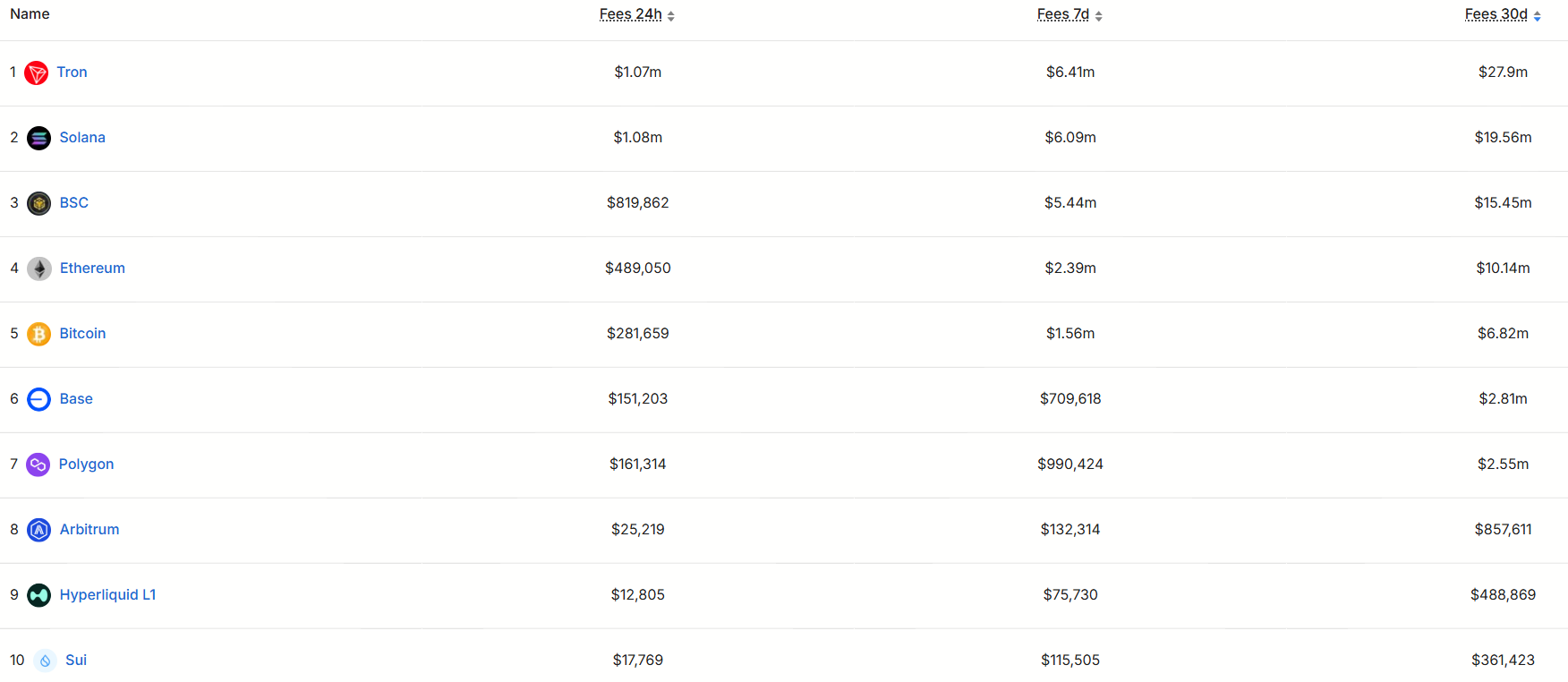
Of course, the overall gap remains significant. Top-ranked Tron has a monthly revenue of $27.9 million, while tenth-ranked Sui has only $360,000—a difference of over 77 times. Reality is quickly淘汰 (táotài - eliminating) public chain projects that "tell stories but lack real demand." Even Zero Network, an L2 network incubated by Web3 wallet company Zerion which raised $22.5 million, has stopped producing blocks for over 3 weeks.

In this context, Polygon is at least still "active at the table."

The Truth Behind the Revenue Surge: Polymarket's Short-Term Push

However, it must be noted that the significant growth in Polygon's fee revenue only became apparent starting in early 2026. According to data disclosed by Castle Labs on January 13, Polygon's current monthly revenue is接近 (jiējìn - approaching) $1.7 million.

The main driver of this revenue growth comes from Polymarket. Since its 15-minute price prediction market (where users bet on whether the price of mainstream coins like BTC, ETH, SOL, XRP will rise or fall in the next 15 minutes, settling every 15 minutes) started charging fees, the Polygon network's daily revenue once reached $100,000.
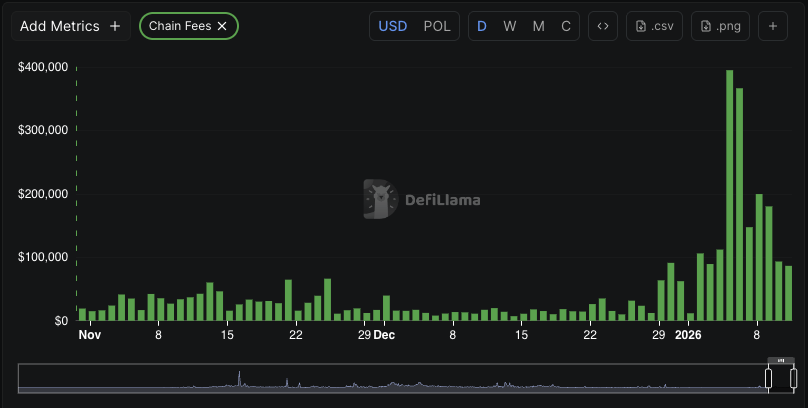
More importantly, Polygon employs a fee-burning mechanism typical of PoS networks: the higher the transaction volume, the more tokens are burned, creating a deflationary effect. Since the beginning of the year, Polygon has burned approximately 12.5 million POL tokens, worth about $1.5 million, representing roughly 0.12% of the total supply.

Projecting based on the current pace, if this trend continues, the burn rate for 2026 could reach about 3.5%, significantly higher than the staking reward annual issuance rate of about 1.5%. The burn volume is already more than twice the staking rewards distributed, resulting in a net supply reduction.

Although Polymarket confirmed via its Discord community in late December 2025 that it would migrate to its own built Ethereum Layer 2 (named POLY), the migration is not immediate. In the short term, Polygon will still benefit from Polymarket's high activity, accelerating the deflationary effect and thus benefiting the POL price.

For further analysis of the correlation between the two, see: 《The Economic Calculus Behind Polymarket's Exit from Polygon》.

Conclusion

Overall, Polygon's current surge in transaction fees and token burning still largely relies on the阶段性 (jiēduàn xìng - phased/periodic) prosperity brought by Polymarket. However, its long-term strategy focused on stablecoin payments and real-world financial infrastructure is also gradually being implemented.

This is perhaps the most noteworthy aspect of Polygon at this moment: short-term data provides market confidence, while long-term布局布局 (bùjú - layout/strategy) determines whether it can remain in the next round of competition.


Related Questions

QWhat is the total acquisition price for Polygon Labs' purchase of Coinme and Sequence, and what is unique about the transaction structure?

AThe total acquisition price exceeds $250 million. Polygon Labs did not disclose the specific price for each company or whether the transaction was conducted in cash, equity, or a mix. The deals are structured to be completed in phases, with Sequence expected to close within the month and Coinme's acquisition awaiting regulatory approval, potentially finalizing by Q2 2026.

QHow does the acquisition of Coinme support Polygon's strategic goals, particularly regarding stablecoins?

ACoinme holds money transmitter licenses across multiple U.S. states and operates a Bitcoin ATM network. This acquisition provides Polygon with existing regulatory compliance infrastructure, allowing it to bypass lengthy approval processes and directly enter the strictly regulated U.S. market to advance its stablecoin strategy.

QWhat role does the acquisition of Sequence play in Polygon's overall strategy?

ASequence provides blockchain wallet and developer infrastructure. The acquisition is aimed at building user-side infrastructure for Polygon's stablecoin strategy, as wallets serve as a critical entry point for users into the on-chain world, impacting security, usability, and scalability.

QWhat has been the main driver behind Polygon's recent surge in fee revenue according to the article?

AThe primary driver of Polygon's recent fee revenue growth is Polymarket, specifically its 15-minute price prediction market that started charging fees. This activity has contributed significantly to daily network revenues, at times reaching $100,000.

QHow does Polygon's tokenomics model currently create a deflationary effect on its native token POL?

APolygon uses a Proof-of-Stake (PoS) fee-burning mechanism. Increased transaction volume leads to more POL tokens being burned, creating a deflationary effect. So far in 2026, approximately 12.5 million POL (worth about $1.5 million) have been burned, exceeding the staking reward issuance rate and resulting in a net supply reduction.

Related Reads

Anthropic Cries Wolf: Is the AGI Threat Real, or Just an IPO Story?

Anthropic has published an article titled "When AI builds itself," discussing the emerging concept of "recursive self-improvement," where AI begins to actively participate in designing, training, testing, and optimizing its own subsequent versions. The company presents internal data showing that by May 2026, over 80% of code merged into its codebase was written by Claude, its AI model. Claude's capabilities have expanded to handling complex, open-ended engineering tasks, achieving a 76% success rate in such areas, and even contributing to research processes, such as optimizing code performance and conducting AI safety experiments. Anthropic outlines an evolution from human-driven development to AI-assisted workflows, culminating in the current stage where AI agents can autonomously write, run, and delegate code. The company cautions that the path toward a "closed loop," where AI continuously improves itself, is becoming visible. It calls for coordinated global mechanisms to potentially slow or pause frontier AI development to allow safety research and societal structures to catch up. However, the timing of this warning coincides with Anthropic's preparations for an IPO, framing the narrative not just as a safety concern but also as a demonstration of Claude's advanced capabilities and its integral role in accelerating Anthropic's own R&D—creating a potential "flywheel" effect for competitive advantage. This contrasts with OpenAI's recent, more policy-oriented discussion of the same risks, highlighting the competitive dynamics in the AI industry as companies position themselves in both the technological and regulatory landscape.

marsbit4m ago

Anthropic Cries Wolf: Is the AGI Threat Real, or Just an IPO Story?

marsbit4m ago

BIT Research: ETF Purchases Have Slowed, Strategy (MicroStrategy) Has Slowed, What Else Can Drive Bitcoin's Rise?

Market Refocus on Inflation and Rate Expectations Weighs on Bitcoin Currently, the market is in a phase of macro-repricing dominated by inflation and interest rate expectations. Bitcoin, which previously benefited from easy liquidity and low inflation, is seeing its core bullish drivers weaken. These drivers were market expectations for interest rate cuts and strong inflows from Bitcoin ETFs and institutions like MicroStrategy (referred to as "Strategy" in the text). The logic has shifted. Recent high inflation data (e.g., CPI hitting 3.8% in a May 2026 report) has caused the market to sharply reduce its rate cut expectations for 2025 and even price in potential hikes. This is a key constraint for Bitcoin, as it lacks cash flows and is highly sensitive to rate expectations. Concurrently, institutional capital flows have slowed significantly. Following the hot CPI data, Bitcoin ETFs saw accelerated outflows, with around $4.3 billion leaving over a period. MicroStrategy's ability to keep adding substantial Bitcoin to its balance sheet is also diminishing. Together, ETF and MicroStrategy holdings total roughly $110 billion, but their momentum as growth engines is cooling. In summary, Bitcoin's current pressure stems not from its own fundamentals but from a changing macro environment. As long as inflation stays elevated, Bitcoin is likely to remain in a consolidating phase. However, historically, inflation eventually peaks. Once it recedes and rate cut expectations rebuild, institutional capital could return, potentially fueling a new and more robust recovery phase for Bitcoin.

marsbit12m ago

BIT Research: ETF Purchases Have Slowed, Strategy (MicroStrategy) Has Slowed, What Else Can Drive Bitcoin's Rise?

marsbit12m ago

Earning 1000 Trillion in Half a Year, 'Pocketing' 20 Million per Capita: This Round of Wealth Creation in the Korean Stock Market is Unprecedented in Scale

The South Korean stock market is experiencing an unprecedented wealth surge in 2026, with household equity and fund asset values soaring by over 1,000 trillion KRW (~$730bn) year-to-date. This translates to an average per capita wealth increase of roughly 20 million KRW, fueled by a historic 109% rally in the KOSPI index. The boom is driven by three converging forces: an AI-driven semiconductor supercycle boosting giants like Samsung and SK Hynix; the government's "Value-Up" market reforms addressing long-standing corporate governance issues; and aggressive real estate regulations that have locked capital within financial markets, preventing profits from flowing back into property. This has triggered a wealth effect, boosting high-end consumption significantly. However, the gains are highly concentrated. The two semiconductor behemoths account for over half the index's value, but retail investors own relatively low stakes in them, systematically missing the biggest rallies. Wealth and consumption benefits are skewed towards luxury goods and imported cars, bypassing mainstream retail. Further risks stem from excessive leverage, with high trading volume in leveraged ETFs, and a market sentiment heavily reliant on the AI sector's fortunes and speculative rumors. While this cycle marks a potential shift from real estate to equities as a primary wealth generator for Koreans, its sustainability, amid structural imbalances and leverage, remains a critical test.

marsbit17m ago

Earning 1000 Trillion in Half a Year, 'Pocketing' 20 Million per Capita: This Round of Wealth Creation in the Korean Stock Market is Unprecedented in Scale

marsbit17m ago

Trading

Spot
Futures

Hot Articles

Discussions

Welcome to the HTX Community. Here, you can stay informed about the latest platform developments and gain access to professional market insights. Users' opinions on the price of S (S) are presented below.

活动图片