After National Intervention: The Reshaping of the 2025 Cryptocurrency Crime Landscape

比推Published on 2026-01-12Last updated on 2026-01-12

Abstract

State-level actors significantly increased cryptocurrency-related activities in 2025, marking a new phase of maturity for illegal on-chain ecosystems. Illicit addresses received at least $154 billion, a 162% year-over-year increase, largely driven by a 694% surge in transactions involving sanctioned entities. Stablecoins dominated illegal transactions, accounting for 84% of the total. North Korean hackers stole a record $2 billion, including a historic $1.5 billion attack on Bybit. Russia launched the rubleksandrovich (A7A5) token to evade sanctions, processing over $93.3 billion in transactions within a year. Iranian proxy networks and China-based money laundering groups also expanded operations, offering specialized criminal services like fraud, terror financing, and sanctions evasion. Illegal infrastructure providers now offer full-stack services—domain registration, hosting, and technical support—enabling both cybercriminals and state actors to scale malicious activities. Cryptocurrency is increasingly linked to real-world violence, including human trafficking and coerced asset transfers. Despite illicit activity growing, it remains below 1% of all traceable cryptocurrency transactions. Collaboration among law enforcement, regulators, and crypto firms is critical to address these evolving threats.

Written by: Chainalysis

Compiled by: Chopper, Foresight News

Original Title: National-Level Players Enter the Scene, Deciphering the Loss of Control and Transformation of Cryptocurrency Crime in 2025


In 2025, we observed a significant increase in cryptocurrency-related activities at the national level, marking a new mature phase in the development of the illegal on-chain ecosystem. Over the past few years, the professionalization within the cryptocurrency crime sphere has deepened; illegal organizations have now established large-scale on-chain infrastructure to support transnational criminal networks in procuring goods and services and laundering proceeds from crypto crimes. Against this backdrop, national governments have also begun to venture into this domain. On one hand, they leverage these mature professional service providers, and on the other, they are building customized, exclusive infrastructure to evade sanctions on a large scale. As governments tap into this illicit cryptocurrency supply chain originally created for cybercriminals and organized crime groups, government agencies, compliance, and security teams now face severe challenges in terms of consumer rights protection and national security.
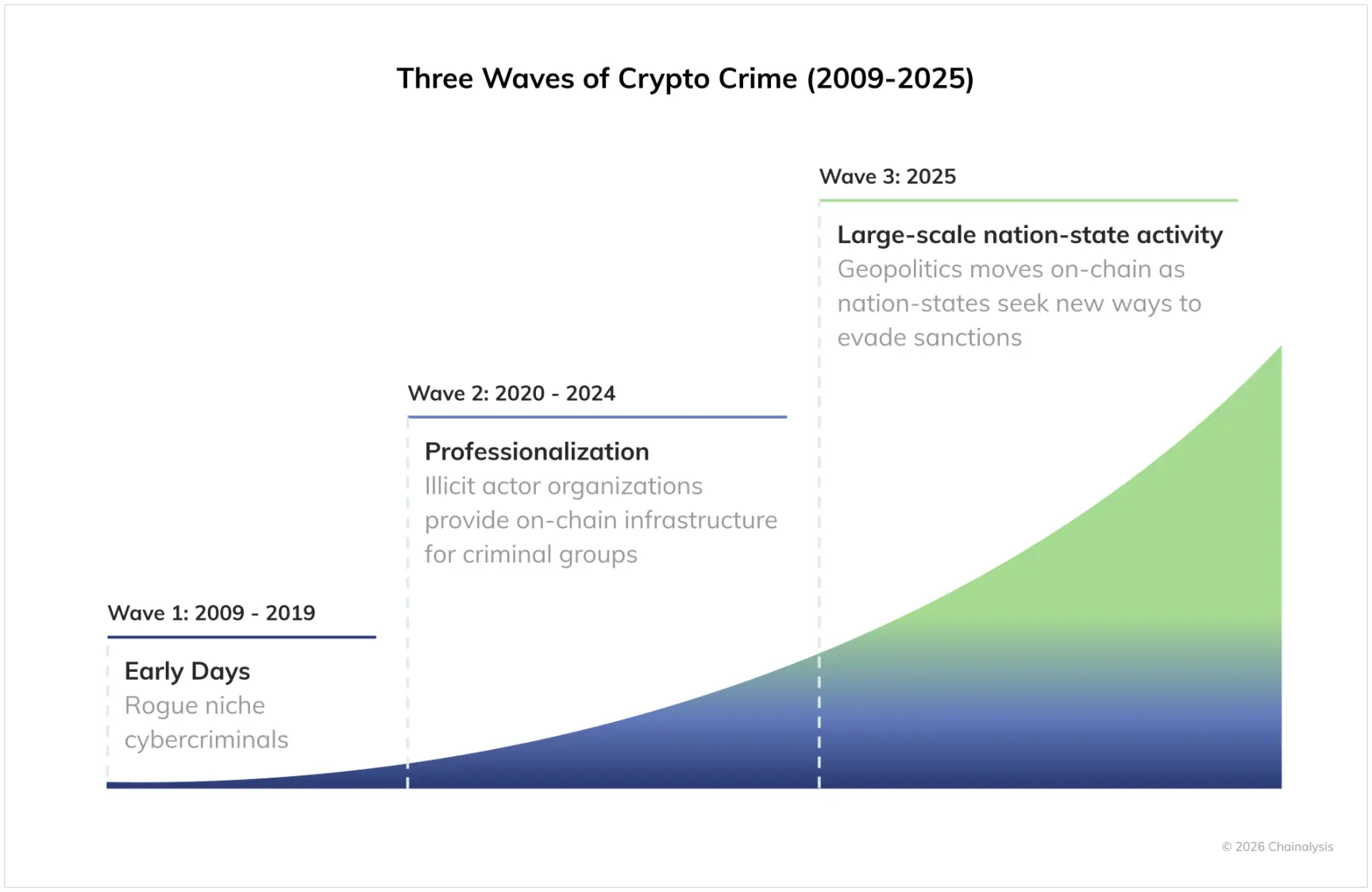
What are the specific on-chain manifestations of these developments and other industry changes? Next, we will analyze them by combining data with macro trends.
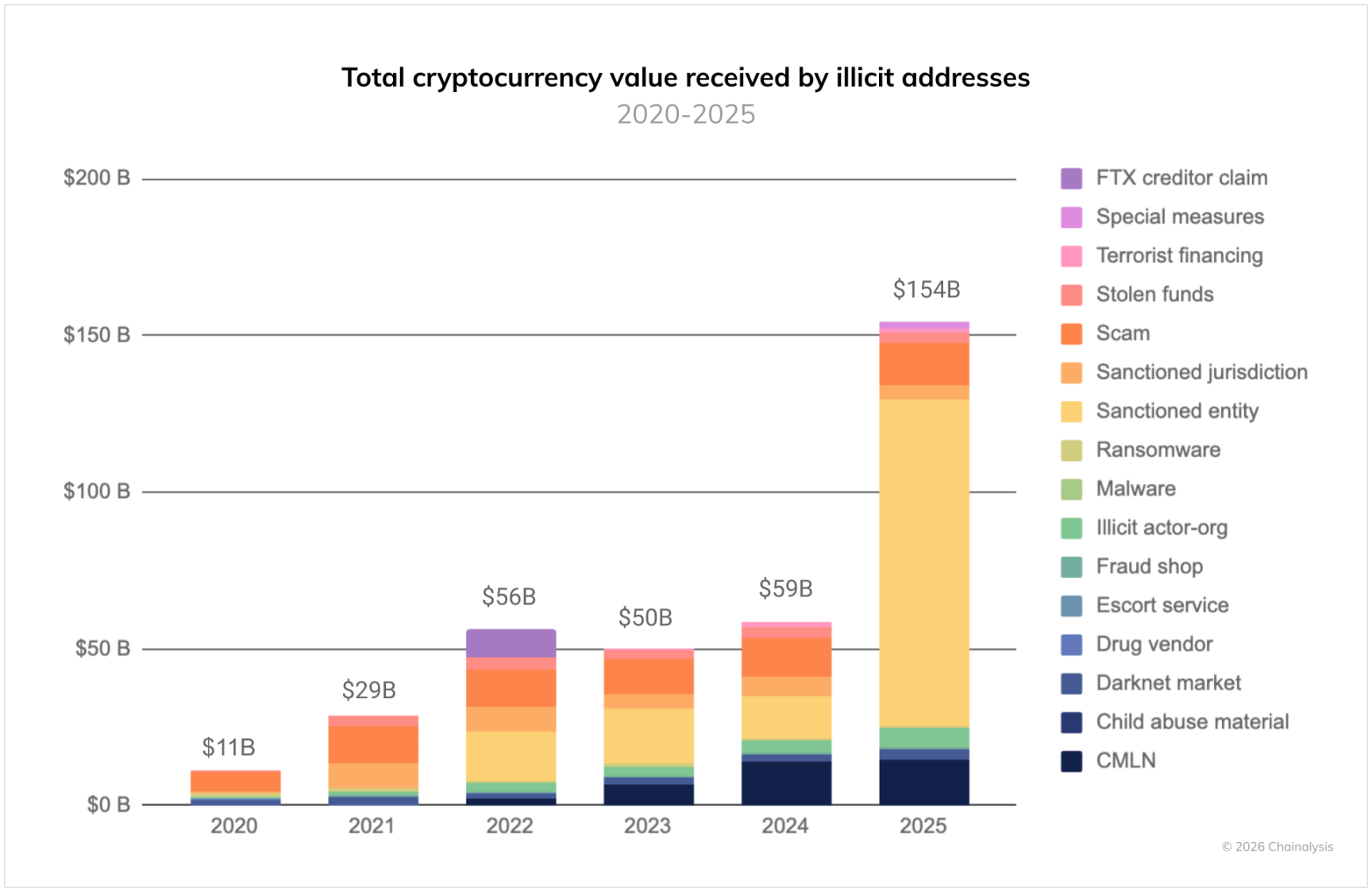
According to our monitoring data, the scale of funds flowing into illegal cryptocurrency addresses in 2025 reached at least $154 billion, a sharp increase of 162% year-on-year. This growth was primarily driven by a surge in fund inflows to sanctioned entities, which skyrocketed by 694% year-on-year. However, even after excluding the growth from sanctioned entities, 2025 still stands as a record year for cryptocurrency crime, as the scale of most illegal activity categories saw growth.

Nevertheless, the scale of these illegal transactions still pales in comparison to the overall cryptocurrency economy, where the main body of transactions remains legitimate. We estimate that although the proportion of illegal transactions in the total traceable cryptocurrency transaction volume in 2025 increased slightly compared to 2024, it remains below 1%.

As shown in the figure below, we also observed a continuous shift in the types of assets involved in cryptocurrency crimes.
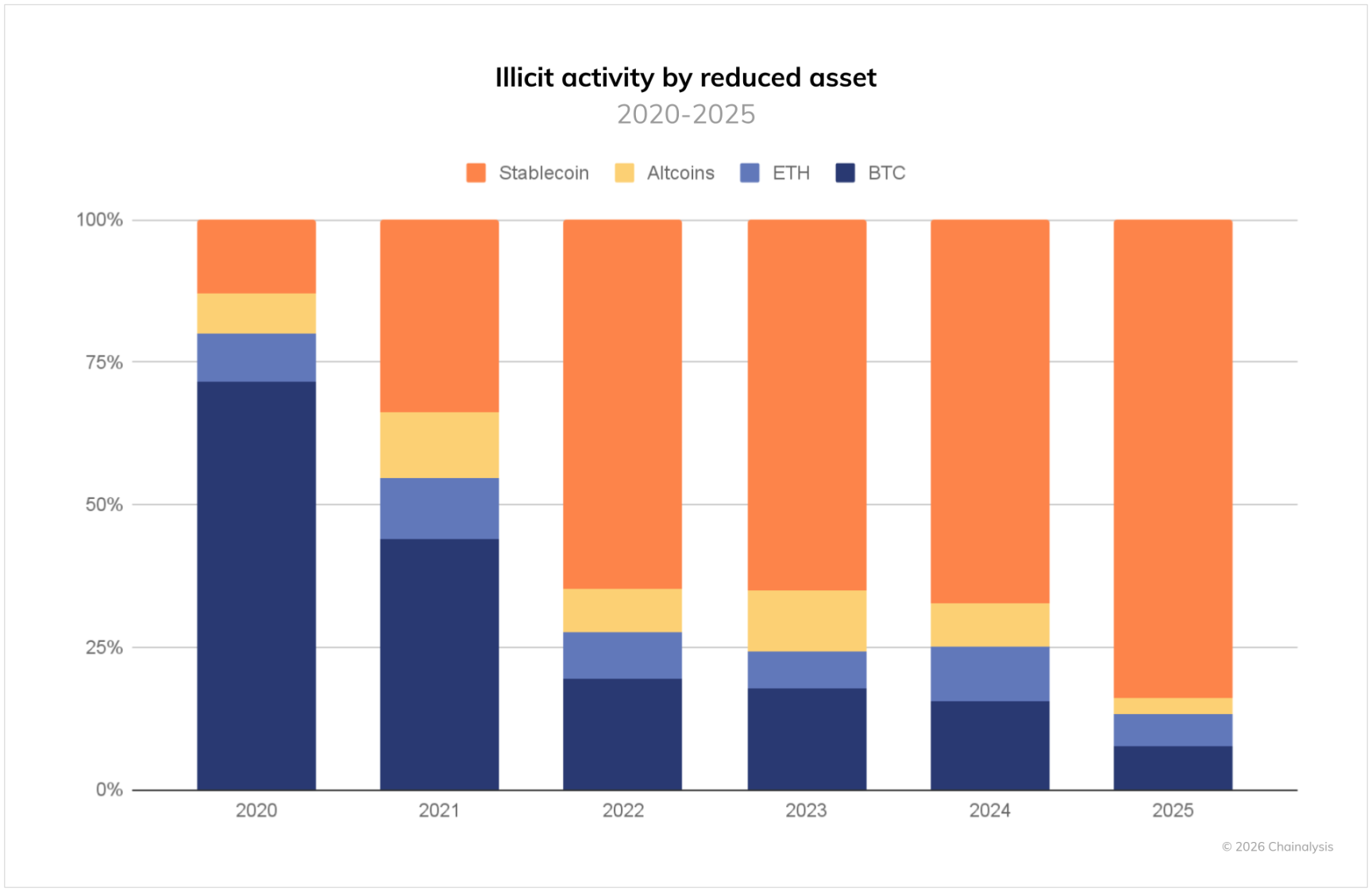
Over the past few years, stablecoins have gradually become the dominant asset in illegal transactions, currently accounting for 84% of the total illegal transaction volume. This trend aligns with the overall development characteristics of the cryptocurrency ecosystem: with advantages such as convenience for cross-border transfers, low volatility, and wide application scenarios, the share of stablecoins in the entire cryptocurrency transaction volume continues to expand.

The following sections will delve into the core trends that defined the 2025 cryptocurrency crime landscape, trends that will remain important to focus on in the future.

National-Level Threats Drive Transaction Volume: North Korean Thefts Hit Record High, Russia's A7A5 Token Facilitates Large-Scale Sanction Evasion

In 2025, stolen funds remained a major threat to the cryptocurrency ecosystem, with hacking groups linked to North Korea alone stealing $2 billion. This figure was primarily driven by several highly destructive large-scale hacking incidents, the most notable being the attack on the Bybit exchange in February. This incident involved nearly $1.5 billion, making it the largest digital asset theft in the history of cryptocurrency. Although North Korean hackers have long been a major force threatening the cryptocurrency ecosystem, the past year saw record highs both in the amount stolen and in the sophistication of their intrusion and money laundering methods.

Particularly noteworthy is that the scale of on-chain activities reached unprecedented levels in 2025. Russia introduced relevant legislation in 2024 to use cryptocurrency to evade sanctions, and this measure was formally implemented in February 2025. The country launched the ruble-backed token A7A5, which saw its transaction volume exceed $93.3 billion in less than a year since its launch.

Meanwhile, over the past few years, Iran's proxy networks have conducted money laundering, illegal oil trading, and bulk commodity procurement for weapons on-chain through verifiable wallet addresses that have been placed on sanctions lists, with a cumulative transaction volume exceeding $2 billion. Despite suffering multiple military strikes, terrorist groups supported by Iran, such as Hezbollah, Hamas, and the Houthis, continue to use cryptocurrency on an unprecedented scale.

In 2025, Chinese money laundering networks emerged as a dominant force in the illegal on-chain ecosystem. These organizations operate with sophisticated models, greatly promoting the diversification and professionalization of cryptocurrency crime, offering various specialized criminal services including "money laundering services." Building upon early illegal operation models like "Huiyin Guarantee," these networks have established full-service criminal enterprises, covering businesses in multiple areas such as fraud, scams, laundering proceeds from North Korean hacker thefts, sanction evasion, and terrorism financing.

Full-Stack Illegal Infrastructure Providers Fuel Malicious Cyber Activities

While governments increase their use of cryptocurrency, traditional cybercrime activities remain rampant: ransomware operators, child sexual abuse and cybercrime platforms, malware distributors, scammers, and illegal marketplaces still rely on vast support networks to maintain operations. Illicit actors and national governments are increasingly dependent on on-chain infrastructure providers that offer full-stack services, including domain registrars, secure and reliable hosting services, and other technical infrastructure that can be used to carry out malicious cyber activities.

These infrastructure providers have evolved into comprehensive infrastructure platforms capable of resisting platform takedowns, abuse complaints, and sanction enforcement. As the scale of these services continues to expand, they may become a key force driving economic crime and state-supported entities to expand the scope of malicious cyber activities.

Growing Correlation Between Cryptocurrency and Violent Crime

In the perception of many, cryptocurrency crime is still confined to the virtual world. The masterminds are merely anonymous figures hiding behind keyboards, not posing a threat in the real world. But in fact, the connection between on-chain activities and violent crime is deepening. Human trafficking gangs are using cryptocurrency for transactions more and more; at the same time, disturbingly, the number of violent coercion attack cases has risen significantly, where criminals use violent means to force victims to transfer crypto assets, and such assaults often occur during peak cryptocurrency price periods.

Looking ahead, collaboration between law enforcement agencies, regulatory bodies, and cryptocurrency companies will be key to addressing these complex, evolving, and interconnected threats. Although the proportion of illegal transactions in the legitimate cryptocurrency transaction volume remains limited, maintaining the integrity and security of the cryptocurrency ecosystem has never been more important.


Twitter:https://twitter.com/BitpushNewsCN

Bitpush TG Discussion Group:https://t.me/BitPushCommunity

Bitpush TG Subscription: https://t.me/bitpush

Original link:https://www.bitpush.news/articles/7601752

Related Questions

QWhat was the total value of illicit cryptocurrency transactions in 2025, and what was the primary driver of this growth?

AThe total value of illicit cryptocurrency transactions in 2025 reached at least $154 billion, a 162% year-over-year increase. This growth was primarily driven by a 694% surge in inflows to sanctioned entities.

QWhich asset has become the dominant currency for illicit transactions, and what percentage of the total illicit volume does it represent?

AStablecoins have become the dominant asset for illicit transactions, representing 84% of the total illicit transaction volume.

QWhich country's state-sponsored groups set a new record for cryptocurrency theft in 2025, and what was the most notable attack?

ANorth Korean hacking groups set a new high for cryptocurrency theft in 2025, stealing $2 billion. The most notable attack was the February hack of the Bybit exchange, which resulted in a loss of nearly $1.5 billion, making it the largest digital asset theft in cryptocurrency history.

QWhat new token did Russia launch in 2025 to facilitate large-scale sanctions evasion, and what was its trading volume?

ARussia launched the ruble-backed token A7A5 in 2025 to facilitate large-scale sanctions evasion. Its trading volume surpassed $93.3 billion in less than a year.

QAccording to the article, what is an emerging and concerning trend regarding the link between cryptocurrency and real-world crime?

AAn emerging and concerning trend is the increasing link between on-chain activity and violent crime. This includes human trafficking networks using crypto for transactions and a significant rise in violent coercion attacks, where victims are forced under duress to transfer crypto assets, often during periods of peak cryptocurrency prices.

Related Reads

Stocks Fell Even More Violently Than Crypto, Where Did the Money Go?

From June to late July 2026, global stock markets, particularly technology and semiconductor stocks, experienced severe declines, with South Korea's KOSPI index facing historic circuit breakers and shedding 40% from its June peak. Key catalysts included SK Hynix's earnings miss despite record profits and competitive pressures from China's CXMT IPO. A global forced deleveraging event unfolded, devastating highly leveraged instruments like the 2x leveraged SK Hynix ETF, which lost over 80% of its value. Surprisingly, Bitcoin showed relative stability during this period, rising roughly 15% from its July low. The article clarifies this wasn't due to an inflow of equity flight capital but because Bitcoin had already undergone a significant correction in May and June, with U.S. spot Bitcoin ETFs seeing record outflows. True safe-haven flows went to gold, severing Bitcoin's short-term "digital gold" narrative. The sell-off is characterized not as an AI story collapse but a liquidity-driven清算 of crowded leveraged positions, potentially halfway through according to some analysts. For substantial capital to return to Bitcoin, the article cites necessary conditions: eased global liquidity pressure, a soft-landing Fed rate cut, and regulatory clarity from the stalled U.S. CLARITY Act. The conclusion is that Bitcoin is not a current safe haven but a pre-cleared asset. Its decoupling from tech stocks highlights its potential future role as a non-correlated asset for institutional portfolios, positioning it favorably for when global capital reallocates post-crisis.

marsbit7m ago

Stocks Fell Even More Violently Than Crypto, Where Did the Money Go?

marsbit7m ago

"The Final Phase Before the New Cycle". What Will Happen to Bitcoin in August

"Bitcoin Faces Crucial Test in August: Experts Predict Consolidation or Further Decline" The price of Bitcoin (BTC) is expected to remain under pressure in August, with experts anticipating either consolidation within a narrow range or a potential drop below $60,000. Despite a double-digit recovery from its July low near $58,000, BTC ended the month trading around $63,500, still roughly 50% below its October 2025 peak of $126,200. Analysts cite several headwinds: a challenging macroeconomic environment with high US interest rates and persistent inflation, which makes fixed-income assets more attractive than speculative ones like crypto. Furthermore, competition for capital is intense, with many investors favoring AI-related stocks. This is reflected in significant outflows from US spot Bitcoin ETFs, with a record $4.5 billion leaving in June and a net outflow of $5.4 billion for the first half of the year. Historically, August is a weak month for crypto, with a median return of -7.49% from 2013 to 2025. Experts also note regulatory uncertainty in the US, particularly the stalled CLARITY Act, as a dampening factor. Despite the bearish near-term outlook, several experts view the current phase as the "last phase before a new Bitcoin cycle" begins, potentially in Q4 2024. This makes it a favorable time for accumulating Bitcoin for the long term. Key price levels to watch are support at $60,000-$61,000, with a break below $58,000 potentially leading to $53,000-$55,000. A move above $67,000 could target $70,000-$75,000, though this is considered a lower probability scenario.

cryptonews.ru13m ago

"The Final Phase Before the New Cycle". What Will Happen to Bitcoin in August

cryptonews.ru13m ago

What Structural Changes Have Occurred in the Cryptocurrency Industry by 2026?

By 2026, the crypto industry is undergoing profound structural shifts, moving beyond price speculation towards deeper integration with the real-world economy. Major changes are driven by four key areas. First, stablecoins, now a $300B+ market, are evolving from crypto-native trading tools into real-world payment and B2B settlement backbones, extending business chains and creating complex accounting and tax obligations. Second, global regulation is maturing. Frameworks like the EU's MiCA are moving from legislation to active enforcement, determining market access. Anti-money laundering rules, such as the Travel Rule, see wider adoption but face enforcement and cross-border challenges. Third, AI Agents are emerging as autonomous transaction entities. Protocols like Coinbase's x402 enable machine-to-machine micropayments using stablecoins, necessitating new frameworks for transaction authorization, tax attribution, and audit trails. Finally, tax transparency is entering an implementation phase. Initiatives like the OECD's CARF, EU's DAC8, and the US Form 1099-DA are shifting reporting burdens to platforms, requiring them to reconcile on-chain data with user identity and tax residency information. Collectively, these trends signify that crypto compliance is becoming foundational infrastructure, requiring consistent data and control systems to meet cross-border operational, regulatory, and audit demands.

marsbit34m ago

What Structural Changes Have Occurred in the Cryptocurrency Industry by 2026?

marsbit34m ago

Trading

Spot
活动图片