After Marvell's 32% Surge, the Chinese Chip Family Behind It Emerges

marsbitPublished on 2026-06-03Last updated on 2026-06-03

Abstract

The stock price of Marvell Technology surged 32.5% on June 2nd, driven by NVIDIA CEO Jensen Huang highlighting its custom ASICs and optical interconnects as core to AI data center architecture. This event brought attention to the Chinese semiconductor family behind Marvell: the Dai siblings. The story centers on three siblings, all UC Berkeley graduates, whose three-decade entrepreneurial journey aligns with major semiconductor industry shifts. In 1995, youngest sister Dai Wei Li co-founded Marvell with her husband Sehat Sutardja and his brother, focusing on storage controllers. Eldest brother Dai Wei Min founded EDA company Ultima, later sold to Cadence, and later founded VeriSilicon (芯原) in China, becoming a leading semiconductor IP provider. Second brother Dai Wei Jin co-founded EDA firm Silicon Perspective (sold to Cadence) and GPU IP company Vivante, later acquired by VeriSilicon. The combined "Dai-Sutardja" family network extends beyond Marvell. Their ventures and investments form a comprehensive ecosystem for the post-Moore's Law, chiplet era. Key holdings include: Dream Big Semiconductor (AI SuperNICs, acquired by Arm), Alphawave (high-speed SerDes IP, acquired by Qualcomm), and Silicon Box (a chiplet advanced packaging foundry). VeriSilicon itself thrives on the AI ASIC and IP boom in China. Collectively, the family's AI infrastructure-related portfolio is estimated at over $22 billion. Their strategy represents a distinct path: building critical components for op...

Author: Ada, Deep Tide TechFlow

On June 2nd, Marvell's stock surged 32.5% in a single day, closing at $290.79, a record high. Over the past 12 months, it has risen 265%. The direct catalyst was Jensen Huang naming Marvell's custom ASICs and optical interconnect as "the core of AI data center architecture" at Computex.

A company being personally endorsed by NVIDIA's CEO at a major conference is rare enough. This company was founded in 1995 by Weili Dai and her husband, Sehat Sutardja, in their living room. Weili Dai is the youngest of the three Dai siblings from Shanghai and one of the driving forces behind this family's thirty-year footprint in the chip industry.

The eldest brother, Weimin Dai, is in Shanghai, serving as the Chairman of VeriSilicon, known as the "first semiconductor IP stock" on the A-share market. Around 2026, VeriSilicon's market cap was approximately 150 billion RMB, with AI ASIC orders hitting record highs for six consecutive quarters. The second brother, Weijin Dai, is currently a director and General Manager of the IP Business Division at VeriSilicon. Vivante, which he founded in 2007, was acquired by VeriSilicon for $57.53 million.

Looking back over the past thirty years, the three Dai siblings founded six companies, with two going public and four being acquired. But that's only half the story. What truly flows beneath is the network woven within the chip industry following the marriage alliance between the "Dai" and "Sutardja" families. From the US to China, from EDA tools to factories or production lines for chiplet advanced packaging, from IP licensing to AI SuperNIC.

Three Siblings Made Six Bets Over Thirty Years, Hitting the Right Timing Each Time

All three Dai siblings graduated with degrees in Electrical Engineering from UC Berkeley. Their entrepreneurial timelines perfectly align with three major paradigm shifts in the semiconductor industry.

1995: Weili Dai, along with her husband Sehat Sutardja and Sehat's brother Pantas Sutardja, founded Marvell in Silicon Valley, focusing on hard drive storage controllers, adopting a pure fabless model. The same year, the eldest brother, Weimin Dai, founded Ultima in Silicon Valley, developing EDA tools. This was the late stage of PC普及 (popularization), where fabless design and the move towards EDA tooling were core features of the semiconductor industry's first major restructuring. The Dai family bet on both trends simultaneously. Ultima was acquired by Cadence in 2000, and Marvell went public in 2000.

1996: Weijin Dai co-founded Silicon Perspective, developing digital implementation EDA, which was acquired by Cadence for approximately $500 million in 2002. Around the same period, the eldest brother, Weimin Dai, turned his attention to China. In 2001, he returned to Shanghai to found VeriSilicon, betting on the "IP licensing + one-stop chip customization" model, providing semi-finished products to nascent SoC design companies in China. That same year, China joined the WTO, and the number of local chip design companies exploded from over 100 to several thousand. VeriSilicon was the ammunition supplier for this wave.

2007: Weijin Dai founded Vivante, focusing on embedded GPU IP, targeting automotive and IoT applications. This was on the eve of the mobile internet boom, a time when all endpoints began requiring graphics capabilities. In 2016, Weimin Dai's VeriSilicon fully acquired Vivante for $57.53 million. Weijin Dai transitioned from CEO of Vivante to General Manager of VeriSilicon's IP Business Division. This internal family merger connected the "China IP leader" and "embedded GPU IP" lines.

2019: Weili Dai embarked on her third venture. After leaving Marvell, she, along with Sehat and former Marvell executive Sohail Syed, founded Dream Big Semiconductor in Silicon Valley, focusing on chip open platforms and AI SuperNICs. In 2021, Weili Dai, Sehat, and Korean semiconductor veteran Han Byung Joon co-founded Silicon Box in Singapore, a chiplet advanced packaging fab. Chiplets represent the only viable industry path to continue boosting single-chip performance as Moore's Law slows, betting on the post-Moore era.

August 2020: Weimin Dai's VeriSilicon went public on the STAR Market, raising 1.862 billion RMB, crowned by the market as the "first semiconductor IP stock." October 2025: Weili Dai's Dream Big was acquired by Arm for $265 million in cash.

Six companies over thirty years, two IPOs, four acquisitions by top-tier buyers. This is an impressive track record, but focusing solely on it misses the real other half of the story.
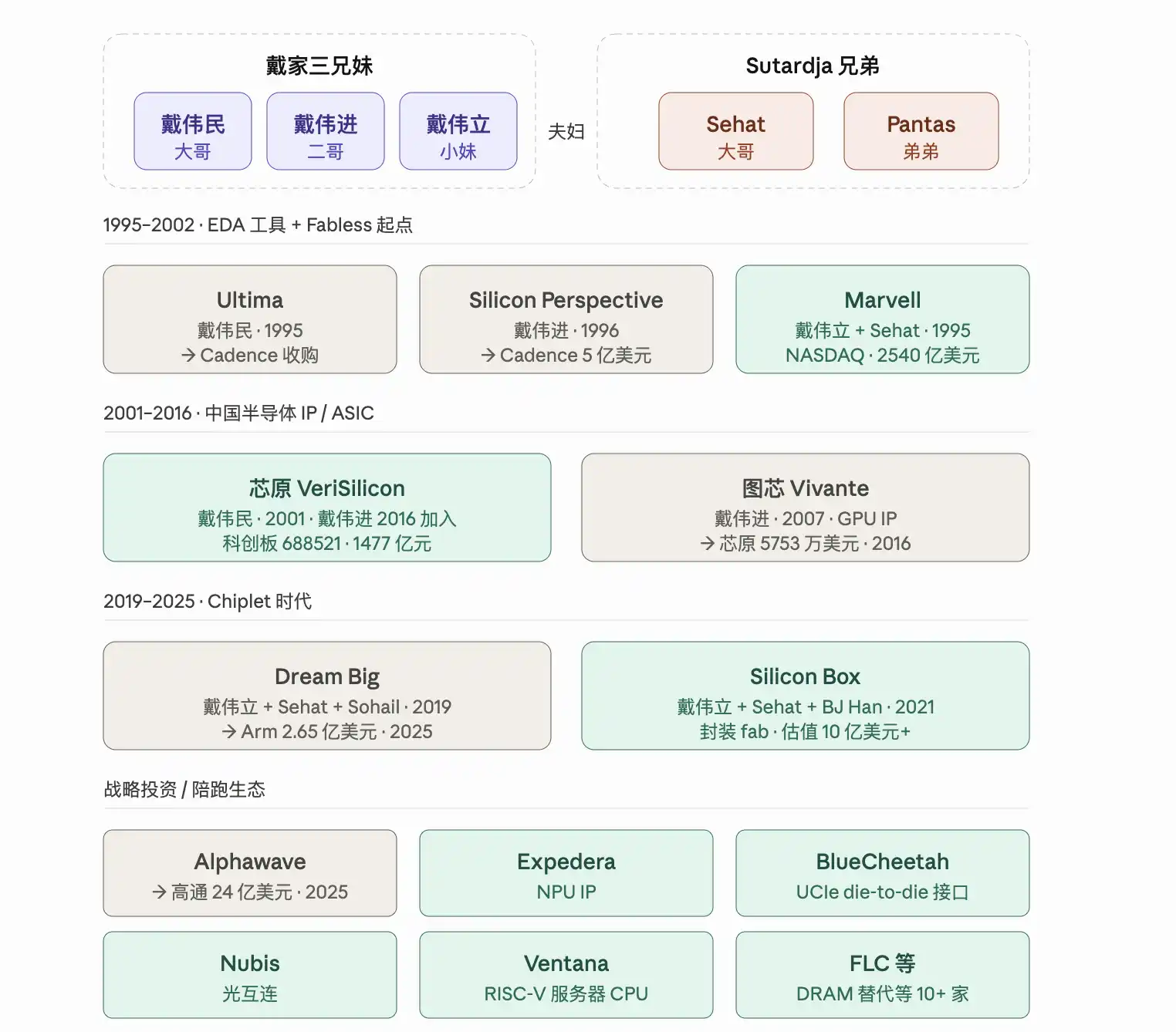
The Industrial Foundation Built by Two Families

The founding trio of Marvell in 1995 was Weili Dai, Sehat Sutardja, and Sehat's brother, Pantas Sutardja. Sehat was born in Jakarta, Indonesia, became a licensed radio technician at 13, and earned his Ph.D. in Electrical Engineering from Berkeley in 1988, where he met and married Weili Dai. Marvell was a product of the collaboration between the "Dai" and "Sutardja" families from day one, not just a husband-and-wife startup.

This advantage has amplified over the thirty years.

The Dai family has deep roots in China's semiconductor ecosystem. The eldest brother, Weimin Dai's VeriSilicon is a leading domestic IP provider. Its cooperation with SMIC and Huahong Grace can be traced back to the founding of SMIC. VeriSilicon's first 0.18-micron standard cell library for SMIC solved the IP export control issues SMIC faced at the time. The second brother, Weijin Dai, from Silicon Perspective to Vivante and back to VeriSilicon, layered networks in EDA, GPU IP, and IoT customers into China's local SoC ecosystem.

Looking at the Sutardja family, starting from the Marvell era, their engineering network extended to Southeast Asia and Europe. In 2021, when Weili Dai and Sehat co-founded Silicon Box in Singapore with Han Byung Joon, the company crossed the unicorn threshold by early 2024. It has a roughly $2 billion advanced semiconductor packaging factory in Tampines, Singapore, and is building a $3.6 billion new factory in Italy. Behind these factories lie industrial policy alignments with Singapore's Economic Development Board and the Italian government. This capacity-scheduling capability across East Asia and Europe is something the Dai family's connections in mainland China alone couldn't unlock.

More significant is the combined investment portfolio of the "Dai + Sutardja" families. Focusing on the chiplet ecosystem, there are at least 15 publicly traceable companies they have invested in or co-founded: Alphawave (high-speed SerDes interconnect IP, acquired by Qualcomm for $2.4 billion in December 2025); Expedera (NPU IP); BlueCheetah (UCIe die interface IP); Nubis (optical interconnect); Ventana (RISC-V server CPUs); FLC (DRAM alternative solutions). These companies, along with the previously mentioned VeriSilicon, Vivante, Dream Big, and Silicon Box, cover nearly every layer needed for the chiplet era: semiconductor IP, interconnect standards, packaging fabs, specialized compute chips. The two families have jointly built an entire industrial foundation for the post-Moore era.

Replicating Marvell's Rise Logic

What is the logic behind Marvell's current surge?

Over the past year, the bottlenecks in AI data centers have been quietly shifting. GPU compute shortages were the story of 2023-2024. By the second half of 2025, as hyper-scale training and inference ramped up, the real bottlenecks became three things: custom ASICs (allowing customers to not constantly buy NVIDIA's general-purpose GPUs), high-speed interconnect between chips, and the advanced packaging capability to pack these into the same package.

Marvell is positioned on the first two. Making custom ASICs like TPUs for Google and Amazon, and using optical communication chips for high-speed transmission. This is the real reason for its 265% rise over the year, and the real reason NVIDIA invested $2 billion in Marvell in March. Jensen Huang himself needs this interconnect thread.

Overlay the same map with the "Dai + Sutardja Family" marker, and the picture changes completely.

Dream Big bets on chiplet platforms and AI SuperNICs (800 Gbps bandwidth for lateral GPU interconnect). When Arm announced the $265 million cash acquisition in October 2025, Arm's intention was clear: to upgrade from selling CPU IP to becoming a "full-stack data center architect," mirroring NVIDIA's 2019 $6.9 billion acquisition of Mellanox.

Alphawave bets on high-speed SerDes interconnect IP, listed in London. On December 18, 2025, Qualcomm completed its $2.4 billion acquisition. The Dai+Sutardja family is Alphawave's second-largest shareholder, with Weili Dai cashing out approximately $237 million from the deal.

VeriSilicon in China operates on "IP + one-stop ASIC customization," similar to what Marvell does in the US, but with a customer structure of Chinese AI chip buyers like Alibaba, ByteDance, and Cambricon. AI compute accounted for 73% of new orders in 2025, and 91% of the 8.24 billion RMB new orders signed in the first four months of 2026. Its market cap is around 147.7 billion RMB ($20.5 billion), about 8% of Marvell's size, but with a steeper growth curve.

Silicon Box bets on chiplet advanced packaging fabs. Its valuation crossed the $1 billion threshold in early 2024. This company doesn't plan to IPO or sell, representing the heaviest piece on the board for the Dai+Sutardja families in the critical AI infrastructure capacity layer.

Additionally, there are over 10 invested/incubated companies like Expedera (NPU IP), BlueCheetah (UCIe die interface IP), Nubis (optical interconnect), Ventana (RISC-V server CPU), FLC (DRAM alternative). Each precisely occupies a position within the previously mentioned "three AI data center bottlenecks."

Adding these assets together, a conservative estimate places the scale of assets directly related to the two families in this AI wave at over $22 billion. This number won't appear on any list because it's dispersed across five jurisdictions, four company types, and over a dozen companies, but it exists.

From the perspective of a family industrial portfolio, the two families have placed at least six independent bets in this AI data center wave, each highly overlapping with the current logic driving Marvell's rise. Marvell is their loudest brand, but far from their only ticket in this round.

The Third Path: Key Components at Standard Transition Points

Currently, there are two mainstream narratives in the AI semiconductor industry.

One is platform-type giants reaping the benefits. NVIDIA sells GPUs + the CUDA ecosystem; Broadcom and Marvell sell custom ASICs + interconnect. This is the track for players with market caps above $150 billion.

The other is independent ASIC startups aiming for IPO. Companies like Tenstorrent, Cerebras, Groq, Etched bypass NVIDIA, focusing on acceleration for specific scenarios, betting on establishing a pole independent of GPUs.

The Dai+Sutardja families have taken a third path: creating key components for open standards, building their own packaging fabs, waiting for acquisition by giants, or becoming the domestic IP leader themselves. This path makes particular sense in the chiplet era because chiplets themselves are the antithesis of closed vertical integration. As long as standards are open, key IP + packaging capacity become scarce commodities, offering a much shorter path than independently building entire ASICs and aiming for IPO.

But the trade-off is clear. This path is destined not to produce the next NVIDIA. It allows founders multiple graceful exits and long-term retention of influence within the industrial ecosystem, but it won't place anyone on the final podium of AI infrastructure.

When Weili Dai and her husband founded Marvell in a Silicon Valley living room in 1995, the company was little-known. Today, Marvell is a $254 billion AI data center star. Although Weili Dai had exited most of her equity from thirty years ago at various points, simultaneously, she and her family still hold stakes in VeriSilicon, Silicon Box, cash from the Alphawave sale, cash from Dream Big's sale to Arm, and equity in over a dozen chiplet ecosystem companies.

Marvell was her most resounding victory, but not her only one, and likely not her last.

Trending Cryptos

Related Questions

QWhat was the direct catalyst for Marvell's single-day surge of 32.5% to a record high on June 2nd?

AThe direct catalyst was Nvidia CEO Jensen Huang's endorsement at Computex, where he highlighted Marvell's custom ASICs and optical interconnects as 'the core of AI data center architecture'.

QWhat is the core business model of the Chinese company VeriSilicon (芯原股份) founded by Dai Weimin?

AVeriSilicon's core business model is 'IP licensing + one-stop custom chip design'. It acts as an ammunition supplier by providing semi-finished products and IP to China's burgeoning SoC design companies.

QWhat are the three key bottlenecks in AI data centers that have emerged in the second half of 2025, according to the article?

AThe three key bottlenecks are: 1) Custom ASICs (to reduce reliance on Nvidia's general-purpose GPUs), 2) High-speed interconnects between chips, and 3) Advanced packaging capabilities to integrate these components.

QDescribe the third strategic path the Dai+Sutardja family has taken in the AI semiconductor industry, distinct from the two mainstream narratives.

AThe third path involves focusing on critical components for open standards (e.g., IP for interconnects, NPUs) and building key manufacturing capacity like advanced packaging fabs (Silicon Box). This strategy relies on acquisition by larger players or achieving leadership in a niche market (like IP in China), rather than building the next full-stack platform like Nvidia or an independent ASIC startup aiming for an IPO.

QWhat is the estimated total asset size related to the current AI wave that the Dai and Sutardja families hold across their portfolio, as per the article?

AThe article provides a conservative estimate that the two families' directly related asset portfolio in this AI wave exceeds $22 billion.

Related Reads

From Gold to Bitcoin: Fixed Supply + Institutional Frenzy, Might It Repeat the 'Explosive' Price Trend?

"From Gold to Bitcoin: Fixed Supply and Institutional Frenzy May Lead to 'Explosive' Price Rally Analysts suggest Bitcoin's price action could mirror gold's over the past two decades, following the launch of spot Bitcoin ETFs. Gold ETFs, introduced in 2004, drove gold's price surge to a current market cap near $28 trillion. Both gold and Bitcoin are non-yielding stores of value, with prices driven purely by investor sentiment rather than cash flows or credit. Gold ETFs experienced dramatic cycles: explosive growth, painful drawdowns, and slow recoveries, with each cycle reaching higher peaks. Bitcoin ETFs, approved in early 2024, saw rapid institutional adoption but are now facing similar volatility. Recent warnings highlight the risk of significant ETF outflows disrupting the current rebound. BlackRock's IBIT, a leading Bitcoin ETF, has sold nearly 100,000 BTC to meet redemptions while still holding over 733,000. The core parallel is fixed supply: when demand surges, prices explode, but demand is often volatile and wave-like, not steady. Institutional interest, through ETFs and corporate adoption, remains a key support pillar, helping to cushion sell-offs. If Bitcoin captures even a fraction of gold's role as a store of value, its upside potential is immense, though the path will be marked by high volatility. For investors, focusing on long-term trends and managing risk is crucial as this 'price explosion' narrative unfolds."

Foresight News14m ago

From Gold to Bitcoin: Fixed Supply + Institutional Frenzy, Might It Repeat the 'Explosive' Price Trend?

Foresight News14m ago

Why Is AI Agent Shopping Hard to Popularize?

The article argues that the popular narrative of "AI agent shopping" – equipping AI with a wallet to autonomously handle purchases – is fundamentally flawed and oversimplifies the complexity of shopping. It deconstructs shopping into two core actions: **information retrieval** (standardized, easily automated) and **value judgment** (deeply subjective and human-centric). The narrative mistakenly assumes AI can fully handle both. Value judgment itself has two layers: **evaluation** (assessing options against criteria) and **demand definition** (setting the criteria, weights, and values). The latter is inherently human and dynamic, as preferences are not fixed but constructed during the decision-making process ("constructive preferences"). The real dividing line for automation is not product standardization, but whether the **act of choosing** itself holds experiential value. For mundane purchases (e.g., printer paper), full AI delegation works. For experiential goods (e.g., wine, furniture), the joy of selection is core to consumption, so AI should act as an assistant that narrows options, leaving the final choice to humans. The "AI wallet" concept confuses three separate elements: decision-making, execution, and fund custody. Current payment industry solutions (e.g., from Stripe, Mastercard, Google, Visa) show that limited, scoped payment authorization tokens are sufficient for most consumer scenarios, not full fund custody. The true use case for autonomous AI wallets is in **B2B procurement** and **machine-to-machine (M2M) settlements** for standardized, high-frequency, low-value transactions. The real bottlenecks for AI shopping are not payment technology, but **1) the lack of trusted data sources** (e.g., fake reviews, counterfeit goods) and **2) the impossibility of automating human demand definition**. The conclusion is that the focus should be on safely automating the assessment and filtering process while reserving for humans the rights to define their criteria and enjoy the final act of choice. For experiential goods, the platform's competitive advantage shifts to providing a superior selection experience.

Foresight News1h ago

Why Is AI Agent Shopping Hard to Popularize?

Foresight News1h ago

After Nine Months of Shorting, a Full Turn to Long: Renowned Trader Opens Bitcoin Positions Around 64K, Crypto Market Long-Short Divergence Intensifies

After nine months of being short, prominent crypto trader Doctor Profit has closed all his bearish positions and started buying Bitcoin near $64,000, signaling a complete bullish reversal. He argues that structural market changes—such as impending U.S. regulation (CLARITY Act) and institutional adoption via securities tokenization—are rewriting the traditional four-year cycle script, potentially bringing the market bottom forward from the widely expected September/October timeframe. This view finds some technical support from on-chain analyst gumsays, who notes a bullish divergence on Bitcoin's weekly chart has persisted for 147 days, nearing the 161-day duration seen before the 2022 cycle low. However, cycle researcher Jake Pahor presents a counter-argument based on historical data. Analyzing patterns since 2014, he identifies three common features of past bear market bottoms: a ~12-month duration from peak to trough, a sustained period of extreme fear (with a proprietary risk score below 20), and the price falling below Bitcoin's realized price (~$53,000 currently). The current cycle, only nine months from its October 2025 peak, meets none of these conditions. The debate highlights a market torn between "front-running" a potential early bottom driven by new fundamentals and waiting for confirmation through traditional on-chain and sentiment metrics. While Doctor Profit opts for aggressive buying, Pahor maintains a disciplined, tiered accumulation strategy, continuing weekly buys at current risk levels but reserving larger orders for if more extreme fear emerges.

marsbit1h ago

After Nine Months of Shorting, a Full Turn to Long: Renowned Trader Opens Bitcoin Positions Around 64K, Crypto Market Long-Short Divergence Intensifies

marsbit1h ago

Senior Trader's Confession: How to Trade Market's False Expectations?

Veteran trader's case study: trading the market's "wrong expectations". This trade centered on a textbook "expectation error" after a weak CPI report. While the market initially priced in broad monetary easing (sending Nasdaq to 30,060), the crucial 30-year real yield hit a 20-year high. This signaled a fractured transmission mechanism: short-term rates eased, but long-term funding costs (vital for tech valuations) refused to fall. The trader executed five short positions on the Nasdaq (NQ) as it fell from 30,060 to 28,768. The core methodology: don't just trade the data, but analyze the market's implied causal chain and identify where it breaks. In this case, the chain was: Weak CPI → Policy Easing → Lower Long-Term Funding Costs → NQ Valuation Expansion. The break occurred between policy easing and long-term rates. The "veto variable" – long-term real yields – refused to confirm the bullish narrative. Trades were structured around "fast variables" (price) temporarily repairing while "slow variables" (funding conditions) remained broken. The article outlines a repeatable framework: 1) Map the market's implied causal chain. 2) Identify the veto variable. 3) Observe if it rejects the narrative. 4) Enter when price still follows the old script. 5) Choose the cleanest asset expression (e.g., short NQ, not broad S&P). 6) Define both invalidation and fulfillment exit conditions. The key insight: Alpha often comes not from an information edge, but from a "reaction function edge" – recognizing when the market is applying an outdated causal logic to new data. The critical question: What causal chain is the market's first reaction relying on, and is that chain still valid today?

marsbit2h ago

Senior Trader's Confession: How to Trade Market's False Expectations?

marsbit2h ago

Trading

Spot

Hot Articles

How to Buy CHIP

Welcome to HTX.com! We've made purchasing USD.AI (CHIP) simple and convenient. Follow our step-by-step guide to embark on your crypto journey.Step 1: Create Your HTX AccountUse your email or phone number to sign up for a free account on HTX. Experience a hassle-free registration journey and unlock all features.Get My AccountStep 2: Go to Buy Crypto and Choose Your Payment MethodCredit/Debit Card: Use your Visa or Mastercard to buy USD.AI (CHIP) instantly.Balance: Use funds from your HTX account balance to trade seamlessly.Third Parties: We've added popular payment methods such as Google Pay and Apple Pay to enhance convenience.P2P: Trade directly with other users on HTX.Over-the-Counter (OTC): We offer tailor-made services and competitive exchange rates for traders.Step 3: Store Your USD.AI (CHIP)After purchasing your USD.AI (CHIP), store it in your HTX account. Alternatively, you can send it elsewhere via blockchain transfer or use it to trade other cryptocurrencies.Step 4: Trade USD.AI (CHIP)Easily trade USD.AI (CHIP) on HTX's spot market. Simply access your account, select your trading pair, execute your trades, and monitor in real-time. We offer a user-friendly experience for both beginners and seasoned traders.

2.9k Total ViewsPublished 2026.04.21Updated 2026.06.02

How to Buy CHIP

Discussions

Welcome to the HTX Community. Here, you can stay informed about the latest platform developments and gain access to professional market insights. Users' opinions on the price of CHIP (CHIP) are presented below.

活动图片