After Close Observation of Wash, Morgan Stanley's Chief Economist Insists: The Fed Will Not Raise Rates This Year

marsbitPublished on 2026-07-06Last updated on 2026-07-06

Abstract

After close observation of Federal Reserve Chair Wash, Seth Carpenter, Morgan Stanley's Chief Global Economist, asserts that the Fed will not raise interest rates this year. Following Wash's speech at the ECB's Sintra forum, Carpenter notes a marginal dovish shift: Wash now more clearly balances the Fed's dual mandate of price stability and maximum employment, rather than focusing nearly exclusively on inflation. Importantly, Wash highlighted that the latest policy meeting (coinciding with falling oil prices) has already lowered market inflation expectations and term premiums, signaling no urgency for a July rate hike. Carpenter's view is supported by data. Recent non-farm payroll figures provide room for the Fed to remain patient. Morgan Stanley's inflation forecasts are below the median FOMC projection, and methodological revisions to PCE inflation could further lower readings. These factors make Carpenter "comfortable" with the call for no hikes in 2024. Carpenter also pushes back against the simplistic narrative that AI will be deflationary and lead to rate cuts. He argues AI investment is currently boosting inflation marginally. More broadly, the business cycle will dictate policy; AI's productivity gains could boost demand and, crucially, raise the equilibrium interest rate (r*), weakening the case for cuts. In contrast, the ECB's path remains more hawkish. Carpenter interprets President Lagarde's Sintra comments as leaving the door open for another 25 basis point hi...

Author:Zhao Ying

The policy stance of the new Federal Reserve Chairman, Wash, is undergoing close market scrutiny. Seth Carpenter, Chief Global Economist at Morgan Stanley, noted in a report after attending the European Central Bank's Sintra Forum in Portugal that, based on employment data, inflation forecasts, and policy signals, the Federal Reserve will not raise interest rates this year.

Carpenter wrote in the report that Wash's remarks at the Sintra policy forum maintained the tone of his inaugural press conference—a strong commitment to price stability but deliberately avoiding specific details on the path to achieve it. Carpenter noted two noteworthy changes:

First, Wash's wording on the dual mandate has become more balanced, shifting from an almost singular focus on inflation to a clearer acknowledgment of the full employment objective.

Second, Wash specifically emphasized that the most recent policy meeting (combined with falling oil prices) has already lowered market inflation expectations and term premiums. This statement led Carpenter to believe that a July rate hike by the Fed is unlikely.

Against the backdrop of uncertainty regarding the Fed's policy path, Morgan Stanley maintains its base case forecast of no rate hikes for the year, suggesting the market need not price in imminent rate hike risks.

Wash's Sintra Signals: Balancing the Dual Mandate, Downplaying Rate Hike Urgency

Carpenter was present for Wash's Sintra forum speech and interpreted it as a marginally dovish shift. He pointed out that Wash had previously left the market with the impression that price stability was an overwhelming priority, whereas this speech more clearly incorporated the full employment goal into the policy framework.

More crucially, Wash proactively pointed out that the policy meeting had already pushed market inflation expectations and term premiums lower, and mentioned that multiple 'working groups' are being formed and will take time. Carpenter believes this combination of wording sends a clear signal: the Fed is in no rush to act in July.

Data Supports Patience: Inflation Forecasts Below FOMC Median, Nonfarm Payrolls Provide Buffer

On the fundamental level, Carpenter cited several factors supporting the no-rate-hike forecast. Last week's nonfarm payroll data continues to provide room for the Fed to stand pat. Meanwhile, Morgan Stanley's inflation forecast is significantly below the median forecast of FOMC members, and there is the possibility of a further substantial downward revision to inflation readings due to methodological changes in PCE inflation.
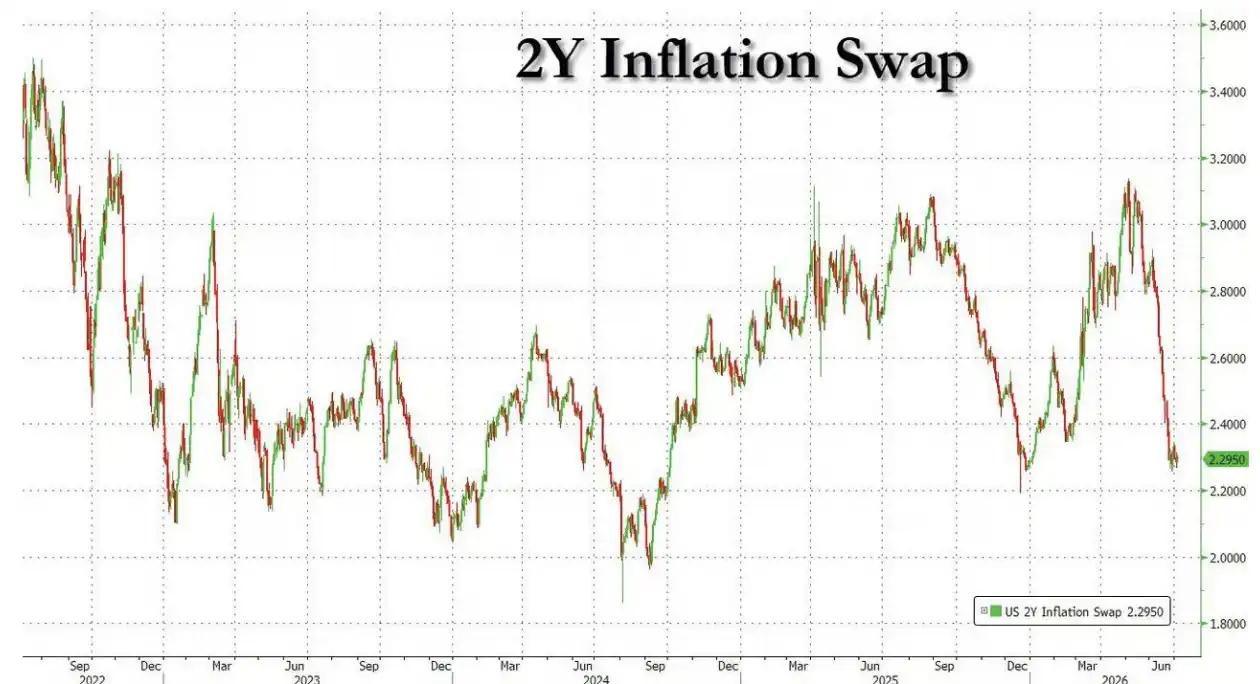
Carpenter stated that the combination of the above factors makes him feel 'comfortable' with sticking to the judgment of no rate hikes for the year. Data could of course change the conclusion, but current evidence points in the same direction.

AI and Productivity: Not a Simple Bet for Rate Cuts

Carpenter also discussed the impact of artificial intelligence on monetary policy and challenged the popular narrative that 'AI will bring deflation and drive rate cuts.' He pointed out that the wave of AI capital expenditure has emerged earlier and on a larger scale in the United States, exerting a marginally inflationary effect in the short term.

More importantly, he offered three counterarguments: First, the state of the business cycle will dominate the policy direction. Second, the deflationary effect is just one of many impacts; higher productivity can also boost demand through consumption and investment. Third, faster productivity growth implies a higher equilibrium interest rate (what economists call r*), further weakening the logic for rate cuts. Carpenter bluntly stated that the simplistic argument that AI inevitably leads to rate cuts is 'almost certainly wrong.'

Diverging ECB Path: Possibly Another 25 Basis Points in September, but Soft Data Leaves Room for Variation

In contrast to the Fed, the European Central Bank's policy direction is more clearly biased towards tightening. Carpenter noted in the article that ECB President Lagarde reiterated in Sintra that the June rate hike was a well-considered decision, not merely a 'precautionary hike.' In his view, this wording implies there is room for further rate hikes.

Morgan Stanley's base case forecast is for the ECB to raise rates by another 25 basis points in September. However, Carpenter also noted that last week's soft European inflation data and the sharp drop in oil prices leave room for policy maneuver—if inflation continues to soften or PMIs show significant weakness, the path to another rate hike could be blocked. He believes that a rate hike in July or more than one hike this year are both difficult to imagine at this point.


Trending Cryptos

Related Questions

QAccording to Morgan Stanley's chief economist, what is the main conclusion regarding the Federal Reserve's interest rate policy this year?

AMorgan Stanley's chief global economist, Seth Carpenter, maintains his baseline forecast that the Federal Reserve will not raise interest rates this year.

QWhat two changes in Federal Reserve Chair Wash's stance did Seth Carpenter note during the Sintra policy forum?

AFirst, Chair Wash's rhetoric on the dual mandate became more balanced, moving from a near-exclusive focus on inflation to a clearer acknowledgment of the full employment goal. Second, he emphasized that the recent policy meeting (combined with falling oil prices) had already pushed down market inflation expectations and term premiums, signaling less urgency for a July hike.

QWhat fundamental data does Carpenter cite to support his forecast of no Fed rate hikes?

AHe cites last week's non-farm payroll data providing room for the Fed to hold steady, and notes that Morgan Stanley's inflation forecast is significantly below the FOMC median. He also mentions the potential for a further substantive downward revision to PCE inflation readings due to methodological changes.

QWhat is Carpenter's view on the popular narrative that AI will lead to deflation and prompt rate cuts?

ACarpenter argues this simple narrative is 'almost certainly wrong.' He states that the state of the business cycle will dominate policy, that AI's deflationary effect is just one factor, and that faster productivity growth implies a higher equilibrium interest rate (r*), which weakens the case for rate cuts.

QHow does the policy path for the European Central Bank (ECB) differ from the Fed's, according to the article?

AThe ECB's policy direction is more clearly tilted towards tightening. Morgan Stanley's baseline forecast is for the ECB to hike rates by another 25 basis points in September, contrasting with the forecast of no hikes from the Fed.

Related Reads

DeepMind's Classic Masterpiece Crowned Again, ICML 2026 Awards Announced

ICML 2026 has announced its annual awards, with diffusion models and AI safety ethics taking center stage. The Outstanding Paper Award was shared by two diffusion model studies. One challenges a core assumption of diffusion language models (DLMs), arguing that their touted "arbitrary order generation" is a "flexibility trap" that harms performance. The other provides a high-accuracy sampling method, pushing the technical ceiling for diffusion models and log-concave distributions. A position paper winning the Outstanding Award raises a critical ethical concern: AI alignment research is unintentionally building a "censor's toolkit," where safety tools like RLHF can be repurposed for content control. Several papers received Honorable Mentions, spanning key areas: mapping where honesty emerges in RLHF-trained models, motion attribution in video generation, quantifying how much language models memorize, analyzing diffusion model consistency via random matrix theory, and providing a mathematical proof for the "grokking" phenomenon in a simple model. The Test of Time Award was given to DeepMind's 2016 seminal work "Asynchronous Methods for Deep Reinforcement Learning," recognizing the enduring impact of the A3C algorithm. Overall, the awards signal a shift in AI research from rapid expansion to deeper scrutiny—validating diffusion models as a major architectural contender while prompting serious ethical reflection within the safety community.

marsbit14m ago

DeepMind's Classic Masterpiece Crowned Again, ICML 2026 Awards Announced

marsbit14m ago

ARK's Massive Buying Spree in Crypto-Linked Stocks: Lower Risk, or Double the Pressure?

ARK Invest, led by Cathie Wood, significantly increased its holdings in crypto-related public stocks in June, purchasing $77 million worth of shares in Coinbase, Circle, and Bullish during Bitcoin's worst monthly performance in four years. The investment thesis is that these stocks offer regulated exposure to the crypto cycle without direct Bitcoin ownership. However, data analysis reveals significant downsides: these stocks exhibit nearly double the volatility of Bitcoin (68%-90% vs. 37.6% 30-day annualized volatility) and carry substantial company-specific risks like earnings, competition, and equity dilution, which account for much of their price movement. Only MicroStrategy closely tracks Bitcoin, acting as a leveraged proxy. Coinbase shows moderate correlation, while Circle and Robinhood have low correlation, being more influenced by stablecoin competition and diversified brokerage operations, respectively. Mining companies like RIOT and MARA have surged due to AI-related ventures, decoupling from Bitcoin's price. The case of Strategy highlights additional equity-structure risks, such as potential value erosion when its market value falls below its net asset value. Ultimately, investing in crypto stocks often means accepting amplified Bitcoin volatility or layering on unrelated business risks, rather than obtaining a safer alternative to direct cryptocurrency ownership.

Foresight News18m ago

ARK's Massive Buying Spree in Crypto-Linked Stocks: Lower Risk, or Double the Pressure?

Foresight News18m ago

Tsinghua University's Special Award Winner, Gu Yuxian, Joins DeepSeek

Tsinghua University's prestigious Graduate Special Scholarship recipient and 2021 Ph.D. candidate, Yuxian Gu, has officially joined DeepSeek. This news coincides with DeepSeek's major recruitment drive and the imminent launch of DeepSeek V4, on whose research paper Gu is listed as an author. A doctoral student in the Conversational AI group under Professor Minlie Huang at Tsinghua, Gu's research focuses on enhancing efficiency throughout the entire lifecycle of large language models. His key contributions span three areas: innovative methods for pre-training data selection (e.g., PDS), advanced knowledge distillation techniques for model compression (notably MiniLLM), and the development of efficient model architectures like Jet-Nemotron. His work has gained significant recognition, with nearly 5,000 citations on Google Scholar. Key publications include the highly cited surveys and papers on pre-trained models and the MiniLLM distillation method. As first author, he has presented at top-tier AI conferences including NeurIPS, ICLR, and ACL. One of his notable achievements is the Jet-Nemotron architecture, which combines Post-Neural Architecture Search (PostNAS) and a novel linear attention module called JetBlock. This model series demonstrates state-of-the-art performance rivaling larger models while achieving substantial efficiency gains in inference. Gu's expertise in creating powerful yet efficient AI systems aligns with industry needs, as evidenced by the adoption of his MiniLLM method by leading tech companies. His move to DeepSeek is anticipated to contribute further advancements in the field.

marsbit44m ago

Tsinghua University's Special Award Winner, Gu Yuxian, Joins DeepSeek

marsbit44m ago

Trading

Spot

Hot Articles

Discussions

Welcome to the HTX Community. Here, you can stay informed about the latest platform developments and gain access to professional market insights. Users' opinions on the price of S (S) are presented below.

活动图片