Karpathy's Latest Outburst: A Single Sentence That Silenced the Entire Agent Developer Community

marsbitPublished on 2026-07-06Last updated on 2026-07-06

Abstract

Andrej Karpathy, a core researcher at Anthropic, recently critiqued the current AI agent development frenzy. He argues that the biggest mistake is forcing agents to perform tasks without first thoroughly understanding the underlying large language models. Drawing from his 2016 "World of Bits" project at OpenAI—an early attempt at web-based agents that ultimately failed due to premature technology—he emphasizes that foundational model work is crucial. Karpathy offers three key pieces of advice: First, focus on getting the base models right before pushing agents. Second, recognize that creating a demo is easy, but building a real product takes a decade, akin to the journeys of autonomous driving and VR. Third, the product is the core capability, not the agent shell; a robust foundation will naturally enable advanced agents. He also suggests looking to neuroscience for inspiration, comparing agent components to brain structures like the hippocampus and thalamus. Despite his caution, Karpathy concludes that independent developers and startups, not large labs like OpenAI, are at the forefront of agent innovation. This is because the agent field is new, with no entity having a five-year head start, leveling the playing field for agile experimenters. His core message is not to abandon agent work, but to build it on a solid, deeply understood foundation.

Karpathy Stirs Up a Storm Internally: Forcing Agents to Work is AI's Biggest Mistake! The Cutting Edge Isn't at OpenAI, It's in Your Hands.

One sentence poured a bucket of cold water over the entire Agent community.

Andrej Karpathy—now a core researcher on the pre-training team at Anthropic—recently dropped a bombshell during a live presentation for Agent developers, leaving the audience in stunned silence:

The biggest mistake in the current AI field is that people are in such a hurry to force Agents to work, without first truly understanding the underlying large models.
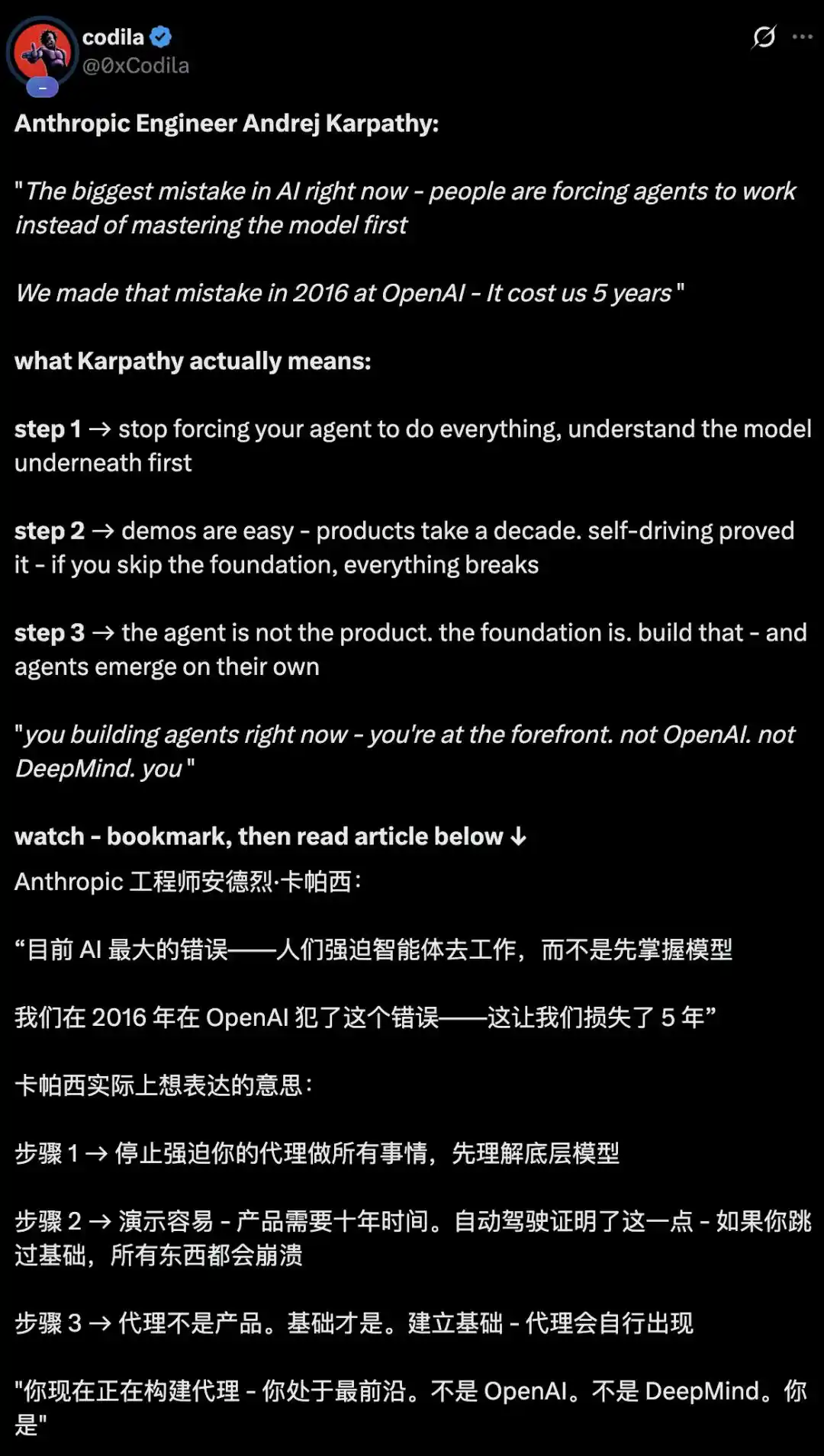
The clip was edited and thrown onto X, where it spread like wildfire in just a few days.

Because it precisely hit the nerve of the hottest, most crowded track that everyone is rushing into right now.

And the person saying this isn't an outsider throwing cold water; it's someone who has been through the trenches, reflecting on their own hard-earned lessons.

Lessons Learned with Real Money on the Line

Let's rewind to 2016.

Back then, Karpathy was working on a project at OpenAI called World of Bits. The goal sounded very "2026": Teach an Agent to use a keyboard and mouse to operate a computer, book flights, order food—basically, do your chores.

Sound familiar? That's almost the exact picture on the first slide of every Agent startup's pitch deck today.

The result? It didn't work out.

Karpathy put it bluntly: He, along with Tianlin Shi and Jim Fan, worked on it, frantically clicking on a few simple web pages, trying to book a flight or order some food. They even managed to publish a paper at ICML 2017.

The paper was titled "World of Bits: An Open-Domain Platform for Web-Based Agents"—a grand vision of a "world of bits" ultimately trapped on a few clunky web pages.
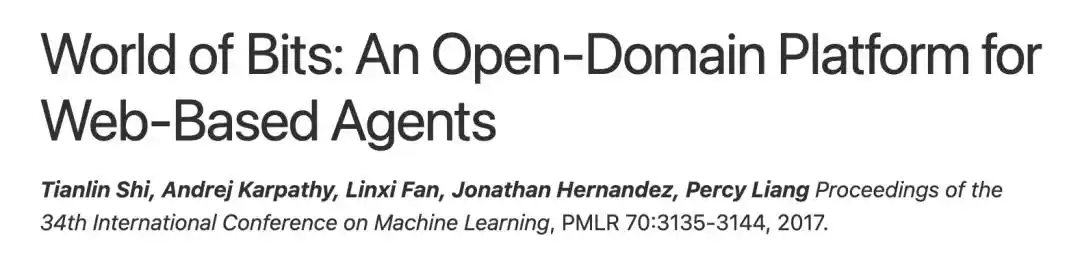
The technology wasn't ready. The only tool they had was reinforcement learning, and no matter how hard they hammered, it just wouldn't work.

Looking back, the truly correct approach back then would have been to completely forget about Agents and turn to working on language models instead.

Five years later, the toolbox is completely different—you folks building Agents today hardly use reinforcement learning at all. Back then, that was unimaginable.

Interestingly, Jim Fan, his co-author on that paper, is now a Senior Research Scientist at NVIDIA, creating explosive projects like Voyager and MineDojo, and winning an Outstanding Paper Award at NeurIPS.
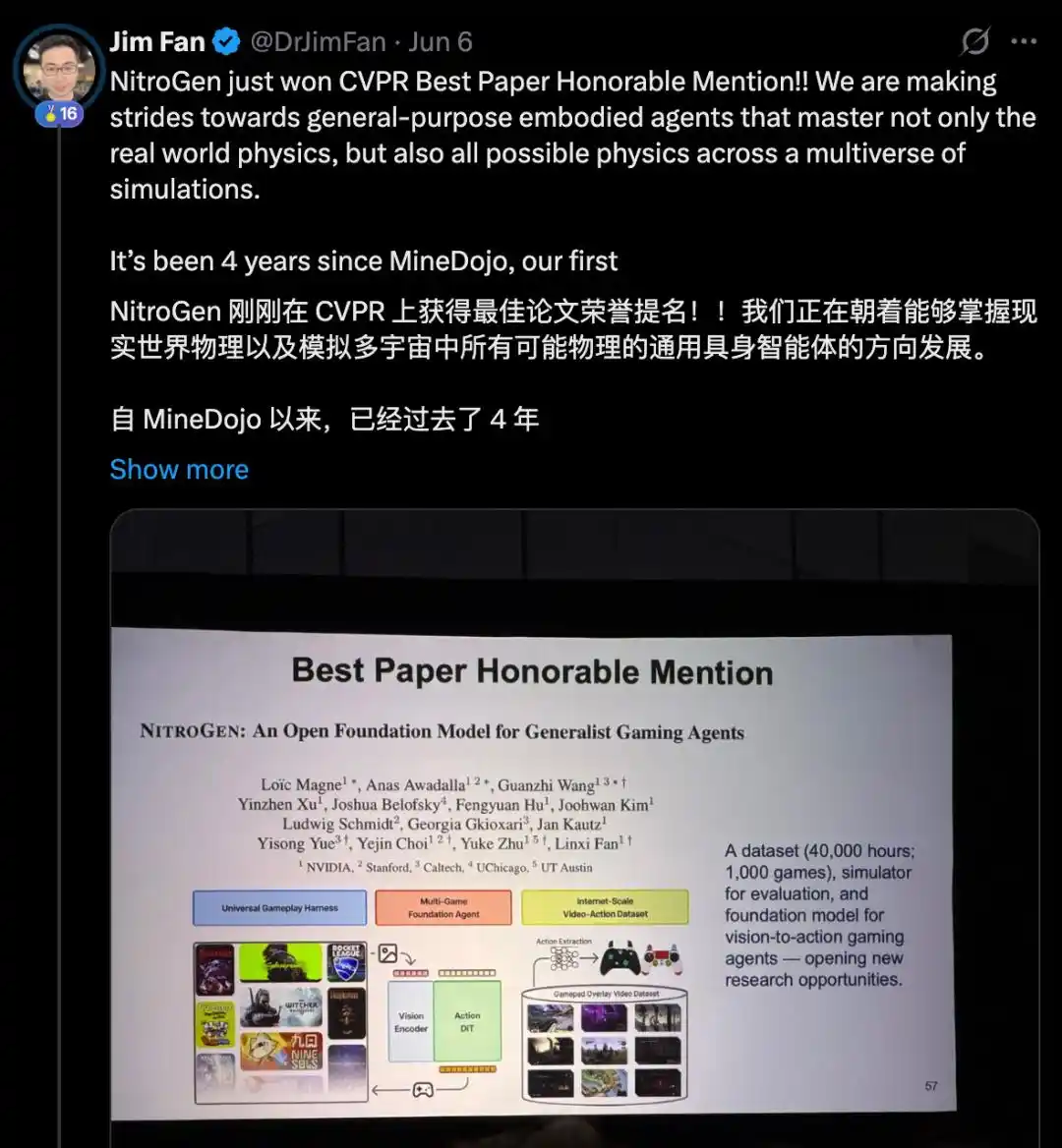
A young intern from a 2016 "failed project" has become a top player in the AI Agent field a decade later.

But the path taken wasn't the one from 2016.

Demos are Easy; Building a Product Takes a Decade

Following this lesson, Karpathy offered three pieces of advice, each directly contradicting the current hype.

First, stop forcing your Agent to do everything. First, get the underlying model right.

When he joined Anthropic's pre-training team this past May, the first thing he wrote on X was: I believe the work on the LLM frontier will be particularly critical in the coming years.
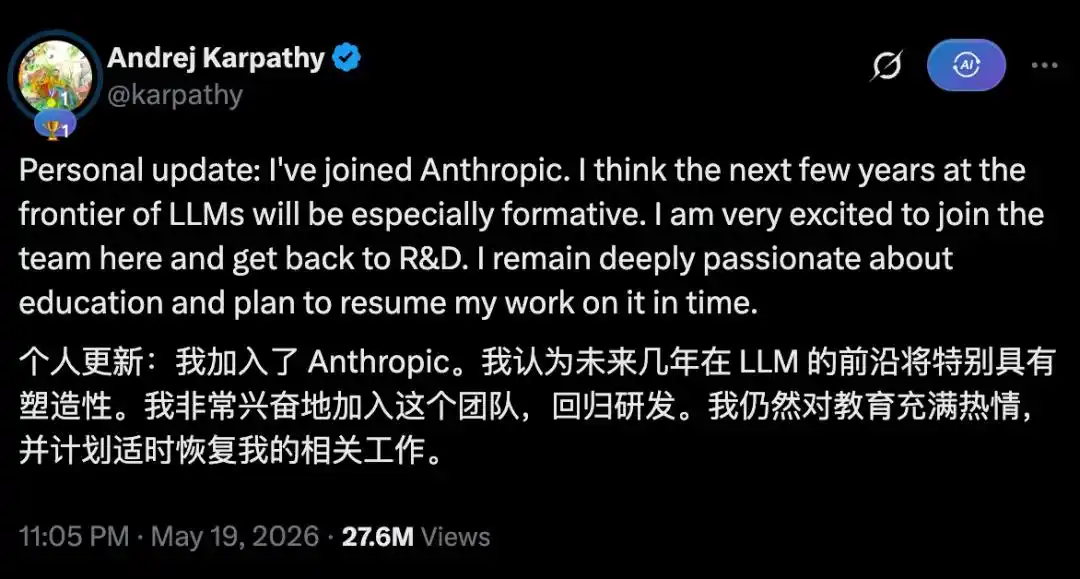
The person who "invented" vibe coding, which Collins Dictionary named its Word of the Year, is now choosing to return to the most foundational pre-training research—this in itself is a "behavioral vote" against the Agent hype.

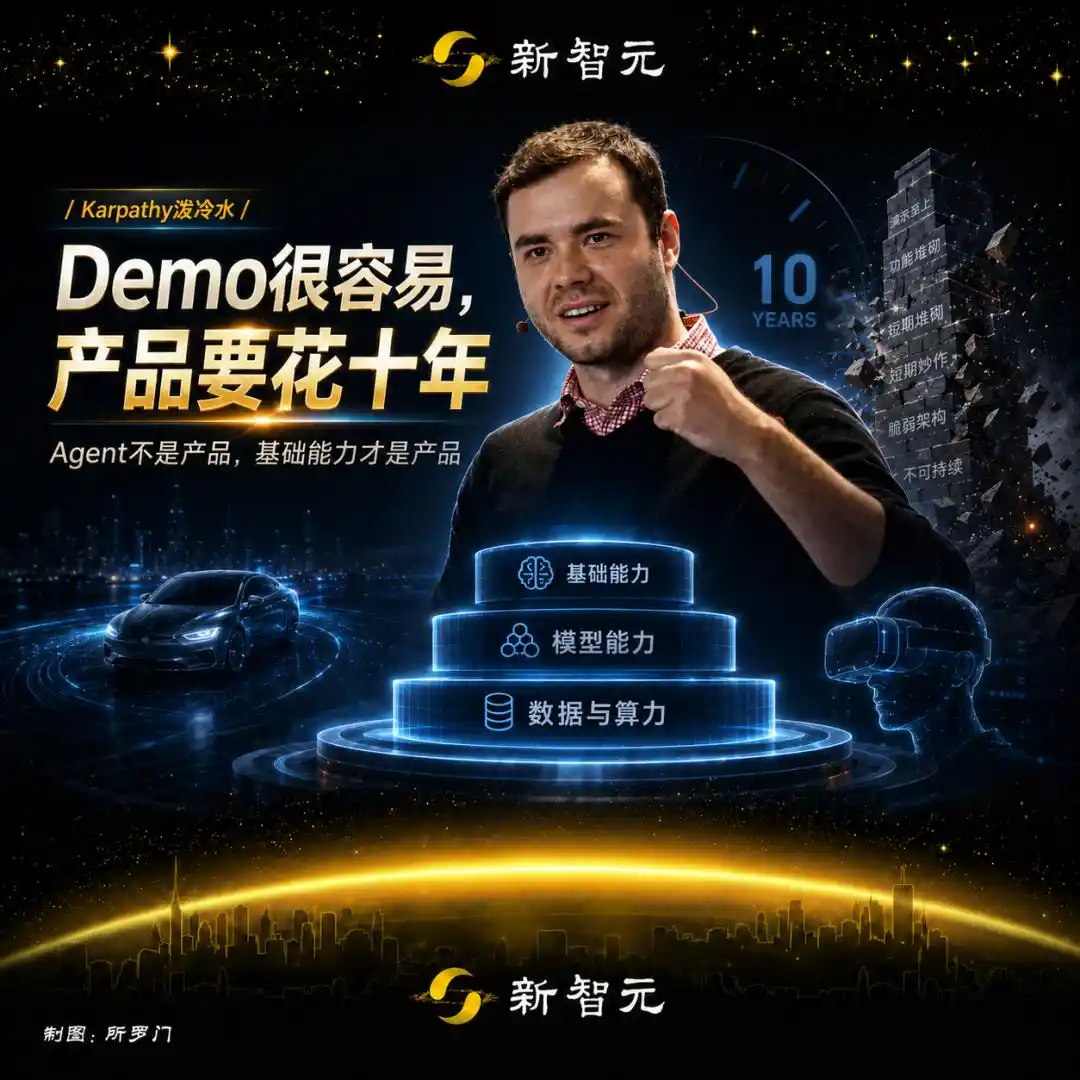
Second, Demos are easy. Turning it into a product takes a decade.

He cited two examples everyone knows: Self-driving cars. Anyone can make a demo of a car driving around the block, but turning it into a real product took a full decade. He personally experienced that marathon at Tesla.

The same goes for VR. Impressive demos were everywhere, yet taking it to a product was also a decade-long journey.

Agents fall into this exact category.

Extremely easy to imagine, extremely easy to demo, but extremely difficult to turn into a real product.

If you're really getting into this field, you need to be prepared to work on it for ten years, not think you've made it after a flashy demo.

Third, an Agent is not the product. Foundational capabilities are the product. Build a solid foundation, and Agents will naturally emerge.

These three sentences almost completely negate the current playbook of "slap a shell on it, stack an Agent, and release it ASAP."

Karpathy's message is clear: If the foundation isn't solid, the faster you build the building, the harder it will collapse.

Self-driving cars have already validated this for everyone over the past decade. There's no reason Agents should skip this lesson.
Learning from the Brain

After the lesson, Karpathy pivoted, diving headfirst into neuroscience for inspiration.

On stage, he fired off a series of questions: In an Agent, what is equivalent to the hippocampus, responsible for memory, indexing, and retrieval?

What corresponds to the basal ganglia, controlling action selection and execution? What is the thalamus, that "seat of consciousness" where multiple thoughts fight for the microphone?

A top AI researcher is saying: What we lack most right now in building digital life isn't fancier features, but reverence for the root question of "what intelligence even is."

He even specifically brought a copy of David Eagleman's neuroscience book, "Brain and Behavior: A Cognitive Neuroscience Perspective," and recommended it to everyone in attendance.
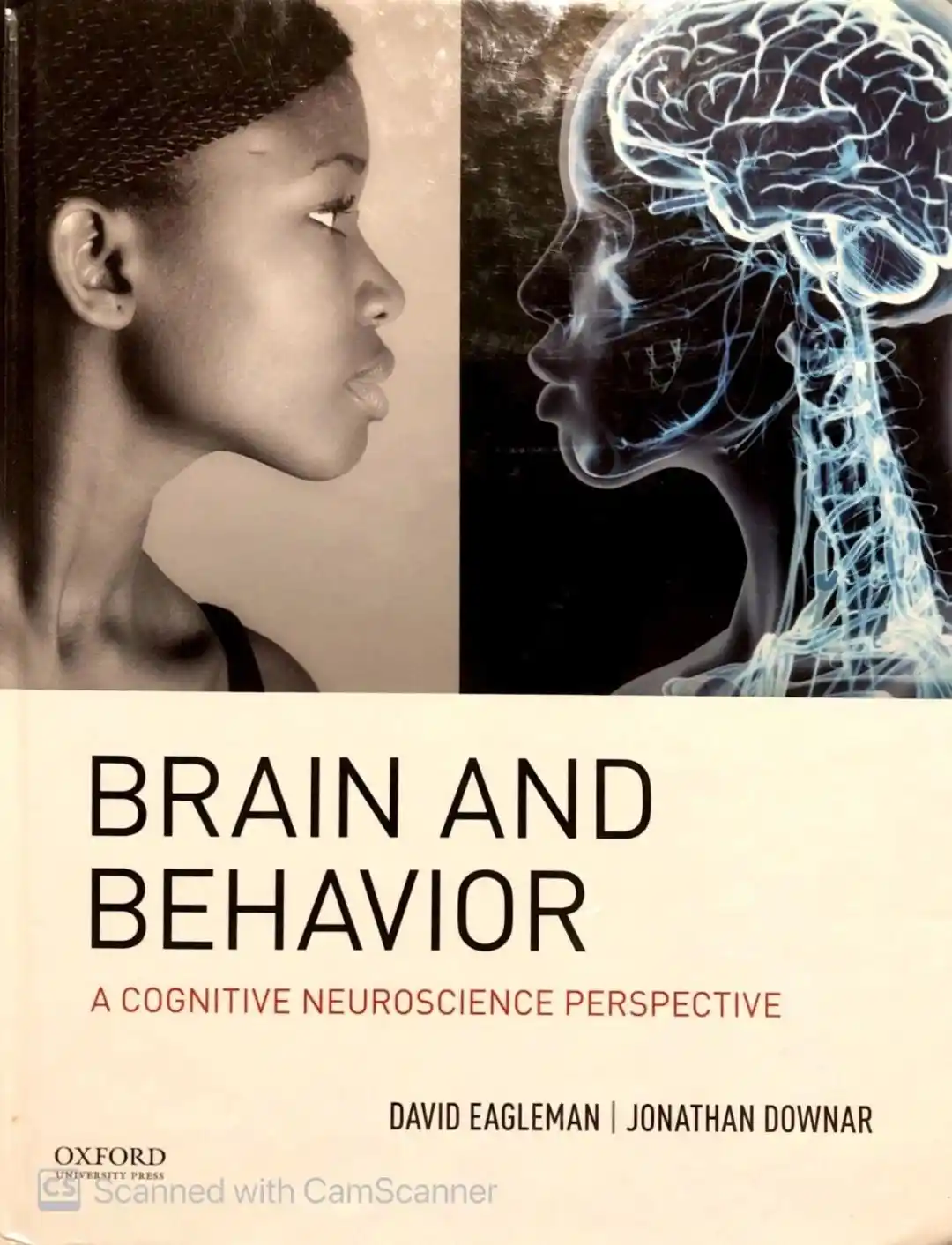
In his view, building Agents today deserves the same approach as in the early days of deep learning—back then, we stole the inspiration for artificial neural networks from the structure of a single neuron; now, we can absolutely go steal from the brain again.

The Real Bombshell was This Last Sentence

If the earlier part was throwing cold water, Karpathy ended by lighting a fire for the audience.

He said to the room full of independent developers and entrepreneurs:

Those truly at the cutting edge of Agent capabilities are you. Not OpenAI, not DeepMind. It's you.

This wasn't just polite talk. He gave a particularly poignant explanation:

For a big lab like OpenAI, training large-scale Transformer language models is indeed unparalleled—when a new Transformer training paper comes out, the reaction inside their Slack is often, "Oh, someone tried this two and a half years ago, we know exactly why it didn't work."

But when a new Agent paper pops up, everyone's reaction is: "Oh, that's really cool, really novel."

Why? Because no major lab has five years of accumulated experience in the Agent field.

The big labs are not at the edge of capability here. You—entrepreneurs, hackers—you are the ones standing at that edge.

The logic isn't hard to grasp.

The big labs have been running on the language model track for so many years, they've already stepped in every pothole and marked every detour. But Agents are a newly opened frontier; no one has a five-year head start. Everyone is almost on the same starting line.

At this point, flexible, daring, and fast-moving independent developers actually have a better chance of stumbling upon something new than the giant, hard-to-turn ships of the major players.

Back to That Initial Bombshell

The cold water Karpathy wants to pour isn't "don't build Agents," but "don't skip the fundamentals to build Agents."

He himself is the best footnote—the person who invented vibe coding and used Agents to great effect made his most important career move in 2026: Returning to pre-training, returning to the most fundamental lab of large models.

The fire he wants to light isn't to make people anxious, but to tell everyone struggling on the front lines: In this battle, you're not behind. You're right at the front.

The hype will always fade, and demos will eventually lose their luster.

But those who truly master the underlying models and are willing to dive deep into something for ten years are the ones who deserve to stand on the shore a decade from now.

References: https://x.com/0xCodila/status/2073544407643496771

This article is from the WeChat public account "新智元" (Xin Zhi Yuan), author: ASI启示录, editor: Solomon


Trending Cryptos

Related Questions

QWhat is Andrej Karpathy's main criticism of the current AI agent development trend?

AAndrej Karpathy criticizes the current trend of rushing to make AI agents perform tasks as the 'biggest mistake' in AI. He argues that developers are focusing on building agents without first fully understanding and solidifying the underlying large language models (LLMs), putting the cart before the horse.

QWhat historical project did Karpathy cite as a failed precursor to today's agent projects, and what was the key lesson?

AKarpathy cited the 'World of Bits' project from 2016 at OpenAI, which aimed to create an agent that could use a keyboard and mouse to perform tasks like booking flights. The project ultimately failed. The key lesson was that the technology (reinforcement learning at the time) wasn't ready, and the correct path would have been to focus on foundational language models instead.

QWhat are Karpathy's three pieces of advice for developers interested in AI agents?

A1. Focus on getting the underlying base model right before pushing the agent to do tasks. 2. Understand that a demo is easy, but turning it into a robust product takes about a decade of work (similar to autonomous driving or VR). 3. Recognize that the base capability (the model) is the real product; the agent functionality will naturally emerge from a solid foundation.

QWhy does Karpathy suggest that independent developers and startups are at the forefront of agent development, not major companies like OpenAI?

AKarpathy argues that while big companies have years of accumulated knowledge in training large-scale Transformer models, no one has a five-year head start in agent development. This new frontier levels the playing field. Independent developers and startups, being more agile, flexible, and willing to experiment quickly, are actually positioned at the cutting edge of discovering new agent capabilities.

QWhat analogy from neuroscience does Karpathy use to illustrate the current shortcomings in agent architecture?

AKarpathy draws an analogy to the human brain, asking what components in an agent correspond to key brain structures: the hippocampus (for memory, indexing, and retrieval), the basal ganglia (for action selection and execution), and the thalamus (the 'seat of consciousness' where multiple thoughts compete). He suggests current agent architectures lack this sophisticated, biologically-inspired design for core cognitive functions.

Related Reads

Treasury Secretary's Move to Suppress Treasury Yields Ignites 'Currency Debasement Trade'! Gold Hits Three-Month High, Bitcoin Surges Over 25% in a Single Week

US Treasury Secretary Besant's efforts to lower long-term Treasury yields by announcing expanded buybacks had only a brief market impact. However, this move fueled a "currency devaluation trade," weakening the US dollar while boosting both gold (to a three-month high) and Bitcoin (up over 25% for the week). Analysts attribute this reaction to deepening market concerns over the massive US fiscal deficit and structural pressures keeping long-term rates elevated, including fierce competition for capital from global government borrowing and massive AI sector financing. Despite the Treasury's actions, fundamental forces like growth, inflation, and capital demand are seen as limiting its ability to sustainably suppress yields. Bitcoin's strong positive correlation with gold has reinforced its narrative as a hedge against devaluation. While equity markets have shown resilience, some strategists warn that Treasury yields nearing 5% increase pressure on the dollar and high-leverage assets. Figures like Ray Dalio have advised reducing bond exposure in favor of gold and some Bitcoin, citing US debt risks. Market opinions are divided on the sustainability of the devaluation trade, with some noting the lack of a near-term catalyst for its next leg higher. The underlying tension between the Treasury's desire for lower borrowing costs and the Federal Reserve's focus on inflation and reducing market intervention remains a key theme. Upcoming events like Nvidia's earnings and the Jackson Hole symposium will test whether AI profits can continue supporting stocks and if the Fed aligns more with Washington's preference for easier financial conditions.

华尔街日报2h ago

Treasury Secretary's Move to Suppress Treasury Yields Ignites 'Currency Debasement Trade'! Gold Hits Three-Month High, Bitcoin Surges Over 25% in a Single Week

华尔街日报2h ago

Alexander Shokhin: Business Needs an Interest Rate Below 10% and the Dollar at 90-95 Rubles

Alexander Shokhin, head of the Russian Union of Industrialists and Entrepreneurs (RSPP), has advocated for potentially using "non-market" tools to keep the ruble within a target exchange rate corridor. This, he argues on August 21, would help avoid excessive volatility, though he called the topic a separate discussion. Shokhin had previously raised the idea of a currency corridor in late May, noting the ruble's current exchange rate is not fully market-driven due to a limited currency segment and reduced foreign currency demand. He stated that many business community colleagues propose fixing a corridor, even through non-market methods, to ensure predictability. The business community's key targets, as outlined by Shokhin in late December 2025, are a Central Bank key rate of 12%, inflation of 4–5%, and a US dollar exchange rate of 90–95 rubles by the end of 2026. A turning point for investment, he said, would be lowering the rate to 12% with 6% inflation, though truly comfortable business conditions would require a rate below 10%. He stressed the critical importance of currency predictability for corporate investment decisions. From a data analysis perspective, the idea of a ruble corridor is not new. A similar mechanism was used in Russia from 1995 to 1998, where the central bank held the dollar within fixed boundaries through regular interventions. This regime lasted three years before ending abruptly during the 1998 default, illustrating the fragility of rigid targets under external shocks. The macro-economic link is clear: stricter corridors require more reserves to defend against currency pressure. The key unresolved technical aspect is the specific sources and volume of such interventions given the current market's limited liquidity. Whether this discussion remains theoretical or leads to concrete corridor parameters will be seen in the coming months.

cryptonews.ru3h ago

Alexander Shokhin: Business Needs an Interest Rate Below 10% and the Dollar at 90-95 Rubles

cryptonews.ru3h ago

Trading

Spot

Hot Articles

Discussions

Welcome to the HTX Community. Here, you can stay informed about the latest platform developments and gain access to professional market insights. Users' opinions on the price of S (S) are presented below.

活动图片