After Capitulation, Bitcoin Market Losses Ease — Yet Selling At A Loss Continues

bitcoinistPublished on 2026-03-12Last updated on 2026-03-12

Abstract

Bitcoin's price has recovered above $70,000, showing early signs of stabilization after a market-wide capitulation. However, on-chain data reveals that realized losses still dominate, with weekly net losses at -$264 million, indicating investors continue to sell at a loss. Although this marks an improvement from the extreme $2 billion weekly losses seen earlier, the market remains fragile. Short-term holder supply has doubled since January 2023, increasing volatility. Additionally, negative funding rates suggest Bitcoin may be at a short-term bottom, yet the overall trend remains uncertain as the market struggles to return to sustained profitability.

With a brief bounce, the price of Bitcoin is now back above the key $70,000 level, showing signs of bullish traction once again. As a result, BTC appears to be showing early indications of stabilization following a wave of capitulation sweeping through the entire market.

Bitcoin Realized Losses Are Dominating The Market

The broader cryptocurrency market is showing positive signs, and Bitcoin’s price has turned slightly bullish after a period of capitulation. However, according to underlying on-chain data, the current market pain has not seemed to have come to an end yet.

Verified author at CryptoQuant and market expert Darkfost shared that market losses are easing after capitulation, but realized losses are still dominating Bitcoin in this context of growing uncertainty. As realized losses continue to dominate on-chain activity, this is an indication that many investors are still closing their positions below their cost basis.

Data shows that there is currently $611 million in realized losses against $346 million in profit, which results in a net Profit and Loss (PnL) of -$264M on a weekly basis. This pattern frequently appears during significant corrections, when the most extreme selling starts to wane, but the market is still processing the effects of recent drops.
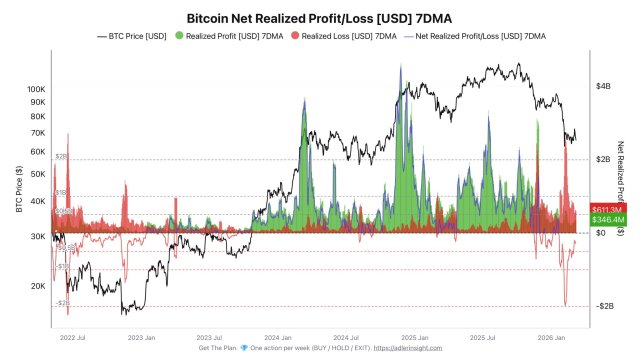
Source: Chart from Darkfost on X

Even though the market remains in the negative territory, this profit and loss divergence highlights a clear improvement in the situation. On February 7, Darkfost highlighted that the weekly average PnL was sitting at approximately $2 billion, marking a clear capitulation as Bitcoin’s price fell below the $60,000 level.

During this market trend, short-term BTC holders were constantly the most active players in the sector. These investors currently maintain a larger share of the supply than during the bear market, leaving Bitcoin in a fragile phase.

In January 2023, the percentage of Bitcoin supply classified as short-term holders was 12%, but today, it is 22%, indicating a 2x growth. At this point, it is crucial that BTC’s momentum continues and holds. This slight resilience is bolstering holding sentiment and accumulation among many investors, which is adding to the current consolidation. Meanwhile, it would be a definite improvement to see the net PnL return to positive territory after more than four months of losses and capitulation.

Funding Rates Are Showing A Negative Trend

While Bitcoin struggles to regain an upward trajectory, certain areas appear to be pulling the asset back. For example, BTC Funding Rates is exhibiting bearish action. CW, a data analyst and crypto investor, highlighted that most of the range when the BTC Perpetual Future Funding Rate fell to a negative value were the bottom of a short-term decline.

After that, CW outlined a general upward trend, with no declines confirmed yet. Currently, the funding rate is in negative territory again, which implies that the present price is a short-term bottom for BTC.

BTC trading at $69,550 on the 1D chart | Source: BTCUSDT on Tradingview.com

Related Questions

QWhat is the current price level that Bitcoin has reclaimed, indicating signs of bullish traction?

ABitcoin has reclaimed the key $70,000 level.

QAccording to the on-chain data, what is the net weekly Profit and Loss (PnL) figure mentioned in the article?

AThe net weekly Profit and Loss (PnL) is -$264 million, with $611 million in realized losses against $346 million in profit.

QWhat key metric, related to futures trading, is in negative territory and is considered an indicator of a potential short-term bottom for BTC?

AThe BTC Perpetual Future Funding Rate is in negative territory, which is considered an indicator of a potential short-term bottom.

QHow has the percentage of Bitcoin supply held by short-term holders changed since January 2023?

AThe percentage of Bitcoin supply held by short-term holders has grown from 12% in January 2023 to 22% today, indicating a 2x growth.

QWhich market analyst, cited in the article, shared that realized losses are still dominating Bitcoin's on-chain activity?

ADarkfost, a verified author at CryptoQuant and market expert, shared that realized losses are still dominating.

Related Reads

Institutional Adoption of Prediction Markets Stuck at the Third Stage

Prediction markets are transitioning from niche platforms focused on elections and sports to mainstream financial tools, as highlighted at Kalshi Research's inaugural conference. While sports still dominate trading volume (around 80%), non-sports categories like macroeconomics, politics, and entertainment are growing faster, signaling a shift from entertainment-based trading to information and risk management tools. Institutions, including Wall Street firms, are increasingly using prediction markets for data reference (Stage 1 adoption), with some progressing to system integration (Stage 2). However, full-scale trading (Stage 3) is limited due to the lack of margin trading, requiring full collateral for positions—a barrier for leverage-dependent entities. Kalshi is working with regulators to introduce margin mechanisms. Key insights from participants like Goldman Sachs and CNBC emphasize the value of real-time pricing for events (e.g., Fed decisions, tariffs), providing benchmarks previously unavailable. The path to maturity mirrors historical financial instruments like options, with expectations that prediction markets will become institutional staples within five years. Political leaders, including Trump and Schumer, now cite Kalshi odds, underscoring its growing influence. The platform rewards domain expertise over traditional finance backgrounds, attracting diverse participants from fields like music and poker. Ultimately, prediction markets are evolving into critical infrastructure for pricing uncertainty.

marsbit32m ago

Institutional Adoption of Prediction Markets Stuck at the Third Stage

marsbit32m ago

The First Year of Computing Power Inflation: The Cheaper DeepSeek Gets, the Harder It Is to Stop This Round of Price Hikes

The year 2026 marks the beginning of "computing power inflation." While AI inference costs have dropped by over 80% in 18 months globally, China's three major cloud providers—Alibaba Cloud, Baidu AI Cloud, and Tencent Cloud—simultaneously announced price hikes of 20–30%. This reflects a deeper structural shift driven by Jevons Paradox: as unit costs fall (e.g., via models like DeepSeek-R1), demand explodes, especially with the rise of reasoning models and AI agents that consume 10–50x more tokens per task. Although DeepSeek open-sourced its model weights, it did not release its inference optimization stack, leaving a significant engineering efficiency gap between cloud providers and smaller players. The big three are leveraging this advantage to reposition: Alibaba focuses on high-margin premium clients, Baidu filters out low-value users, and Tencent capitalizes on ecosystem lock-in. Meanwhile, ByteDance’s Volcano Engine adopts a more moderate pricing strategy to capture displaced customers. Unexpectedly, the price surge is pushing large enterprises toward self-built computing solutions once their cloud bills exceed a certain threshold. While cloud providers aim to boost profitability, they risk driving away innovative startups and accelerating competition from GPU leasing and domestic hardware providers like Huawei. The涨价 trend is expected to persist for 2–3 years, fueled by rising token consumption from reasoning models, AI agent adoption, and NVIDIA export restrictions. The inflection point depends on whether domestic chips can match NVIDIA’s efficiency, likely around 2027–2028. Until then, cloud providers will maintain pricing power, and the key for AI companies is to optimize token usage—the real moat in this era.

marsbit1h ago

The First Year of Computing Power Inflation: The Cheaper DeepSeek Gets, the Harder It Is to Stop This Round of Price Hikes

marsbit1h ago

Trading

Spot
Futures

Hot Articles

What is $BITCOIN

DIGITAL GOLD ($BITCOIN): A Comprehensive Analysis Introduction to DIGITAL GOLD ($BITCOIN) DIGITAL GOLD ($BITCOIN) is a blockchain-based project operating on the Solana network, which aims to combine the characteristics of traditional precious metals with the innovation of decentralized technologies. While it shares a name with Bitcoin, often referred to as “digital gold” due to its perception as a store of value, DIGITAL GOLD is a separate token designed to create a unique ecosystem within the Web3 landscape. Its goal is to position itself as a viable alternative digital asset, although specifics regarding its applications and functionalities are still developing. What is DIGITAL GOLD ($BITCOIN)? DIGITAL GOLD ($BITCOIN) is a cryptocurrency token explicitly designed for use on the Solana blockchain. In contrast to Bitcoin, which provides a widely recognized value storage role, this token appears to focus on broader applications and characteristics. Notable aspects include: Blockchain Infrastructure: The token is built on the Solana blockchain, known for its capacity to handle high-speed and low-cost transactions. Supply Dynamics: DIGITAL GOLD has a maximum supply capped at 100 quadrillion tokens (100P $BITCOIN), although details regarding its circulating supply are currently undisclosed. Utility: While precise functionalities are not explicitly outlined, there are indications that the token could be utilized for various applications, potentially involving decentralized applications (dApps) or asset tokenization strategies. Who is the Creator of DIGITAL GOLD ($BITCOIN)? At present, the identity of the creators and development team behind DIGITAL GOLD ($BITCOIN) remains unknown. This situation is typical among many innovative projects within the blockchain space, particularly those aligning with decentralized finance and meme coin phenomena. While such anonymity may foster a community-driven culture, it intensifies concerns about governance and accountability. Who are the Investors of DIGITAL GOLD ($BITCOIN)? The available information indicates that DIGITAL GOLD ($BITCOIN) does not have any known institutional backers or prominent venture capital investments. The project seems to operate on a peer-to-peer model focused on community support and adoption rather than traditional funding routes. Its activity and liquidity are primarily situated on decentralized exchanges (DEXs), such as PumpSwap, rather than established centralized trading platforms, further highlighting its grassroots approach. How DIGITAL GOLD ($BITCOIN) Works The operational mechanics of DIGITAL GOLD ($BITCOIN) can be elaborated on based on its blockchain design and network attributes: Consensus Mechanism: By leveraging Solana’s unique proof-of-history (PoH) combined with a proof-of-stake (PoS) model, the project ensures efficient transaction validation contributing to the network's high performance. Tokenomics: While specific deflationary mechanisms have not been extensively detailed, the vast maximum token supply implies that it may cater to microtransactions or niche use cases that are still to be defined. Interoperability: There exists the potential for integration with Solana’s broader ecosystem, including various decentralized finance (DeFi) platforms. However, the details regarding specific integrations remain unspecified. Timeline of Key Events Here is a timeline that highlights significant milestones concerning DIGITAL GOLD ($BITCOIN): 2023: The initial deployment of the token occurs on the Solana blockchain, marked by its contract address. 2024: DIGITAL GOLD gains visibility as it becomes available for trading on decentralized exchanges like PumpSwap, allowing users to trade it against SOL. 2025: The project witnesses sporadic trading activity and potential interest in community-led engagements, although no noteworthy partnerships or technical advancements have been documented as of yet. Critical Analysis Strengths Scalability: The underlying Solana infrastructure supports high transaction volumes, which could enhance the utility of $BITCOIN in various transaction scenarios. Accessibility: The potential low trading price per token could attract retail investors, facilitating wider participation due to fractional ownership opportunities. Risks Lack of Transparency: The absence of publicly known backers, developers, or an audit process may yield skepticism regarding the project's sustainability and trustworthiness. Market Volatility: The trading activity is heavily reliant on speculative behavior, which can result in significant price volatility and uncertainty for investors. Conclusion DIGITAL GOLD ($BITCOIN) emerges as an intriguing yet ambiguous project within the rapidly evolving Solana ecosystem. While it attempts to leverage the “digital gold” narrative, its departure from Bitcoin's established role as a store of value underscores the need for a clearer differentiation of its intended utility and governance structure. Future acceptance and adoption will likely depend on addressing the current opacity and defining its operational and economic strategies more explicitly. Note: This report encompasses synthesised information available as of October 2023, and developments may have transpired beyond the research period.

363 Total ViewsPublished 2025.05.13Updated 2025.05.13

What is $BITCOIN

Discussions

Welcome to the HTX Community. Here, you can stay informed about the latest platform developments and gain access to professional market insights. Users' opinions on the price of BTC (BTC) are presented below.

活动图片