Hormuz Strait Reopening: Will the Fed Turn "Dovish" and the Market Reprice "Rate Cuts"?

marsbitPublished on 2026-06-16Last updated on 2026-06-16

Abstract

The article outlines two key factors that may lead the U.S. Federal Reserve, under Chair Wash, to adopt a more dovish stance at the upcoming FOMC meeting. First, the anticipated reopening of the Strait of Hormuz is expected to ease oil and energy prices, thereby reducing upward inflationary pressures. This shift could lead the Fed to view energy prices as a neutral or even deflationary factor. Second, recent core CPI data showed significant cooling, with a monthly increase of only 0.21%, contrasting with the still-strong core PCE. This divergence supports a dovish interpretation. Market implications are significant. While the FOMC is expected to remove "easing bias" language and project unchanged rates for the year—moves already priced in—Chair Wash's potential for more dovish commentary presents an upside risk. Consequently, there is room for the market to further price out remaining hike expectations and increase expectations for rate cuts. The report notes that the 2-year Treasury yield, though down recently, remains well above February levels, indicating further potential downside as inflation risks fade.

Written by: Zhao Ying

Source: Wall Street News

Two major catalysts for disinflation are simultaneously unfolding, providing ample justification for Fed Chair Wash to adopt a more dovish stance at this week's Federal Open Market Committee (FOMC) meeting.

According to a report from Citi Research released on June 15th via Wind Trading Desk, the planned reopening of the Strait of Hormuz is expected to push oil prices lower, eliminating the upside risk to inflation from energy prices. Meanwhile, last week's core CPI data came in surprisingly cool, with a month-on-month increase of only 0.21%.

The combination of these two developments further weakens the rationale for the Fed to maintain a hawkish stance, bringing the path to eventual rate cuts back onto the table.

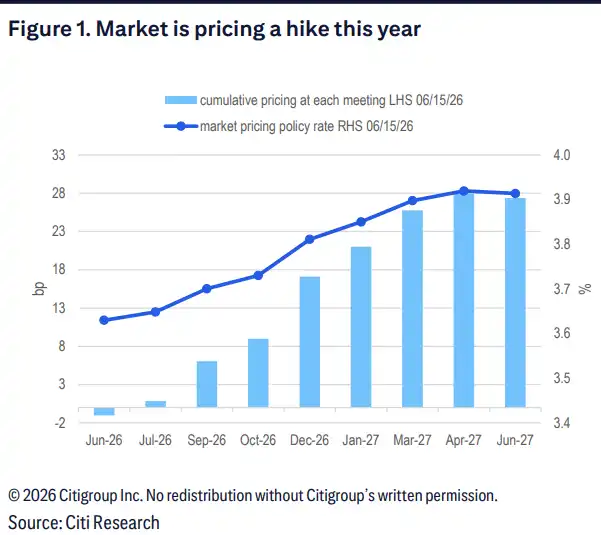
For the markets, this assessment has direct pricing implications. The two-year Treasury yield has fallen by about 13 basis points compared to a week ago, but remains more than 60 basis points higher than its February level. There is still room for market pricing of rate hikes to be compressed, and for pricing of rate cuts to be further increased.
Energy Price Pressures Ease, Upside Inflation Risks Blunt

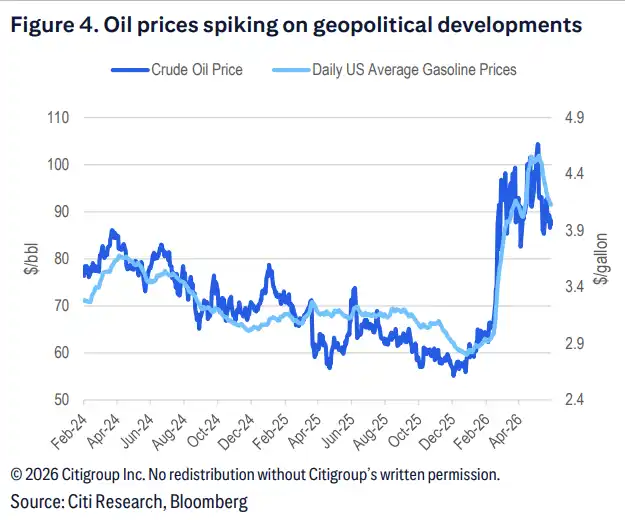
Expectations for the reopening of the Strait of Hormuz are a core driver of the current dovish narrative. Once the strait resumes passage, increased crude oil supply will lead to lower oil and other energy prices.

Gasoline prices have been declining for a full month, with the national average dropping from around $4.50 per gallon to $4.00. Citi expects further declines following other energy commodities. This trend is likely to produce at least several months of negative overall inflation readings in the coming months, prompting Fed officials to shift their characterization of energy prices from an "inflation risk" to a "neutral or even disinflationary factor."
Core CPI Cools, Divergence Among Inflation Metrics Intensifies

On the core inflation front, although May's core PCE is still expected to remain strong, core CPI has shown clear signs of cooling, with a month-on-month increase of only 0.21%.

Core PCE is increasingly becoming an "outlier" among current inflation metrics—both trimmed-mean PCE and core CPI are closer to target levels and show a clearer downward trend. This divergence is being increasingly recognized by both markets and Fed officials, also providing data support for a dovish stance.

FOMC Hawkish Adjustments Fully Priced In, Dovish Signals Have Upside Potential

The report expects this week's FOMC statement to remove the "easing bias" wording, and the median dot in the interest rate projections (dot plot) will indicate rates held steady this year. However, these hawkish adjustments are already fully anticipated by the market and do not constitute new information.

The real variable lies in Chair Wash's wording. Considering the latest developments regarding the Strait of Hormuz reopening and the cooling trend in core inflation, the risk of Wash delivering more dovish signals at this meeting is tilting to the upside. If his wording proves more accommodative than expected, the market's repricing of the rate cut path could accelerate.

Room for Treasury Yields to Fall Further, Market Pricing Has Adjustment Room

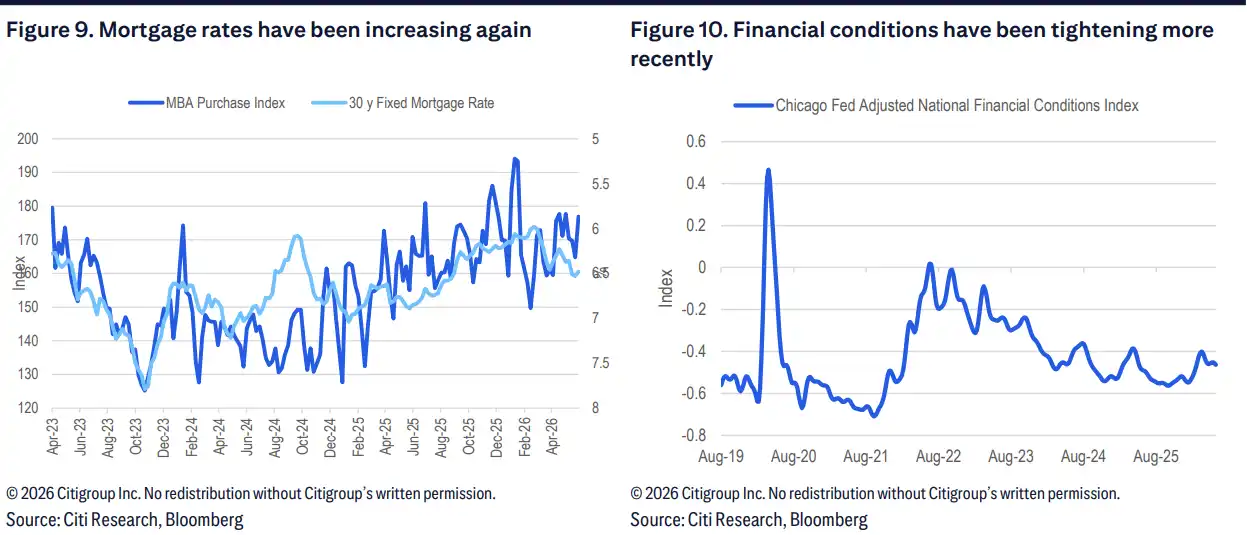
From a market pricing perspective, the report believes implied probabilities of rate hikes in interest rate futures remain elevated. Although the two-year Treasury yield has fallen about 13 basis points from a week ago, it is still over 60 basis points higher than its February level, indicating the market has not fully priced in the impact of receding inflation risks.

As the previously supporting upside inflation risks to the hawkish outlook gradually dissipate, the market is expected to further compress pricing for rate hikes while simultaneously increasing pricing for rate cuts, leaving further room for Treasury yields to decline.
Related Questions

QAccording to the article, what are the two catalysts for inflation decline that could push the Fed towards a dovish turn?

AThe two catalysts are: 1) The planned reopening of the Strait of Hormuz, which is expected to push down oil prices and reduce energy price pressure on inflation. 2) The cooler-than-expected core CPI data for the previous week, which showed a monthly increase of only 0.21%.

QHow does the article describe the trend of gasoline prices and its expected impact?

AGasoline prices have been falling for a month, with the national average dropping from about $4.50 per gallon to $4.00. Citi expects them to fall further in line with other energy prices. This trend is projected to deliver several months of negative overall inflation readings and lead the Fed to view energy prices as a neutral or even deflationary factor rather than an inflation risk.

QWhat divergence in inflation indicators does the article highlight, and why is it significant?

AThe article highlights a divergence between core PCE and other inflation metrics like core CPI and trimmed-mean PCE. While core PCE remains strong, core CPI and trimmed-mean PCE are closer to the Fed's target and show a clearer disinflationary trend. This growing recognition of the divergence provides data support for a more dovish Fed stance.

QWhat is the market's current pricing for interest rates according to the report, and what potential adjustment does it see?

AThe market has already priced in expected hawkish adjustments from the FOMC, such as removing "accommodative bias" language. However, the report states that interest rate futures still imply an overly high probability of rate hikes. There is room for the market to further price out hikes and increase pricing for rate cuts, suggesting Treasury yields have more room to fall.

QWhat is the key variable for the market at the upcoming FOMC meeting, according to the article's analysis?

AThe key variable is the tone and wording of Fed Chair Wash's statements. Given the latest developments (Strait of Hormuz reopening, cooling core inflation), the risk is tilted towards Wash delivering a more dovish message than expected. If his wording is more temperate, the market's repricing of the rate cut path could accelerate.

Related Reads

After Tokenization of Assets, How to Exit?

Title: How to Exit After Asset Tokenization? Author: Symbiotic Compiled by: Hu Tao, ChainCatcher Summary: Tokenization addresses how assets go on-chain but largely leaves the redemption question unresolved. While tokenized assets can settle instantly, the underlying redemption for assets like treasuries, private credit, or real estate can take from T+1 to 180 days. This gap hinders DeFi adoption of Real World Assets (RWAs). Three emerging models aim to provide instant exit liquidity, differing primarily in their capital structure and efficiency: 1. **Balance Sheet Model (e.g., Grove Basin):** A single entity (like Sky) provides immediate liquidity from its balance sheet, acting as a bridge during the settlement period. It offers simplicity and deep initial liquidity but is constrained by a single entity's capacity and risk appetite. 2. **Asset-Specific Vault Model (e.g., Upshift Clear):** Independent liquidity providers fund dedicated vaults for each supported asset, earning fees. It decentralizes capital sources but isolates liquidity and capital per asset, leading to potential fragmentation. 3. **Shared Liquidity Layer Model (e.g., Symbiotic Liquid Lane):** A shared capital pool supports multiple RWA types simultaneously. Funds remain productive between redemptions (e.g., earning yield in lending markets). Exits are settled via a competitive RFQ market. This model aims for higher capital efficiency, scalability across assets, and serves longer-duration assets like private credit. Key differentiators are: 1) Source of capital and risk bearer, 2) Redemption pricing mechanism, 3) Capital efficiency, 4) Scalability to new asset types, and 5) Composability. The shared liquidity layer model represents a move from piecemeal solutions toward scalable infrastructure, enabling T+0 exits by pooling capital, maintaining yield, and using competitive pricing, thus enhancing RWA utility in DeFi.

marsbit9m ago

After Tokenization of Assets, How to Exit?

marsbit9m ago

After Tokenizing Assets, How to Exit?

After tokenization, a key unresolved issue is providing holders with a reliable exit mechanism, as underlying asset settlement (taking days to months) lags far behind on-chain token settlement. Three primary models for instant liquidity have emerged, differing in their capital structure and efficiency: 1. **Balance Sheet Model (e.g., Grove Basin):** A single, well-capitalized entity (like Sky) provides immediate liquidity from its own reserves. This offers simplicity and deep initial liquidity but is constrained by that single balance sheet's capacity and risk appetite, limiting scalability. 2. **Dedicated Vault Model (e.g., Upshift Clear):** Independent liquidity providers (LPs) fund separate vaults for each supported asset. This decentralizes capital sources but isolates liquidity and capital, which becomes inefficient as the number of tokenized assets grows. 3. **Shared Liquidity Layer Model (Symbiotic Liquid Lane):** Independent capital providers fund shared vaults that can support multiple tokenized assets simultaneously. Capital remains productive between redemptions (e.g., earning yield in DeFi markets). Exits are settled via a competitive RFQ market where market makers bid. The article argues that the shared layer model offers superior capital efficiency and scalability. It transforms exit liquidity from an asset-specific patch into shared market infrastructure, allowing liquidity capacity to grow with overall market participation rather than being fragmented per asset. This is particularly valuable for longer-duration assets like private credit, where reliable T+0 exits can significantly enhance their utility in DeFi.

链捕手22m ago

After Tokenizing Assets, How to Exit?

链捕手22m ago

Anthropic's Triple Moment: Code Leak, Government Confrontation, and Weaponization

This article analyzes Anthropic's recent conflicts and strategic moves following the U.S. government's emergency halt of its new Fable model, citing national security concerns over potential "jailbreaks." The author argues this incident reveals deeper tensions between AI labs, governments, and the software industry. While critics view Anthropic's safety-focused rhetoric as marketing fear, the author suggests it serves as a commercial moat masking the company's core economic imperative: moving closer to end-users and their valuable data to avoid being commoditized. The piece outlines a coming clash between frontier AI labs like Anthropic and established software companies. Labs need real-world usage data for model improvement via reinforcement learning, creating a cycle where better products attract more users and more data. This threatens software firms who, as Microsoft's Satya Nadella warns, risk having their value captured by a few dominant models. Anthropic's controversial policy changes—initially secretly degrading Fable's performance for LLM development and expanding data retention—are framed as assertions of control, justified by its safety narrative. The company's foundational belief that it alone is sufficiently concerned about superintelligent AI dangers legitimizes its actions, from resisting government demands to shaping usage policies. The author concludes that this alignment of mission, talent, and business strategy is powerful but concerning, as it concentrates immense potential power in the hands of those convinced of their own righteous understanding.

marsbit32m ago

Anthropic's Triple Moment: Code Leak, Government Confrontation, and Weaponization

marsbit32m ago

Xpeng and NIO Compete on Computing Power, Li Auto Shifts Architecture

On June 15, 2026, Li Auto unveiled details of its self-developed chip, Mahe M100, for its new L9 Livis model. CTO Xie Yan stated the goal was not just a faster chip, but a fundamentally different one, targeting the chip architecture itself. While competitors like NIO, Xpeng, and Huawei highlight TOPS (computing power) figures for their self-developed chips, Li Auto’s Mahe M100 focuses on redesigning the underlying architecture. It employs a "dynamic data flow architecture" to address memory bandwidth bottlenecks in large model inference, claiming up to 3x the effective computing power of Nvidia's Thor U for its specific workloads and a 40% reduction in latency. The chip's design was peer-reviewed and accepted at ISCA 2026. However, this performance is highly optimized for Li Auto's own VLA2.1 algorithm, meaning it may not generalize as well to other tasks. Li Auto aims to achieve full-stack in-house development with Mahe M100, covering chip, compiler, OS, AI algorithms, and domain controller—a level of vertical integration few competitors match. Beyond the chip, CEO Li Xiang introduced a new strategic narrative: the "embodied intelligent vehicle," defined as an integration of an EV, a professional driver, an AI computer, and a life assistant. This shifts competition from features like large screens to systemic AI capabilities. A key commitment was that Li Auto's Mahe VLA autonomous driving model will match Tesla's FSD V14 by Q4 2026, with specific OTA milestones set for July, September, and December. Financially, Li Auto faces pressure with declining revenue and vehicle gross margins since Q4 2025, while maintaining high R&D investment (approx. ¥12B in 2026, 50% AI-related). Its 2026 sales target is 550,000 vehicles, up from 406,000 in 2025. The new L9 Livis garnered over 10,000 pre-orders in two weeks. The effectiveness of these strategic moves—new products, OTAs, and the novel chip architecture—will begin to show in Q3 2026 financial results, with the year-end FSD V14 benchmark being the ultimate test.

marsbit1h ago

Xpeng and NIO Compete on Computing Power, Li Auto Shifts Architecture

marsbit1h ago

Trading

Spot
Futures
活动图片