Author: Gino Matos
Compilation: Luffy, Foresight News
TL;DR:
- The New York Times reports that Meta has formed a small team to develop an internal project codenamed Arena, a point-based prediction app allowing users to wager on outcomes of politics, sports, and global events.
- Prediction markets have demonstrated genuine demand. With 3.56 billion daily active users, Meta has the potential to bring this niche sector to the mass market.
- However, Meta's trust crisis, combined with election and misinformation scrutiny, could make Arena a regulatory target even before it scales.
On June 23, The New York Times reported that Mark Zuckerberg is leading a dedicated team to develop a prediction market application called Arena. Users will use platform points to place bets on outcomes like political elections, sporting events, and international affairs.
This is the same company that rebranded for the metaverse and whose Reality Labs division has accumulated nearly $90 billion in losses. Now turning to prediction markets, a sector with strong real demand and an established user base but fraught with complex regulatory rules, this pivot could be Meta's smartest strategic adjustment or a repeat of its past costly failures.
The Metaverse's Staggering Bill
In October 2021, Facebook officially changed its name to Meta. Zuckerberg stated the company's core goal was "to bring the metaverse to life" and predicted the metaverse would reach one billion users within a decade.
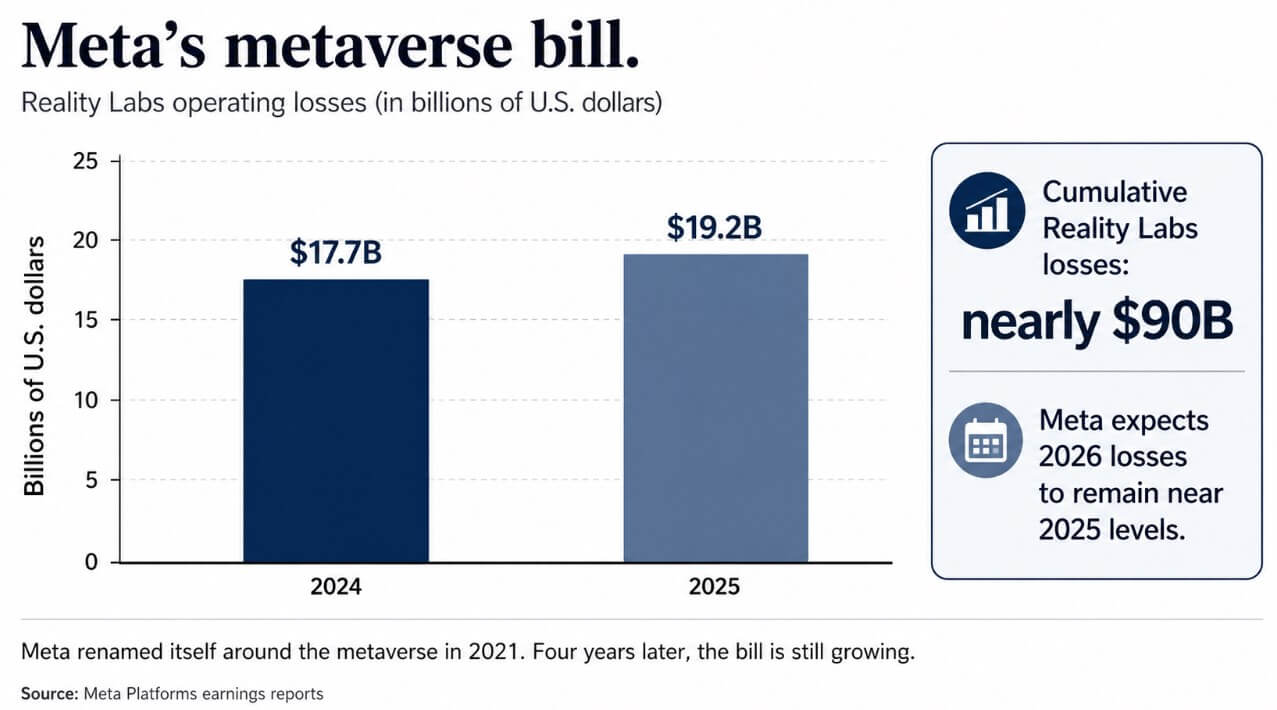
Losses for the Reality Labs division, which carries this vision, have continued to swell: $17.7 billion in operating losses in 2024, $19.2 billion in 2025, with cumulative losses nearing $90 billion. Meta has indicated to investors that losses for this segment in 2026 could be on par with 2025.
Its flagship social VR platform, Horizon Worlds, saw monthly active users drop below 200,000 in 2022, far short of the initial 500,000 target. Meta subsequently revised expectations downward again and plans to wind down the VR version by 2026.
Why Prediction Markets Are a Completely Different Game
In 2026, the combined monthly trading volume of the two leading platforms, Kalshi and Polymarket, was approximately $24 billion, with industry projections for full-year prediction market trading volume exceeding $130 billion.
Robinhood launched a prediction markets section in 2025, Interactive Brokers integrated event contracts into its trading platform, and the Golden Globe Awards even incorporated prediction market interaction segments. A Bernstein research report in April estimated the sector's annual trading volume could reach $1 trillion by 2030.
Meta has always been adept at replicating popular products and leveraging its massive traffic to overtake: Instagram launched Stories after Snapchat's ephemeral posts; Meta launched Threads after Twitter dominated social text for a decade; Reels followed TikTok's short-video craze. As of April, Meta's family of apps boasts 3.56 billion daily active users, a traffic volume that dwarfs all existing prediction market platforms.
Arena's points-based design continues Meta's consistent strategy: capturing existing user behaviors and demand, embedding them within its own traffic ecosystem, and relying on massive distribution to compensate for a lack of product originality.
Building a prediction market primarily requires software, an information feed, an account system, content moderation, and compliance, with some scenarios possibly involving licensed partners. In contrast, the metaverse requires custom hardware, immersive content, avatars, dedicated runtime environments, and years spent cultivating user habits. The massive losses at Reality Labs prove the extreme cost of creating a completely new paradigm from scratch.
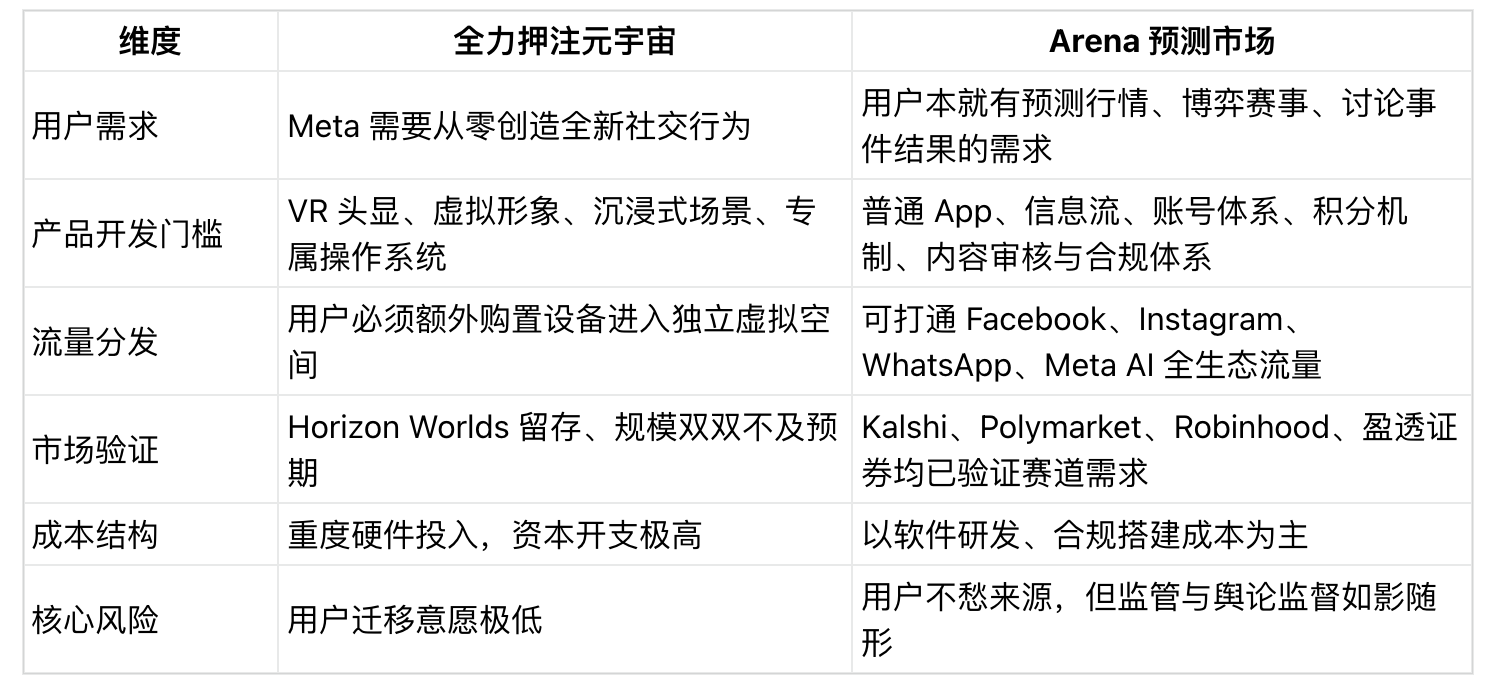
Comparison of Core Dimensions: Metaverse vs. Prediction Market Arena
Arena Is Not Meta's First Foray into Prediction Markets; Its Previous Product Was Shut Down Long Ago
As early as 2020, during the initial pandemic, Meta launched Forecast, a points-based public prediction app focused on current events, which was shut down in 2022. At that time, Polymarket had not yet exploded with the 2024 U.S. presidential election, Kalshi had not won its lawsuit with the Commodity Futures Trading Commission (CFTC) over election contracts, and annual industry trading volume had not yet surpassed $50 billion.
The sector Meta is about to enter is rife with regulatory penalty cases:
- In 2022, the CFTC determined Polymarket was offering off-exchange event derivative contracts without registration and fined it $1.4 million.
- Kalshi spent years in federal litigation fighting for the right to offer election contracts. A district court issued a favorable ruling in September 2024, and the CFTC dropped its appeal in May 2025, opening a compliance space for election event contracts, but debates over political trading and market integrity persist.
- In April 2026, the CFTC brought the first-ever insider trading lawsuit in prediction markets, accusing an active-duty U.S. military officer of profiting from trades on Polymarket using confidential information about Venezuelan operations.
Meta's past forays into financial products have long made regulators highly wary of its financial ambitions. The digital stablecoin project Diem (originally Libra), spearheaded by Facebook, was ultimately sold at a low price to Silvergate Bank in 2022 after regulators concluded that Meta controlling a payment network for billions of users would concentrate excessive financial and social power. During the Libra hearings, Meta's model combining social identity, political content, financial incentives, and market data faced fierce opposition from regulators.
It's precisely because points-based prediction gaming can avoid stringent financial regulations in the early stages that Meta has chosen it as Arena's starting point.
What Advantages Does Massive Traffic Bring?
The most viable form for Arena's initial product is building mass prediction features leveraging social scale: Instagram creators launching prediction markets for award shows, Facebook groups discussing sports odds, WhatsApp communities sharing collective prediction views, and Meta AI aggregating mainstream expectations across the network.
This version would temporarily avoid the cash-settled event contracts that have previously drawn regulatory penalties, operating solely within Meta's social graph of 3.56 billion daily active users.
However, the core logic of prediction markets relies on real monetary stakes to discipline prediction behavior and form fair prices. Once replaced with points-based interaction incentives, the product will prioritize reach and user engagement time over the accuracy of prediction outcomes.
Meta's poor track record of handling political content and combating misinformation means regulators and media will naturally scrutinize every controversy Arena triggers.
Meta's traffic advantage is sufficient to support the sector's scale. The success logic of Stories and Reels is identical: capture existing user preferences and amplify their spread through a billion-user platform. If Arena builds lightweight social prediction features, controls financial barriers to entry, and makes prediction markets easily accessible to the average Facebook user while platforms like Kalshi maintain their professional trading positioning, Meta could grow the overall industry pie, benefiting existing leading platforms.
Crypto-native users with financial awareness have built the trillion-dollar prediction market sector. Meta's 3.56 billion daily active users represent a massive, previously untapped mainstream user base, which is also the greatest opportunity in this move.
But just two months before news of Meta's entry broke, the CFTC brought the first-ever insider trading lawsuit in prediction markets, indicating ongoing tightening of regulatory scrutiny. Meta's platforms covering prediction markets related to elections, sports events, and public figures are highly susceptible to regulatory intervention. Coupled with the company's negative history of handling sensitive political content, Meta enters the arena with an inherent credibility deficit, where its massive traffic could amplify all kinds of negative controversies.
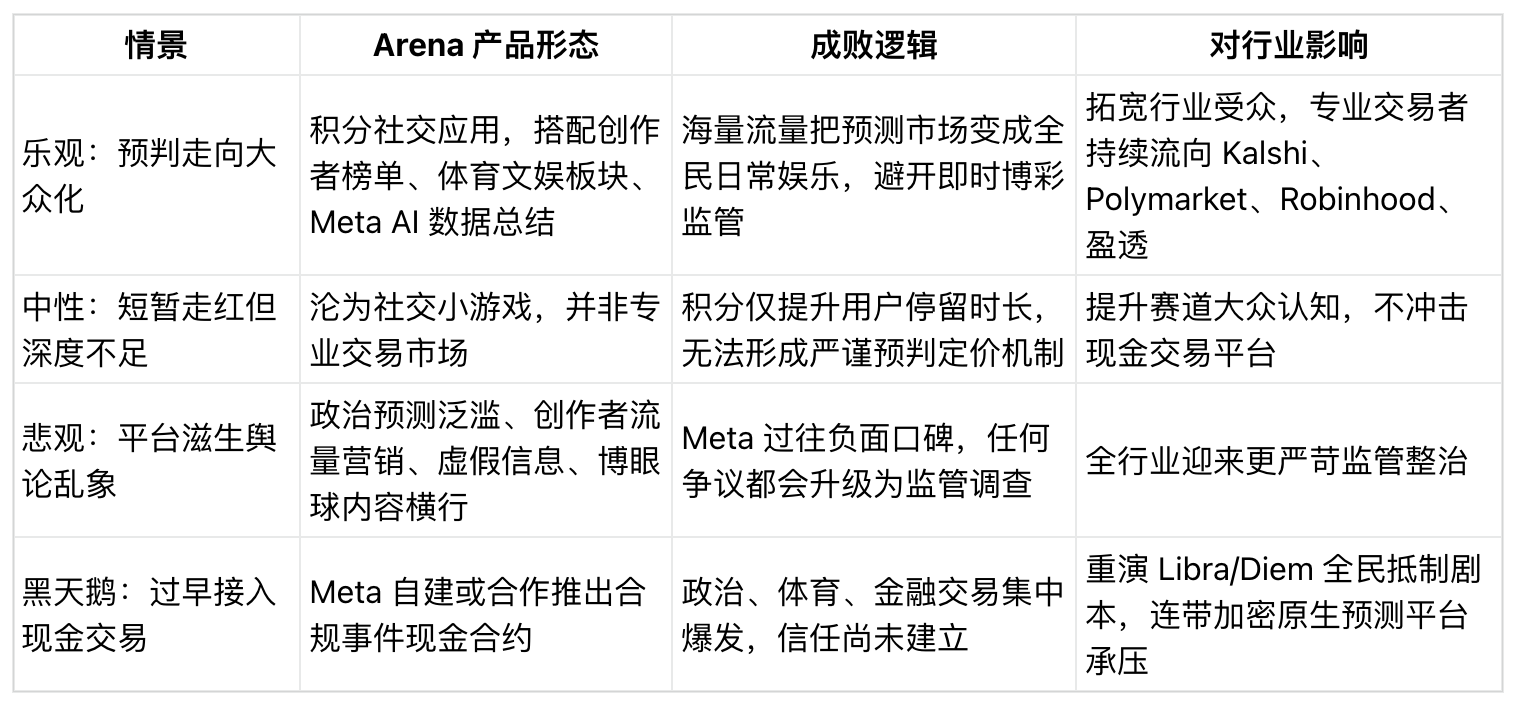
Four Potential Development Scenarios for Arena
Several of Meta's previous financial products have failed outright because regulators deemed trust issues unsolvable.
Arena has inherent advantages: the prediction market sector is established, and a real user base exists. But the operator, Meta, carries the same negative reputation that doomed Libra. Once elections and monetary transactions are involved, trust becomes a core asset Meta must earn through long-term stewardship; traffic scale alone cannot compensate for a lack of credibility.