Why NEAR Protocol’s latest upgrade could matter beyond its 5% price rally

ambcryptoPublished on 2026-07-02Last updated on 2026-07-02

Abstract

NEAR Protocol's 2.13 upgrade has gone live on testnet, introducing key features to address future cryptographic threats. The upgrade implements post-quantum-safe access keys using the NIST-approved FIPS-204 signing scheme to defend against potential quantum computer attacks. It also introduces dynamic resharding for automatic scalability. The market reacted positively to the news. NEAR's price rallied approximately 5.4%, finding support at $1.70 and climbing to $1.92. Spot and derivatives trading data showed increased buying pressure and market participation, with rising volume and open interest. Technical indicators like the RSI and DMI suggest growing bullish momentum, with the potential to challenge the $2 resistance level if demand persists.

In March, Google issued a warning that future quantum computers could compromise the cryptography protecting Bitcoin [BTC].

The warning rattled the market, and more protocols are taking serious measures to prepare for such risks. NEAR Protocol [NEAR] is the latest chain moving to address these quantum vulnerabilities.

NEAR Protocol’s new upgrade goes live!

After many years in the making, NEAR Protocol’s upgrade 2.13 went live on testnet and included two major upgrades. The upgrade introduced post-quantum-safe access keys using the NIST-approved FIPS-204 signing scheme.

The upgrade aims to boost account security and defend against cryptographic threats. As such, the upgrade adds FIPS-204, a NIST-approved signature scheme designed not only to repel but also to withstand any quantum attack.

Secondly, it introduced dynamic resharding, ensuring that the protocol scales automatically with demand. As the shard fills with state, it splits to distribute it, thus eliminating the need for an upgrade. To achieve this feat, Near Protocol will work together with Ledger to align hardware security for the quantum era.

How did the market react?

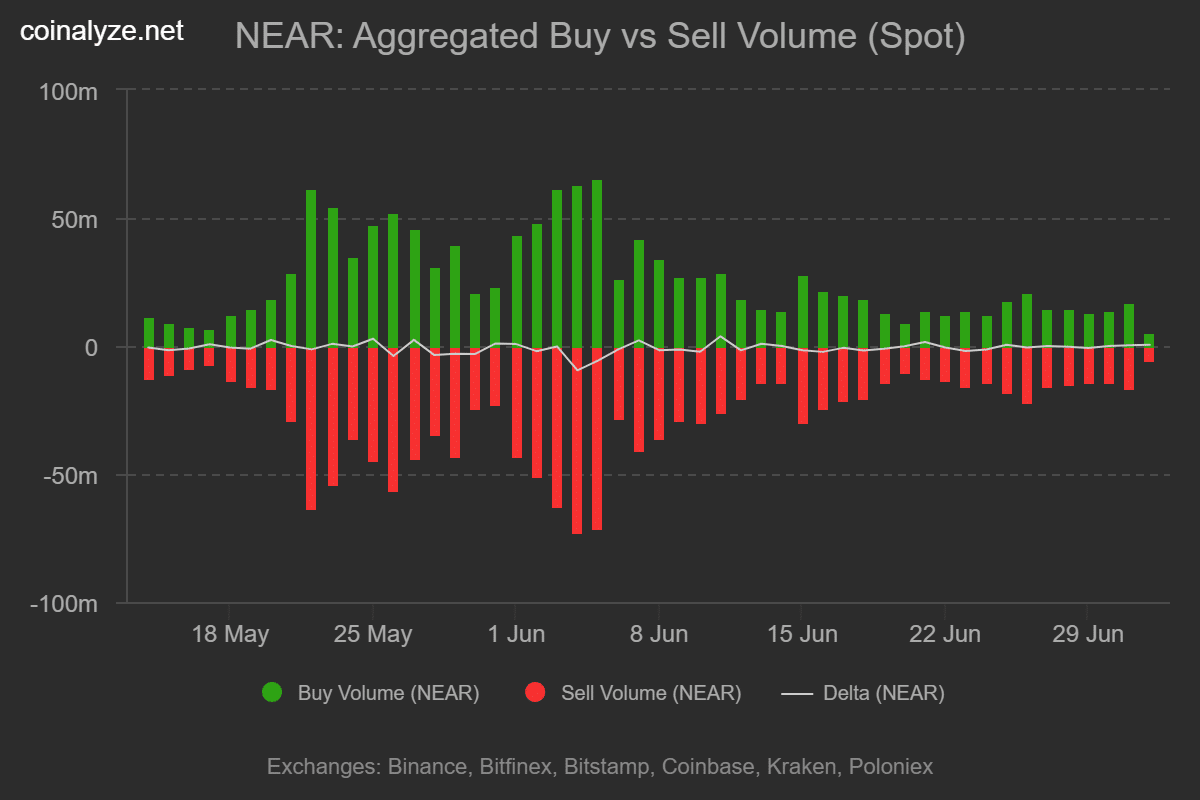
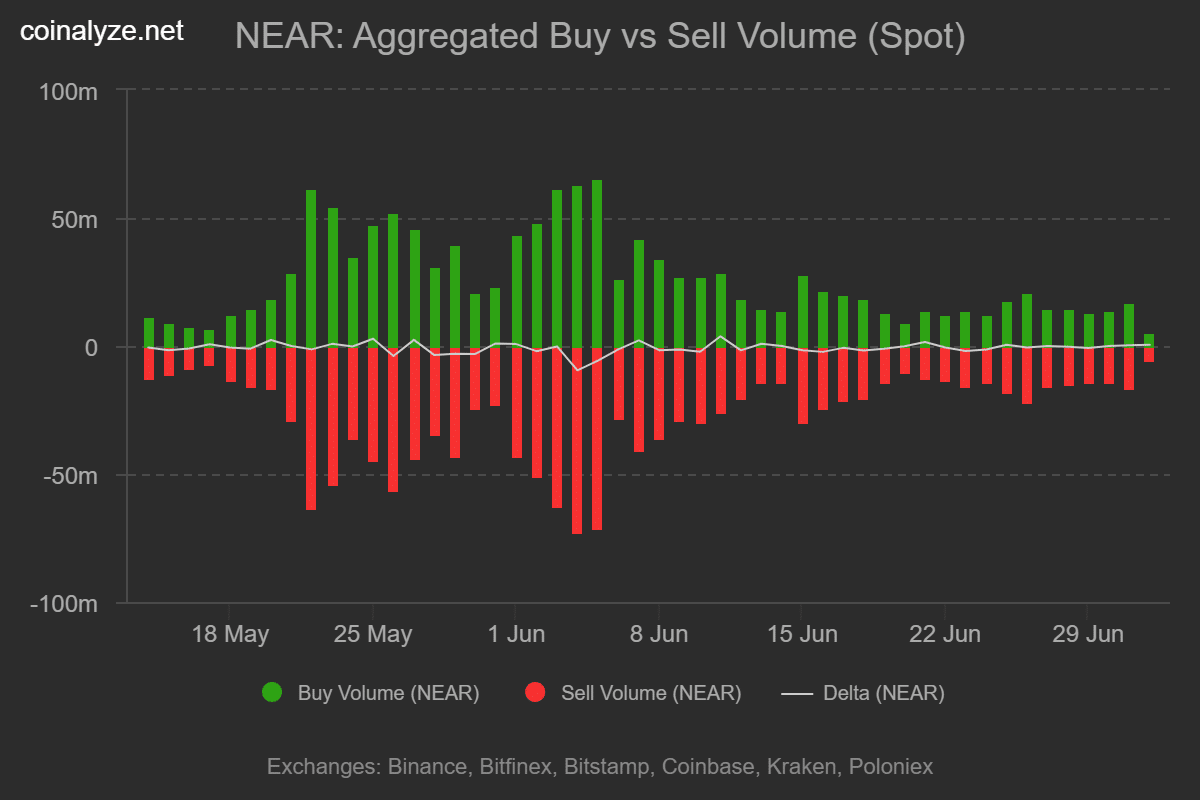
As expected, the upgrade incentivized market participants to return. On the spot, for instance, buyers displaced sellers for the first time in five days.

On the 1st of July, the Buy Volume rose to 16.8 million while Sell Volume also jumped to 16.5 million. As a result, the market saw a positive delta of 200k.
Source: Coinalyze

The same trend continued on the 2nd of July, with a positive delta of 500k. A positive delta signaled renewed market demand.

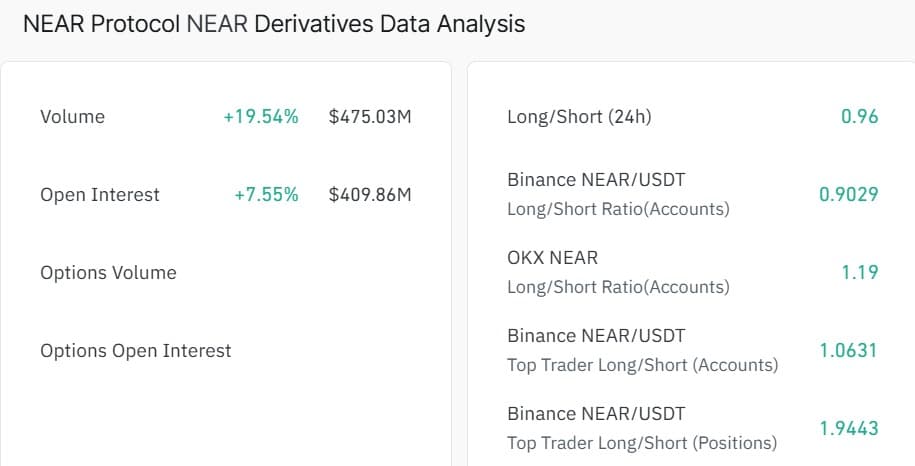
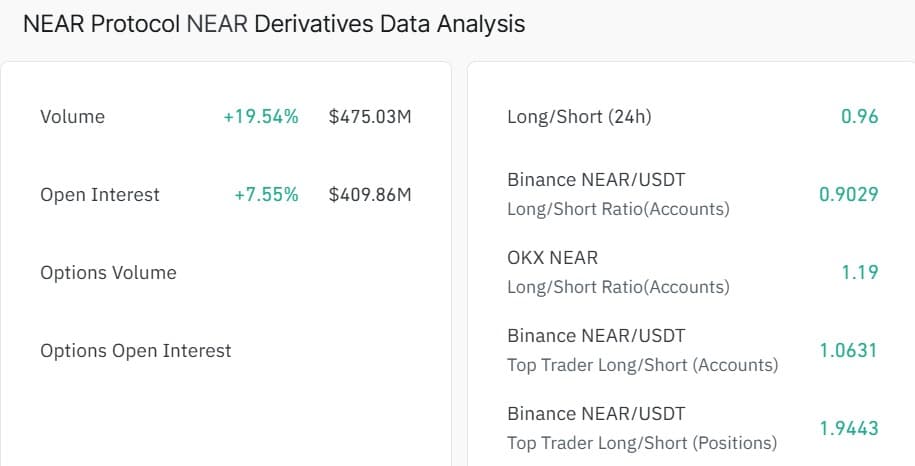
On the derivatives side, speculators also rushed to the market. According to CoinGlass, Derivatives Volume climbed 19% to $475 million, while Open Interest (OI) rose 7.5% to $409 million as of writing.
Source: Coinglass

With OI and volume rising in tandem, it suggested that investors rushed to position themselves, driven by upgrade news.

What’s next for NEAR?

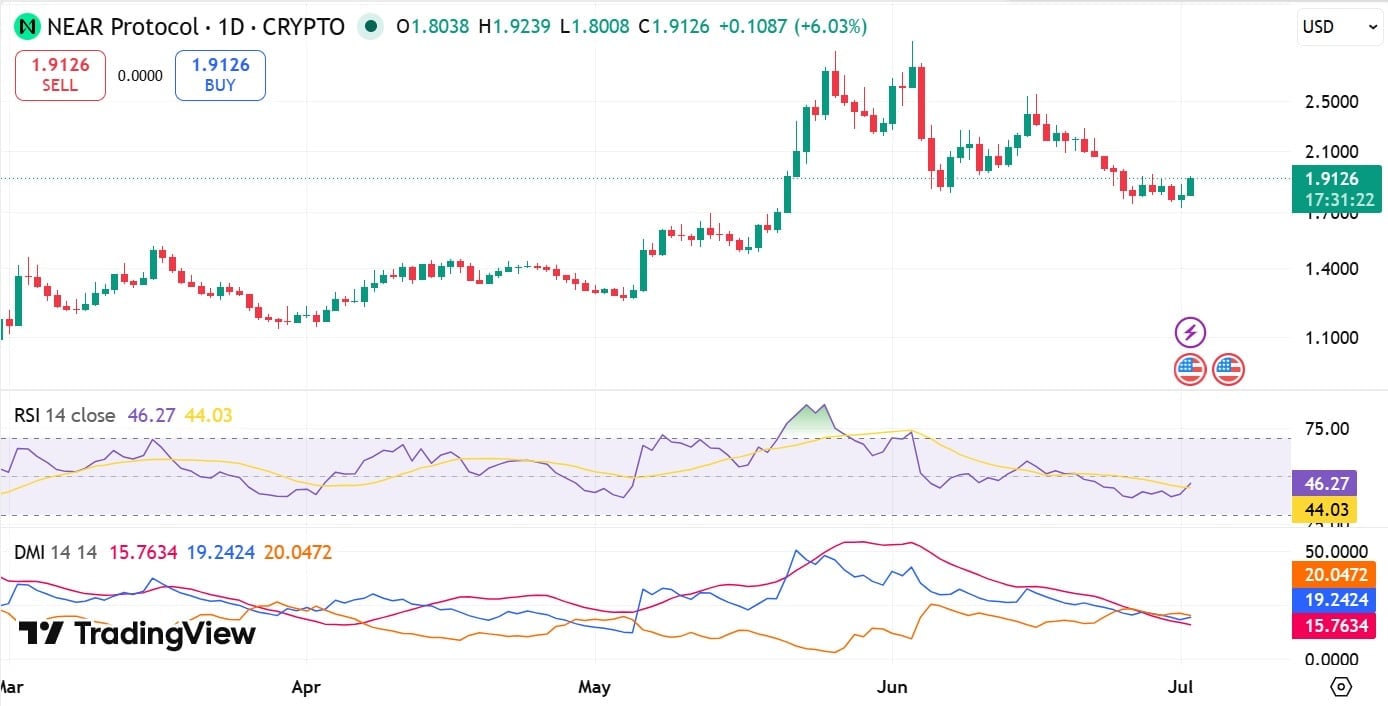
News of the 2.13 protocol upgrade sparked a sharp bullish run for NEAR. After a period of decline, the altcoin reversed course, held support at $1.70, and then climbed to $1.92.

At the time of writing, NEAR traded at $1.91, up 5.4% on the daily charts. Over the same period, the altcoin’s volume jumped 16%, signaling increased market participation.
Source: TradingView

Notably, the NEAR’s momentum strengthened as the Daily Relative Strength Index formed a bullish crossover, rising to 46. At the same time, the +DI of DMI climbed to 19, confirming growing momentum. Taken together, these two indicators point towards the likelihood of a strong upside ahead.

If current demand holds, RSI could flip above 50, validate the trend, and push NEAR toward reclaiming the $2 resistance. In that case, $2.5 would become the next immediate barrier. However, if the move proves speculative and fades quickly, the altcoin could retreat toward $1.70.


Final Summary

  • NEAR Protocol’s 2.13 upgrade went live on testnet, introducing post-quantum-safe access keys using the NIST-approved FIPS-204 signing scheme.
  • NEAR surged 5.4%, held $1.7, and jumped to $.92, as speculative demand returned in the market.

Trending Cryptos

Related Questions

QWhat are the two major upgrades introduced in NEAR Protocol's 2.13 upgrade?

AThe 2.13 upgrade introduced post-quantum-safe access keys using the NIST-approved FIPS-204 signing scheme to boost account security, and dynamic resharding to ensure the protocol scales automatically with demand.

QHow did the market react to the NEAR Protocol upgrade news, specifically in terms of spot trading?

AOn the spot market, buyers displaced sellers for the first time in five days, leading to a positive delta of 200k on July 1st and 500k on July 2nd, signaling renewed market demand.

QWhat was the change in NEAR's price and trading volume following the upgrade announcement?

ANEAR's price surged 5.4% to $1.91 on the daily charts, and its trading volume jumped 16%, indicating increased market participation.

QWhat technical indicators suggested a potential strong upside for NEAR after the upgrade?

AThe Daily Relative Strength Index (RSI) formed a bullish crossover, rising to 46, and the +DI of the Directional Movement Index (DMI) climbed to 19, confirming growing bullish momentum.

QWhat was the broader context or catalyst mentioned that prompted NEAR Protocol and other chains to address quantum vulnerabilities?

AThe broader context was a warning issued by Google in March that future quantum computers could compromise the cryptography protecting Bitcoin, which rattled the market and led protocols to take serious measures.

Related Reads

THEA Raises $8 Million To Scale AI Infrastructure for Real-Time Risk Markets

Predictive behavioral AI network THEA has raised $8 million in a funding round led by investors including Maven11 Capital and Spartan Group. Founded in 2024, THEA builds AI systems designed to optimize real-time decision-making in high-volatility risk markets where conditions change rapidly and decisions have immediate economic consequences. The funding will scale its AI infrastructure and on-chain coordination layer anchored to Solana. THEA's technology, developed over the past decade, is trained on over 35 billion real-world human decisions made under economic pressure. Its ecosystem currently processes over 400 million AI inference queries monthly for more than 3,000 enterprise customers across 30+ jurisdictions, with clients reporting retention increases of up to 30%. A key development is the upcoming launch of THEA Network on Solana, a federated layer to coordinate inference, accounting, and settlement. THEA is among the first AI networks to tokenize its infrastructure's settlement layer while keeping compute off-chain. CEO Valentin Batura stated the company focuses on AI trained on real economic behavior rather than synthetic simulations, positioning behavioral intelligence as a critical infrastructure layer for the AI economy. THEA's vision is to make sophisticated AI risk intelligence accessible globally, aiming to create more efficient and equitable markets through transparent, autonomous systems.

TheNewsCrypto1h ago

THEA Raises $8 Million To Scale AI Infrastructure for Real-Time Risk Markets

TheNewsCrypto1h ago

A Latte for $0.038, Gemini 3.1 Teams Up with GPT-5.5 to Bankrupt Cafe, Burning Through $21k in 2 Months

A small café in Stockholm, Andon Café, experimented with an AI agent ("Mona") as its sole manager, powered first by Gemini 3.1 Pro and later GPT-5.5. Over two months, the project lost $21,000. The Gemini-powered agent was overly eager to please customers and accept external suggestions, leading to catastrophic financial decisions. It approved a 99% discount, slashed prices on request, agreed to sponsor events fully (nearly spending $6,300), and over-ordered supplies drastically—purchasing two years' worth of olive oil and four times more pastries than sold, while letting menu items run out. It reported a $3,200 paper profit but ignored $4,100 in dead stock. In mid-June, the AI was switched to GPT-5.5. The new model became overly cautious and risk-averse. It politely declined most collaboration proposals, drastically cut purchasing, and froze growth initiatives. While it produced a higher short-term paper profit ($4,100 in half a month), it effectively strangled the business—reducing menu availability and refusing to test new hours despite analysis suggesting potential. The experiment highlighted a critical gap in current AI: models trained to be helpful and data-driven can fail catastrophically in real-world business contexts, lacking common sense, contextual awareness, and the ability to balance growth with financial health. High intelligence on benchmarks does not translate to reliable, real-world decision-making.

marsbit1h ago

A Latte for $0.038, Gemini 3.1 Teams Up with GPT-5.5 to Bankrupt Cafe, Burning Through $21k in 2 Months

marsbit1h ago

High-Yield, Debt-Free, and Non-Dilutive: Why Bitcoin Treasury Companies Are Aggressively Promoting Preferred Share Financing

Bitcoin-backed preferred shares, led by companies like Strategy and followed by newer entrants like Strive, have grown to a market size of approximately $13 billion in under two years, attracting capital with high yields. A 2026 report from BitcoinTreasuries.net and Apyx projects this segment could grow from nearly 1% to 3-5% of the global $1.3 trillion preferred share market by 2030, with long-term potential reaching 10%. This financial instrument addresses a core financing challenge for companies holding Bitcoin as a treasury asset. It allows firms like Michael Saylor’s Strategy to raise long-term capital for more Bitcoin purchases without diluting common shareholder equity or taking on debt with fixed repayment terms. Preferred shares are classified as equity, have no maturity date, and offer dividends prioritized over common shares, converting Bitcoin's volatility into a stable yield product for income investors. Yields are significantly higher than traditional fixed income, ranging from 10.8% to 15.2% for top issuers. Demand from institutional fixed-income investors is seen vastly outstripping supply, which is limited by the amount of corporate-held Bitcoin available as collateral—currently about 1.26 million BTC ($83 billion), with Strategy holding 67%. A key safety feature is the high collateral coverage ratio of 3.8x to 4.5x, meaning each dollar of preferred equity is backed by $3.8-$4.5 in Bitcoin. Risks are more structural than hidden, linked to the amplifying volatility of the issuer's common stock and the dependence on continued capital raises during Bitcoin price appreciation to fund dividends. Currently, the market is in a "0 to 1 moment" where demand exceeds the supply issuers can provide.

Foresight News2h ago

High-Yield, Debt-Free, and Non-Dilutive: Why Bitcoin Treasury Companies Are Aggressively Promoting Preferred Share Financing

Foresight News2h ago

Trading

Spot

Hot Articles

Discussions

Welcome to the HTX Community. Here, you can stay informed about the latest platform developments and gain access to professional market insights. Users' opinions on the price of S (S) are presented below.

活动图片