What's the Connection Between Pinduoduo's Huang Zheng and Blockchain?

链捕手Published on 2026-06-15Last updated on 2026-06-15

Abstract

This text explores the unexpected connection between Pinduoduo founder Colin Huang and blockchain, as suggested in his article *Turning Capitalism Upside Down*. Huang argues Pinduoduo's core business is about managing "uncertainty." He posits that wealth flows to the rich because they absorb life's uncertainties (e.g., illness, job loss) that devastate the poor, who pay a premium for certainty through insurance or stable prices. Pinduoduo's model attempts a "reverse insurance": by aggregating consumer demand via group-buying and flash sales, it creates a large, predictable order for manufacturers. This certainty allows factories to remove risk premiums, passing savings back as lower prices, thus partially reversing the wealth flow. The key obstacle, Huang notes, is that an individual's buying intent is an unreliable promise. He then asks if blockchain is the natural solution for this "reverse insurance." The text elaborates that blockchain, through smart contracts with binding deposits, could transform casual intent into a costly-to-break, enforceable commitment. This replaces interpersonal trust with coded rules, making promises credible, pricable, and resistant to fraud. Finally, the author draws a parallel to Bitcoin, framing two paths to creating certainty: the "Pinduoduo path" of aggregating decentralized will into scale, and the "Bitcoin path" of locking rules into immutable code. Both sacrifice something—personal freedom or system flexibility—to manufacture trust an...

Author: Seven Research

An elder colleague once recommended that I read Huang Zheng's "Turning Capitalism on Its Head." After the recommendation, I sought it out and read it, and jotted down some thoughts afterward.

Why bring it up now? Because many might find it hard to imagine that Huang Zheng—someone in e-commerce, famous for "low prices" and "help me cut the price"—could have anything to do with blockchain. Yet, after reading that article, I discovered there indeed is a connection, and it was pointed out by Huang Zheng himself.

I. The Underlying Logic of Pinduoduo: A Business About "Uncertainty"

First, let's talk about what this article is about.

Most people see Pinduoduo and see cheapness, see targeting lower-tier markets. But Huang Zheng himself said that what he's actually doing is an "insurance" business—a business about "uncertainty."

He first poses a poignant question: Why does money always flow toward the wealthy?

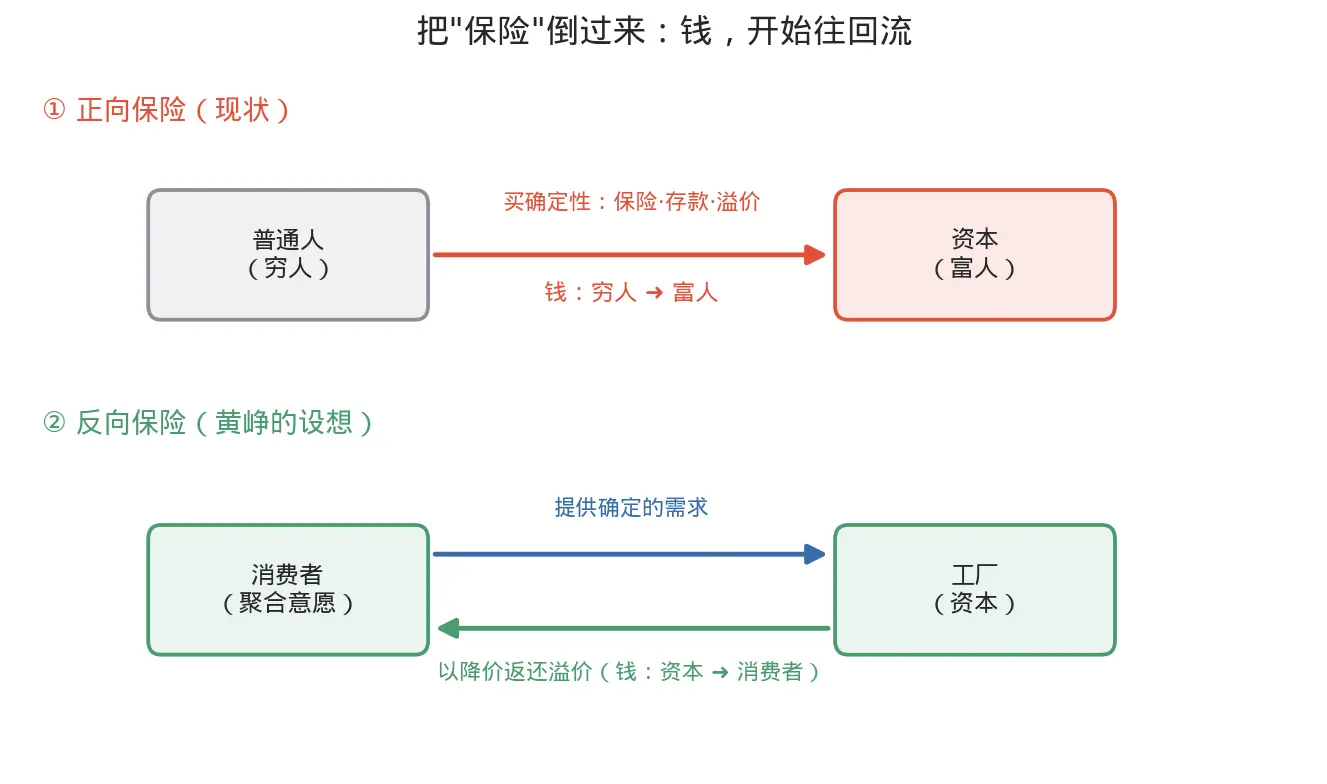
His answer: Because the wealthy bear "uncertainty" for others. The probabilities of life's misfortunes—sickness, unemployment, major illness—striking anyone are roughly the same. But the same blow that might cripple a poor person is just a small, calculable fluctuation on a rich person's ledger. Thus, the poor are willing to spend money for "peace of mind"—buying insurance, depositing money in banks for meager interest, preferring to pay more for goods to get certainty. Money, bit by bit, flows from the bottom to the top. This is the "upright" way.

II. "Reverse Insurance": Turning Capitalism on Its Head

So, can it be turned upside down? Can ordinary people, in turn, sell "certainty" to capital?

The difficulty lies in this: an individual's promise is worthless. You can cancel an online order anytime with zero cost to yourself; merchants have no recourse. They can only overstock, passing the cost back into the price. Huang Zheng puts it bluntly:

"Your action is treated as a statistical fluctuation, not as a promise that must be fulfilled."

But what if it's not one person, but ten thousand? Pinduoduo's group buying, flash sales—essentially, they catch you before you can hesitate, locking ten thousand people's "intention to buy" at the same moment, forcefully assembling a guaranteed order, eliminating the factory's risk of "producing and not selling." Grateful for this certainty, the factory converts the premium it would have set aside for risk into a "price reduction" returned to consumers. Money flows backward a notch. This is what he calls "reverse insurance."
III. The Final Puzzle Piece: Blockchain

By now, you might still not see the connection to blockchain. Honestly, I didn't either at first.

It's near the end of the article that Huang Zheng himself poses a question. He says that to productize, standardize, and monetize this kind of "certainty," a decentralized approach is needed to prevent fraud and create a virtuous cycle of good money driving out bad; then he asks: Isn't blockchain inherently designed for this kind of "reverse insurance"?

Just this one sentence made me pause. An e-commerce entrepreneur, after a long detour, lands the point squarely on blockchain. He doesn't elaborate further, but upon reflection, it makes perfect sense.

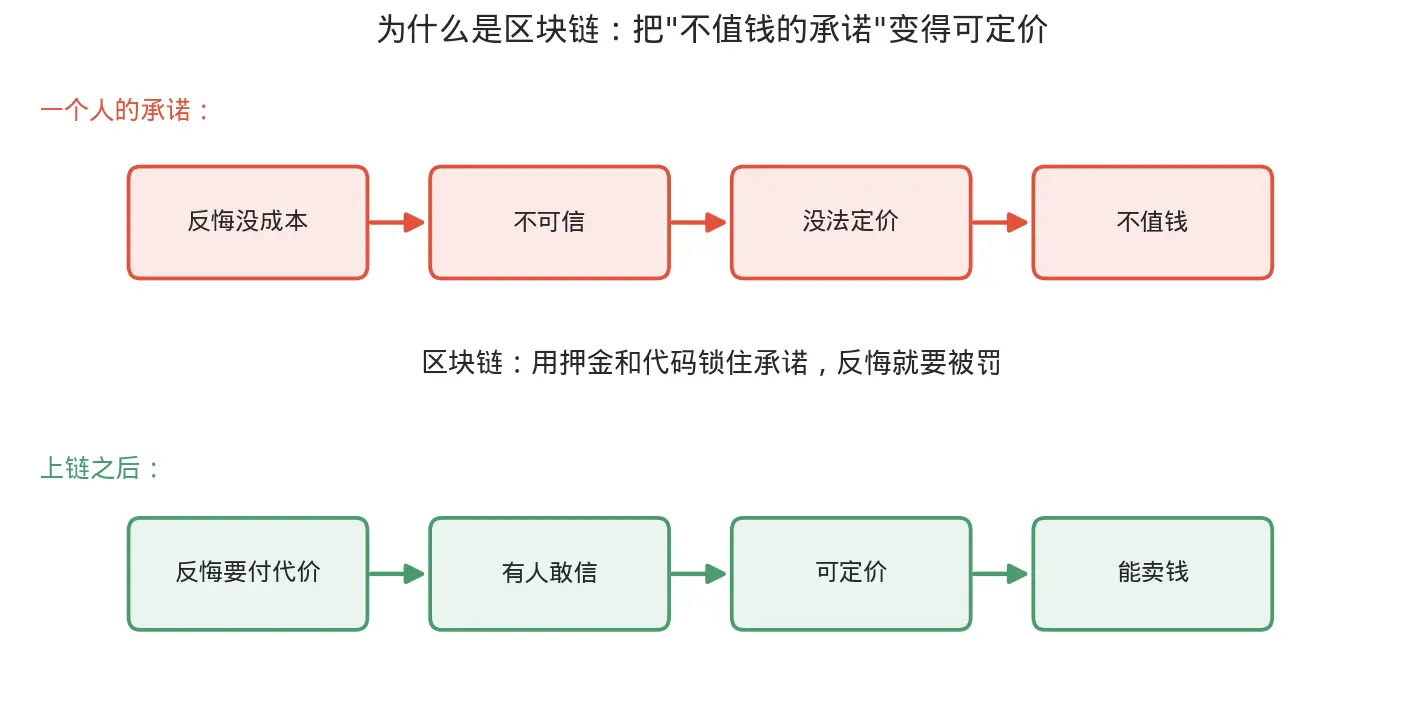
The biggest deadlock for reverse insurance, as mentioned, is that "an ordinary person's promise is worthless"—costless, untrustworthy, unpriced. And blockchain precisely cures this disease:

  • Use smart contracts to irrevocably bind your promise to a deposit. If you renege, the deposit is forfeited, and you face penalties.

  • This way, your "intention to buy" becomes, for the first time, a real promise with a cost to breaking it, a promise that can be enforced. Only then would the factory dare to believe it and arrange production accordingly.

Ultimately, it shifts the basis of "trust" from people to rules. You see, the missing puzzle piece he needed—making promises trustworthy, priceable, and immune to middleman fees—is exactly the inherent capability of blockchain.
IV. Extended Thought: Two Paths to Creating Certainty

Following his question, I couldn't help but think one layer deeper about Bitcoin (an occupational hazard, forgive me for bringing crypto into this).

Bitcoin is essentially the purest example of "trusting rules": fixed supply, open-source algorithm, immutable rules.

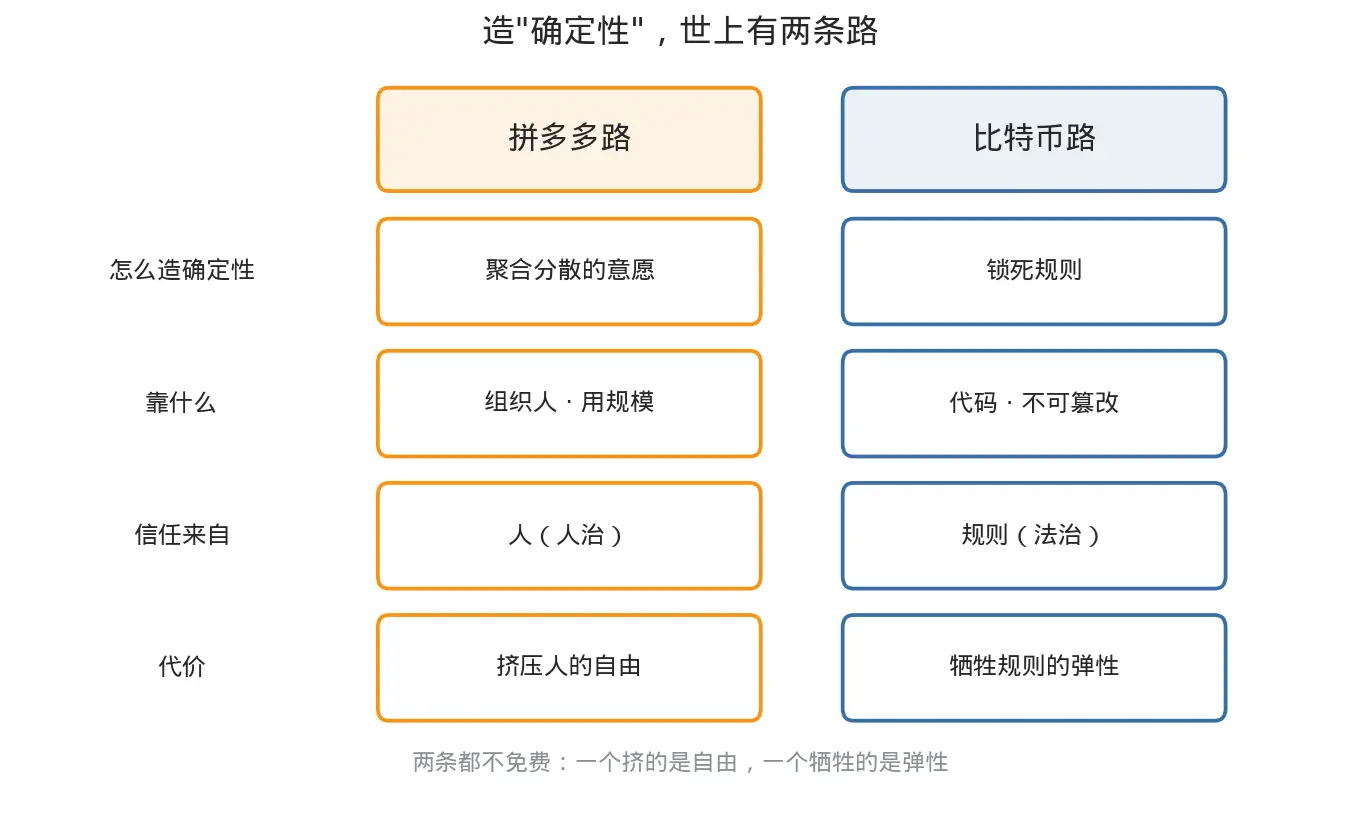
  • The certainty of fiat currency relies on the restraint of the issuer; it's rule by man.

  • The certainty of Bitcoin relies on cold, impersonal, unfeeling code; it's rule by law.

One relies on people, the other on rules. So, there are actually two paths in the world to creating certainty:

  1. The Pinduoduo path: Aggregate scattered intentions into momentum, using scale to forcibly flatten uncertainty.

  2. The Bitcoin path: Lock the rules completely from the start, leaving no room for human discretion or intervention.

Neither path is free. The former squeezes human freedom; the latter sacrifices rule flexibility.
If you're interested, you can also re-read the article "Turning Capitalism on Its Head."

Related Questions

QWhat is the fundamental business logic of Pinduoduo according to the article?

AAccording to the article, the fundamental business logic of Pinduoduo is a business about 'uncertainty' or an 'insurance' business. Founder Colin Huang argues that Pinduoduo operates on the principle of a 'reverse insurance' model.

QHow does Pinduoduo's 'reverse insurance' model work to redistribute wealth flow?

APinduoduo's 'reverse insurance' model works by aggregating the diffuse intentions of numerous consumers into a single, large, and certain purchase order at a specific moment (e.g., through group buying). This provides manufacturers with production certainty, allowing them to eliminate the 'risk premium' they would normally charge. The cost savings are then passed back to consumers as lower prices, causing money to flow 'backwards' from capital to ordinary people.

QWhat is the core problem that prevents ordinary people's commitments from being valuable, and how does blockchain potentially solve it?

AThe core problem is that an individual's promise or purchase intent lacks credibility and is costless to break (e.g., easy cancellations). Blockchain, through smart contracts, can bind a promise to a deposit. If the promise is broken, the deposit is forfeited, creating a tangible cost for reneging. This transforms a casual 'intent to buy' into a credible, enforceable, and financially accountable commitment that manufacturers can trust.

QAccording to the article's extension, what are the two paths to creating 'certainty' as exemplified by Pinduoduo and Bitcoin?

AThe article outlines two paths: 1) The 'Pinduoduo Path': Creating certainty by aggregating scattered intentions into a large-scale force that flattens out uncertainty through collective action. 2) The 'Bitcoin Path': Creating certainty by locking rules into immutable code from the outset, eliminating the possibility of human discretion or manipulation, thus relying on 'rule of code' rather than 'rule of man'.

QWhat key question did Colin Huang himself raise that connects his 'reverse insurance' concept to blockchain technology?

AColin Huang raised the question: 'Is blockchain inherently born for this kind of 'reverse insurance'?' He suggested that the decentralized, fraud-resistant nature of blockchain, which enables a virtuous cycle of good money driving out bad, is perfectly suited for productizing, standardizing, and monetizing the 'certainty' required for his model.

Related Reads

Microsoft Announces Commercial-Grade Quantum Computer to be Completed in Three Years: Will the Boots Land?

Microsoft announces plans to build a commercially viable quantum computer by 2029, a significant acceleration from the previous industry consensus of a decade. The breakthrough is fueled by their new Majorana 2 quantum chip, which boasts a record-breaking average qubit lifetime of 20 seconds—a 1,000-fold reliability improvement over its predecessor. This leap was achieved by leveraging topological qubits, a theoretically more stable technology using Majorana zero modes, and switching the core superconducting material from aluminum to lead. Crucially, Microsoft's "Discovery" agentic AI platform accelerated the R&D process. AI agents autonomously analyzed vast experimental data, optimized manufacturing parameters (like the lead alloy composition), and solved issues like "ghost noise," dramatically speeding up experimentation. While the 20-second coherence time is a landmark, challenges remain: scaling from 12 qubits to the millions needed for practical applications, managing compilation costs, and verifying quantum results. Skeptics call for peer-reviewed data, and questions persist about whether even 20 seconds is sufficient for complex algorithms like breaking RSA encryption. The race is on with other approaches (superconducting, trapped ions), but Microsoft's confidence in its topological roadmap signals a potential shortcut to a scalable quantum future.

marsbit8m ago

Microsoft Announces Commercial-Grade Quantum Computer to be Completed in Three Years: Will the Boots Land?

marsbit8m ago

Is There Really a "World Cup Curse" in the Market?

Is there really a "World Cup Curse" affecting markets? Historical data shows global equity markets often underperform during the tournament. The S&P 500 has averaged negative returns of -1.5% to -2.11% across 19 World Cups since 1950, with declines in 58% of events. China's Shanghai Composite fell in 71% of tournaments since 1994. Studies confirm reduced trading activity during matches, with volumes dropping significantly, especially when a home nation plays. A team's loss can also lead to negative sentiment and selling pressure in its domestic market the next day. However, the "curse" may be partly attributed to seasonal weakness. Many tournaments are held in June-July, a historically weaker period for stocks ("Sell in May and go away"). The 2022 Qatar World Cup, held in November-December, saw a smaller drop in trading volume compared to summer events, suggesting timing plays a role. The cryptocurrency market's performance during World Cups has been mixed and largely driven by its own major catalysts (e.g., Mt. Gox hack, FTX collapse, halving cycles) rather than the tournament. Investment opportunities have shifted over time. Traditional beneficiaries like TV manufacturers have seen fading returns as streaming platforms become the core viewing channel. Classic consumer plays like beer and sportswear face challenges from changing consumption trends. Newer digital assets, like fractionalized collectible player cards on blockchain, have seen explosive growth. While gambling is a traditional sector, prediction markets are emerging. In conclusion, while a statistical correlation exists, the World Cup's direct impact on markets is likely limited and intertwined with seasonal patterns. With lower liquidity during the event, the simplest strategy for many might be to step back from trading and enjoy the games.

marsbit15m ago

Is There Really a "World Cup Curse" in the Market?

marsbit15m ago

Why 'AI Service Subscription' Is Destined to Die Out?

"Why 'AI Service Subscription Models' Are Doomed to Disappear" The article argues that the flat-rate subscription model for AI services is fundamentally unsustainable. It points to recent industry shifts, such as Anthropic limiting access to its flagship Claude Fable 5 model for subscribers after just 14 days, and GitHub and OpenAI moving towards credit-based or usage-based billing. The core problem is that subscription models rely on a capped human consumption limit—like watching videos or listening to music—which keeps costs predictable. However, the rise of autonomous AI agents shatters this premise. Agents can consume 5 to 30 times more computing resources (tokens) than a human chatting, and they operate continuously without user presence. This removes the natural usage cap, making fixed-price plans financially unviable as heavy users incur massive costs. Attempts to patch the model with higher tiers or usage caps have failed, often leading to "adverse selection" where only the heaviest users subscribe. The industry's solution is to hollow out subscriptions, replacing "unlimited" access with prepaid credits charged per token, akin to a utility meter. While chat-based subscriptions may linger, the real value and revenue are shifting to pay-as-you-go models. The current period represents a final, heavily subsidized phase for users. The conclusion is that the soul of subscription—a fixed price for worry-free use—is dying, soon to be replaced by pure usage-based pricing where everyone pays for their own "electricity meter."

marsbit16m ago

Why 'AI Service Subscription' Is Destined to Die Out?

marsbit16m ago

Trading

Spot
Futures

Hot Articles

Discussions

Welcome to the HTX Community. Here, you can stay informed about the latest platform developments and gain access to professional market insights. Users' opinions on the price of S (S) are presented below.

活动图片