Interop Roadmap "Acceleration": After Fusaka Upgrade, Ethereum Interoperability May Take a Key Leap

深潮2025-12-11 tarihinde yayınlandı2025-12-11 tarihinde güncellendi

Özet

The Ethereum Fusaka upgrade, while primarily noted for expanding blob capacity and reducing L2 data costs, introduced the underappreciated EIP-7825—a critical enabler for Ethereum’s ZK and interoperability roadmap. EIP-7825 imposes a per-transaction gas limit (~16.78 million gas), preventing "mega-transactions" from blocking entire blocks. This change makes proof generation parallelizable, transforming it from a logic-bound challenge into a solvable computational problem. As a result, real-time ZK proofs become feasible, even for large blocks, paving the way for near-instant finality. This upgrade supports the development of L1 zkEVM, which can serve as a trust anchor for L2s, enabling secure, instant cross-chain communication without relying on optimistic challenge periods or centralized bridges. Furthermore, the shift from zkEVM to more efficient zkVM architectures is accelerated by EIP-7825, as zkVMs can leverage parallelization for faster, cheaper proof generation. Ultimately, these advancements are key to achieving seamless interoperability—not just for asset transfers, but for generalized cross-chain logic and communication—bringing Ethereum closer to a future where users experience a unified, chain-agnostic interface powered by real-time ZK verification.

Author: imToken

In previous articles of the Interop series, we discussed OIF (Intent Framework) and EIL (Interoperability Layer), which respectively address the standardization of cross-chain intents (making the entire network understand what you want to do) and the execution channel issue (enabling funds to move in a standardized manner).

However, achieving a perfect "single-chain experience" still faces the trade-off between speed and trust. After all, in the current interoperability experience, one must either endure slowness (such as Optimistic Rollup requiring a 7-day challenge period to confirm finality) or sacrifice decentralization (relying on the trust assumptions of multi-signature bridges).

To break this "impossible triangle," it is essential to have a foundational capability that spans the "Acceleration" and finalization (Finalisation) of Ethereum's interoperability roadmap—the "real-time proof" brought by ZK technology (extended reading: "Ethereum Interop Roadmap: How to Unlock the 'Last Mile' of Mass Adoption").

And in the recently activated Fusaka upgrade, the inconspicuous EIP-7825 has cleared the biggest engineering obstacle for this ultimate goal.

I. The Underestimated EIP-7825 Behind the Fusaka Upgrade

On December 4, the Ethereum Fusaka upgrade was officially activated on the mainnet. Unlike the fanfare of the Dencun upgrade, the market spotlight was mostly focused on Blob scaling and PeerDAS, with much discussion about the further reduction of L2 data costs.

But beyond this noise, there was actually an inconspicuous proposal, EIP-7825, which cleared the biggest obstacle for Ethereum to achieve L1 zkEVM and real-time proofs, and can even be said to be quietly paving the way for the ultimate goal of Interop.

In this Fusaka upgrade, the focus was almost entirely on scaling: Blob capacity expanded by 8 times, combined with PeerDAS random sampling verification, making the cost narrative of the DA (Data Availability) track a thing of the past.

Indeed, cheaper L2s are a good thing, but for Ethereum's long-term ZK roadmap, EIP-7825 is the real game-changer because it sets a Gas limit for a single transaction on Ethereum (about 16.78 million Gas).

As we all know, Ethereum's block Gas Limit has been increased to 60 million this year. But even as the upper limit continues to rise, theoretically, if someone is willing to pay an extremely high Gas Price, they could still send a super-complex "Mega-Transaction" that directly occupies the entire block's 60 million Gas capacity, thereby clogging the entire block.

This was allowed before, but EIP-7825 introduces a new restriction: no single transaction can consume more than 16.78 million Gas, regardless of the block size.

So why limit the size of a single transaction? Actually, this change has no impact on ordinary user transfers, but for ZK Provers (proof generators), it is a matter of life and death, and it is also closely related to how ZK systems generate proofs.

To give a simple example, before EIP-7825, if a block contained a "Mega-Transaction" consuming 60 million Gas, the ZK Prover had to run this extremely complex transaction sequentially—it couldn't be split or parallelized. This is like a single-lane highway where a giant truck is driving extremely slowly in front, and all the cars behind (other transactions) have to wait for it to pass.

This undoubtedly sentenced "real-time proof" to death—because the time to generate the proof becomes completely unpredictable, potentially taking dozens of minutes or even longer.

After EIP-7825, even if the block capacity expands to 100 million Gas in the future, since each transaction is forcibly limited to within 16.78 million Gas, each block is broken down into predictable, bounded, and parallelizable "small task units." This means that Ethereum's proof generation has changed from a tricky "logical puzzle" to a pure "money problem":

As long as enough parallel computing power can be invested, we can process these split small tasks simultaneously in an extremely short time, thereby generating ZK proofs for huge blocks.

As Michael, co-founder and CEO of Brevis, said, EIP-7825 is the most underestimated upgrade on the future path of ZK and Ethereum's 100x scaling. It turns "real-time proof" from "theoretically impossible" to "engineerable," as long as we can solve the computing power problem through parallel computing. Even a 200 million Gas block could achieve second-level proofs. This is not only a breakthrough in ZK technology but also the physical foundation for Ethereum's Interoperability Layer (EIL) to achieve second-level cross-chain settlement.
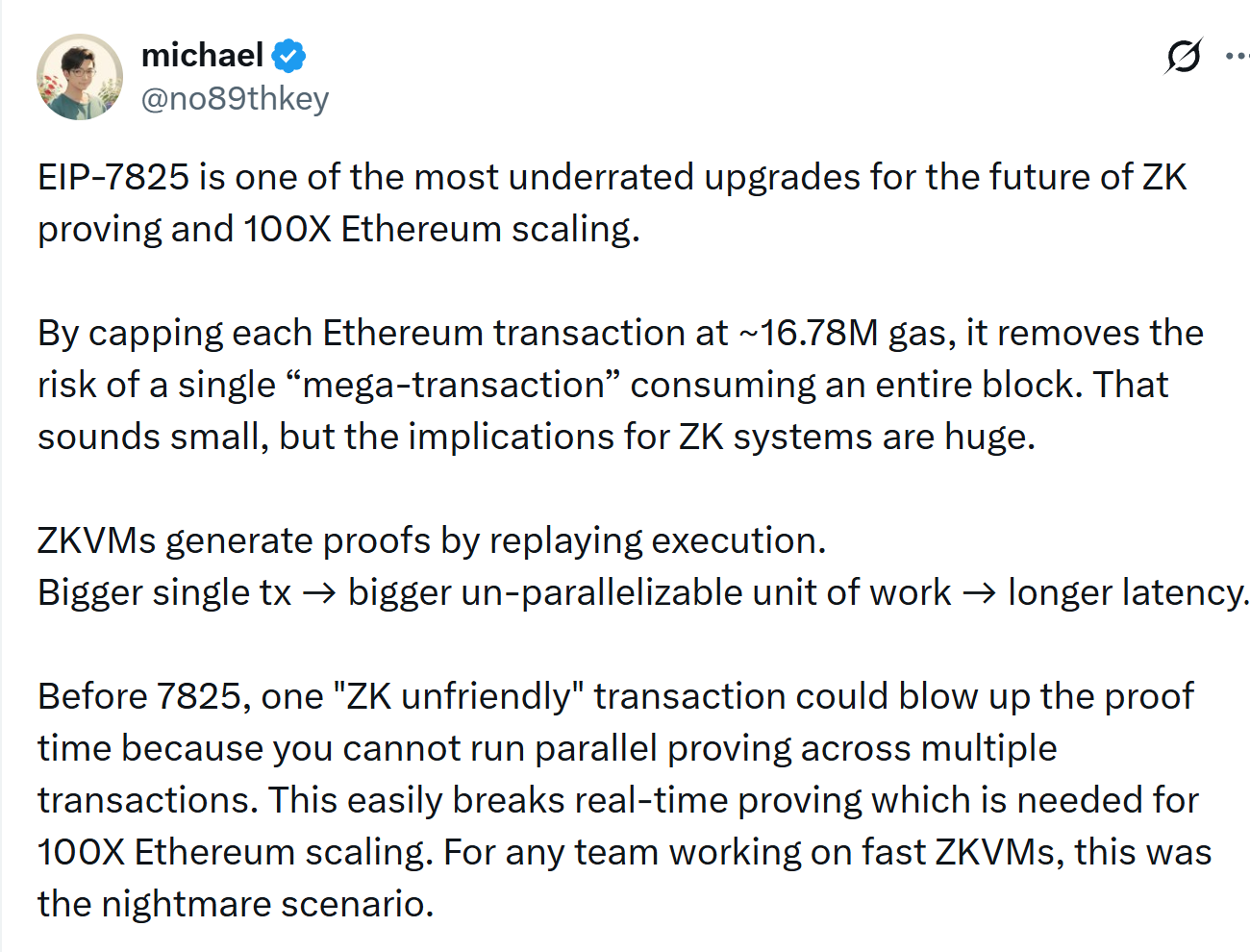
So this upgrade may not seem like the main event, but it is actually a huge breakthrough for the ZK roadmap and Ethereum's scaling future in 2026.

II. L1 zkEVM: The "Trust Anchor" for Ethereum Interoperability

However, although EIP-7825 paves the physical path (parallelizability) for real-time proofs by limiting the size of single transactions, this is only one side of the coin. The other side is how the Ethereum mainnet itself utilizes this capability?

This involves the most hardcore narrative in Ethereum's roadmap—L1 zkEVM.

For a long time, zkEVM has been regarded as the "holy grail" for scaling Ethereum, not only because it can solve performance bottlenecks but also because it redefines the trust mechanism of blockchain. Its core idea is to enable the Ethereum mainnet to generate and verify ZK proofs.

In other words, in the future, after each Ethereum block is executed, it can output a verifiable mathematical proof, allowing other nodes (especially light nodes and L2s) to confirm the correctness of the result without recalculating—if the ability to generate ZK proofs is directly written into the Ethereum protocol layer (L1), the proposer (Proposer) packs a block and generates a ZK proof, and the verifying nodes no longer need to rerun the transactions; they only need to verify this tiny mathematical proof.

What does this mean for interoperability?

In the context of Interop, the significance of L1 zkEVM far exceeds scaling itself. It can be said to be the "trust anchor" for all L2s. After all, if Ethereum L1 can generate proofs in real time, it means that all L2s can read L1's final state in real time and trustlessly. This will bring about two qualitative changes:

  • Eliminate the challenge period: The confirmation time between chains will be compressed from "7 days (OP mechanism)" to "seconds (ZK mechanism)";

  • Decentralized interconnection: Cross-chain will no longer require trust in third-party multi-signature bridges but will trust the mathematical truth of the Ethereum mainnet;

This is also the physical foundation we mentioned in the previous article for EIL (Interoperability Layer) to truly work—without L1's real-time finality, interoperability between L2s will never escape the shadow of "delay."

The goal is set (L1 zkEVM), and the physical limitations are removed (EIP-7825), but what about the specific implementation tools?

This leads to the subtle evolution happening in the ZK technology stack: from zkEVM to zkVM.

III. Fusaka & EIP-7825: The Interoperability Roadmap is Liberated

If EIP-7825 provides a "parallelizable hardware environment" for ZK by limiting the size of single transactions, then the evolution of the ZK technology stack is to find a "more efficient software architecture." This may sound like a tongue twister, but the difference is significant and represents two stages of ZK development (extended reading: "ZK Route 'Dawn Moment': Is Ethereum's Endgame Roadmap Accelerating Comprehensively?").

The first stage is naturally zkEVM, which can be regarded as the compatibility faction or the reformist faction.

The logic is to strive to imitate every instruction of the Ethereum EVM, allowing developers to deploy Solidity code directly, reducing migration costs and barriers.

In other words, the biggest advantage of zkEVM is its compatibility with existing Ethereum applications, greatly reducing the workload for Ethereum ecosystem developers. They can reuse most of the existing infrastructure and tools (including execution clients, block explorers, debugging tools, etc.).

However, precisely because of this, since the EVM was not designed with ZK-friendliness in mind, for the sake of compatibility, zkEVM's proof efficiency often has a ceiling, and the proof time is much slower, with a heavy historical burden.

zkVM, on the other hand, belongs to the radical revolutionary faction, directly building a virtual machine that is extremely friendly to ZK proofs (such as based on RISC-V or WASM) to speed up proof time and achieve better execution speed and performance.

But it also loses compatibility with many EVM features and the ability to use existing tools (such as low-level debuggers). However, a clear trend is that more and more L2 projects are shedding their burdens, optimizing proof speed and cost to the extreme, and exploring architectures based on zkVM.

So why is the Fusaka upgrade the unlocker?

After all, before EIP-7825, whether it was zkEVM or zkVM, once they encountered a Mega-Transaction on Ethereum, the proof generation time would skyrocket due to the inability to split tasks.

Now, EIP-7825 forcibly breaks down transactions into predictable small units. With a parallelizable environment, an efficient architecture like zkVM can exert its maximum power. Even complex Ethereum blocks, when placed in a zkVM and combined with parallel computing power, can achieve real-time proofs.

What does this mean for interoperability? The proliferation of zkVM combined with EIP-7825 means that the cost of generating proofs will drop significantly. When the cost of generating a cross-chain proof is low enough to be negligible and the speed is as fast as sending an email, traditional "cross-chain bridges" will completely disappear, replaced by underlying universal message protocols.

In Conclusion

As repeatedly mentioned in previous articles of the Interop series, the ultimate goal of Interop is not just asset "cross-chain," nor is it limited to the concept of "asset bridges" anymore. It is a set of system-level capabilities, including cross-chain data communication, cross-chain logic execution, cross-chain user experience, cross-chain security, and consensus.

From this perspective, Interop can be understood as the universal language between future Ethereum ecosystem protocols. Its significance lies not only in transmitting value but also in sharing logic. The role of ZK in this is to guarantee execution correctness and support real-time state verification, making cross-domain calls "dare to do, able to do." It can even be said that without real-time ZK, it is difficult to have truly usable Interop UX.

So when EIP-7825 was quietly activated in the Fusaka upgrade, and as L1 zkEVM gradually becomes a reality, we are getting closer to that endgame: execution, settlement, and proof are completely abstracted in the background, and users are completely unaware of the existence of chains throughout the process.

This is the Interop endgame we all look forward to in the future.

İlgili Sorular

QWhat is the significance of EIP-7825 in the Fusaka upgrade for Ethereum's interoperability?

AEIP-7825 introduces a per-transaction gas limit of approximately 16.78 million gas, which prevents 'mega-transactions' from blocking the entire block. This allows ZK provers to process transactions in parallel, making real-time proof generation for large blocks feasible and paving the way for instant cross-chain settlements in Ethereum's interoperability layer (EIL).

QHow does L1 zkEVM serve as a 'trust anchor' for Ethereum's interoperability?

AL1 zkEVM enables Ethereum mainnet to generate and verify ZK proofs for its own blocks. This allows L2s to read L1's finalized state in real-time without trust assumptions, eliminating challenge periods (e.g., reducing from 7 days to seconds) and enabling decentralized cross-chain interactions without relying on third-party bridges.

QWhat is the key difference between zkEVM and zkVM in the context of ZK technology evolution?

AzkEVM focuses on compatibility with Ethereum's EVM, allowing developers to reuse existing tools and infrastructure but often at the cost of slower proof generation due to EVM's ZK-unfriendly design. zkVM prioritizes proof efficiency and performance by building a ZK-friendly virtual machine (e.g., based on RISC-V or WASM), sacrificing some EVM compatibility for faster execution and lower costs.

QHow does EIP-7825 combined with zkVM architecture improve interoperability?

AEIP-7825 breaks down transactions into small, parallelizable units, while zkVM provides an efficient architecture for proof generation. Together, they drastically reduce the cost and time required to generate cross-chain proofs, making traditional bridges obsolete and enabling seamless, instant cross-chain communication at the protocol level.

QWhat is the ultimate goal of Interop (interoperability) in the Ethereum ecosystem according to the article?

AThe ultimate goal of Interop is not just cross-chain asset transfers but a comprehensive system-level capability that includes cross-chain data communication, logic execution, user experience, security, and consensus. It aims to create a universal language for Ethereum protocols, enabling value transfer and logic sharing with real-time state verification powered by ZK technology, all abstracted away from end-users for a seamless experience.

İlgili Okumalar

Five Core Forms of AI Agent in YC's Eyes

The article outlines five core architectural patterns for effective AI Agents, emerging from tools like Codex and Claude, that move beyond simple prompts towards reusable, process-based capabilities. 1. **Skills**: Reusable, parameterized workflows that function like method calls, allowing a single process (e.g., "/investigate") to handle various tasks based on input parameters. 2. **Thin Harness**: A lightweight execution framework (~200 lines) that manages the AI model's "hands and feet"—handling loops, file I/O, and context—without becoming bloated. 3. **Resolvers**: Routing tables that map tasks to specific Skills, preventing "context corruption" when managing dozens of Skills and ensuring outputs go to the correct locations. 4. **Latent vs. Deterministic Layer**: A critical separation where LLMs handle judgment, synthesis, and pattern recognition, while deterministic code handles tasks requiring precision, consistency, and low cost (like calculations). 5. **Memory**: A persistent, accumulating knowledge base (e.g., a markdown folder) with a "current trusted conclusion" section and an append-only timeline, enabling the system to learn and retain context over time. Together, these patterns create a "process power"—a durable competitive advantage. Unlike one-off prompt-based applications whose value quickly commoditizes, a well-designed AI Agent system encodes experience into reusable, parameterized workflows, offloads stable rules to code, and continuously learns through memory. This creates a structured, hard-to-replicate capability that can provide sustained value for individuals or businesses, such as an accountant automating client reviews while preserving privacy and accumulating expertise.

marsbit1 saat önce

Five Core Forms of AI Agent in YC's Eyes

marsbit1 saat önce

Tiger Research: On-Chain Risk Operators, The Market Cap Gap Between 147 Trillion and 70 Billion

This report by Tiger Research examines the evolution of risk management in decentralized finance (DeFi) lending. It highlights a power shift from protocol developers to specialized professional risk operators who manage on-chain capital. The era of protocols and community governance solely dictating DeFi lending is ending. A new professional asset management layer has emerged. While the sector is nascent, capital and distribution channels are rapidly consolidating around top risk operator teams, whose past performance is now a key criterion for institutional entry. The industry's development, accelerated by modular infrastructures like Morpho, has led to a clear division of labor mirroring traditional finance: distribution channels (e.g., exchanges), strategy/risk management (the risk operators), and product infrastructure/asset custody (smart contract protocols). This structure lowers the entry barrier for traditional institutions. Currently, the total value managed by risk operators is approximately $70 billion, dominated by a few leading teams like Steakhouse (RWA focus), Sentora (AI models), and Gauntlet (crisis management). Competition now centers on collateral standards, distribution access, and crisis response capabilities. The report outlines three primary entry paths for institutions: 1) **Distribution Model**: Leveraging external risk operators as backend service providers (common for exchanges). 2) **Asset Supply Model**: Onboarding real-world assets to DeFi as collateral. 3) **Independent Operator Model**: Building an in-house team to become a risk operator (e.g., Bitwise). The core opportunity lies in the strategy/risk management layer, where traditional financial institutions can leverage their existing expertise in due diligence and risk assessment without deep technical development. A vast opportunity gap exists: the global traditional asset management industry manages ~$147 trillion, while the entire DeFi sector is only ~$800 billion, with the risk operator niche at ~$70 billion. This disparity signifies immense growth potential. Once robust risk frameworks and clearer regulations are established, even a minor allocation from traditional markets could trigger exponential DeFi growth. Early movers who help build these foundational systems will gain significant rule-setting influence and first-mover advantages.

marsbit1 saat önce

Tiger Research: On-Chain Risk Operators, The Market Cap Gap Between 147 Trillion and 70 Billion

marsbit1 saat önce

Interview with Circle's Chief Economist: USDC's Entry into Hyperliquid Benefits Circle and HYPE, Stablecoins Are Becoming Marginal Buyers of U.S. Treasuries

In an interview with Circle's Chief Economist Gordon Liao, the conversation covers the strategic significance of USDC replacing USDH as the reference asset on the decentralized perpetual exchange Hyperliquid. This shift, facilitated by Coinbase as the reserve manager and Circle providing technical infrastructure, aims to capture net interest income for the platform, with 90% of reserve earnings directed back to Hyperliquid for HYPE token buybacks. Liao discusses how stablecoins like USDC, with their substantial on-chain settlement volumes (e.g., $21 trillion in Q1 2026), are emerging as marginal buyers of U.S. Treasuries, concentrating on short-term debt and effectively reducing the weighted duration of the market, which may provide underlying support for long-term rates. The dialogue also explores the evolving nature of stablecoins as both a medium of exchange and a vehicle for capital and collateral liquidity. Additionally, the panel touches on the CLARITY Act's legislative progress, noting compromises around "activity-based rewards" and remaining hurdles like ethics concerns. On AI, there's debate over value capture, with predictions that distribution and application layers, rather than foundational model companies like OpenAI, will accrue most value. Regarding the bond market, Liao attributes the rise in 30-year yields primarily to an increased term premium (around 80 bps) driven by supply-demand dynamics, including fiscal expansion and changing investor demand, rather than expectations of Fed rate hikes.

marsbit1 saat önce

Interview with Circle's Chief Economist: USDC's Entry into Hyperliquid Benefits Circle and HYPE, Stablecoins Are Becoming Marginal Buyers of U.S. Treasuries

marsbit1 saat önce

İşlemler

Spot
Futures

Popüler Makaleler

HPP Nasıl Satın Alınır

HTX.com’a hoş geldiniz! House Party Protocol (HPP) satın alma işlemlerini basit ve kullanışlı bir hâle getirdik. Adım adım açıkladığımız rehberimizi takip ederek kripto yolculuğunuza başlayın. 1. Adım: HTX Hesabınızı OluşturunHTX'te ücretsiz bir hesap açmak için e-posta adresinizi veya telefon numaranızı kullanın. Sorunsuzca kaydolun ve tüm özelliklerin kilidini açın. Hesabımı Aç2. Adım: Kripto Satın Al Bölümüne Gidin ve Ödeme Yönteminizi SeçinKredi/Banka Kartı: Visa veya Mastercard'ınızı kullanarak anında House Party Protocol (HPP) satın alın.Bakiye: Sorunsuz bir şekilde işlem yapmak için HTX hesap bakiyenizdeki fonları kullanın.Üçüncü Taraflar: Kullanımı kolaylaştırmak için Google Pay ve Apple Pay gibi popüler ödeme yöntemlerini ekledik.P2P: HTX'teki diğer kullanıcılarla doğrudan işlem yapın.Borsa Dışı (OTC): Yatırımcılar için kişiye özel hizmetler ve rekabetçi döviz kurları sunuyoruz.3. Adım: House Party Protocol (HPP) Varlıklarınızı SaklayınHouse Party Protocol (HPP) satın aldıktan sonra HTX hesabınızda saklayın. Alternatif olarak, blok zinciri transferi yoluyla başka bir yere gönderebilir veya diğer kripto para birimlerini takas etmek için kullanabilirsiniz.4. Adım: House Party Protocol (HPP) Varlıklarınızla İşlem YapınHTX'in spot piyasasında House Party Protocol (HPP) ile kolayca işlemler yapın.Hesabınıza erişin, işlem çiftinizi seçin, işlemlerinizi gerçekleştirin ve gerçek zamanlı olarak izleyin. Hem yeni başlayanlar hem de deneyimli yatırımcılar için kullanıcı dostu bir deneyim sunuyoruz.

161 Toplam GörüntülenmeYayınlanma 2026.04.29Güncellenme 2026.04.29

HPP Nasıl Satın Alınır

GENIUS Nedir

I. Proje Tanıtımı1. Genius Nedir?Genius (GENIUS), “nihai on-chain terminal” olarak konumlandırılan, gizlilik ve hız odaklı merkeziyetsiz bir ticaret platformudur. En üst düzey gizlilik teknolojilerini entegre ederek, BNB Chain gibi ağlar üzerinde, kullanıcıların merkezi borsalara benzer kesintisiz bir deneyimle on-chain etkileşimde bulunmalarını sağlayacak bir sonraki nesil gizlilik ticaret altyapısını inşa etmeyi hedeflemektedir.2. Genius Nasıl Çalışır?Genius'un temel teknik mimarisi şu şekilde yapılandırılmıştır:(1) Zincir-görünmez: Kullanıcıların, çapraz zincir işlemleri, varlık sarmalama veya karmaşık gaz yönetimi için çok adımlı onayları manuel olarak yönetmelerine gerek yoktur.(2) İmzasız Ticaret: Turnkey gibi entegrasyonlar aracılığıyla, Genius, pop-up onayları veya işlem başına yetkilendirme olmadan anlık ticareti mümkün kılar.(3) Agregatörlerin Agregatörü: Genius, 150'den fazla DEX ile entegre edilmiş en iyi sınıf bir agregasyon yığını ile desteklenmektedir ve rakip ürünlere kıyasla üstün teklif verimliliği iddia etmektedir.(4) Hesap Yönetimi: Platform, saklama dışı bir mimari benimsemekte ve anahtar yönetimi için Turnkey ve Lit Protocol'ü kullanarak, kullanıcıların hesaplarına güvenli bir şekilde geçiş anahtarları aracılığıyla erişmelerini sağlamaktadır.3. Genius'u Kim Yarattı?Resmi Hizmet Şartlarına göre, Genius, Shuttle Labs, Inc. tarafından geliştirilmiştir. Projenin resmi X hesabına göre, Ryan Myher, Ghost protokolünün piyasaya sürülmesi gibi ürün iterasyonunu yönlendiren ana katkı sağlayıcılardan biridir ve daha geniş topluluk katılımını sağlamaktadır.Binance kurucusu CZ, ekibin daha hızlı ve gizliliği koruyan bir on-chain ticaret deneyimi inşa etmesine yardımcı olmak amacıyla resmi olarak projeye danışman olarak katılmıştır.Ayrıca, proje, Genius ve Genius Bridge Protocol (GBP) temelini korumaktan sorumlu Genius Vakfı ile birlikte çalışan YZi Labs'dan güçlü destek almıştır.4. Genius TokenomisiGENIUS, Genius ekosisteminin yerel token'ıdır. Şu anda, proje tam bir tokenomi belgesi yayınlamamıştır.Son resmi açıklamalara göre, Genius, deflasyonist bir mekanizma içermekte ve toplam token arzının %4.6'sı, erken lansman aşamasında zaten yakılmıştır.Genius Puanları (GP) Sistemi:(1) Ticaretle Kazan: Platform, 200 milyon Genius Puanı ödül havuzu oluşturmuş ve kullanıcılar terminal aracılığıyla gerçekleştirilen her ticaret için GP kazanmaktadır.(2) Seviye ve Rozetler: Genius, Akıllı'dan Tanrı'ya kadar uzanan bir ilerleme tabanlı rozet sistemi sunmakta olup, daha yüksek seviyeler ek avantajlar ve faydalar sunmaktadır.(3) Yerel Getiri: Gösterge panelinde usdGG gibi belirlenen varlıklara sahip kullanıcılar, karmaşık staking süreçlerine girmeden doğrudan yerel getiri kazanabilirler.(4) Yönlendirme Teşvikleri: Yönlendirenler, USDC cinsinden %45'ten fazla ücret iadesi kazanabilir ve ek GP alabilirler.5. Zaman Çizelgesi & Ana Dönüm NoktalarıMart 2020: Projenin resmi X hesabı oluşturuldu ve erken hazırlık aşamasının başlangıcını işaret etti.13 Ocak 2026: Genius, YZi Labs'tan çok milyon dolarlık bir yatırım aldığını duyurdu ve aynı zamanda gizlilik ticaret altyapısının inşasını hızlandırmak için CZ'yi danışman olarak onayladı.18 Nisan 2026: Proje, Ghost gizlilik protokolünün yakında piyasaya sürüleceğini duyurdu.29 Nisan 2026: Ghost protokolü, ilk 50 testçisine resmi olarak açıldı ve BNB Chain'de gizlilik ticareti için yeni bir dönemin başlangıcını işaret etti. Aynı zamanda, ekip %4.6'lık token'ın yakıldığını doğruladı.​II. Token Bilgileri1) Temel BilgilerToken adı: GENIUS (Genius)III. İlgili BağlantılarWeb sitesi:https://www.tradegenius.com/homeKeşif Araçları:https://bscscan.com/address/0x1f12b85aac097e43aa1555b2881e98a51090e9a6Sosyal Medya:https://x.com/GeniusTerminalNot: Proje tanıtımı, resmi proje ekibi tarafından yayınlanan veya sağlanan materyallerden gelmektedir ve yalnızca referans amaçlıdır, yatırım tavsiyesi niteliğinde değildir. HTX, herhangi bir doğrudan veya dolaylı kayıptan sorumluluk kabul etmemektedir.

246 Toplam GörüntülenmeYayınlanma 2026.04.29Güncellenme 2026.05.12

GENIUS Nedir

GENIUS Nasıl Satın Alınır

HTX.com’a hoş geldiniz! Genius (GENIUS) satın alma işlemlerini basit ve kullanışlı bir hâle getirdik. Adım adım açıkladığımız rehberimizi takip ederek kripto yolculuğunuza başlayın. 1. Adım: HTX Hesabınızı OluşturunHTX'te ücretsiz bir hesap açmak için e-posta adresinizi veya telefon numaranızı kullanın. Sorunsuzca kaydolun ve tüm özelliklerin kilidini açın. Hesabımı Aç2. Adım: Kripto Satın Al Bölümüne Gidin ve Ödeme Yönteminizi SeçinKredi/Banka Kartı: Visa veya Mastercard'ınızı kullanarak anında Genius (GENIUS) satın alın.Bakiye: Sorunsuz bir şekilde işlem yapmak için HTX hesap bakiyenizdeki fonları kullanın.Üçüncü Taraflar: Kullanımı kolaylaştırmak için Google Pay ve Apple Pay gibi popüler ödeme yöntemlerini ekledik.P2P: HTX'teki diğer kullanıcılarla doğrudan işlem yapın.Borsa Dışı (OTC): Yatırımcılar için kişiye özel hizmetler ve rekabetçi döviz kurları sunuyoruz.3. Adım: Genius (GENIUS) Varlıklarınızı SaklayınGenius (GENIUS) satın aldıktan sonra HTX hesabınızda saklayın. Alternatif olarak, blok zinciri transferi yoluyla başka bir yere gönderebilir veya diğer kripto para birimlerini takas etmek için kullanabilirsiniz.4. Adım: Genius (GENIUS) Varlıklarınızla İşlem YapınHTX'in spot piyasasında Genius (GENIUS) ile kolayca işlemler yapın.Hesabınıza erişin, işlem çiftinizi seçin, işlemlerinizi gerçekleştirin ve gerçek zamanlı olarak izleyin. Hem yeni başlayanlar hem de deneyimli yatırımcılar için kullanıcı dostu bir deneyim sunuyoruz.

222 Toplam GörüntülenmeYayınlanma 2026.04.29Güncellenme 2026.05.12

GENIUS Nasıl Satın Alınır

Tartışmalar

HTX Topluluğuna hoş geldiniz. Burada, en son platform gelişmeleri hakkında bilgi sahibi olabilir ve profesyonel piyasa görüşlerine erişebilirsiniz. Kullanıcıların A (A) fiyatı hakkındaki görüşleri aşağıda sunulmaktadır.

活动图片