After Tokenization of Assets, How to Exit?

marsbitPublished on 2026-06-16Last updated on 2026-06-16

Abstract

Title: How to Exit After Asset Tokenization? Author: Symbiotic Compiled by: Hu Tao, ChainCatcher Summary: Tokenization addresses how assets go on-chain but largely leaves the redemption question unresolved. While tokenized assets can settle instantly, the underlying redemption for assets like treasuries, private credit, or real estate can take from T+1 to 180 days. This gap hinders DeFi adoption of Real World Assets (RWAs). Three emerging models aim to provide instant exit liquidity, differing primarily in their capital structure and efficiency: 1. **Balance Sheet Model (e.g., Grove Basin):** A single entity (like Sky) provides immediate liquidity from its balance sheet, acting as a bridge during the settlement period. It offers simplicity and deep initial liquidity but is constrained by a single entity's capacity and risk appetite. 2. **Asset-Specific Vault Model (e.g., Upshift Clear):** Independent liquidity providers fund dedicated vaults for each supported asset, earning fees. It decentralizes capital sources but isolates liquidity and capital per asset, leading to potential fragmentation. 3. **Shared Liquidity Layer Model (e.g., Symbiotic Liquid Lane):** A shared capital pool supports multiple RWA types simultaneously. Funds remain productive between redemptions (e.g., earning yield in lending markets). Exits are settled via a competitive RFQ market. This model aims for higher capital efficiency, scalability across assets, and serves longer-duration assets like priva...

Author: Symbiotic

Compiled by: Hu Tao, ChainCatcher

 
Summary:
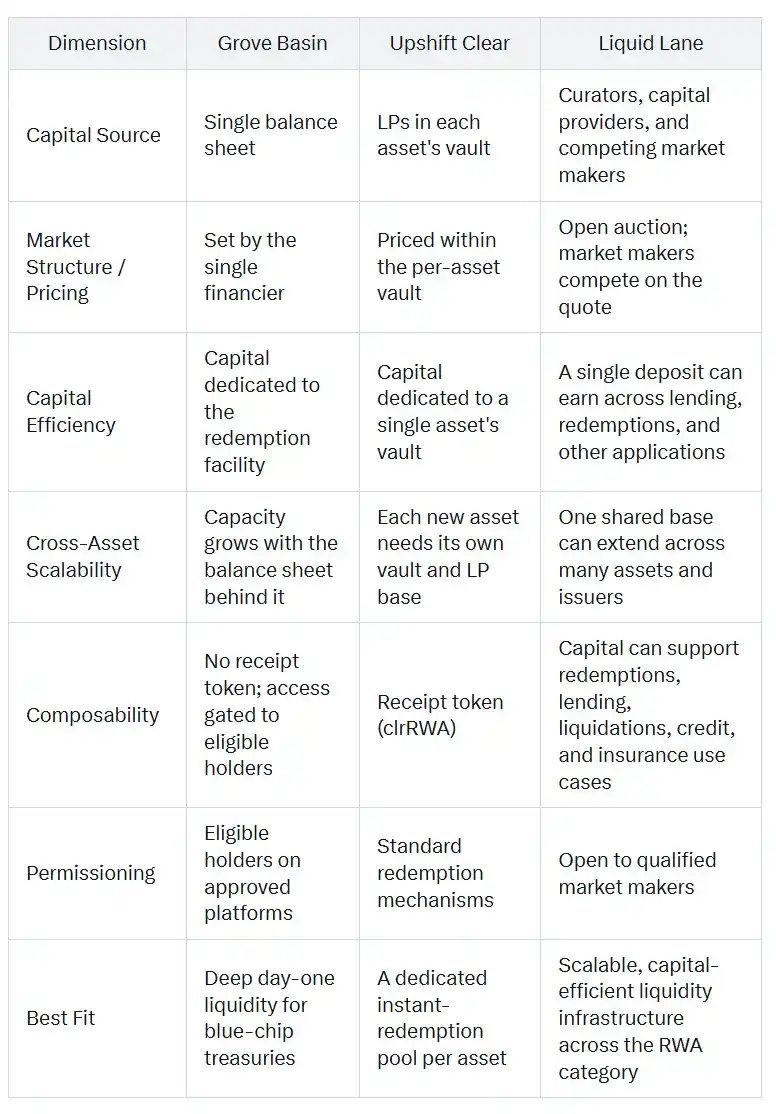
  • All three methods allow holders to exit immediately, so their speeds are comparable. The real difference lies in the capital structure behind the exit.

  • The key distinction is how each model handles redemption capital: Grove Basin uses a single balance sheet, Upshift Clear sets up a dedicated vault for each asset, while Symbiotic's Liquid Lane settles through a public market via a shared liquidity layer.

  • Grove Basin provides instant liquidity for tokenized vaults, with capital from Sky's balance sheet, launched in partnership with institutional collaborators. Upshift Clear extends this model to independent liquidity provider (LP) capital, with each supported asset having a dedicated vault.

  • Launched by Symbiotic, Liquid Lane is built on shared capital that can support multiple assets simultaneously, continues to earn yield from multiple sources between redemptions, and settles through an open RFQ marketplace where qualified market makers compete.

  • The result is higher capital efficiency per deposit, and the capacity of the liquidity layer grows with increased market participation, precisely where reliable exit mechanisms are hardest to provide and most valuable.


Exit is the Unresolved Half of the Tokenization Problem

Tokenization solves how assets get on-chain, but barely addresses how holders redeem them. A tokenized treasury or private credit fund can be issued, transferred, and distributed efficiently on-chain, while the underlying redemption process still takes approximately T+1 day for a treasury and 60 to 180 days for private credit, real estate, and structured products. The time gap between a token settling in one block and a fund settling in months is the crux of this long-standing issue.

This gap is crucial because DeFi markets need confidence that tokenized assets can be converted into liquid value when needed. With reliable liquidity infrastructure, RWAs can move beyond simple asset representation to become efficient financial primitives: they can serve as credit collateral, leverage backing, debt coverage, and assets underwriting risk in on-chain markets.


Emerging Instant Liquidity Architectures

Three models have emerged aiming to provide immediate exit pathways for tokenized real-world assets, but they differ in their sources and structuring of capital:

  1. Balance Sheet Model. In this model, a well-capitalized single entity provides liquidity immediately from its own reserves when an eligible holder redeems for stablecoins, then waits in the background for the underlying settlement. Grove’s Basin is an example, funded from Sky’s balance sheet.

  2. Dedicated Vault Model. Independent liquidity providers fund separate pools for each supported asset, earning the redemption spread. Upshift Clear, initially launched in partnership with Superstate, adopts this model.

  3. Shared Liquidity Layer Model. Independent capital providers fund a common capital base that supports multiple assets simultaneously, settling through an open, competitive market. Symbiotic’s Liquid Lane is built on this model.

The question worth exploring is which architecture is best suited for liquidity that must scale across assets, issuers, and risk profiles while remaining capital efficient.


How to Evaluate a Liquidity Layer for Tokenized Assets

Exit speed itself is nearly uniform and tells little. The meaningful comparison is everything that happens in the five-dimensional space behind the exit.

  1. Who supplies the capital and bears the risk? Where does the liquidity come from? Who bears the duration and credit risk of the underlying asset during the redemption settlement?

  2. Redemption Pricing. The mechanism that determines the discount a holder pays for early redemption—whether it's a single provider's quote, fixed parameters of a dedicated pool, or bidding among multiple participants.

  3. Capital Efficiency and Cost of Supply. How much committed capital a model requires to support redemptions and the opportunity cost of tying up that capital for settlement events. This cost ultimately reflects in the spread holders pay and whether liquidity providers can sustain the model.

  4. How does the model scale to different asset types? What is required to extend coverage to new assets and issuers as the market grows?

  5. Composability. Whether and how holders' claims and providers' funds can be used elsewhere in on-chain finance. This determines if liquidity is siloed in a single venue or can support other uses.

These five categories describe how robust and scalable a liquidity model is as the tokenization market grows in size and variety. The next sections apply them to each model in turn.


Balance Sheet Liquidity for Tokenized Treasuries and Credit

Grove Basin provides instant stablecoin liquidity for RWAs by prefunding when an eligible holder initiates an approved redemption via a supported tokenization platform. Grove Basin serves as a programmable credit facility against pending settlements.

Strengths of this design:

  • Immediate balance sheet depth. Since Basin is funded by an existing reserve base, it can provide considerable liquidity from day one.

  • Simple user experience. Basin operates through supported tokenization platforms, so eligible holders can exit faster while the traditional redemption process continues in the background.

  • An ideal solution for bonds and money market funds with short settlement cycles. These typically settle in T+1 to T+2, making the balance sheet bridge efficient for bridging the gap.

These trade-offs stem from the same design choices:

  • Capacity depends on a single balance sheet. The liquidity ceiling is ultimately tied to the size and risk appetite of the funding balance sheet. This means capacity growth relies on a single reserve base, not a broader capital market forming around the opportunity.

  • Access is restricted. Basin is only available to eligible holders, approved transactions, and supported platforms. This allows the model to control how liquidity scales but also limits how widely it can be accessed and reused across the broader market.

  • First application is for the most liquid part of the market. Tokenized T-bills and money market funds have inherently shorter settlement cycles.

Grove Basin is a powerful, vertically integrated solution to improve exit mechanisms for tokenized treasuries. Its main drawback is that liquidity depth, risk allocation, and economic benefits are tied to a single balance sheet model.


Upshift Clear: Asset-Specific Vaults for Instant Liquidity

Upshift Clear, initially launched with Superstate, applies the instant redemption model to independent USDC liquidity providers through dedicated vaults. LPs deposit USDC into a vault to back RWAs, receiving a composable receipt token clrRWA and earning fees from the redemption spread.

Strengths of this model:

  • Independent capital. Liquidity comes from LPs who opt in, so capacity can grow with the market, independent of any single institution's reserves.

  • General-purpose design. The platform aims to support any RWA with a standard redemption mechanism, providing issuers with a repeatable path to instant redemptions.

  • Clear, voluntarily assumed risk. Upshift Clear prices the settlement spread as a yield opportunity LPs knowingly take on, achieving a clear risk-reward match.

  • Composable receipts. The clrRWA token can circulate in DeFi, so LP positions aren't confined to the vault itself.

Where the model is more constrained:

  • Capital siloed by asset. Each supported asset has its own dedicated funding pool, so each new asset must attract its own liquidity. As coverage expands, the number of pools grows with the number of assets, potentially fragmenting market liquidity coordination.

  • Capital serves one asset at a time. Funds within a specific vault are committed to that specific asset, limiting what each dollar can do between redemption events.

  • The launch asset tests a more specific liquidity problem. Superstate's USCC is a ~$267M crypto arbitrage fund, advantaged by instant exit, but its liquidity challenges differ from longer-duration private credit or structured assets. It provides a solid starting point for the model, while raising a broader question: how well does the same design perform for less liquid, longer-duration assets?

Upshift Clear offers a flexible option for issuers looking to set up dedicated instant redemption pools for specific assets. Its main drawback is that liquidity, risk, and capital efficiency are allocated on an asset-by-asset basis.

Liquid Lane: Shared, Efficient, Cross-Asset Liquidity

Symbiotic Liquid Lane is a shared liquidity layer for tokenized assets. Redemption funding comes from Symbiotic vaults, which can support multiple tokenized assets simultaneously, rather than being tied to a single balance sheet or isolated in pools dedicated to a single asset. Between settlement events, these funds continue to earn yield from multiple sources and are ready when holders need to exit.

Vault managers decide how to deploy the capital. They choose which issuers and assets to support, set risk parameters, and develop vault strategies based on asset type, redemption patterns, and yield opportunities. This makes the liquidity layer configurable, not one-size-fits-all: different managers can build different strategies on the same shared infrastructure.

When a holder wants to redeem, qualified market makers bid on the redemption discount via a request-for-quote layer. Once a quote is accepted, vault funds settle the redemption atomically on-chain immediately, while the issuer's redemption process proceeds in the background.

The resulting model has four structural advantages:

  • Shared capital across multiple assets. A single vault can support redemptions for multiple RWA types. New assets tap into the same capital base, so liquidity capacity grows with market participation, not fragmented asset-by-asset.

  • Funds earn yield between redemptions. Collateral isn't idle waiting for redemption demand. It can earn underlying lending yields in whitelisted lending markets like Morpho and Aave, earn redemption spreads when settling redemptions, and back financial obligations in other Symbiotic applications (e.g., credit and insurance). Thus, a single deposit generates yield from multiple sources, maximizing capital efficiency and DeFi composability.

  • Configurable risk and yield strategies. Managers can tailor vault strategies by choosing supported assets, issuers, limits, and risk parameters. This means liquidity can be deployed according to different risk appetites and market views, rather than forcing all assets into the same pool design.

  • Open, competitive settlement. Liquid Lane uses a competitive request-for-quote (RFQ) marketplace where qualified market makers bid to settle exit trades. The redemption discount is set by market competition, and the yield is split among makers, capital providers, and managers.

This design aims to serve the part of the market where providing reliable exit is hardest and thus most valuable: tokenized private credit, structured assets, and other products with lengthy redemption windows. These can have windows of 60 to 180 days, and reliable exit infrastructure would transform how assets are held, financed, and used on-chain.

Initial integrations for Liquid Lane include Fasanara (first vault manager) and Midas (first issuer via mGLOBAL and mF-ONE), alongside additional vault managers such as Avantgarde Finance, Barter, and Kpk.


Side-by-Side Comparison

Conclusion: From Liquidity Patches to Shared Infrastructure

Tokenized assets need reliable exit mechanisms to achieve broad adoption. The question is whether these exits are built as one-off solutions or as infrastructure that can scale with the market.

If each asset requires its own liquidity pool, each issuer its own financing channel, or each exit relies on a separate reserve, the market gets faster exits but not truly scalable liquidity. A sustainable liquidity model is different: it is shared, efficient, and flexible—growing with market participation without fragmenting capital each time coverage expands.

That is what Symbiotic Liquid Lane aims to be. It turns redemption liquidity from a single-purpose mechanism into a shared layer for the tokenized market: a single capital base that can support multiple assets, multiple obligations, and multiple yield sources.

For issuers, this means increased demand, distribution, and assets under management (AUM), as tokenized assets become easier to hold and use as collateral. For market makers, it means participating in RWA settlement without needing to hold idle inventory upfront. For capital providers, it means a single deposit earning across lending, redemption, and Symbiotic applications.

Liquid Lane is the shared liquidity infrastructure for RWAs: cross-asset, capital-efficient, T+0.

Related Questions

QWhat is the core challenge addressed in the article regarding tokenized real-world assets (RWAs)?

AThe article identifies 'exit' or redemption as the core, unsolved challenge for tokenized RWAs. While assets can be efficiently issued and transferred on-chain, the underlying redemption process remains slow (e.g., T+1 day for treasuries, 60-180 days for private credit), creating a critical gap with the speed of blockchain settlements.

QAccording to the article, what are the three emerging models for providing instant exit liquidity for tokenized RWAs?

AThe three models are: 1) The Balance Sheet Model (e.g., Grove Basin), where a single, well-capitalized entity provides immediate liquidity from its own reserves. 2) The Dedicated Vault Model (e.g., Upshift Clear), where independent liquidity providers fund separate vaults for each supported asset. 3) The Shared Liquidity Layer Model (e.g., Symbiotic's Liquid Lane), where shared capital from multiple providers supports multiple assets simultaneously via a competitive settlement market.

QWhat are the five key dimensions the article uses to evaluate and compare the different liquidity layer models?

AThe five key dimensions are: 1) Source of capital and who bears the risk. 2) Mechanism for pricing redemptions. 3) Capital efficiency and cost of supply. 4) Scalability across different asset types. 5) Composability (whether the capital and claims can be reused elsewhere in DeFi).

QWhat is the main structural advantage of Symbiotic's Liquid Lane model compared to the others?

AIts main structural advantage is the use of a shared liquidity pool where a single vault can support redemptions for multiple tokenized assets. This shared capital base is more efficient, can earn yield from multiple sources (like lending, other Symbiotic apps) between redemptions, and scales liquidity capacity with overall market participation rather than requiring separate pools per asset.

QWhat asset types does the article suggest are the primary target for the most valuable exit infrastructure?

AThe article suggests that the most valuable and challenging application for reliable exit infrastructure is for tokenized private credit, structured assets, and other products with long redemption windows (60-180 days), as opposed to short-duration assets like tokenized treasuries. Reliable exit mechanisms for these longer-term assets would fundamentally change how they are held, financed, and used on-chain.

Related Reads

2029 Finale Prediction: When Cryptocurrency Completely "Vanishes", Who Can Remain in This Financial Upheaval?

By 2029, the crypto industry will have transformed into a largely invisible but foundational layer for traditional finance. This timeline outlines the key shifts from now until then. By mid-2026, the most sought-after assets on-chain will not be traditional tokens, but synthetic perpetual contracts for private, high-growth companies (like SpaceX, OpenAI). These become primary price discovery tools, highlighting the market's craving for real-world asset value. Most altcoins enter a sustained bear market as their fundamental lack of asset-backed value is exposed. In late 2026, the "AI + Crypto" narrative largely fades as AI giants prove they don't need crypto infrastructure, except for prediction markets betting on model performance. Simultaneously, a quiet but significant wave of tokenization for institutional assets (money market funds, private credit) begins. The industry splits into a noisy speculative economy and a silent institutional one. Throughout 2027, major public blockchain foundations pivot decisively to serve institutional clients, building compliance toolkits and sales teams. However, key sectors hit growth ceilings: private perpetual contracts are legally restricted from public promotion, stable币 growth is capped by looming political uncertainty, and tokenization projects remain cautious. In 2028, following a U.S. election assumed to maintain a regulatory (not prohibitive) stance, a pivotal change occurs. After a major liquidation crisis exposes the flaws of synthetic contracts lacking a real-asset anchor, new regulations allow the *public solicitation* of private security sales (secondary market shares) to accredited investors. This creates a legitimate, direct on-ramp for retail capital into previously illiquid private equity. By 2029, the resulting bull market is driven by trading in real, innovative company shares (biotech, robotics, AI labs), not speculative tokens. "Crypto" as a distinct asset class recedes; it becomes the mundane, unseen plumbing for this new global private markets infrastructure. Tokens that survive are those capturing real cash flows from this infrastructure. Speculation persists but is marginalized. The core questions posed at the start are answered: token value is tied to legally enforceable claims on real assets, frontier tech adoption happens via private market channels, and crypto's absorption into traditional finance is marked by its becoming boring and invisible. The key validation for this entire thesis is whether, by late 2028, a legal pathway exists for ordinary accredited investors to access private assets directly.

marsbit26m ago

2029 Finale Prediction: When Cryptocurrency Completely "Vanishes", Who Can Remain in This Financial Upheaval?

marsbit26m ago

After the U.S. Banned Fable 5, Zhipu's Stock Soared 47%

On June 15, Chinese AI company Zhipu's stock surged up to 47.6% in Hong Kong, closing with a 32.82% gain. This sharp rise followed two key industry events. On June 12, Anthropic was compelled by a U.S. government export control order to suspend global access to its latest flagship models, Claude Fable 5 and Claude Mythos 5, impacting developers and businesses reliant on them. The next day, Zhipu announced it was opening access to its new open-source flagship model, GLM-5.2, for all Coding Plan users, with API and model weights (under the MIT license) to follow. The Anthropic incident highlighted a critical shift in the AI industry: beyond raw capability, the stability, continuous accessibility, and control over AI models are becoming equally vital, especially as AI integrates deeper into business workflows. Zhipu's move, emphasizing that "frontier intelligence should not belong to a few nor be subject to arbitrary revocation," positioned its open, accessible model as an alternative. GLM-5.2 focuses on "Long Horizon Tasks" with a 1M context window, aiming for consistency in complex, extended projects. Market analysts suggest this event exposes the risk of dependency on closed-source models subject to single jurisdiction policies, potentially accelerating a shift toward domestic base models and localized deployments. The investment response indicates a new valuation metric is emerging—prioritizing which companies can provide AI capabilities that are not only advanced but also reliably and sustainably accessible.

marsbit27m ago

After the U.S. Banned Fable 5, Zhipu's Stock Soared 47%

marsbit27m ago

PANews Column Registration and Article Submission Guide

"PANews Column Registration and Submission Guide" provides instructions for users to register as columnists and publish articles on the PANews platform. Key application requirements are emphasized: content should focus on in-depth analysis within Crypto, Web3, blockchain, data, and viewpoints. Content primarily for brand/product introductions will not be approved, and heavily AI-generated content will be rejected. Promotional (PR/soft) content is directed to the business channel. **Registration Process:** * **Web:** Go to the official website footer, click "Apply for Column," and register with a phone number or email (login via verification code, no password). Fill in the column name, description, upload an avatar, and submit links to previously published work. * **Mobile:** Navigate to "My" -> "Contribute & Create" and complete the form. **Article Submission Tutorial:** 1. Log in to the PANews website. 2. Access the "Creator Center" from your personal homepage. 3. Use the editor to create and publish articles. **Video Upload:** The platform supports embedding videos from third-party sites (e.g., Bilibili). Copy the embed code from the source video, use the editor's "Insert/Edit media" button, paste the code under the "Embed" tab, and adjust the display size (recommended: width 100%, height 560px). **PANews Skills (AI Agent Tool):** PANews offers an official AI Agent skill set called PANews Skills, enabling AI tools to query platform content, track trends, and publish column articles directly. It includes three main skills: 1. `panews`: For tracking daily must-read lists, popular articles, and funding news. 2. `panews-creator`: For managing columns, publishing articles, and uploading images. 3. `panews-web-viewer`: For parsing PANews webpages into Markdown. These skills are compatible with various AI Agent tools (OpenClaw, Cursor, Claude Code, ChatGPT, Gemini, etc.). To use the `panews-creator` skill, users must obtain a specific authentication value from the PANews website after logging into their columnist account.

marsbit38m ago

PANews Column Registration and Article Submission Guide

marsbit38m ago

I Built Myself an Investment Workbench Using AI

For the past two weeks, I've been immersed in Vibe Coding—using AI to write code from natural language descriptions. This process has enabled me to quickly build functional tools that address long-standing personal ideas. Previously, I had many concepts but found execution too cumbersome. Key ideas included a unified dashboard for assets across US stocks, Crypto, HK stocks, and A-shares; a real-time alert system for price movements; an investment map visualizing sector relationships; and a tool to correlate prediction market bets with news and market data. Traditional development hurdles meant these often remained unrealized. Using AI (Codex, Claude Code, and DeepSeek API), I built four initial tools: 1. A **Cross-Market Asset Dashboard** showing total assets, daily P&L, and holdings by market, with added features for alerts and sector mapping. It's deployed locally for privacy. 2. A **Prediction Market (PM) Monitor** tracking bets on events (e.g., company valuations) and correlating probability shifts with news and market movements. I categorize bets by conviction to filter noise. 3. A **Simple Operations Backend** for managing my writing workflow (topics, progress, publishing). It's cloud-deployed for mobile access. 4. A **One-Click Formatting Tool** that automates converting drafts into various platform-specific formats, saving manual effort. While these tools are basic, they represent a significant shift: AI lowers the barrier to creating personalized systems. I believe individual investors can now feasibly build core systems for: * **Asset Observation** (tracking holdings and changes) * **Signal Monitoring** (watching for key market shifts) * **Sector Mapping** (understanding network relationships within a sector) * **Performance Review** (documenting rationale and outcomes) The power of Vibe Coding is its fast feedback loop. Ideas can be implemented, tested, and iterated on rapidly, turning "want-to-do" into "done." This marks the start of my new phase, where I'll share investment thoughts, tool tests, on-chain operations, and educational Web3 content.

marsbit54m ago

I Built Myself an Investment Workbench Using AI

marsbit54m ago

Trading

Spot
Futures
活动图片