Reddit's Viral Image Suggests Your Laptop Could Run Fable 5 in 2 Years

marsbitPublished on 2026-07-07Last updated on 2026-07-07

Abstract

Reddit's r/LocalLLaMA community sparked widespread discussion with a chart predicting that "Mythos-class" AI capabilities (referring to models like Fable 5) could run locally on high-end consumer laptops by approximately July 2028. The projection is based on analyzing the historical timeframe for cutting-edge AI capabilities, from initial cloud release to becoming practically runnable on local hardware. This lag averaged about 24.8 months across four generations: GPT-3 (37 months), GPT-3.5 (17 months), GPT-4 (~24 months), and Claude 3.5 Sonnet/GPT-4o (21 months). The trend suggests the democratization of AI, shifting from centralized cloud control to decentralized, private local operation. Key drivers include advancements in model efficiency (MoE architecture, quantization), rapid open-source replication of frontier capabilities, and evolving hardware. The post highlights that while current geopolitical dynamics may control *access* to the most powerful models, they cannot halt the *proliferation* of equivalent capability to local devices over time. This implies a future where privacy, offline workflows, and reduced costs become standard, challenging the current subscription-based cloud AI paradigm.

【Introduction】A chart from the r/LocalLLaMA community went viral across the AI circle: Fable 5-level AI expected to run locally on laptops in about 2 years.

In two years, a Fable 5-level AI might just be sitting in your laptop.

Just yesterday, a chart posted in r/LocalLLaMA, the world's largest community for local large models, flooded the entire AI sphere—

The title was simple and blunt: If trends hold, Mythos-class capability may run on high-end consumer hardware in about 2 years.
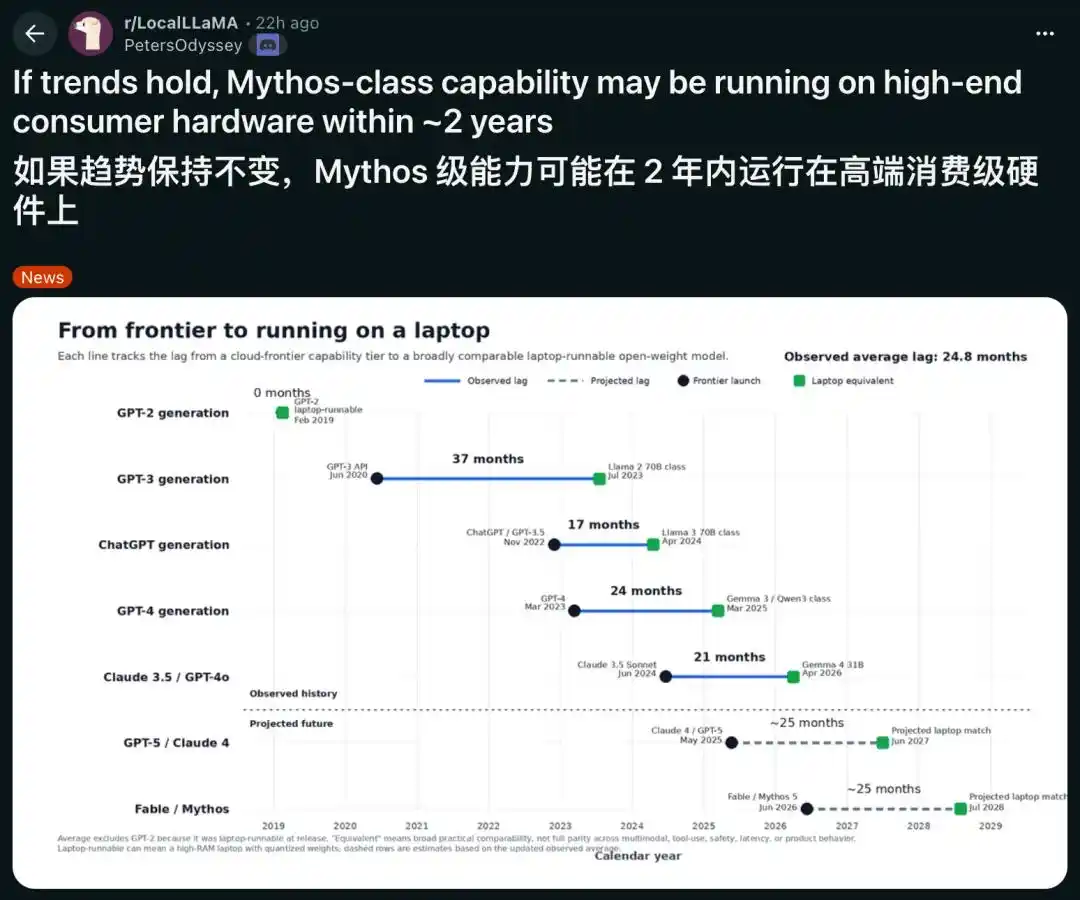
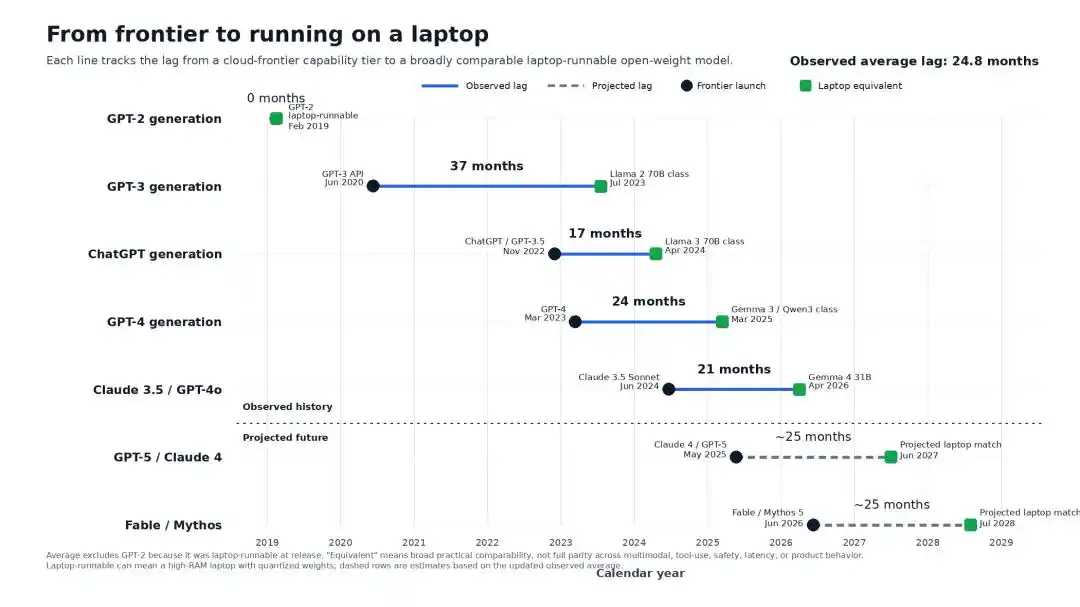
The chart's logic is straightforward: it marks out the time gap between each generation of frontier models being released in the cloud and their capabilities being matched by open-source models running on local hardware—

GPT-3-level capability took 37 months. GPT-3.5-level, 17 months. GPT-4-level, about 24 months. Claude 3.5 Sonnet / GPT-4o-level, 21 months.

Averaging across the four generations gives roughly 24.8 months—almost exactly two years.

Then, the poster extrapolated this trend line forward, and the landing point is startling: The frontier capability of Fable / Mythos 5-level will likely be practically usable on a high-end laptop locally around July 2028.
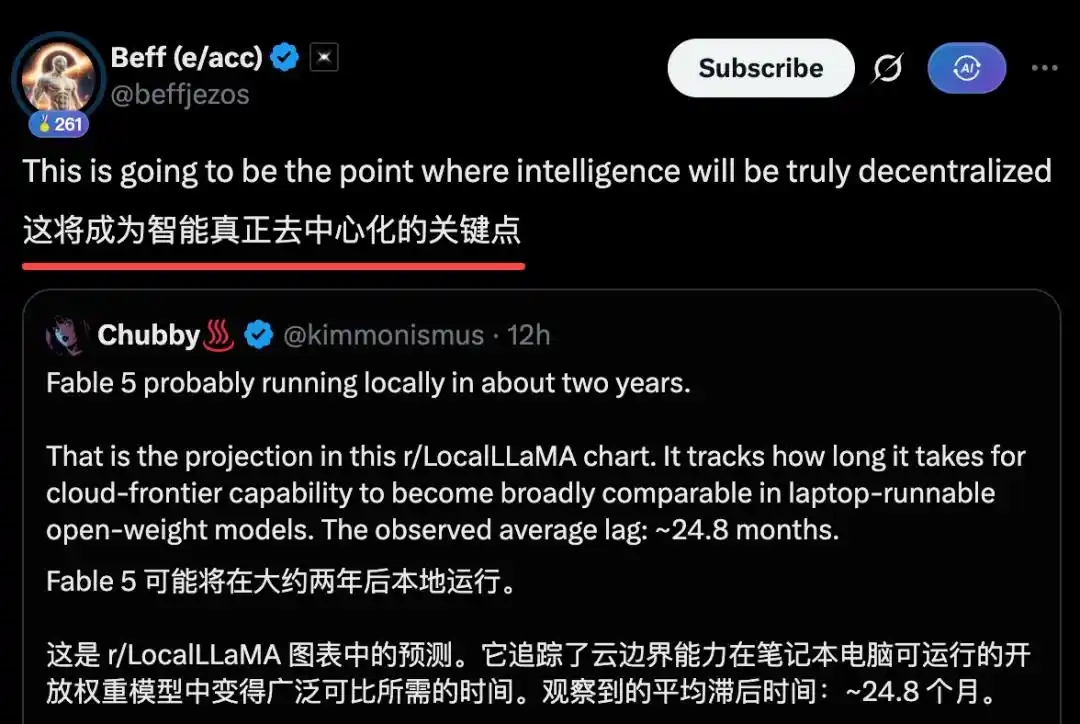
A major X influencer reposted the chart with one sentence that ignited the internet: "This will be the moment intelligence truly decentralizes."
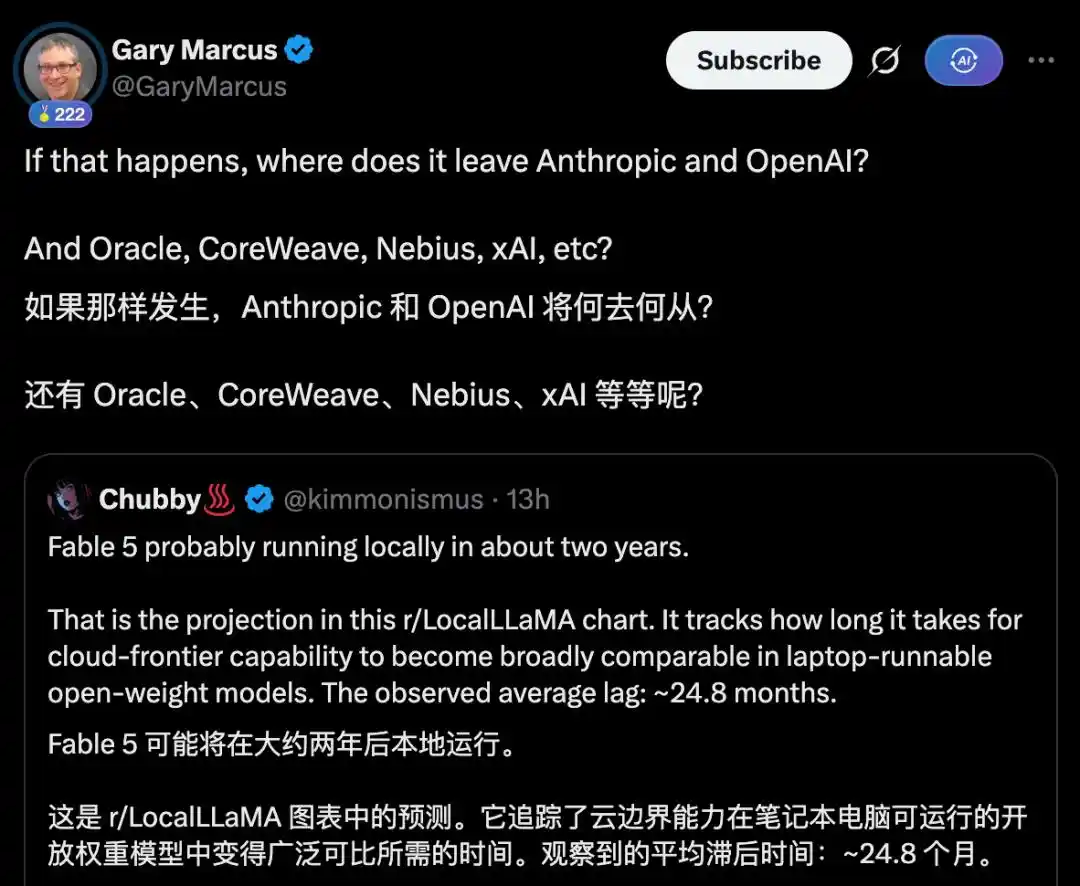
Influencer @GaryMarcus went further to question what would become of Anthropic, OpenAI, and others if this holds true.
What does local execution mean?

No internet connection, no queuing, no worries about subscription quotas, not a single byte of your data leaves your machine.

The intelligence you cautiously rent from the cloud today, billed by the token, could be a one-time hardware purchase two years from now.

Two Hard Trends Supporting the 24-Month Timeline

This projection is supported by two hard trends.

On the model side, MoE architecture, Q4/Q8 quantization, better RL and data recipes continue to drive down the compute required for equivalent capabilities.

The open-source community's catch-up cycle for frontier capabilities generally falls between 12 to 25 months, and the distilled, efficient versions will only accelerate their migration to consumer hardware.

The latest data point on the chart is proof: It took 21 months from Claude 3.5 Sonnet's release in June 2024 to Google's release of Gemma 4 31B in April 2026—a 31-billion-parameter open-source model that now matches Claude Sonnet 4.5 on the Arena AI leaderboard and even leads on GPQA.

The untouchable cloud king from two years ago now fits on a consumer-grade graphics card.

In reality, Gemma 4 31B has reached Claude 3.5 Sonnet's, even early Opus's, level in coding, reasoning, and tool-calling.

And GPT-4—the frontier benchmark from two years ago—was caught up by Gemma 3 and Qwen3 in March to April 2025, exactly 24 months later.
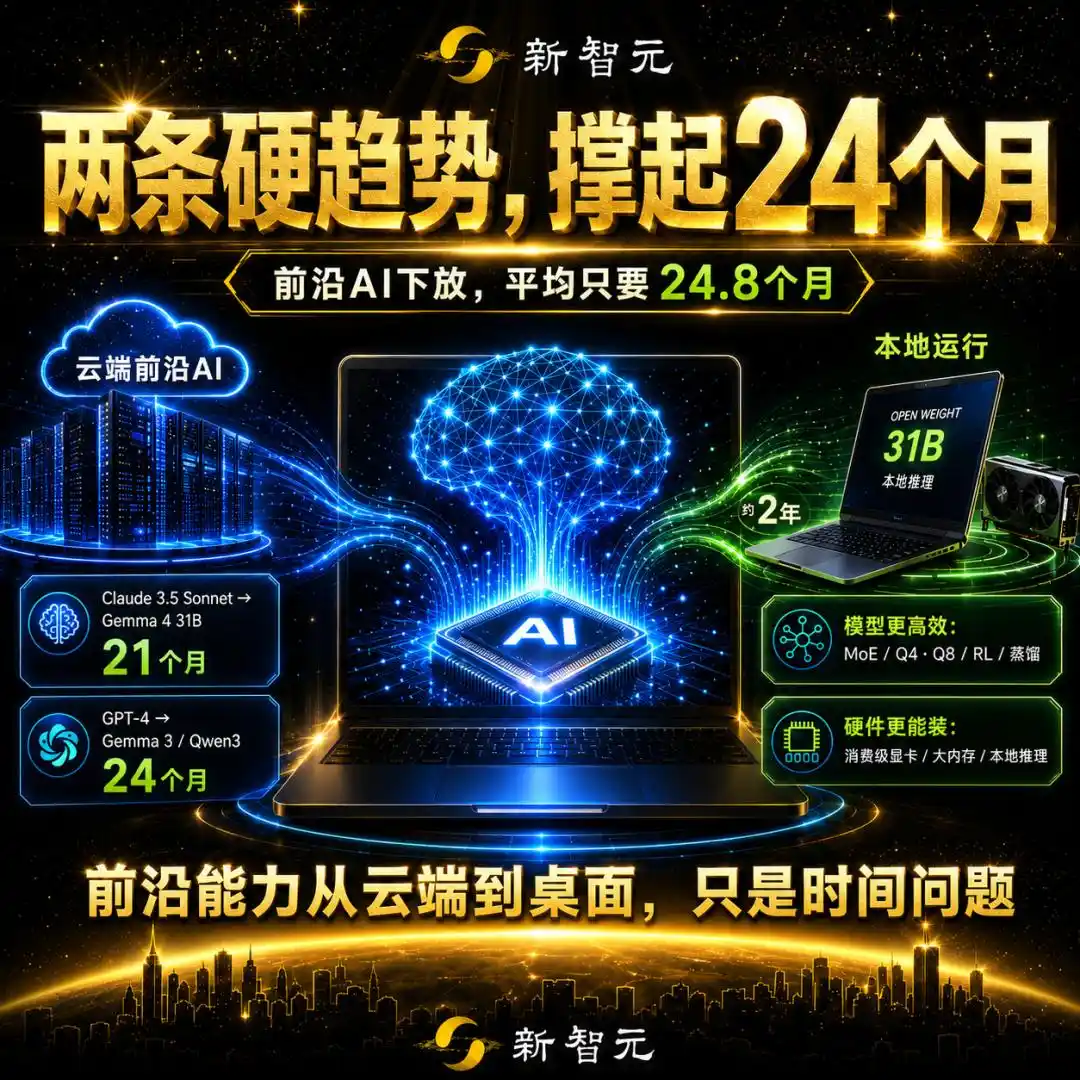
It's only a matter of time before frontier capability moves from the cloud to the desktop, and that timeframe is steadily converging to around two years.

Some are looking to China: GLM 5.2, a 753B parameter MoE architecture with an MIT open-source license and a 1M token context window, closely trails Claude Opus 4.8 on SWE-bench Pro.

In other words, even if Anthropic locks its doors, other contenders will bring equivalent capability to your desktop via a different path.

Blockades Can Restrict Access, But Not Time

This chart truly strikes the most sensitive nerve of the moment.

The past month witnessed the AI industry's first-ever "model recall": release, block, negotiation, unblock—every step of the Fable 5 saga emphasized two words: scarcity and control.

Who gets to use the strongest model has, for the first time, become a question answered with a passport.

This chart offers another perspective: From GPT-3 to today, no generation of frontier capability has successfully remained exclusively in the cloud for more than three years.

Distillation proliferates, open source catches up. Regulation can decide who uses Fable 5 today, but it cannot decide whose laptop runs a Fable 5-level model two years from now.

For developers, this means local agents, privacy-preserving computation, and offline workflows are worth investing in now; for hardware vendors, an arms race around large memory and high bandwidth has already begun; for the entire industry, this means the exclusive window for frontier models may be just 24 months—AI is transitioning from cloud monopoly to desktop democratization.

This might be the most ironic and optimistic aspect of that chart: Washington answers "Who deserves the strongest AI?" with a piece of paper; Redditors answer with four historical data points—In two years, everyone.

Remember July 2028. On that day, today's myth might just be your everyday tool.

Reference: https://www.reddit.com/r/LocalLLaMA/comments/1uoij3s/if_trends_hold_mythosclass_capability_may_be/

This article is from the WeChat public account "AI Era (新智元)", author: ASI启示录; editor: 所罗门

Trending Cryptos

Related Questions

QWhat is the core claim made by the Reddit post in r/LocalLLaMA that went viral?

AThe post claims that if current trends hold, 'Mythos'-class or Fable 5-level AI capabilities could be running practically on high-end consumer laptops in approximately 24 months, around July 2028.

QWhat historical data trend does the analysis in the article rely on to support its prediction?

AThe analysis tracks the time lag between the release of frontier models (GPT-3, GPT-3.5, GPT-4, Claude 3.5 Sonnet/GPT-4o) and the availability of open-source models with comparable performance on consumer hardware. The average lag across these four generations is about 24.8 months.

QAccording to the article, what are the two main trends driving this capability to local devices?

AThe two main trends are: 1) Model-side advancements like MoE architectures, quantization (Q4/Q8), and better RL/data recipes reducing computational requirements. 2) The real-world proof of open-source models (e.g., Gemma 4 31B) achieving performance parity with recent frontier models (e.g., Claude 3.5 Sonnet) within the predicted timeframe.

QWhat broader implication for the AI industry does the article suggest based on this trend?

AThe article suggests the trend indicates AI is moving from cloud-based monopoly to 'desktop democratization.' It implies the exclusive window for frontier models may shrink to about 24 months, enabling local, private, and offline workflows and reducing dependency on centralized cloud services and access controls.

QHow does the article contrast the current geopolitical controls on AI access with the predicted future?

AThe article contrasts current geopolitical access controls, which use 'passports' to determine who can use the strongest AI, with the predicted future where, in about two years, Fable 5-level capability could be available locally to 'everyone,' making today's restricted technology a common commodity.

Related Reads

Unitree's IPO Frenzy: The Real Mystery is How It Will Spend the 42 Billion Raised

Unitree, a Chinese robotics company, is set for a public listing after its IPO registration was approved by regulators. The company, which started with quadruped robots and has expanded into humanoids, plans to raise approximately 4.2 billion yuan through its offering. The article traces Unitree's rapid growth from its founding in 2016 to its current status. It highlights key milestones like the 2021 CCTV Spring Festival Gala performance, the 2023 launch of its affordable Go2 robot dog and the H1 humanoid robot, and a series of subsequent product launches. By 2025, the company reported revenue of 1.71 billion yuan, profitability, and sales exceeding 5,500 humanoid robots. As the first publicly-listed humanoid robot company on China's STAR Market, Unitree's main challenges are sustaining growth and deploying its newly raised capital effectively. The humanoid robot sector in China is crowded, with over 140 companies. Competitors include UBTech (focusing on industrial and consumer markets), Fourier, and international players like Tesla Optimus and 1X NEO. The article outlines three critical challenges for Unitree: establishing a strong second product line beyond its quadruped robots, maintaining its price advantage while ensuring quality, and successfully advancing its embodied AI capabilities through partnerships like the one with NVIDIA for the H2 Plus platform. Unitree's likely strategy involves a "developer tools + industry benchmarks" approach: using low-cost models like the R1 and G1 to build developer adoption and volume, leveraging high-end platforms for AI training, and securing pilot projects in sectors like logistics and manufacturing to build case studies. The company's future success hinges on converting its current momentum in shipments and pilot programs into sustainable, large-scale commercial contracts as the broader market evolves.

marsbit36m ago

Unitree's IPO Frenzy: The Real Mystery is How It Will Spend the 42 Billion Raised

marsbit36m ago

Examining the Open USD Partner Lineup: Follow Who's Joining to See Where the Money Flows

**Title: Deciphering the Open USD Partner Roster: Following the Money** The launch of Open USD is notable less for the stablecoin itself and more for its expansive list of over 140 founding partners, which reads like a "who's who" of global finance and tech. This coalition, including asset managers like BlackRock, card networks Visa and Mastercard, banks (BNY Mellon, Standard Chartered, etc.), tech giants (Google, IBM), merchants (Shopify), and crypto firms (Coinbase, Ripple, Aave, MetaMask), signals a strategic shift. The diverse membership reveals that stablecoins are increasingly viewed not as products to compete over, but as shared infrastructure too critical to be left to any single entity. Each partner category has distinct motives. Asset managers like BlackRock seek to manage the large, sticky cash reserves, a lucrative fee-generating opportunity. Merchants like Shopify aim for lower-cost settlement and potential yield on balances. Banks join defensively to retain custody and settlement roles, fearing deposit outflows to stablecoins. Tech companies bet on programmable money for future machine-to-machine commerce. Crypto firms gain mainstream legitimacy and distribution channels. Remarkably, the consortium includes direct competitors (Visa vs. Mastercard, Coinbase vs. Ripple), indicating that the fear of exclusion from this emerging financial layer outweighs competitive rivalries. However, this shared governance could also lead to slow decision-making. The roster's composition is the real message: it represents a collective bet that a widely accepted, consortium-owned stablecoin is preferable to proprietary versions or having none at all. For incumbents like Circle and Tether, this alliance poses a significant threat, as potential clients have collectively chosen to build their own alternative. The absence of major U.S. retail banks (busy with their own tokenized deposit networks) is equally telling. In essence, the partner list maps where the industry believes value and risk will flow in a tokenized dollar future, marking stablecoin's evolution from a product to a utility.

Foresight News59m ago

Examining the Open USD Partner Lineup: Follow Who's Joining to See Where the Money Flows

Foresight News59m ago

Trading

Spot

Hot Articles

Discussions

Welcome to the HTX Community. Here, you can stay informed about the latest platform developments and gain access to professional market insights. Users' opinions on the price of AI (AI) are presented below.

活动图片