7 Months After the Collapse of Huiwang, Southeast Asia's Escrow Platforms Undergo a Major Reshuffle

Odaily星球日报Published on 2026-07-22Last updated on 2026-07-22

Abstract

Following the collapse of Huione Pay—dubbed the "Alipay of Southeast Asia"—seven months ago, the region's underground financial guarantee platform sector is undergoing a significant reshuffle. This power vacuum has been swiftly filled by emerging platforms such as XinBi, Tiger/Navigator, JinBei (renamed JinBo), Dali/Tiancheng, and FullyLight. These platforms, operating largely via Telegram and offering services like escrow for illicit transactions, have absorbed the vast user base and markets left behind by Huione. While positioning themselves as "trust intermediaries," their primary clientele consists of networks involved in online scams, money laundering, illegal gambling, and even human trafficking. For instance, the Tiger/Navigator platform explicitly provides "escrow" services for kidnapping-for-ransom operations ("强押车交易"). Data underscores the immense scale: Huione alone processed over $103 billion in cryptocurrency payments and facilitated over $31 billion through its escrow market before its downfall, linking it to Cambodia's notorious Prince Group. Since its collapse, competitors have seen explosive growth. For example, the XinBi platform has accumulated over $1.6 billion in total USDT revenue, while platforms like NewPay, OkPay (under Dali), and FullyLight Wallet collectively processed over $4.8 billion in USDT in a single year. This ecosystem thrives in regions like Cambodia and Myanmar, where regulatory gaps allow these platforms to act as critical financial in...

Original | Odaily (@OdailyChina)

Author | Wenser(@wenser 2010 )
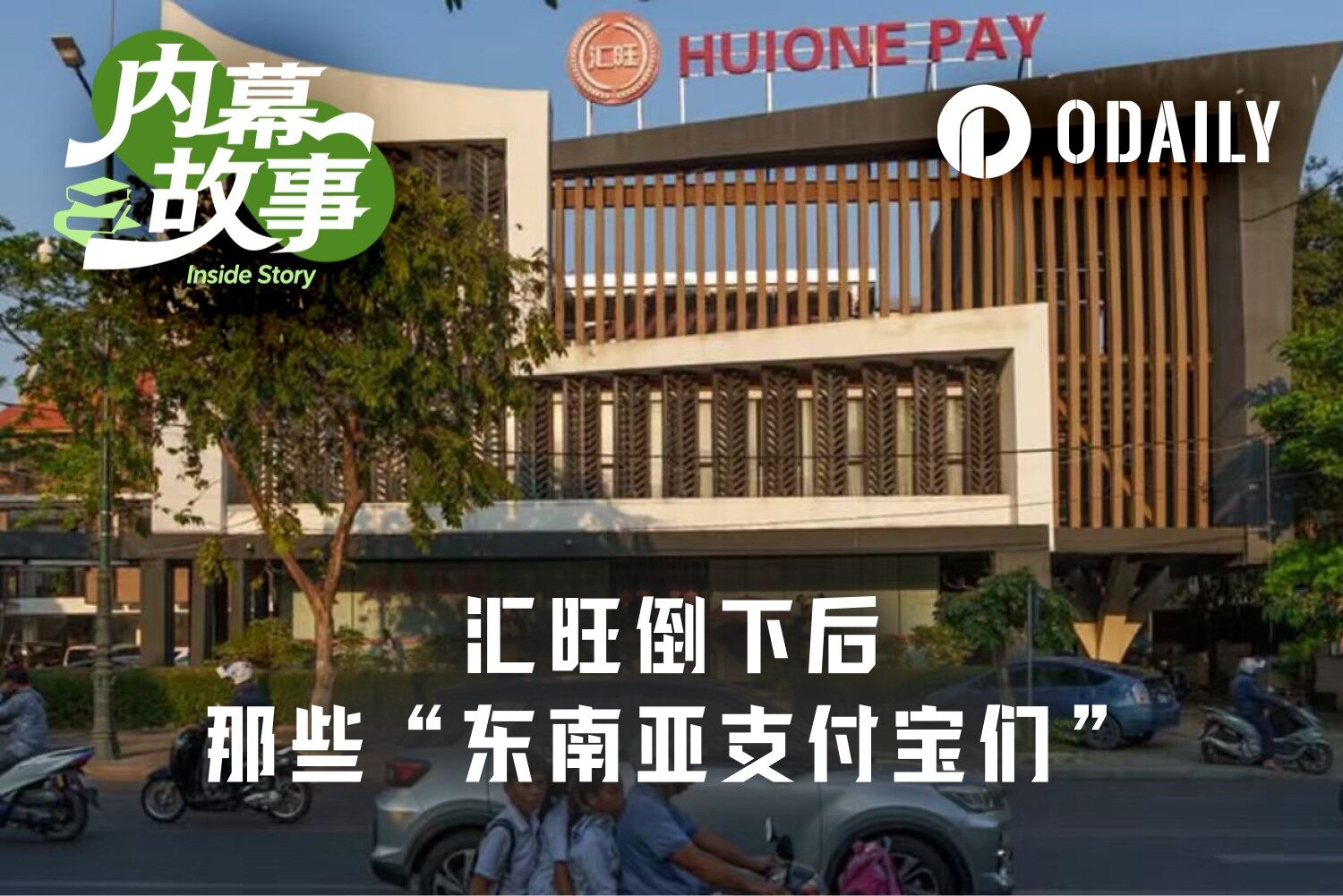
On December 1st last year, Huiwang Pay, often dubbed the "Southeast Asian Alipay," officially collapsed.

Since then, the tumultuous "era of free finance in Southeast Asia" has come to a definitive end. Unexpectedly, the "war over escrow platforms" did not conclude; instead, it ushered in a new round of territorial expansion. More escrow platforms have risen to the occasion, absorbing the users and market share left behind by Huiwang, setting the stage for another grand spectacle interwoven with elements of "finance and freedom, black industries and money laundering, trust and escrow."

To this day, platforms like XinBi, Jinbei, Dali, and FullyLight have gradually stepped into the spotlight, inheriting Huiwang's legacy: on one hand, facilitating black and gray industries and money laundering operations; on the other, continuing to play the commercial role of a "trusted intermediary."

In Southeast Asia, a land characterized by both openness and conservatism, another wave of turmoil involving money, dreams, and danger has already begun.

The Death of Huiwang: $15 Billion in BTC Confiscated by the US, 900,000 Users Left Empty-Handed

Four years ago, in 2021, Huiwang was just an obscure currency exchange platform in Cambodia, with peak early business volume around $2-3 billion; four years later, this exchange platform quietly transformed and ballooned into an underground financial empire centered on escrow services, handling hundreds of billions of dollars in funds—according to the "UNODC Report of May 2025," it had cumulatively received over $24 billion in cryptocurrency. Fueling this system were 900,000 registered users, 9,289 public Telegram groups, and the gray and black industry networks intertwined with fraud compounds, human trafficking, and "pig-butchering" scams behind these groups.

Behind this vast web of interests was the actual controller of the Prince Group—Chen Zhi. In October 2025, the U.S. Department of Justice and Treasury Department filed criminal charges against Chen Zhi and issued a global arrest warrant, confiscating 127,000 Bitcoins under his name (worth approximately $15 billion at the time), setting the highest record for a single cryptocurrency asset seizure in U.S. judicial history. The Prince Group thus became a thing of the past.(Recommended reading:"$15 Billion BTC Changes Hands: US DOJ Eradicates Cambodia's Prince Group, Becoming World's Largest BTC Whale".)

The collapse of the Prince Group almost immediately impacted Huiwang. With its largest financier and liquidity provider gone, Huiwang's capital chain snapped: on December 1, 2025, Huiwang issued a statement announcing delayed redemptions; 2 days later, the National Bank of Cambodia claimed that its license had been revoked as early as 2024 and the company had completed liquidation. The once-spectacular offline scenes of "releasing over a thousand account numbers daily, with queues for withdrawals" ultimately turned into mere numbers on the screen—amounts ranging from thousands to hundreds of thousands of dollars that could no longer be withdrawn.

Some gray industry practitioners lamented that taking down Huiwang was like "shaking the foundation of Cambodia's gray industry." But beneath that foundation, new escrow platforms had long been growing like weeds in the shadows.
After Huiwang, Who Are the "Next Southeast Asian Alipays"?

As early as May 14, 2025, the security agency Elliptic pointed out in a report that Telegram had banned thousands of crypto crime groups and channels related to "XinBi Escrow," noting that by 2024, the platform had cumulatively processed over $8.4 billion in suspicious transactions, ranking alongside the Huiwang Group as the "largest crypto black market."

Following Huiwang's collapse, XinBi and other secondary escrow platforms have become even more cautious, hiding their escrow business behind various self-operated platforms.

XinBi: The Escrow Platform Most Likely to Become the "Second Huiwang," with Total Revenue Exceeding $1.6 Billion

In early July this year, a "$1.7 million cryptocurrency exchange user asset theft case" brought XinBi back into the public spotlight.

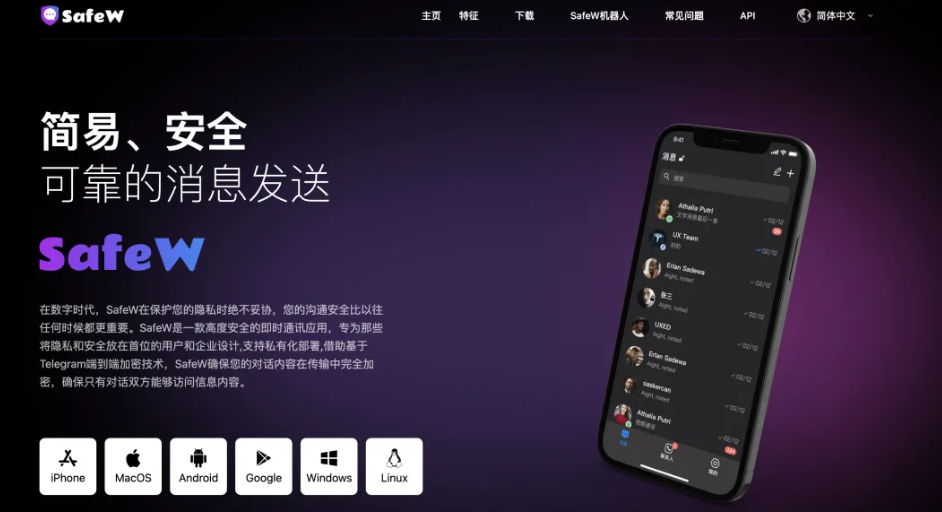
Through a series of on-chain investigations, security firm Bitrace discovered that after extracting the victim's funds, the attacker transferred the stolen money in multiple batches to the same Newpay platform user address. It is understood that this entity is a crypto payment tool launched by XinBi Escrow, whose predecessor was the KYC-free payment tool Xinbi Wallet based on Telegram Bot in 2025(Odaily Note: After XinBi developed its own application Xinbipay, this channel was shut down, users were migrated to mobile device apps, and it was later renamed Newpay to evade regulation).

According to Bitrace monitoring, the total revenue of the XinBi escrow platform, established in 2022, has exceeded 1.6 billion USDT. Its business growth has been particularly rapid since the collapse of the Huiwang Group.
Linghang/Tiger Escrow: The "Human Trafficking" Escrow Platform Masquerading as an "Overseas Labor" Service

Among the top escrow platforms in Southeast Asia, Linghang Escrow is the only one operating "overseas labor public group and private group businesses"(Odaily Note: Public groups refer to open groups providing long-term transaction escrow services; private groups refer to private groups providing temporary transaction escrow services, similar to large and small groups on WeChat), and this platform explicitly states it provides escrow services for "strong vehicle transaction" (Odaily Note: "Strong vehicle" is industry jargon referring to kidnapping).
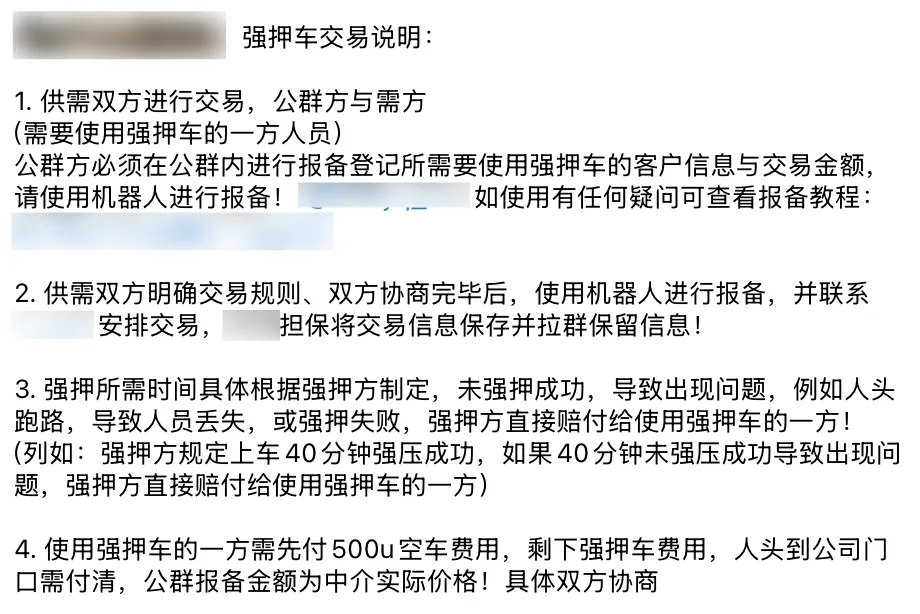
According to Bitrace monitoring, a dedicated group deposit address for Linghang Escrow was activated on February 23, 2025, and in the less than 5 months since then, it has received over 100 million USDT in inflows, and this is merely the deposit submitted by merchants operating "strong vehicle escrow business" under Linghang Escrow to the dedicated group address. Within the deposit limit, merchants can repeatedly execute business, meaning the actual transaction volume of business and the funds related to Southeast Asian cross-border human trafficking far exceed this figure.

Jinbei/Jinbo: Escrow Platforms Focused on Online Gambling

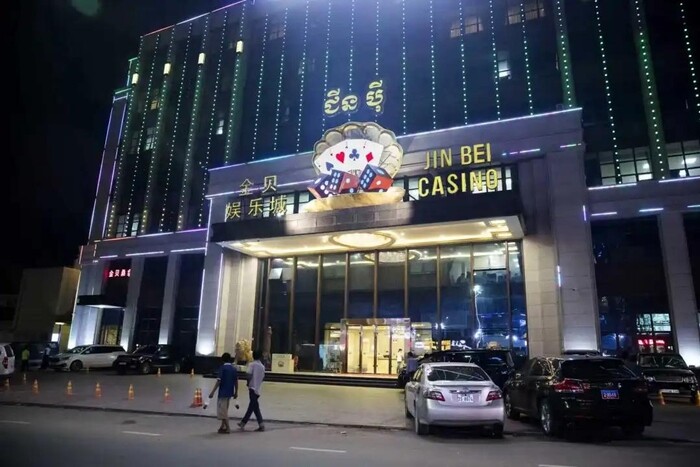
This platform was initially co-founded by Prince Group founder Chen Zhi and children of Cambodian government dignitaries, under the full name Jinbei Cambodia Investment Co., Ltd. To conceal its activities, the company was reportedly also closely linked to Chen Zhi's casino business in Sihanoukville, Cambodia, hence its primary focus has always been on online gambling-related escrow services.

Affected by events like the fall of the Prince Group, Jinbei also faced sanctions from the U.S. government. Last year, the Cambodian Gambling Committee and Cambodian police once cracked down hard and shut down some casinos under Jinbei. However, informed sources later revealed: "Only Jinbei 1 and Jinbei 3 casinos were closed, while 6 affiliated compounds under Jinbei continue to operate normally." Currently, Jinbei has been renamed Jinbo Escrow Platform.
Dali/Tiancheng Escrow: Inheriting the Tudou Escrow Under Huiwang

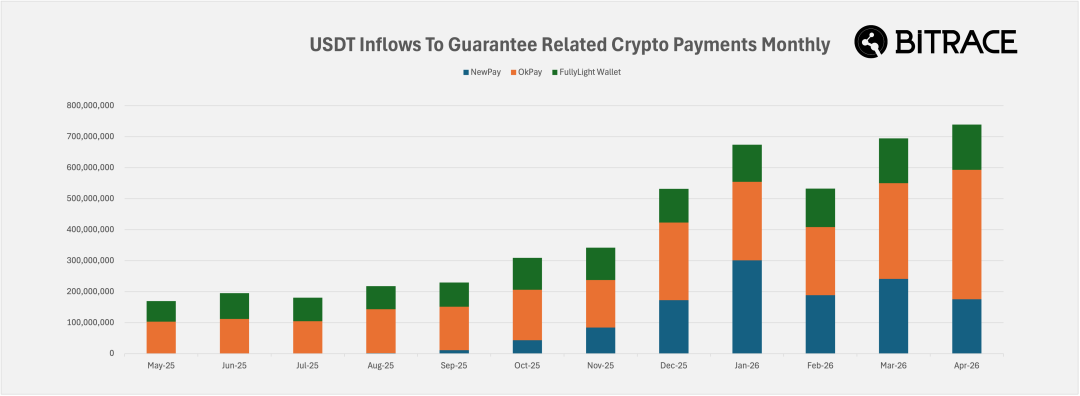
According to Bitrace monitoring, after Tudou Escrow and Huiwang (Haowang) Pay stopped processing redemptions, user bases for XinBi Escrow, Dali Escrow, FullyLight Escrow, and their payment tools all saw significant increases. Among them, OkPay under Dali Escrow inherited a large number of Tudou Escrow's public groups, showing the greatest growth.
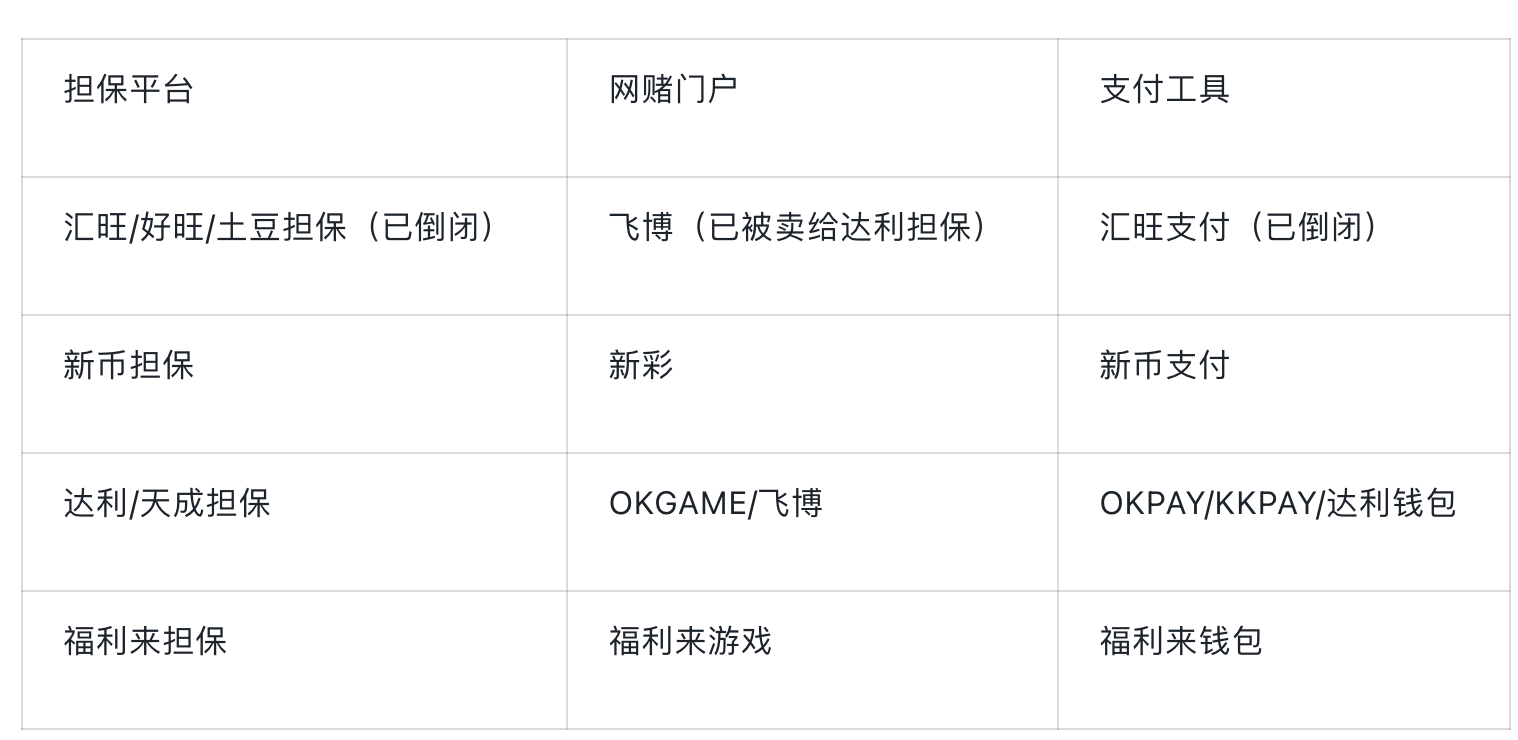
Statistics show that from May 2025 to April 2026, the three payment tools NewPay, OkPay, and FullyLight Wallet collectively received funds exceeding 4.8 billion USDT. Currently, Dali Escrow is primarily active under the name Tiancheng Escrow.
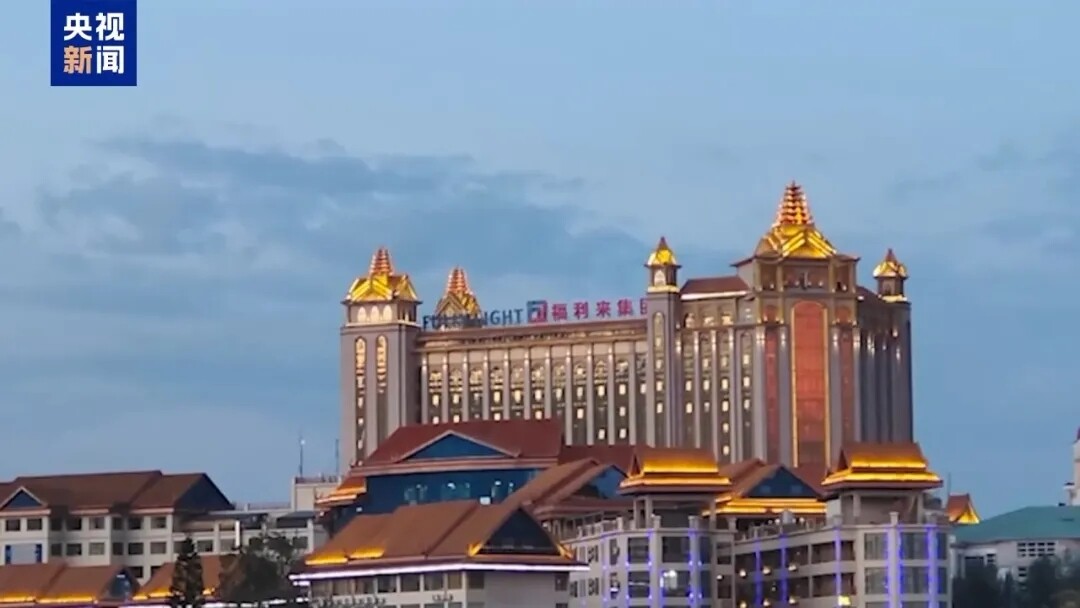
FullyLight Escrow: The Industry Chain of the Fraud Compounds of One of the "Four Northern Myanmar Families"

In 1996, after completing initial capital accumulation through drug trafficking in earlier years, Liu Zhengxiang (original name Liu Abao) established the FullyLight Group in Myanmar's Kokang Self-Administered Zone. Later, the group's business expanded to encompass tourism, hotels, real estate, entertainment, and more, gradually becoming the core enterprise of the Liu Abao family and propelling its growth into one of the later "Four Northern Myanmar Families."

In 2025, the Ministry of Public Security cracked the Liu family crime syndicate case, ultimately verifying that the family was involved in fraud funds exceeding 2.6 billion yuan, gambling funds over 8 billion yuan, extortion amounting to over 17 million yuan, and illegal gains from organized prostitution exceeding 16 million yuan.

It is worth noting that FullyLight Escrow primarily serves local large-scale fraud compounds, established to meet the latter's "labor demands." Currently, with the dismantling of the Liu family crime gang...
When Escrow Platforms Become Black Industry Intermediaries, "Southeast Asian Alipay" is Just a Façade

In June this year, Elliptic updated data related to the Huiwang platform during "Operation Riptide" carried out in cooperation with the FBI. Among it, the Huiwang escrow market cumulatively received funds exceeding $31 billion; Huiwang Pay processed over $103 billion in cryptocurrency payments. The Huiwang Escrow Market became the largest online illegal marketplace ever operated, far surpassing previous dark web markets like Silk Road ($216 million), AlphaBay (over $1 billion), and Hydra (over $5 billion).

Looking back at the five escrow platforms mentioned above, they are but a hidden corner of Southeast Asia's "distorted financial ecosystem" unknown to the average person. On this land of rapid development yet insufficient infrastructure and institutional preparation, financial services have become a breeding ground for crimes such as human trafficking, compound fraud, pig-butchering scams, and online gambling.

The so-called "Southeast Asian Alipay" is merely an external nickname, certainly not a commercial achievement.

Right now, they may be enjoying the glory of millions in daily income, but justice will not be absent.

Reference Information:

The Rise and Fall of a Telecom Fraud Empire Behind $15 Billion

2026 Report on Illegal Cryptocurrency Transaction Escrow Platforms By Bitrace

Behind Myawaddy: The Singularity Moment of Asia's Black Industries and the East's Rise, West's Decline in the Global Underground Society

U.S. Treasury Department Financial Crimes Enforcement Network: Notes on the Money Laundering Business of the Huiwang Group


Trending Cryptos

Related Questions

QWhat was the main reason for the collapse of Huiwang (the 'Southeast Asian Alipay'), and what was the estimated value of Bitcoin seized by the U.S. Department of Justice from its controlling entity?

AThe collapse of Huiwang was primarily triggered by the fall of its largest liquidity provider, the Prince Group, after its controller, Chen Zhi, was indicted and had his assets seized by U.S. authorities. The U.S. Department of Justice seized approximately 127,000 bitcoins, valued at around $15 billion, from Chen Zhi.

QWhich platform is described as the most promising candidate to become the 'second Huiwang' after its downfall, and what is its estimated total revenue?

AThe XinBi (NewPay) guarantee platform is described as the most promising candidate to become the 'second Huiwang'. According to Bitrace monitoring, its total revenue has exceeded $1.6 billion USDT.

QAmong the newly prominent guarantee platforms mentioned, which one is uniquely involved in providing services related to 'labor export' and human trafficking under the guise of 'guarantee for forced vehicle transactions'?

AThe Linghang (also known as Tiger) guarantee platform is uniquely involved. It operates 'labor export' groups and explicitly offers guarantee services for 'forced vehicle transactions', which is industry jargon for kidnapping and human trafficking-related activities.

QAccording to the Elliptic report cited in the article, how much cryptocurrency did the Huiwang guarantee market and its payment platform handle in total, establishing it as a major illegal market?

AAccording to the Elliptic report, the Huiwang guarantee market accumulated over $31 billion in received funds, while the Huiwang payment platform processed over $103 billion in cryptocurrency payments. This established the Huiwang guarantee market as the largest online illegal market ever operated.

QWhat is the original business background of the FullyLight (Fuli Lai) guarantee platform, and which notorious criminal group was it associated with before being dismantled?

AThe FullyLight guarantee platform originated from the FullyLight Group, founded by Liu Zhengxiang (also known as Liu Abao) in Myanmar's Kokang region. It was a core enterprise of the Liu family, one of the 'Four Families of Northern Myanmar', and primarily served local scam compounds. The Liu family criminal syndicate was dismantled by Chinese authorities in 2025.

Related Reads

Bitcoin Mining Farms Are Becoming AI Factories

Bitcoin mines are transforming into AI factories. This shift is driven by the convergence of three key assets from the previous crypto cycle: infrastructure, talent, and capital. Crypto mining companies like Crusoe, CoreWeave, and Bitdeer are repurposing their core competency—securing power, land, and grid connections in remote locations—to build data centers for AI clients. These firms are signing multi-billion dollar, long-term contracts with companies like Anthropic, AWS, and Microsoft, as AI's demand for reliable, high-capacity compute surpasses the profitability of Bitcoin mining. Simultaneously, crypto entrepreneurs and engineers are applying their skills to new AI ventures. Examples include OpenSea's co-founder launching OpenRouter (an AI model aggregator), and former Coinbase engineers building Fal.ai (a generative media infrastructure platform). Their experience in building scalable, global software networks translates effectively to the AI space. Furthermore, capital accumulated during the crypto boom is now fueling AI. Figures like Jed McCaleb (co-founder of Ripple) funded Voltage Park, a large-scale GPU cloud provider. Notably, some crypto investments, like FTX's early bets on Anthropic and Cursor, have generated astronomical paper returns, demonstrating how high-risk crypto capital flowed into AI before it became mainstream. The transition is not just about repurposing hardware, but about redirecting critical resources—power infrastructure, distributed systems expertise, and venture funding—to the next technological frontier: artificial intelligence.

链捕手9m ago

Bitcoin Mining Farms Are Becoming AI Factories

链捕手9m ago

Morpho Launches Fixed-Rate Product Midnight: Lenders and Borrowers Set Their Own Rates, Ending the Era of Interest Rate Models

Morpho Launches Fixed-Rate Product Midnight: Lenders and Borrowers Set Their Own Rates, Ending the Era of Algorithmic Interest Models On-chain lending has grown to $60 billion but remains minuscule compared to traditional finance's $200 trillion annual credit volume. Morpho identifies the lack of fixed rates and maturity dates as key bottlenecks. Institutions need predictability, not the passive floating rates set by algorithmic models. Midnight allows lenders and borrowers to directly quote rates, set terms, and become price makers, not takers. Fixed-rate lending is now viable due to cheaper, faster blockchains and the entry of institutions demanding control and certainty over returns, costs, and duration. Morpho Blue previously gave users control over risk; Midnight adds control over interest rates. Past attempts at on-chain fixed-rate lending failed primarily because they were built on top of floating-rate pools (creating unpredictability) or lacked sufficient active participants. Midnight avoids these pitfalls as a standalone primitive with fixed rates at its core, built upon Morpho Blue's existing large and active user base. Midnight offers distinct value: institutions gain predictable term structures and full control; fintech companies can offer tailored fixed-rate products; lenders/borrowers achieve predictability and efficiency; and curators can now differentiate by configuring both risk and interest rates. Morpho Midnight is not a replacement for Morpho Blue. The Morpho network will now feature two complementary market structures: floating-rate/open-term (Blue) for flexibility and fixed-rate/fixed-term (Midnight) for predictability. Liquidity can flow between them. The launch will be gradual, prioritizing security. Initially, it will support direct lending on Base network with one trading pair (cbBTC/USDC) and limited maturity dates. Advanced features like auto-rollovers will be introduced later.

marsbit9m ago

Morpho Launches Fixed-Rate Product Midnight: Lenders and Borrowers Set Their Own Rates, Ending the Era of Interest Rate Models

marsbit9m ago

human.tech Launches Clean SDK for Privacy-First Web3 Apps

human.tech has launched the Clean SDK, a toolkit enabling developers to build privacy-first Web3 applications with transparent accountability. Released alongside Aztec's version 5, the SDK provides components for integrating zero-knowledge identity verification, sanctions screening, and private transactions, without developers handling sensitive user data or building compliance infrastructure from scratch. It uses zero-knowledge proofs and programmable verification to allow apps to confirm user legitimacy and sanctions compliance while keeping identities confidential. The first application built on the SDK, Shield, a privacy bridge to Aztec, also launched. It allows users to transfer assets privately while proving a unique human is behind each transfer and that funds have passed sanctions checks, as verified by a May 2026 audit. The SDK offers three core verification techniques: Proof of Innocence (sanctions screening against 23 sources), Proof of Personhood (simpler verification via Human Passport), and Proof of Clean Hands (higher-assurance zero-knowledge government ID checks). This allows apps to authenticate users and transactions without exposing personal data. Designed for Aztec builders, the SDK lets developers add programmable privacy to decentralized apps, eliminating the need to create their own verification and ZK infrastructure. Shield demonstrates its practical use for private bridges, but the SDK aims to enable a wider ecosystem of private, accountable financial apps and services. The launch addresses growing demand for infrastructure that balances privacy and accountability. The SDK avoids traditional identity databases, storing encrypted data off-chain, screening at both entry and exit points, and including a gated disclosure mechanism for legal requests. human.tech's products, including the Clean SDK, focus on using zero-knowledge technology to enable verifiable personhood and privacy in digital systems.

TheNewsCrypto46m ago

human.tech Launches Clean SDK for Privacy-First Web3 Apps

TheNewsCrypto46m ago

Unlocking $100 Million in Liquidity? Pump.fun's New Policy Tests the 5-Minute Pump Technique

Pump.fun, a popular meme coin launchpad, has introduced a new standard mechanism called BOOST. It aims to address a significant capital efficiency issue: when a newly launched token graduates from its initial bonding curve to a liquidity pool (LP), roughly 20% of its liquidity becomes permanently locked as "dead liquidity," estimated to waste over $100 million annually. Instead of locking these funds permanently, BOOST repurposes them. Upon a token's migration, approximately 20% of the settlement funds (e.g., 17.6 SOL or ~$2516 USDC) are used to buy back the token on the open market over a 5-minute period via a Time-Weighted Average Price (TWAP) mechanism. All purchased tokens are immediately burned. This creates a brief, systematic buy pressure immediately after migration, potentially generating a short-term price surge ("pump") while permanently reducing the token's circulating supply. The goal is to enhance the immediate post-launch trading experience, potentially increasing trader retention and sustainable protocol revenue, which funds ongoing token buybacks. However, concerns exist that this artificial 5-minute boost could lower the barrier for launching low-quality tokens and lead to steeper price crashes once the buy pressure stops, if followed by large sell-offs. The feature automatically applies to tokens migrating after July 21, 2024, but not to previously migrated tokens or those launched via the Mayhem AI Agent lab.

marsbit53m ago

Unlocking $100 Million in Liquidity? Pump.fun's New Policy Tests the 5-Minute Pump Technique

marsbit53m ago

Trading

Spot

Hot Articles

Discussions

Welcome to the HTX Community. Here, you can stay informed about the latest platform developments and gain access to professional market insights. Users' opinions on the price of S (S) are presented below.

活动图片