28,000-Star Hit Creator Unexpectedly Fired by Google, Silicon Valley Big Shots Quickly Vie for the Talent

marsbitPublished on 2026-06-26Last updated on 2026-06-26

Abstract

A nearly 7-year Google veteran, Justin Poehnelt, was fired shortly after his open-source project 'gws' (a Google Workspace CLI built in Rust) went viral, amassing over 28,000 GitHub stars. The tool, designed for both humans and AI agents, allowed terminal access to all major Workspace services like Gmail and Drive by dynamically generating commands from Google's own APIs. The dismissal came just two days after Google announced its "official" Workspace CLI at its Cloud Next 2026 conference, leading to widespread criticism that the company appropriated his work. Poehnelt believes the real reason was internal fear that his project demonstrated how AI agents could fundamentally disrupt and simplify interaction with Google's core Workspace products, potentially threatening its established business model. Following his public disclosure of the events, which garnered millions of views, tech leaders like OpenClaw's Peter Steinberger and CEOs from OpenRouter and Vercel swiftly offered him jobs, highlighting the perceived misstep by Google in letting a top-performing innovator go.

The most surreal scene in the tech world in 2026 has just unfolded.

The protagonist is Justin Poehnelt, a veteran employee with nearly 7 years at Google, belonging to the Workspace Developer Relations (DevRel) team.

Simply put, the team's purpose is to create open-source tools and abstraction layers for Google's various APIs, making them easier for external developers to use.

Two months ago, he personally created a CLI for Google Workspace called gws—a command-line tool written in Rust that allows direct operation of the Google ecosystem from the terminal: Gmail, Drive, Calendar, Sheets, Docs, Chat......

It covers all Workspace services you can think of.
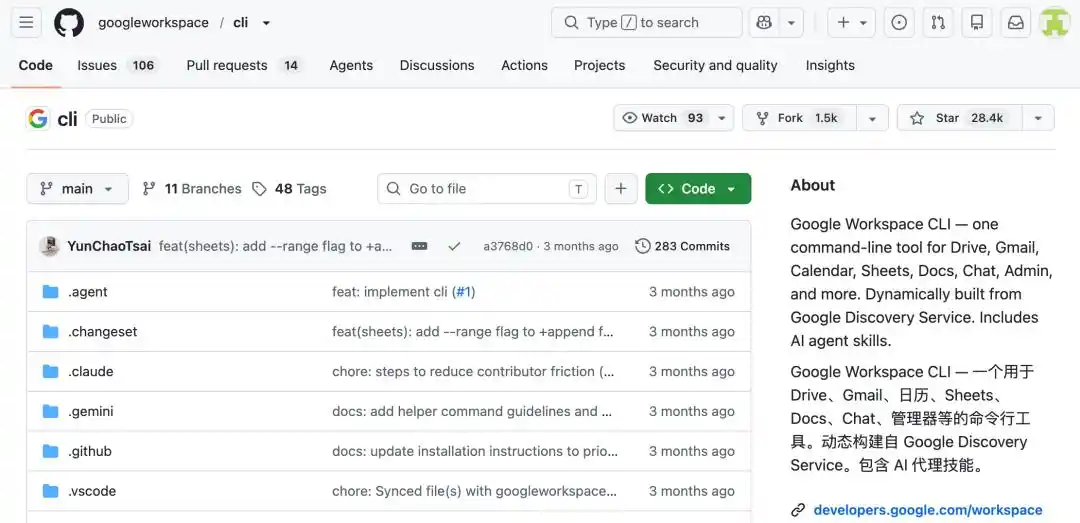
What's even more impressive is that this isn't a static list of commands. It dynamically generates all commands at runtime by reading Google's own Discovery Service—if Google adds a new API tomorrow, it supports it automatically the day after, requiring zero maintenance.

Moreover, it was designed for AI Agents from day one. Built-in with over 40 Agent skill files, its outputs are all structured JSON, ready for AI to use.

The result upon release was explosive.

Within just a few days, gws topped the Hacker News charts (953 points, 285 comments), GitHub stars soared to over 28,000, and tens of thousands of real users poured in.
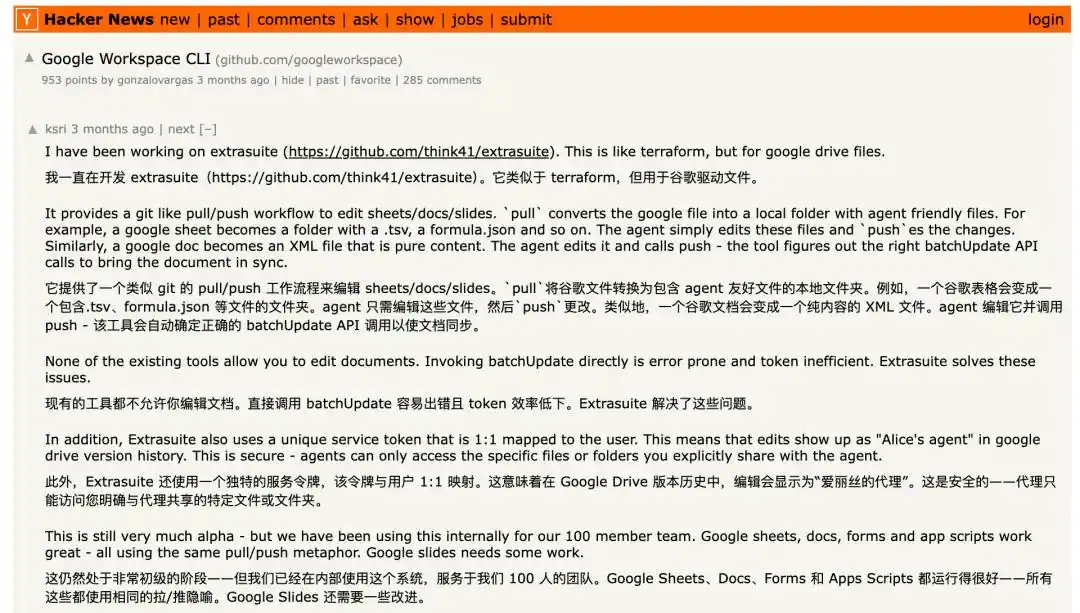
Managers and Directors flocked to learn about the design philosophy behind this tool.

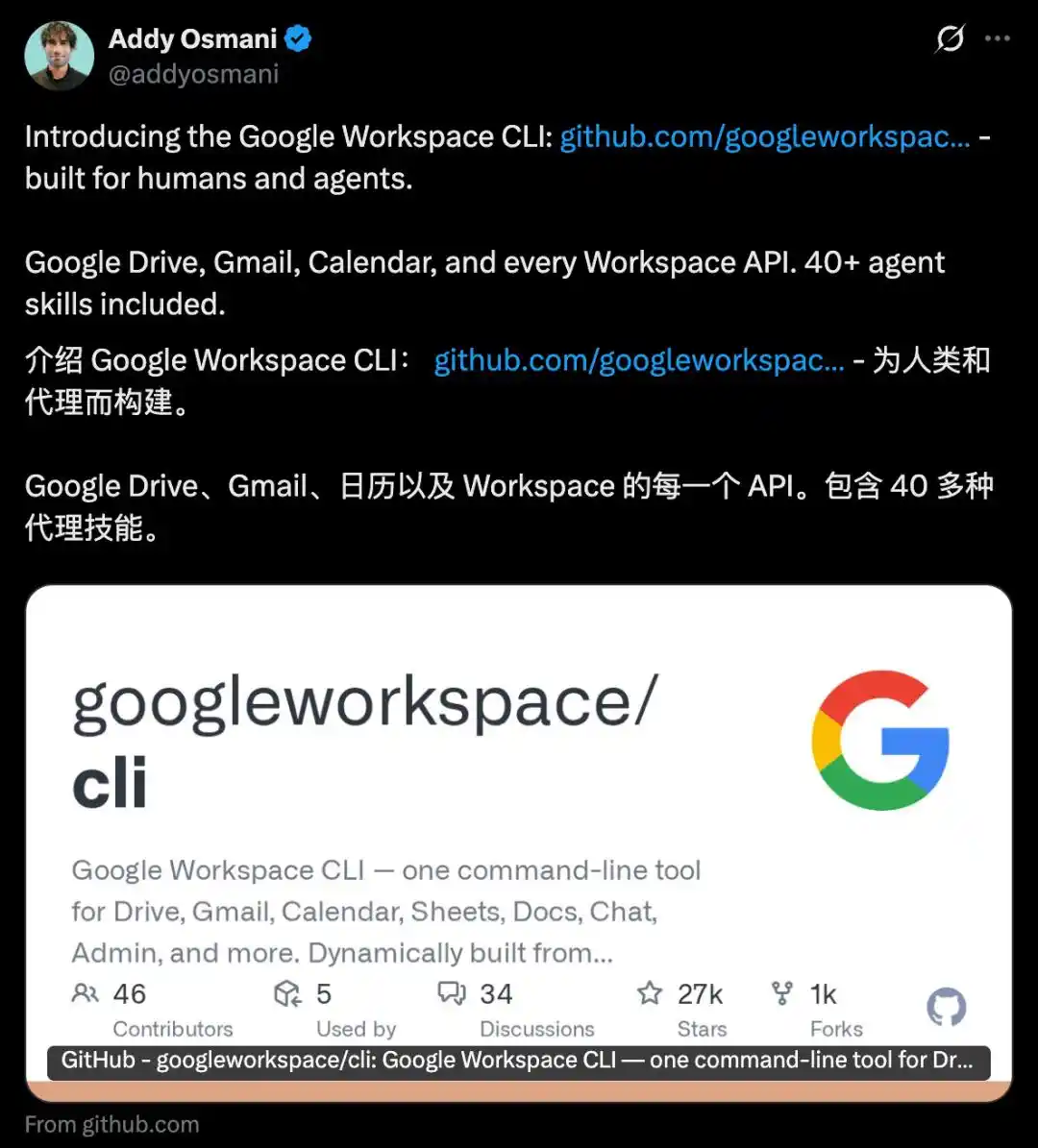
Addy Osmani, Director of Google Cloud AI, gave it a push on X with a concise and powerful caption: "Introducing the Google Workspace CLI—built for humans and agents."
At any normal company, this would be a champagne-popping highlight moment.

But what Google gave him wasn't a reward; it was a termination notice.

The viral hit became a dismissal notice.

A Textbook Case of "Kill the Goose That Lays the Golden Eggs"

What followed was even more absurd.

Just two days before Poehnelt was officially fired, Google publicly announced at the Cloud Next 2026 conference: "We're launching the 'official' Workspace CLI."

The scale of that conference? Over 32,000 attendees, three keynotes, more than 700 breakout sessions.

The same thing, coming from an employee's hands, was called "a violation." Coming from the company's mouth, it's called "innovation."

Just two days ago, Poehnelt disclosed everything on X, and the post's views quickly surged to 4 million.
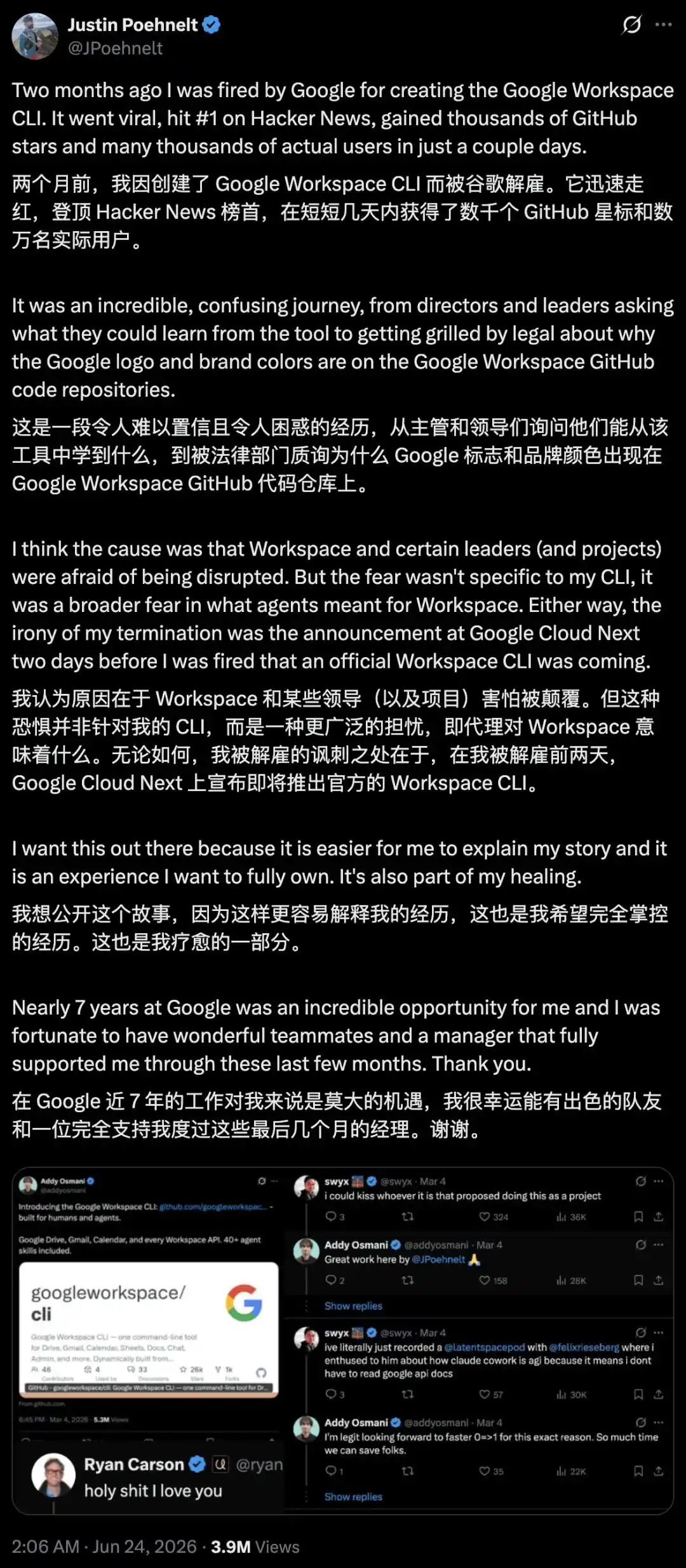
Netizens' comments were direct—isn't this essentially "appropriating the idea for free" and then killing the goose that laid the golden egg?
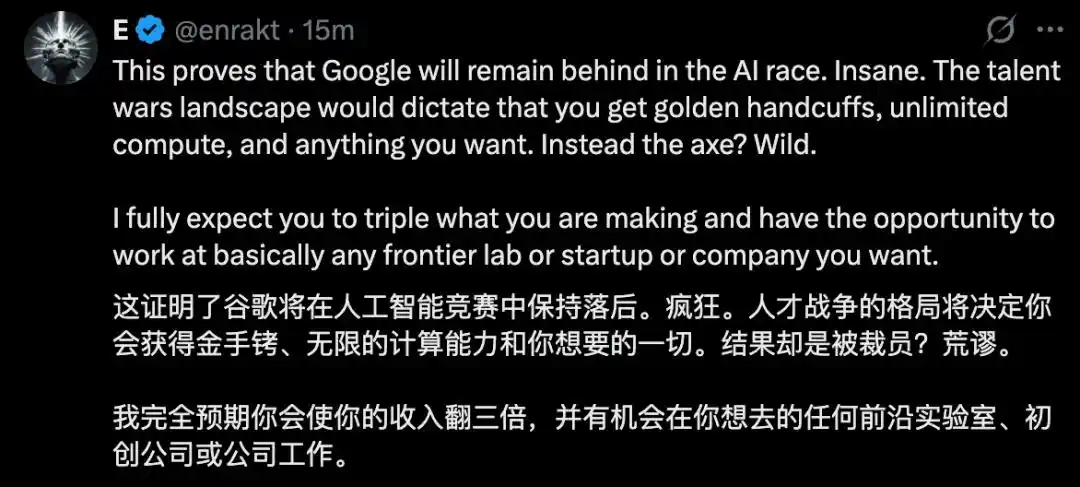
A former Google employee added a sharp comment under the post: "Having spent 7 years at Google, I applaud you. It's all because of the Cloud leadership, a bunch of folks who only know office politics and empire building."

The 'Openclaw' Founder's Direct Jab

The most ironic part is, before leaving, the individual involved left a gracious remark: his nearly 7 years at Google were an incredible experience, he was lucky to have fantastic teammates and a manager who fully supported him in the final months.

Gracious as it was, the slap in the face landed solidly.

This surreal incident within the big tech company soon drew a crowd.

OpenClaw founder Peter Steinberger was the first to step into the fray. He reposted Poehnelt's post, adding a sharp jab:

"Google fired the guy who made the Google Workspace CLI for making the Google Workspace CLI. Lucky for me, Google can't fire me."
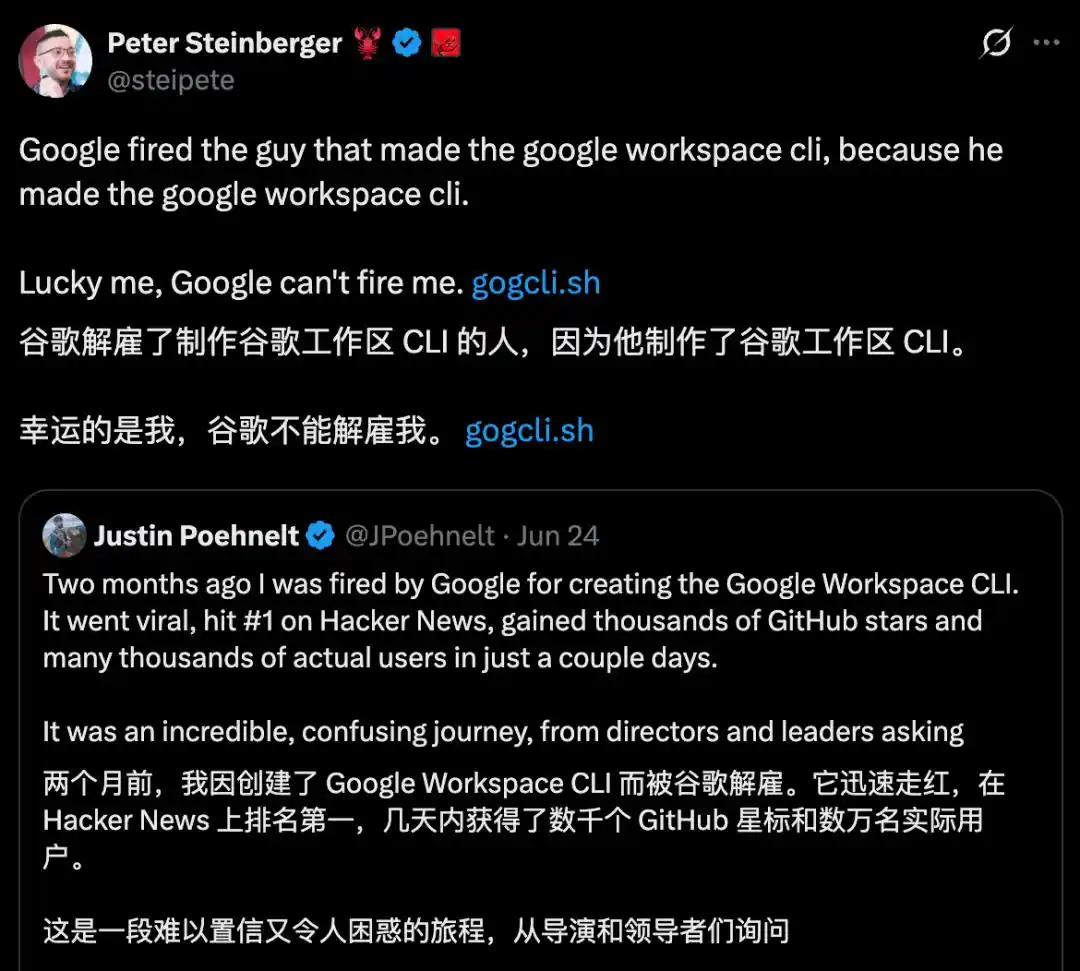
With one sentence, he tore off the fig leaf covering how big company bureaucracy suppresses grassroots tech geeks.

The mockery was complete.

What's even more hilarious is that Peter Steinberger immediately switched to recruitment mode. He publicly invited Justin Poehnelt to join the Codex team online.

This move was truly masterful~

CEOs from OpenRouter, vercel, and other companies also joined the talent battle.

Finding a job is the least of this guy's worries now.

The Real Trigger

So the question arises: why was the creator of a tool that brought the company a massive influx of users, even attracting Directors for insights, fired?

According to Poehnelt's own analysis, the surface trigger was absurd, almost like a joke: the legal department confronted him, seriously questioning—why were Google's logo and brand colors appearing in the GitHub repository for Google Workspace.
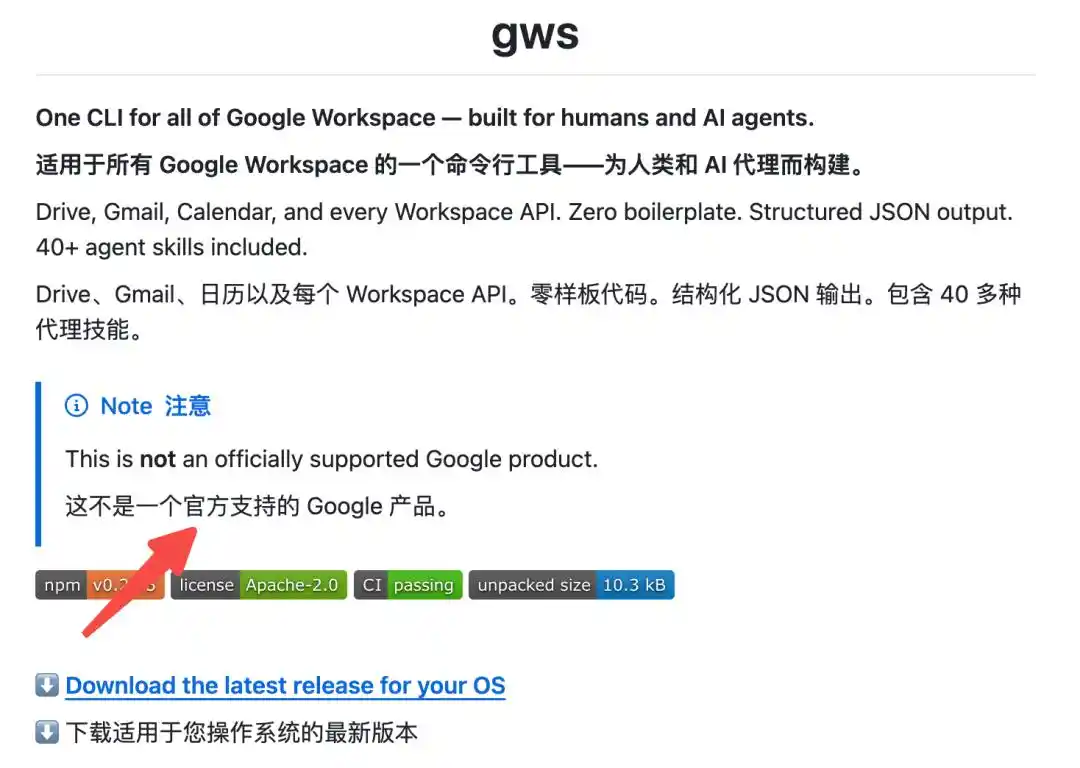
A Google employee, for a Google tool, placed under the official Google GitHub organization googleworkspace, with Google's logo, was chased down by Google's legal team asking, "What gives you the right to use our logo?"

This logic itself is surreal enough.

What's even more ironic is that a core part of the DevRel team's daily work is to release open-source tools with Google branding under Google's GitHub organization—because developers only trust and use them when they see the official logo.

The line between "unofficial open-source project" and "official product" has always been deliberately blurred, because the higher the blur, the higher the user adoption rate.

This is a strategy Google itself has been playing for years.

But the person involved saw it clearly. He said the real reason wasn't the logo or brand compliance at all—it was fear.

"I believe Workspace and certain leaders, certain projects, are afraid of being disrupted," Poehnelt wrote. "But this fear isn't specifically about my CLI; it's a broader concern about what AI Agents really mean for Workspace."

This statement is the core of the entire matter.
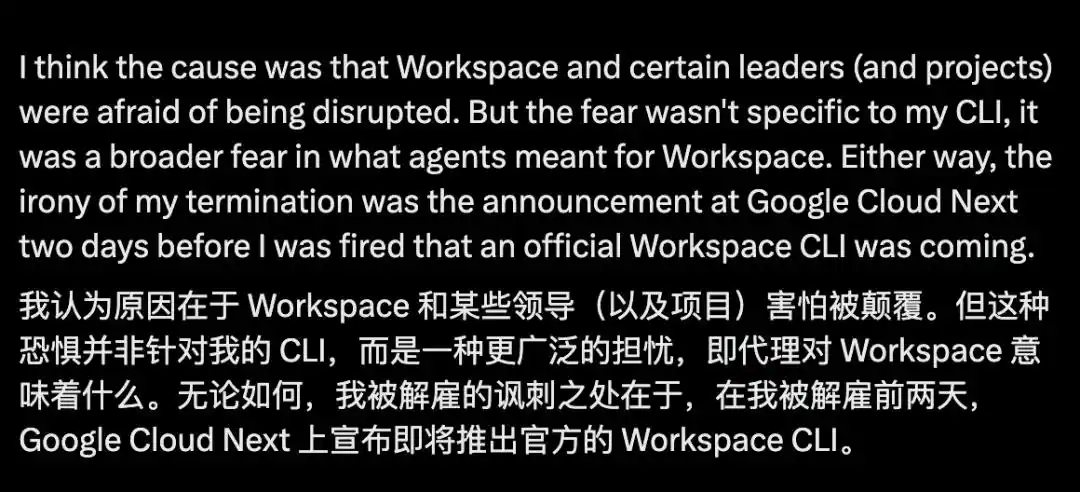
What gws does essentially transforms Google Workspace from a "you need to log into a webpage, open an interface, and click around yourself" product into a "AI Agent works for you, you just give natural language commands" infrastructure.

And it has already proven this path works.

This precisely touches Google's most sensitive nerve.

Workspace is Google's major cash cow, a productivity suite with over 3 billion users, the lifeline countless businesses pay subscriptions for.

An Agent tool casually made by an internal DevRel employee, which went viral in days, essentially handed evidence of "your moat is being filled in" directly to all executives.

When an Agent can read your emails, schedule meetings, search documents, write reports for you—who needs software that makes you log into a webpage and click around yourself?

gws posed this question for everyone.

The more useful and popular it became, the more it resembled a wake-up call.

Thus, the suppression came from within, not from competitors—the first to want to snuff out this spark was precisely the company that should have been most proud of it.

It's worth noting that Addy Osmani—a 14-year Google veteran who led Chrome and later Cloud AI developer experiences—who helped push that "explosive tweet" for Poehnelt, also left Google around the same time.

Whether there's a causal link between their departures is unknown, but the coincidence in timelines is already quite telling.

References:

https://x.com/JPoehnelt/status/2069482265953087602

https://x.com/steipete/status/2069594195522941059?s=20

https://github.com/googleworkspace/cli

This article is from WeChat public account "Xinzhiyuan" (New Zhiyuan), author: ASI Revelation, Editor: Solomon


Related Questions

QWhy was Justin Poehnelt fired by Google after creating a highly successful CLI tool for Google Workspace?

AHe was fired because Google's legal department questioned his use of Google's logo and branding in the project's repository, although he believes the real reason was internal fear that his tool, which empowered AI agents to use Workspace, threatened the established product and business model.

QWhat is the key feature of the 'gws' CLI tool that made it instantly popular?

AIts key feature is that it dynamically generates commands at runtime by reading Google's own Discovery Service, automatically supporting new APIs with zero maintenance, and it is designed from the ground up for AI Agents with structured JSON output.

QHow did the tech community and other companies react to Justin Poehnelt's firing?

AThe tech community expressed outrage, calling it a case of corporate exploitation. Several tech leaders, including OpenClaw's Peter Steinberger and CEOs from OpenRouter and Vercel, immediately offered him job opportunities.

QAccording to the article, what is the ironic timing related to Google's official announcement of a Workspace CLI?

AGoogle officially announced its 'official' Workspace CLI at the Cloud Next 2026 conference just two days before formally firing Justin Poehnelt, the creator of the highly successful unofficial version.

QWhat does the article suggest is the deeper, underlying reason for Google's reaction to the 'gws' tool?

AThe article suggests the deeper reason is fear within Google that AI Agents, empowered by tools like gws, could disrupt or 'flatten the moat' of the traditional, user-interface-based Google Workspace product, which is a major revenue source.

Related Reads

Trillion-Dollar Pension Fund Entry? Franklin Bitcoin Dividend Reinvestment ETF Comes with a Built-in Selling Pressure Ceiling

Franklin Templeton has filed to launch two ETFs that embed a "default configuration" logic into Bitcoin investment, aiming to tap into massive pension fund flows. These "Bitcoin Dividend Reinvestment Index ETFs" will initially hold 95% equities and 5% Bitcoin, automatically reinvesting stock dividends to buy Bitcoin. However, a quarterly rebalancing rule forces selling of Bitcoin if its allocation exceeds 5%, capping its maximum holding at 20%. While the product cleverly circumvents advisor reluctance and compliance hurdles by labeling itself as a U.S. equity product, its actual Bitcoin buying power is minimal. Given low dividend yields (e.g., ~1% for broad market indices), annual Bitcoin purchases from a fund the size of Franklin's existing Bitcoin ETF would be a mere $3.6 million—negligible against Bitcoin's daily trading volume. Crucially, during bull markets, the fund becomes a programmed, passive *seller* of Bitcoin, potentially creating sustained sell pressure if many similar funds emerge. The strategy leverages investor inertia and automatic enrollment, similar to the success of target-date funds in 401(k) plans. It also uses an offshore Cayman subsidiary for holding Bitcoin and raises a tax complication where investors must pay taxes on dividends they never receive as cash. Although recent U.S. regulatory changes allow crypto in retirement plans, widespread adoption as a default option faces legal hurdles. The core premise remains: the system doesn't need to convince anyone to buy Bitcoin actively; it simply relies on people doing nothing.

marsbit2m ago

Trillion-Dollar Pension Fund Entry? Franklin Bitcoin Dividend Reinvestment ETF Comes with a Built-in Selling Pressure Ceiling

marsbit2m ago

Bitcoin Hits 20-Month Low as Largest Bull Suffers $15 Billion Paper Loss

Bitcoin Hits 20-Month Low as Major Bull Loses $15 Billion On June 25th, Bitcoin fell below $60,000, hitting a low of $58,030—its lowest level since October 2024. The sell-off triggered over $1 billion in leveraged liquidations in 24 hours, with longs accounting for $788 million. This marks a more than 53% decline from the October 2025 all-time high of $126,198. A critical factor in the downturn is the weakening position of MicroStrategy, the largest corporate Bitcoin holder. With 847,363 BTC at an average cost of $75,651, the company now faces over $14.6 billion in unrealized losses. Its core financing flywheel—raising capital to buy Bitcoin—is stalling. Its variable-rate preferred shares (STRC), a key fundraising tool, have fallen 25% below their $100 target. This raises doubts about its ability to continue providing steady institutional demand for Bitcoin. Simultaneously, U.S. spot Bitcoin ETFs are experiencing significant outflows, with a single-day net outflow of $469 million on June 24th. This represents the most severe sustained capital flight since their launch. The macroeconomic backdrop remains restrictive, with persistent inflation delaying expected Fed rate cuts. Analysts note a shift in capital allocation, with institutional funds moving away from crypto towards AI infrastructure stocks. Immediate pressure comes from approximately $10 billion worth of Bitcoin options expiring on June 26th, which could increase market volatility. The combined effect of these factors—eroding core demand pillars, macro headwinds, and capital rotation—has decisively broken the $60,000 support level.

Foresight News8m ago

Bitcoin Hits 20-Month Low as Largest Bull Suffers $15 Billion Paper Loss

Foresight News8m ago

STRC Falls Below $80, Can Conservative Investors Still Buy the Dip?

The article analyzes whether the STRC (a perpetual preferred stock issued by MicroStrategy) presents a buying opportunity after its price fell below its $100 par value to around $80, offering a seemingly high yield of 13-15%. The core argument is that STRC's discount reflects market skepticism about the sustainability of MicroStrategy's capital structure model, not just temporary panic. This model relies on issuing securities (like STRC) to raise funds to buy more Bitcoin, a "flywheel" that works in a bull market. The recent small sale of BTC to fund dividends, while minor, broke the psychological "never sell" anchor and signaled potential strain. Key risks identified are not a traditional Ponzi collapse but a potential breakdown in the financing narrative: 1) If Bitcoin enters a deep bear market, crushing MicroStrategy's stock premium (mNAV), its ability to raise cheap capital weakens. 2) If STRC remains deeply discounted, it signifies permanently higher funding costs. 3) The high cash dividend yield represents a significant ongoing expense. 4) If selling BTC to pay dividends becomes routine, the bullish narrative reverses. The conclusion is that STRC is not a risk-free high-yield asset. It is a high-coupon bet on whether MicroStrategy's BTC treasury financing model can withstand a bear market. Buying it is a wager that the market will continue to believe in and fund this structure at acceptable costs. The current price asks if this cycle's "casualty" might be a BTC treasury company's融资 model itself.

marsbit23m ago

STRC Falls Below $80, Can Conservative Investors Still Buy the Dip?

marsbit23m ago

Why Do Crypto Projects Keep Changing Their Names?

**Why Do Crypto Projects Keep Changing Names?** In the crypto world, changing a project's name is common—over 16% of projects have done so, including major ones like Polygon (formerly Matic Network). This contrasts sharply with traditional businesses, which fiercely protect brand equity. The core reason is that in crypto, brand loyalty is often weak. Users are frequently investors, airdrop hunters, or yield seekers, not traditional consumers. A name associated with price crashes, hacks, or failed narratives becomes a liability, not an asset. Renaming can be a strategic reset to shed this baggage. Name changes serve as a potent marketing tool. They can signal a genuine pivot in strategy or scope (e.g., EthSign dropping "Eth" as it expanded). However, they are often used to "narrative surf," rebranding to align with hot trends like AI, RWA, or the metaverse (e.g., Elrond → MultiversX). Critically, renaming is also a PR tactic to distance a project from past failures like security breaches (e.g., Anyswap → Multichain). The most significant risk emerges when a name change is coupled with a token migration or swap. This process can allow projects to reset exchange price charts, erase visible historical downtrends, and create an illusion of a fresh start. It often facilitates liquidity resets, where low float can be exploited for pumps. More alarmingly, migrations sometimes mask overhauls to tokenomics, introducing substantial new token supply through "ecosystem funds" or "node rewards," effectively diluting existing holders. The fundamental issue isn't renaming itself, which can be valid for strategic evolution. The problem is when it functions as an escape from history—a way to avoid accountability for past mistakes, failed promises, and poor performance. When a project announces a rebrand, the critical questions are: What tangible new capability or strategy does it represent? Has the tokenomics changed? And what part of its past is it most trying to make users forget?

marsbit30m ago

Why Do Crypto Projects Keep Changing Their Names?

marsbit30m ago

A Trillion-Dollar Entry Point for Pension Funds? Franklin's Bitcoin Dividend Reinvestment ETFs Come with a Built-In Selling Pressure Ceiling

Franklin Templeton filed for two ETFs on June 18 that embed a "default option" logic into Bitcoin investing. These funds—the Franklin US Equity Bitcoin Dividend Reinvestment Index ETF and the Franklin US Innovative Equity Bitcoin Dividend Reinvestment Index ETF—aim to automatically allocate a portion of investor dividends to Bitcoin, initially with a 95% stock and 5% Bitcoin allocation. The mechanism is designed for financial advisors, not retail investors. By packaging Bitcoin exposure within a standard equity fund label, advisors can bypass internal compliance restrictions against direct cryptocurrency allocation for their clients. Dividends from the stock holdings are automatically used to buy Bitcoin via spot ETFs, futures, or options. However, the structure imposes strict rebalancing rules: if Bitcoin's allocation exceeds 5%, it is trimmed back to 4.5% quarterly, with a hard cap of 20%. This means the fund becomes a systematic seller during Bitcoin price rallies. Realistically, the potential buying pressure is minimal. Based on dividend yields (approximately 1.05% for broad market, 0.52% for innovative equity), the annual inflow into Bitcoin would be a tiny fraction of the fund's assets. For comparison, Franklin's existing Bitcoin ETF ($359 million AUM) would generate only about $3.6 million in annual Bitcoin purchases—negligible against Bitcoin's daily trading volume. The innovative equity fund, heavily weighted in low-dividend stocks like Nvidia, would have even weaker buying power. The product utilizes an offshore Cayman subsidiary to hold Bitcoin, a common compliance tactic for commodity exposure in mutual funds. A key drawback for investors is the tax liability: they must pay taxes on dividends that are automatically converted into Bitcoin, requiring out-of-pocket cash for a gain they never directly receive. For the strategy to scale significantly, such funds would need to become a default or near-default option in retirement plans like 401(k)s. Recent regulatory moves, including a Trump executive order and a Department of Labor proposal offering fiduciary safe harbors for including crypto assets, could pave the way. However, widespread employer adoption likely awaits further legal clarity. Ultimately, the fund's model leverages investor inertia and automated systems, rather than convincing anyone to actively choose Bitcoin. While it creates a new, albeit small, structural buyer, its rebalancing rules also establish a built-in "selling ceiling" that could dampen price upside if similar products proliferate.

Foresight News32m ago

A Trillion-Dollar Entry Point for Pension Funds? Franklin's Bitcoin Dividend Reinvestment ETFs Come with a Built-In Selling Pressure Ceiling

Foresight News32m ago

Trading

Spot
Futures
活动图片