A Trillion-Dollar Entry Point for Pension Funds? Franklin's Bitcoin Dividend Reinvestment ETFs Come with a Built-In Selling Pressure Ceiling

Foresight NewsPublished on 2026-06-26Last updated on 2026-06-26

Abstract

Franklin Templeton filed for two ETFs on June 18 that embed a "default option" logic into Bitcoin investing. These funds—the Franklin US Equity Bitcoin Dividend Reinvestment Index ETF and the Franklin US Innovative Equity Bitcoin Dividend Reinvestment Index ETF—aim to automatically allocate a portion of investor dividends to Bitcoin, initially with a 95% stock and 5% Bitcoin allocation. The mechanism is designed for financial advisors, not retail investors. By packaging Bitcoin exposure within a standard equity fund label, advisors can bypass internal compliance restrictions against direct cryptocurrency allocation for their clients. Dividends from the stock holdings are automatically used to buy Bitcoin via spot ETFs, futures, or options. However, the structure imposes strict rebalancing rules: if Bitcoin's allocation exceeds 5%, it is trimmed back to 4.5% quarterly, with a hard cap of 20%. This means the fund becomes a systematic seller during Bitcoin price rallies. Realistically, the potential buying pressure is minimal. Based on dividend yields (approximately 1.05% for broad market, 0.52% for innovative equity), the annual inflow into Bitcoin would be a tiny fraction of the fund's assets. For comparison, Franklin's existing Bitcoin ETF ($359 million AUM) would generate only about $3.6 million in annual Bitcoin purchases—negligible against Bitcoin's daily trading volume. The innovative equity fund, heavily weighted in low-dividend stocks like Nvidia, would have even weak...


Written by: Thejaswini M A

Compiled by: Saoirse, Foresight News


The simplest way to control other people's money is to wait until they let their guard down and stop paying attention. A significant portion of financial institution profits is built purely on people's procrastination and inertia.


Years ago, two economists, Richard Thaler and Shlomo Benartzi, concluded that trying to convince others through argument is a futile endeavor. Instead of exhausting oneself in debate, it's better to design rules that leverage the inertia of inaction to change choices. Clearly, most people are too lazy to actively opt out.


If one had to manually fill out forms to join a retirement savings plan, fewer than half would participate. But once enrollment is set as the default, requiring a manual action to opt out, participation rates instantly soar above 90%. The same principle applies to auto-renewing subscriptions: over half of paying users don't even use the service they're subscribed to. Last week, I subscribed to watch the FIFA World Cup, fully aware I'd completely forget about the service after the tournament.


A key premise of this mechanism: the fund holder and the person designing the product allocation must be two different people. The employer selects the fund menu for the 401(k) plan, and employees are passively enrolled into this allocation framework.


On June 18th, Franklin Templeton filed an application to launch two ETFs, embedding this 'default allocation' logic into Bitcoin investment.


Looking at the broader capital landscape, the protective moat these products can create is actually minuscule.


The decision to buy Bitcoin itself is a major barrier to industry adoption. Even though Trump's appearance at a Bitcoin conference briefly alleviated public concerns, this barrier remains objectively present.


Financial advisors need to actively allocate Bitcoin, explain the decision to clients and compliance departments, and bear all the risk of loss if the price plummets. Due to career risk considerations, the vast majority of advisors deliberately avoid recommending Bitcoin to their clients.


Financial advisors build standardized portfolio models, autonomously selecting underlying funds, and clients passively hold the allocated assets. When clients review their holdings statements, they only see generic labels like 'US Large-Cap Stocks, 40%' and don't delve into what assets are actually held underneath. If an advisor uses this dividend reinvestment version of the fund, the client unknowingly holds Bitcoin.


This product is not designed to trick ordinary retail investors—institutions know retail investors actively review their holdings. This underlying structure is actually tailored for financial advisors.


This is Wall Street's core playbook. The target-date fund industry, which grew to $4 trillion, expanded on this same logic: the default allocation itself is the product; as long as users choose inaction, they automatically hold the asset. Investors who manually enter tickers to select stocks themselves are not covered by this logic, and Franklin doesn't rely on such retail investors. The funds are truly targeting capital managed downstream by other professionals.


The Dividend Reinvestment Plan (DRIP) is the most effortless 'set-and-forget' tool in investing: when a stock pays a dividend, the money doesn't go into your account but is automatically used to buy more of the same stock. You continuously add to positions you already hold, with almost no effort required to manage it—that's what DRIP means.


Franklin has reversed this mechanism: its two funds—the Franklin US Equity Bitcoin Dividend Reinvestment Index ETF and the Franklin US Equity Innovation Sector Bitcoin Dividend Reinvestment Index ETF—will not use dividends to buy more stocks but will directly purchase Bitcoin.


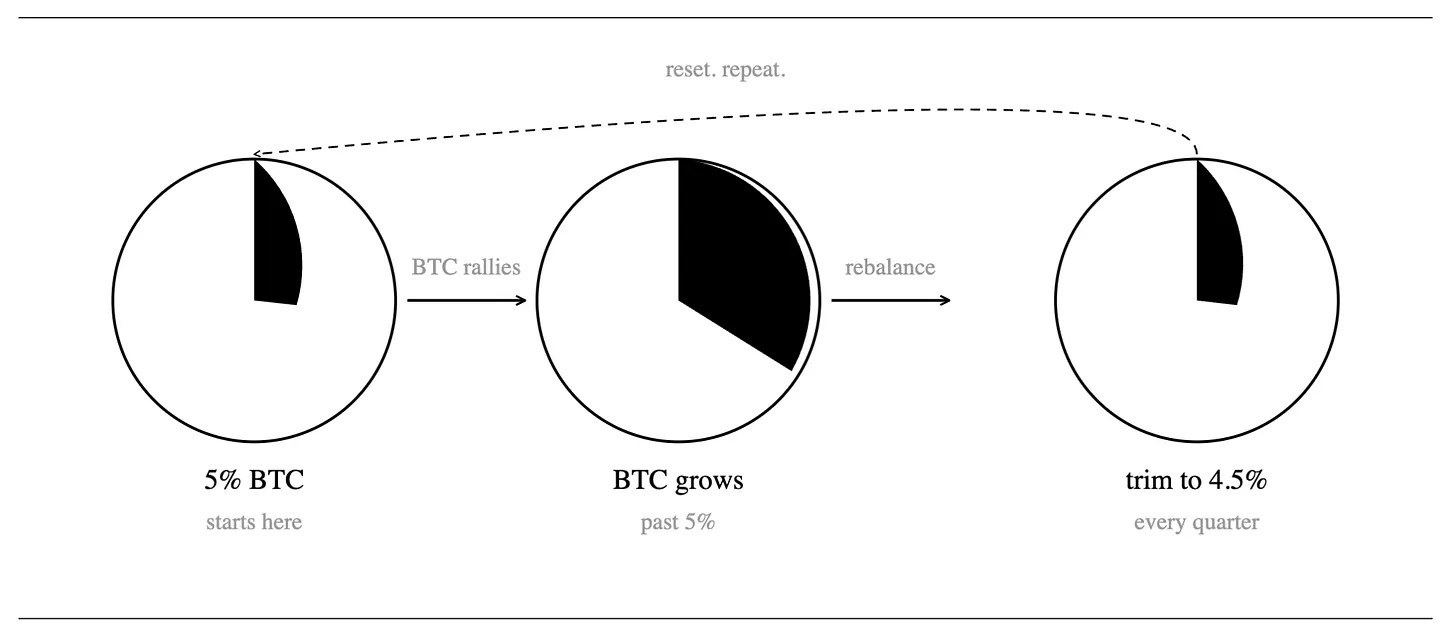
For the Bitcoin allocation, the funds plan to hold spot Bitcoin ETFs, Bitcoin futures, and options. The products have built-in quarterly rebalancing with asymmetric rules: if Bitcoin rises significantly and its weight breaches the 5% target line, it will be reduced to 4.5% during the next quarter's rebalancing. A hard cap is also set, limiting Bitcoin holdings to a maximum of 20% of the fund's total assets.


The initial allocation is 95% stocks and 5% Bitcoin. All dividends distributed quarterly will be used to increase the Bitcoin position. If the Bitcoin price rises and its allocation expands, during the quarterly rebalancing, some Bitcoin will be sold to bring the allocation back down to 4.5%. The proceeds from this reduction will flow back into stock assets.
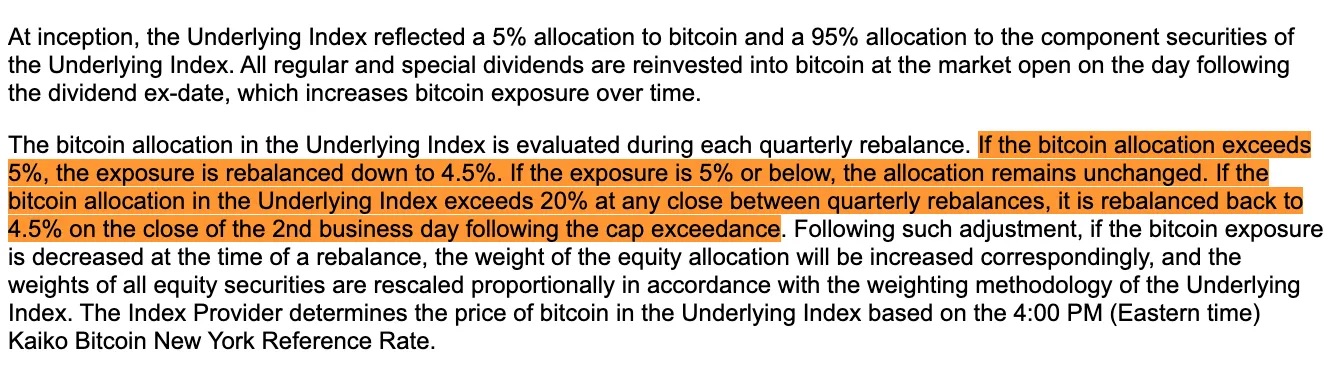


Even if Bitcoin prices surge wildly between two rebalancing periods, its share in the fund will never break through the 20% red line.


To bypass numerous regulatory processes, the Bitcoin held by the funds will be uniformly held by Franklin's wholly-owned subsidiary in the Cayman Islands. This subsidiary will handle the allocation using spot crypto, futures, and options.


Both funds track proprietary indices customized by VettaFi. Franklin plans to officially launch them on September 1st; the fee section in the filing is blank, and the management fee has not been announced yet.


Setting Aside Rosy Expectations, Facing Reality


While it seems to connect to the Wall Street system, creating new stable Bitcoin buyers with promising prospects, calculating the real numbers reveals that the so-called incremental buying is merely a trickle.


The annualized dividend yield of broad US equity indices is 1.05%, while the innovation sector index yields only 0.52%. Both funds have an initial allocation of 95% stocks and 5% Bitcoin, and only dividends generated by the stock portion are used to buy Bitcoin. Converted, the broad-based fund can only allocate about 1% of its total assets annually to buy Bitcoin, and the innovation fund only 0.5%.
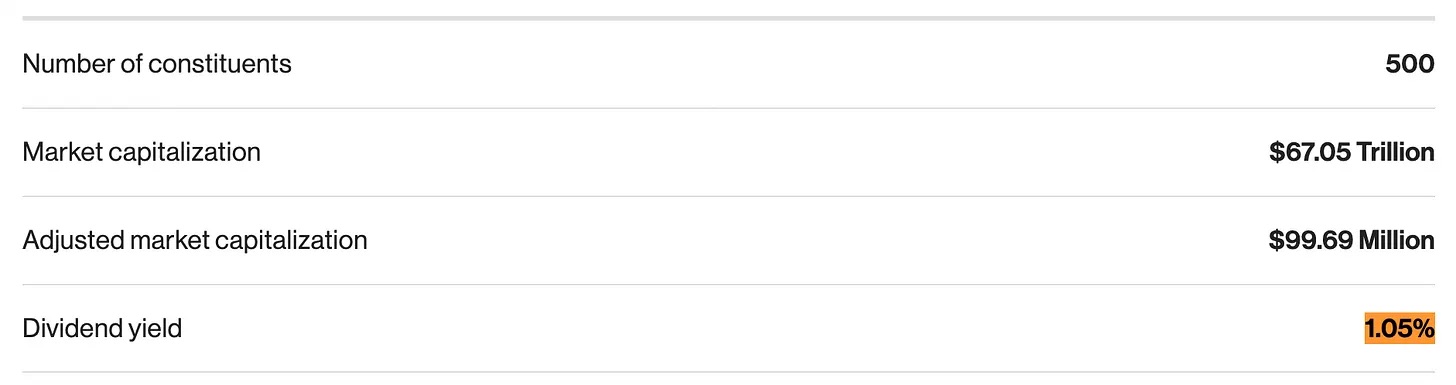


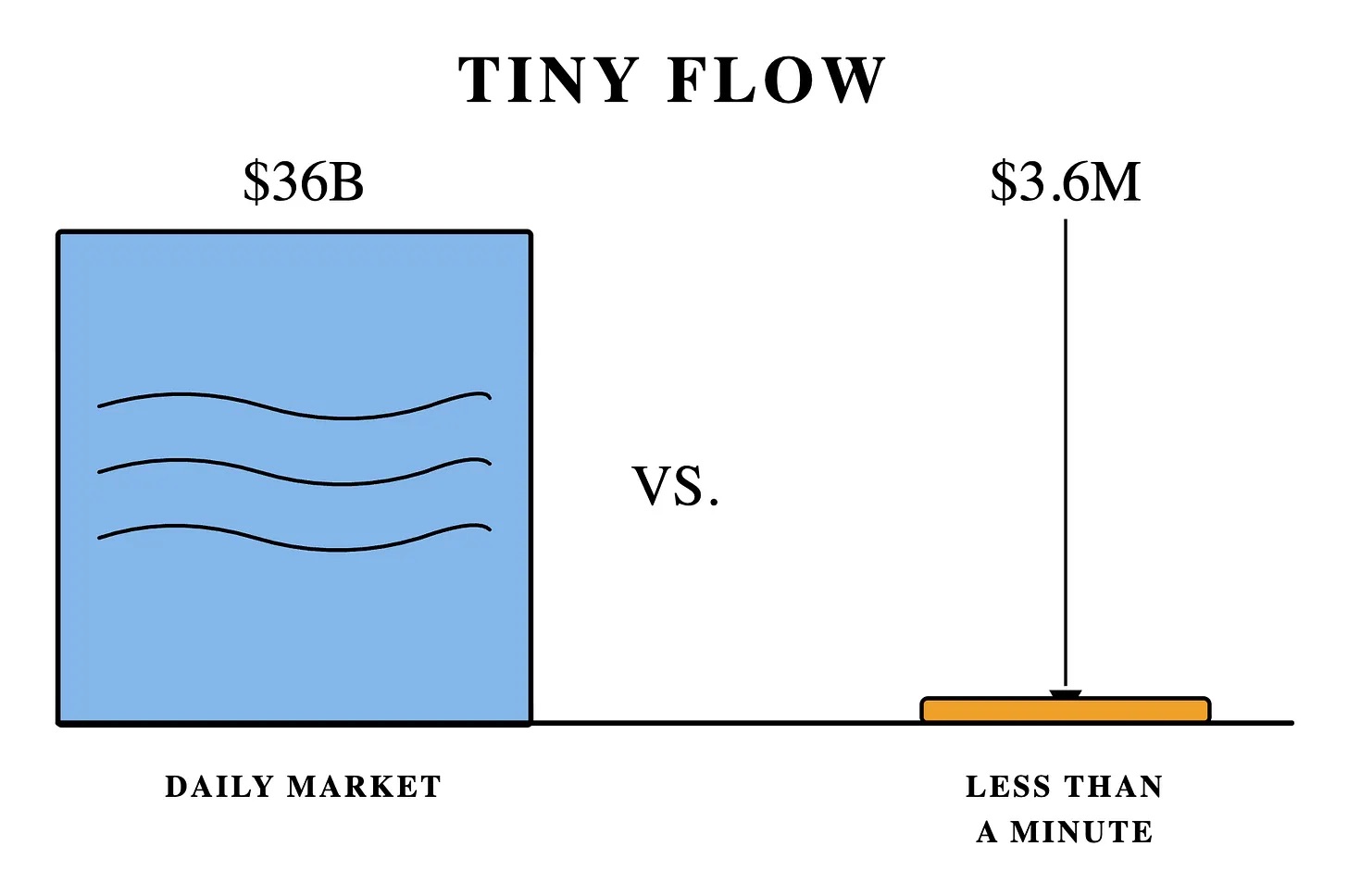
Based on Franklin's existing Bitcoin ETF (size $359 million), the corresponding annual new Bitcoin buying power is only $3.6 million. Bitcoin's daily trading volume is about $36 billion. The fund's entire year of buying volume can be absorbed by the market in less than a minute.


The design of the innovation sector fund hides deeper flaws: it is heavily weighted in stocks like Nvidia, Apple, and Microsoft, which pay very low or no dividends. Since the fund buys Bitcoin solely using stock dividends, it lacks a steady cash flow for continuous additions. Coupled with the reverse mechanism of quarterly rebalancing, once Bitcoin's allocation exceeds 5%, it must be reduced to 4.5%. The higher Bitcoin rises, the harder the fund sells. In a bull market, the selling pressure from continuous disposals could easily offset the tiny buying increment from meager dividends. From its foundational design, this product is destined to struggle with holding an appreciating asset long-term.


On days when Bitcoin performs well, this fund will instead become a passive seller.


Why? Index funds are forced into passive trades by the market. Traders familiar with the fixed trading times and targets of an index can position ahead to profit from arbitrage. Franklin's two funds恰恰 create the opposite scenario: they are programmed, passive, continuous selling tools. The funds buy Bitcoin the day after dividends are received and sell uniformly during quarterly rebalancing. Short-term traders can accurately predict these operation nodes and harvest the fund from both the buying and selling sides.


The selling pressure from a single fund of similar size is minuscule, like a mosquito bite. But once similar products form a complete category, the cumulative selling pressure will become significant. If a large amount of similar capital floods the market, every Bitcoin price rise would face continuous selling, creating a difficult-to-break price ceiling.


Beyond this core default allocation playbook, the filing subtly incorporates three other clever designs:


  1. Compliance Evasion Tactics. Internal regulations at many financial institutions prohibit allocating to cryptocurrencies. However, this fund is externally labeled merely as a 'US Large-Cap Equity Product,' allowing advisors to allocate it compliantly for clients, indirectly achieving Bitcoin exposure.
  2. Offshore Structure Compliance Solution. Bitcoin is uniformly held by a wholly-owned subsidiary in the Cayman Islands. This is a common compliance method for public funds holding commodity-like assets. It doesn't disrupt the fund's existing tax qualifications, is legal, and is widely used in the industry.
  3. Tax Legacy Issue. Dividends are automatically converted to Bitcoin before they ever reach you, but this dividend income is still taxable. The funds are locked within the crypto asset, forcing you to use additional personal cash to pay taxes on dividend income that never hit your account.


For this model to truly take shape, such funds must become the default allocation for pensions or be positioned right next to the default asset pool. With the passage of the Pension Protection Act of 2006, employers received legal support to automatically enroll employees, defaulting them into corresponding funds.


Back then, only 5% of 401(k) plans offered target-date funds. Today, the coverage rate is 96%, and the industry's total size has exploded from $100 billion to $4 trillion.


In August 2025, Trump signed an executive order officially lifting restrictions, allowing 401(k) plans to allocate to cryptocurrencies. In March 2026, the US Department of Labor issued a new rule draft stating that if a plan fiduciary includes alternative assets like cryptocurrencies in the pension options menu, they can enjoy liability protection.


The public comment period for the draft ended on June 1st. For formal regulations to be enacted by the end of this year, the relevant processes must be completed before then. Compared to adding optional crypto products for investors, directly setting crypto assets as the pension default allocation faces higher implementation hurdles. Therefore, regardless of the final rule text, corporate legal departments generally judge that most employers will choose to wait and see, acting only after court precedents confirm the safe harbor liability clauses.


The core of this system is never about convincing anyone to actively buy Bitcoin. Human attention is the scarcest resource in the world. Any model that eliminates the need for thought and runs automatically on inertia will ultimately prevail.


The entire system just needs to leverage people's laziness.

Trending Cryptos

Related Questions

QWhat is the core mechanism behind Franklin Templeton's proposed Bitcoin Dividend Reinvestment ETFs, and how does it aim to capture capital?

AThe core mechanism is leveraging the 'default option' bias and investor inertia. The ETFs will initially hold 95% stocks and 5% Bitcoin. Dividends generated from the stock portion are automatically used to buy more Bitcoin instead of being reinvested in the underlying stocks. This process happens passively without the end-investor needing to take action, thereby capturing capital from advisors and retirement plans that use these funds as a default or standard allocation, rather than from proactive retail investors.

QAccording to the article, why might the Franklin Templeton Innovation Sector ETF be fundamentally flawed in its design for holding Bitcoin?

AIt is flawed because its holdings, like Nvidia, Apple, and Microsoft, pay very low or no dividends. Since the fund relies solely on stock dividends to purchase Bitcoin, it generates minimal ongoing buying power. More critically, its quarterly rebalancing rule forces it to sell Bitcoin if its allocation rises above 5% (down to 4.5%). Therefore, in a bull market where Bitcoin's price increases, the fund becomes a programmed, passive seller, potentially offsetting the tiny buy pressure from dividends.

QWhat is the potential 'sell-side ceiling' effect described in the article regarding these Bitcoin-linked funds?

AThe 'sell-side ceiling' effect refers to the scenario where if many similar funds flood the market, their built-in rebalancing mechanisms would trigger automatic Bitcoin sales whenever its price rises sufficiently to exceed the target allocation (e.g., 5%). This creates persistent, predictable sell pressure during upward price movements, potentially forming a price ceiling that is difficult for Bitcoin to break through on a sustained basis.

QWhat are two key compliance or structural advantages mentioned for Franklin Templeton's ETF design?

A1. **Compliance Bypass**: The fund can be marketed as a standard U.S. equity product, allowing financial advisors to allocate to it for clients even if their firm's internal policies prohibit direct cryptocurrency investments. 2. **Offshore Structure for Compliance**: The Bitcoin exposure is held through a wholly-owned subsidiary in the Cayman Islands. This is a common and legal structure for public funds to hold commodity-like assets, preserving the fund's tax status and regulatory standing.

QWhat recent regulatory developments does the article cite as potentially paving the way for crypto in retirement accounts?

AThe article cites: 1) An August 2025 executive order signed by former President Trump allowing 401(k) plans to include cryptocurrencies. 2) A March 2026 proposed rule from the U.S. Department of Labor that would grant fiduciary liability protection to plan sponsors who include alternative assets like crypto in their investment menus. The public comment period for this draft rule ended June 1, 2026, with formal rules potentially finalized by year-end.

Related Reads

Domestic First Explosion-Proof Certification, World's First Fueling Brain Solution: How Did They Secure Two 'Firsts'?

China's embodied AI sector is booming, with over ¥37 billion in funding this year. The focus has shifted decisively to real-world application, particularly in hazardous, repetitive tasks humans should avoid. A key, often prohibitive, barrier to entry for robots in environments like gas stations and oil fields is obtaining explosion-proof certification, requiring meticulous hardware and circuit design from the ground up. The article explores three main application areas. At gas stations, the challenge lies in executing a long, precise sequence of actions (opening caps, handling the fuel nozzle) with millimeter accuracy across diverse car models. For facility inspections, robots need sustained autonomous patrols combined with real-time anomaly detection and response. Port scenarios introduce the complexity of multi-robot coordination. Addressing the core challenge of long-horizon tasks, the piece highlights a technical breakthrough: a "world model"-driven approach. This enables predictive planning, allowing the AI to visualize the desired end-state (e.g., nozzle returned, cap closed) and work backward to synthesize intermediate visual frames. This "imagination" of the task trajectory, as implemented in the H-GAR architecture, guides action generation, significantly reducing cumulative error in multi-step operations. The three-step H-GAR process involves generating a coarse action draft, synthesizing target-conditioned observation frames, and then refining actions based on visual context and a memory of past successful motions. The conclusion emphasizes that success in specialized, safety-critical fields requires long-term commitment and deep integration of the "embodied brain" (AI) with a purpose-built, certified physical "body." Mastering this brain-body-data闭环 (closed-loop) is positioned as a crucial competitive advantage for commercialization.

marsbit24m ago

Domestic First Explosion-Proof Certification, World's First Fueling Brain Solution: How Did They Secure Two 'Firsts'?

marsbit24m ago

Bitcoin Bear Market Triggers Crypto Layoffs, Yet Fuels Industry's Most Aggressive M&A Wave Ever

A prolonged Bitcoin downturn is forcing crypto companies to lay off employees and automate operations, but has simultaneously triggered the industry's most aggressive wave of mergers and acquisitions (M&A). In the first half of 2026, crypto M&A deal value reached $93.7 billion, 26 times higher than the same period last year. This activity is primarily driven by traditional financial institutions—banks, payment processors, and asset managers—who are acquiring compliant crypto infrastructure like custody solutions, payment rails, and regulatory licenses instead of building them internally. Examples include Mastercard's acquisition of stablecoin firm BVNK and Franklin Templeton's launch of a dedicated crypto division via acquisition. This consolidation contrasts sharply with a shrinking crypto labor market, where active job openings have plummeted. Companies like Coinbase are restructuring to become "AI-native," leading to a sharp increase in roles requiring AI skills, while engineering and compliance positions now dominate hiring. Financially pressured crypto firms, such as Messari which was acquired at a fraction of its prior valuation, are becoming prime targets. Capital remains available but is highly selective, flowing overwhelmingly into businesses that bridge digital assets with traditional finance, such as tokenization platforms and regulated trading venues. The trend indicates a market where capital is rewarding compliant, utility-focused infrastructure while weaker models consolidate or downsize.

marsbit24m ago

Bitcoin Bear Market Triggers Crypto Layoffs, Yet Fuels Industry's Most Aggressive M&A Wave Ever

marsbit24m ago

Trillion-Dollar Pension Fund Entry? Franklin Bitcoin Dividend Reinvestment ETF Comes with a Built-in Selling Pressure Ceiling

Franklin Templeton has filed to launch two ETFs that embed a "default configuration" logic into Bitcoin investment, aiming to tap into massive pension fund flows. These "Bitcoin Dividend Reinvestment Index ETFs" will initially hold 95% equities and 5% Bitcoin, automatically reinvesting stock dividends to buy Bitcoin. However, a quarterly rebalancing rule forces selling of Bitcoin if its allocation exceeds 5%, capping its maximum holding at 20%. While the product cleverly circumvents advisor reluctance and compliance hurdles by labeling itself as a U.S. equity product, its actual Bitcoin buying power is minimal. Given low dividend yields (e.g., ~1% for broad market indices), annual Bitcoin purchases from a fund the size of Franklin's existing Bitcoin ETF would be a mere $3.6 million—negligible against Bitcoin's daily trading volume. Crucially, during bull markets, the fund becomes a programmed, passive *seller* of Bitcoin, potentially creating sustained sell pressure if many similar funds emerge. The strategy leverages investor inertia and automatic enrollment, similar to the success of target-date funds in 401(k) plans. It also uses an offshore Cayman subsidiary for holding Bitcoin and raises a tax complication where investors must pay taxes on dividends they never receive as cash. Although recent U.S. regulatory changes allow crypto in retirement plans, widespread adoption as a default option faces legal hurdles. The core premise remains: the system doesn't need to convince anyone to buy Bitcoin actively; it simply relies on people doing nothing.

marsbit56m ago

Trillion-Dollar Pension Fund Entry? Franklin Bitcoin Dividend Reinvestment ETF Comes with a Built-in Selling Pressure Ceiling

marsbit56m ago

Trading

Spot
Futures

Hot Articles

Discussions

Welcome to the HTX Community. Here, you can stay informed about the latest platform developments and gain access to professional market insights. Users' opinions on the price of S (S) are presented below.

活动图片