Why Do Crypto Projects Keep Changing Their Names?

marsbitОпубліковано о 2026-06-26Востаннє оновлено о 2026-06-26

Анотація

**Why Do Crypto Projects Keep Changing Names?** In the crypto world, changing a project's name is common—over 16% of projects have done so, including major ones like Polygon (formerly Matic Network). This contrasts sharply with traditional businesses, which fiercely protect brand equity. The core reason is that in crypto, brand loyalty is often weak. Users are frequently investors, airdrop hunters, or yield seekers, not traditional consumers. A name associated with price crashes, hacks, or failed narratives becomes a liability, not an asset. Renaming can be a strategic reset to shed this baggage. Name changes serve as a potent marketing tool. They can signal a genuine pivot in strategy or scope (e.g., EthSign dropping "Eth" as it expanded). However, they are often used to "narrative surf," rebranding to align with hot trends like AI, RWA, or the metaverse (e.g., Elrond → MultiversX). Critically, renaming is also a PR tactic to distance a project from past failures like security breaches (e.g., Anyswap → Multichain). The most significant risk emerges when a name change is coupled with a token migration or swap. This process can allow projects to reset exchange price charts, erase visible historical downtrends, and create an illusion of a fresh start. It often facilitates liquidity resets, where low float can be exploited for pumps. More alarmingly, migrations sometimes mask overhauls to tokenomics, introducing substantial new token supply through "ecosystem funds" or "node...

Author: Gu Yu, ChainCatcher

In the traditional business world, brand equity is a company's lifeline. Frequent name changes are almost equivalent to actively destroying its moat.

NVIDIA wouldn't change its name every few years, Apple wouldn't abandon 'Apple' because of a business pivot, and Nike wouldn't scrap its brand and start over just because of a market downturn.

But in the cryptocurrency world, the rules are often reversed. According to RootData statistics, over 16% of crypto projects have changed their names, with many well-known first-tier projects exhibiting frequent name changes.

Just yesterday, the on-chain IP ecosystem Story Protocol announced a name change to DATA, with IP tokens migrating 1:1 to the new DATA tokens. In the preceding months, Xion rebranded as Verona, Matrixport changed its name to BIT, and the TON token symbol was changed to GRAM. Even earlier, a slew of prominent projects like Klaytn, EOS, Fantom, MakerDAO, Elrond, and Matic Network have undergone name changes.
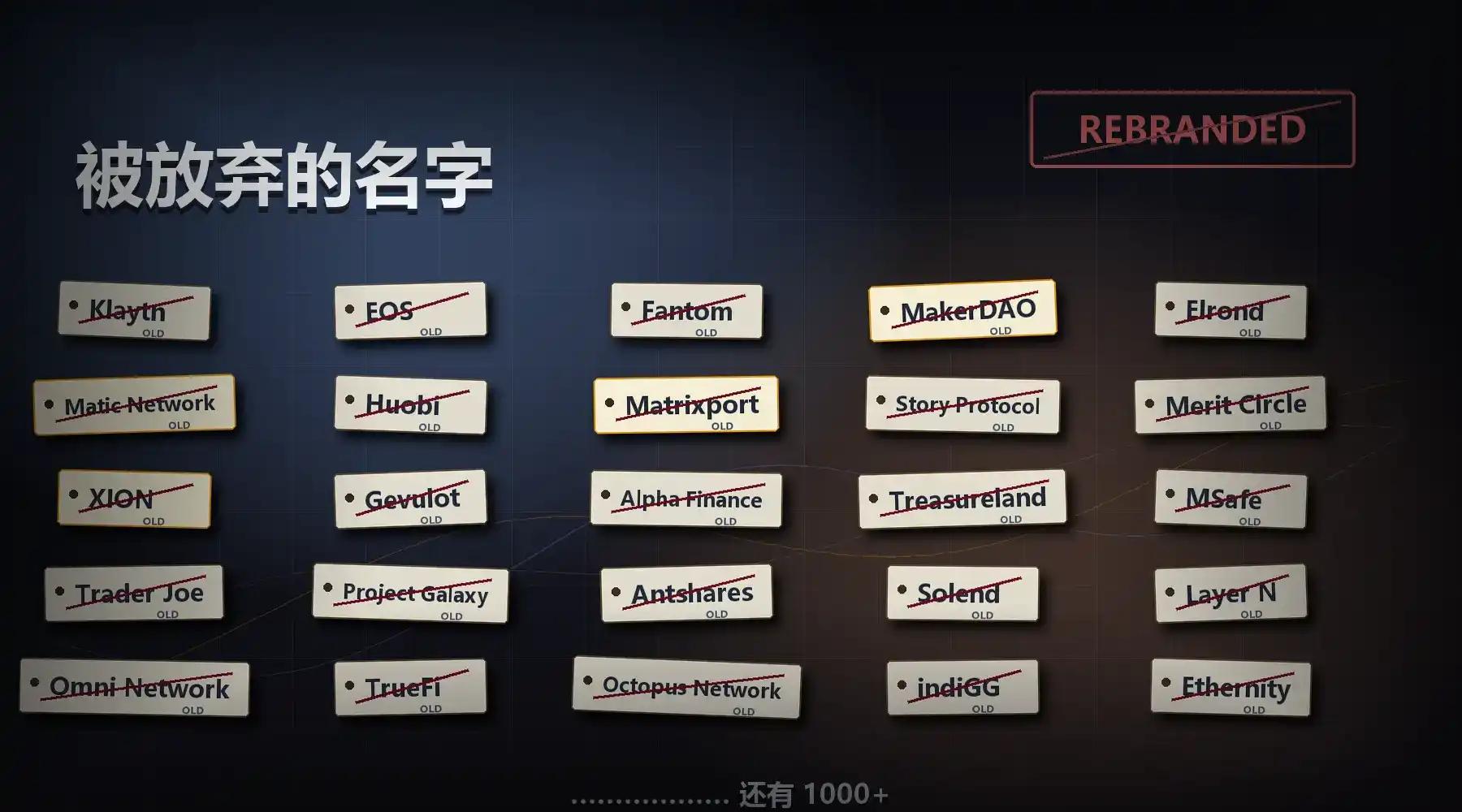
Some projects, more extreme, have changed names multiple times. For instance, MAITRIX's former names include CENTRAL, X Network, and XLD Finance; BitSafe was previously known as dlcBTC and DLC.Link; TaleX had former names Read2N and Metale Protocol; KGeN was once called indiGG and Kratos Gaming Network. The names keep changing, but most projects haven't gained new life from new names, often fading into obscurity instead.

This raises a question seldom seriously discussed in the crypto industry: Why do crypto projects keep changing their names?

The answer might not be complex: because in the crypto industry, the brand is not the most important asset; attention, narrative, token price, and liquidity are.

I. Crypto Brand Loyalty Is Too Low

Traditional brands fear name changes because user loyalty stems from long-term consumption experiences. A user who has bought iPhones for years, drunk Starbucks for years, or worn Nike for years—their brand perception isn't formed overnight and won't easily change due to a single marketing campaign.

But the user structure of crypto projects is entirely different.

Most early users aren't traditional consumers but investors, airdrop hunters, liquidity providers, node participants, and narrative traders. They use a product not necessarily because it's good, but because there might be an airdrop, potential returns, or upside.

This implies that crypto brand user loyalty is inherently weak.

In traditional industries, users ask, "Is this brand trustworthy?" In crypto, users more often ask, "Can this coin still go up?" As long as prices are stagnant long-term, narratives fail, or ecosystems die down, an old name becomes a liability.

A name associated with a crash, being trapped in losses, hacks, team controversies, or roadmap failures struggles to inspire market imagination. It carries not brand equity, but the scars of price charts and community resentment.

This is the fundamental reason crypto projects dare to change names frequently: often, the old name has no moat, only historical baggage.

II. Name Changes as a Marketing Strategy

Not all name changes should be simplistically viewed as "changing skins." Some projects rename because the original name cannot encompass the new strategic scope. As market buzzwords shift, if a name includes outdated concepts like "Social" or "DAO," or if the name's meaning is no longer fitting, a name change becomes inevitable.

For example, the decentralized social protocol OpenSocial rebranded as Eden after pivoting to AI, the decentralized e-signature platform EthSign dropped "Eth" from its name after business expansion, and the Ethereum sidechain Matic Network changed its name to Polygon (meaning polygon) after building multiple scaling solutions.

When a project's business boundaries fundamentally change, the original brand can limit external perception. A name change at this point is a necessary strategic adjustment.

Of course, there are also many projects proactively "riding the hype," gaining more attention by incorporating trending concepts into their names. During the last metaverse hype, Elrond rebranded as MultiversX, directly adding "Multiverse" to its name, clearly hoping to latch onto the metaverse and multi-dimensional digital world narrative.

Similarly, as AI, RWA, and Perp become industry hotspots, many projects will rename to quickly align with the new concepts. For instance, Vanilla Finance rebranded as Superp, and Function X changed its name to Pundi AI, reshaping their narratives.

After all, in the crypto industry, narrative itself is part of asset pricing. The closer a name aligns with a new narrative, the easier it is to be noticed again by exchanges, KOLs, retail investors, and market-making capital.

For many projects, the core reason for a name change is that the old brand has sunk into a trust abyss.

In crypto history, hacks, contract vulnerabilities, cross-chain bridge exploits, and team scandals can rapidly destroy a project's brand credibility. Once users associate a name with "hacked," "collapsed," "rugged," or "poor compensation," continuing with the old name means constantly carrying negative PR.

Thus, rebranding becomes the project team's most direct PR tool, euphemistically termed "brand repositioning."

Anyswap's rebrand to Multichain after a hack, and Alpha Finance's name change to Stella after a $37 million exploit, carry similar undertones. Superficially, they are adjusting product lines and strategic positioning; but from a market perception standpoint, the name change also serves, to some extent, the function of "cutting ties with the old memory."

III. The Gray Area of Name Changes and Token Swaps

If it were just a name change, the impact would be limited. What's truly worth being vigilant about is that many crypto project name changes often come with token swaps.

A token swap means old tokens need to migrate to new ones. Exchanges issue announcements, deposits/withdrawals are suspended, old trading pairs are delisted, and new ones are listed. For project teams, this is a rare opportunity for a "second listing."

Many projects also conduct token splits. For instance, 1:100 or 1:1000 splits, breaking higher-priced tokens into a larger quantity to make the unit price appear cheaper. Projects like SKY and BEAM have employed similar tactics. A stock split itself doesn't change company value, but a lower unit price often attracts more retail attention.

More crucially, after a name change and token swap, exchange historical price charts are often reset to zero.

For many old tokens, the historical burden is immense. Years of trapped positions, downtrends, negative news, and resistance levels are all embedded in the old price charts. After the new token launches, it superficially possesses a brand-new chart—no historical highs as resistance, no long-term bearish shadow, and no immediate memory of trapped positions.

This is extremely advantageous for project teams and market makers. When old tokens migrate to new ones, many exchanges suspend deposits/withdrawals. At this point, the actual circulating supply on secondary markets can become very light. On the few platforms where trading remains open, market-making capital might only need relatively little money to pump the new token price, creating the market illusion of a "post-upgrade surge."

Subsequently, the project team, early participants, or market makers might use the restored liquidity and user FOMO to complete distribution.

This is the most dangerous aspect of name changes with token swaps: it superficially appears as a brand upgrade but is, in essence, potentially a liquidity reset.

Going further, many projects redesign tokenomics during the swap process. Ordinary users see a 1:1 migration and think their rights aren't harmed. But the project team might simultaneously add new validator rewards, ecosystem funds, team incentives, node subsidies, and strategic reserves, thereby creating a large number of new tokens out of thin air.

FRONT's rebrand to Self Chain and TVK's change to Vanar Chain are classic cases. Both drastically increased token supply under the pretexts of node rewards and ecosystem building, diluting the value for existing token holders.

IV. The Real Problem Isn't Renaming, But Evading History

Crypto projects can certainly change their names; that in itself isn't a grave issue.

Changes in technical roadmap, expansion of product boundaries, shifts in market trends, or cutting legal risks can all bring about reasonable brand repositioning. Cases like Matic's rebrand to Polygon show that a good name can indeed help a project embrace a larger strategic vision.

But in more instances, crypto project name changes aren't about building brand equity; they're about escaping from it.

Escaping old price charts, escaping trapped positions, escaping hacks, escaping failed narratives, escaping user skepticism, escaping stories that have run their course.

This is precisely the biggest difference between the crypto industry and the traditional business world: traditional companies fear losing brand memory, while many crypto projects fear users remembering too much.

Therefore, when a project announces a name change, the market shouldn't only ask what the new name is, but should probe three questions:

What real new capabilities or strategies has it actually added? Has its tokenomics changed? What old history is it most trying to make users forget?

If behind the name change lies real products, real revenue, real users, and a clearer strategy, then it might be the start of a new chapter. But if the name change is merely accompanied by a token swap, trend-chasing, token inflation, and chart resetting, then it's likely just a repackaged old game.


Пов'язані питання

QWhat is the main reason why cryptocurrency projects frequently change their names according to the article?

AAccording to the article, the main reason is that in the cryptocurrency industry, brand loyalty is not the most important asset. Instead, attention, narratives, token prices, and liquidity are paramount. Unlike traditional businesses, a project's old name can become a liability associated with past failures, price drops, or security breaches, and renaming can be a strategy to shed this negative historical baggage and renew market interest.

QHow does the user base in the crypto industry differ from traditional industries in terms of brand loyalty?

AIn traditional industries, user loyalty is built on long-term consumption experiences and product reliability. In contrast, the article states that many early users of crypto projects are not traditional consumers but investors, airdrop hunters, liquidity providers, and narrative traders. Their engagement is often driven by potential profits (like airdrops or price appreciation) rather than product quality or brand trust. Therefore, crypto brand loyalty is inherently weaker, making users more likely to abandon a project if its narrative fades or its token price stagnates.

QBeyond strategic rebranding, what other motivations for name changes are highlighted in the article?

ABeyond genuine strategic rebranding (e.g., reflecting an expanded business scope), the article highlights other motivations: 1) "Narrative-chasing" by incorporating trendy keywords like AI, RWA, or Metaverse into the new name to attract attention. 2) PR crisis management to distance a project from negative events like hacks, scandals, or failed promises. 3) A potentially exploitative tactic involving a token migration or swap, which can reset price charts (clearing negative historical K-lines), facilitate token splits to attract retail investors, and sometimes hide changes to tokenomics that dilute holder value.

QWhat is the most dangerous aspect associated with a name change that also involves a token swap/migration?

AThe most dangerous aspect, as described in the article, is that it can serve as a "liquidity reset." During the swap, trading is often halted, and the old token's trading history (K-line) is erased for the new token. This removes visible historical price resistance and negative trends. With a temporarily reduced circulating supply post-migration, market makers can more easily pump the new token's price, creating an illusion of a successful "upgrade" and potentially allowing insiders to sell at inflated prices before liquidity fully returns.

QWhat three questions should the market ask when a cryptocurrency project announces a name change, according to the article's conclusion?

AThe article concludes that the market should ask: 1) What real new capabilities or strategies has the project actually added? 2) Has the token economics changed? 3) What old history is it most trying to make users forget? If the name change is backed by genuine product improvements, revenue, users, and a clearer strategy, it can be positive. However, if it's primarily accompanied by a token swap, narrative-chasing, token dilution, and a K-line reset, it's likely just a repackaging of old problems.

Пов'язані матеріали

Yangtze Memory Earns Nearly 4 Billion Per Day, Can It Replicate ChangXin's 4 Trillion Yuan Myth?

Yangtze Memory Technologies (YMTC), a leading Chinese NAND flash memory chipmaker, has filed for an IPO after completing listing guidance. Its prospectus reveals a staggering Q1 2026 net profit of 33.38 billion yuan, averaging nearly 4 billion yuan daily, surpassing competitor ChangXin Memory Technologies (CXMT) during the same period. This follows CXMT's recent blockbuster科创板 debut, which saw its market cap briefly exceed 4 trillion yuan. YMTC's journey has been fraught with challenges, including the bankruptcy of its former major shareholder, Tsinghua Unigroup, and subsequent takeover by Hubei state-owned capital, followed by U.S. sanctions restricting equipment and technology access. Despite these hurdles, YMTC has grown its global NAND bit shipment share to 14% in Q2 2026, ranking third worldwide. However, the article highlights key differences from CXMT's "4 trillion yuan myth." While profitable, YMTC's earnings surge is closely tied to a cyclical boom, with Q1 2026 NAND prices ~173% higher than 2025's average. Furthermore, YMTC operates in the more crowded NAND market, whereas CXMT, as China's sole major DRAM producer, benefits more directly from AI server demand and holds a scarcer strategic position. YMTC's future valuation, the article argues, will depend less on replicating CXMT's hype and more on its success in transitioning to higher-margin enterprise SSD products, securing global client certifications (like Apple, amid U.S. pressure), and maintaining profitability after the current memory price cycle peaks, which analysts warn could happen as early as 2027-2028. The IPO aims to raise funds to accelerate this transformation amidst a tightening competitive window.

marsbit3 хв тому

Yangtze Memory Earns Nearly 4 Billion Per Day, Can It Replicate ChangXin's 4 Trillion Yuan Myth?

marsbit3 хв тому

From "Building the Body" to "Building the Brain": The Key Shift in Capital Investment for Embodied Intelligence

From Building Bodies to Building Brains: The Key Shift in Capital Investment for Embodied Intelligence As of August 2026, the embodied AI sector has shifted from a conceptual stage to a heavily invested domain, underscored by Unitree Robotics' successful IPO at a $480 billion market cap. Data from IT桔子 reveals explosive growth: 425 Chinese startups in the field, with 75% founded within the last three years, and total investment in the first eight months of 2026 hitting ¥124.5 billion, 11.6 times the 2023 annual amount. Over 850 institutions are now invested. A critical trend is the capital pivot from "building bodies" (humanoid robots) to "building brains" (embodied AI systems). While humanoid robots attracted the most cumulative funding (¥84 billion), the number of funding deals for AI brain systems surpassed them in 2026 (38.8% vs. 21.1%). This mirrors the smartphone industry, where the OS and chip, not just the hardware, define success. Investment in core components like dexterous hands also surged, signaling a maturing supply chain. The entrepreneurial landscape is concentrated, with Beijing, Guangdong, and Shanghai hosting 67% of companies. It is also academically driven, with nearly a quarter of founders from Tsinghua University, whose startups raised a median amount ten times higher than others. Industry giants like Baidu, Alibaba, and Tencent are heavily involved through strategic investments. Despite the capital frenzy, Unitree's founder cautions that the industry's "ChatGPT moment"—where a robot can handle 80% of tasks in an unfamiliar environment—is still 2-10 years away. The consensus is that capital is betting ahead of the true commercial inflection point. The window for new entrants, especially outside core tech hubs, is narrowing as the race evolves from lab demos to full-scale industrialization.

marsbit3 хв тому

From "Building the Body" to "Building the Brain": The Key Shift in Capital Investment for Embodied Intelligence

marsbit3 хв тому

U.S. 'Operation Economic Outcast' Targets Iran's Crypto Sector, Over $100 Million in Oil-Related Payments Allegedly Facilitated via Cryptocurrency

U.S. Treasury Launches "Operation Economic Outcast," Sanctions Iran's Crypto Sector On August 24, the U.S. Treasury Department initiated "Operation Economic Outcast," a government-wide economic campaign against Iran. As part of this, the Office of Foreign Assets Control (OFAC) issued a sectoral sanctions determination targeting digital assets under Executive Order 13902, significantly expanding its authority. The Treasury stated that Iran is increasingly using cryptocurrency as a "tool of choice" to evade sanctions and support transactions linked to the Islamic Revolutionary Guard Corps (IRGC). Concurrently, OFAC sanctioned Ukrainian-Emirati broker Ivan Obukhov and his company, Foscom FZE. The Treasury alleges that since 2023, Obukhov has processed over $100 million in cryptocurrency payments to facilitate oil sales on behalf of the IRGC-Quds Force. Nearly 60 other entities, individuals, and vessels involved in nuclear procurement, cyber operations, and oil revenue networks were also sanctioned. This move marks an escalation from prior actions against specific exchanges, now establishing a broad basis to sanction any foreign entity deemed to operate in or support Iran's digital asset sector. Treasury Secretary Scott Bessent warned that any entity engaging economically with the Iranian regime will face the full reach of U.S. power, calling the operation an "economic D-Day" aimed at isolating Tehran.

marsbit28 хв тому

U.S. 'Operation Economic Outcast' Targets Iran's Crypto Sector, Over $100 Million in Oil-Related Payments Allegedly Facilitated via Cryptocurrency

marsbit28 хв тому

Торгівля

Спот
活动图片