BlackRock Converts $5 Billion Worth of Bitcoin into ETF

cryptonews.ruPublished on 2026-08-26Last updated on 2026-08-26

Abstract

Wall Street is streamlining the shift from self-custody to ETFs for crypto investors, allowing direct conversion of digital assets into fund shares without an initial sale. Major issuers are increasingly adopting this in-kind creation model. BlackRock has notably expanded access, lowering the minimum conversion threshold for its iShares Bitcoin Trust (IBIT) from $25 million to $1 million and processing over $5 billion in such conversions so far. Other firms like Bitwise have similarly reduced their minimums, with demand growing steadily. The appeal extends beyond convenience, offering potential tax advantages and reducing reliance on private keys. The trend now includes Ethereum and Solana, with a significant portion of new ETF shares being created via in-kind transactions. While infrastructure challenges remain, the process is becoming more standardized, moving from a bespoke service for large players toward a mainstream component of institutional crypto investing.

Wall Street is making it easier for crypto investors to transition from self-custody to exchange-traded funds without having to sell their digital assets first.

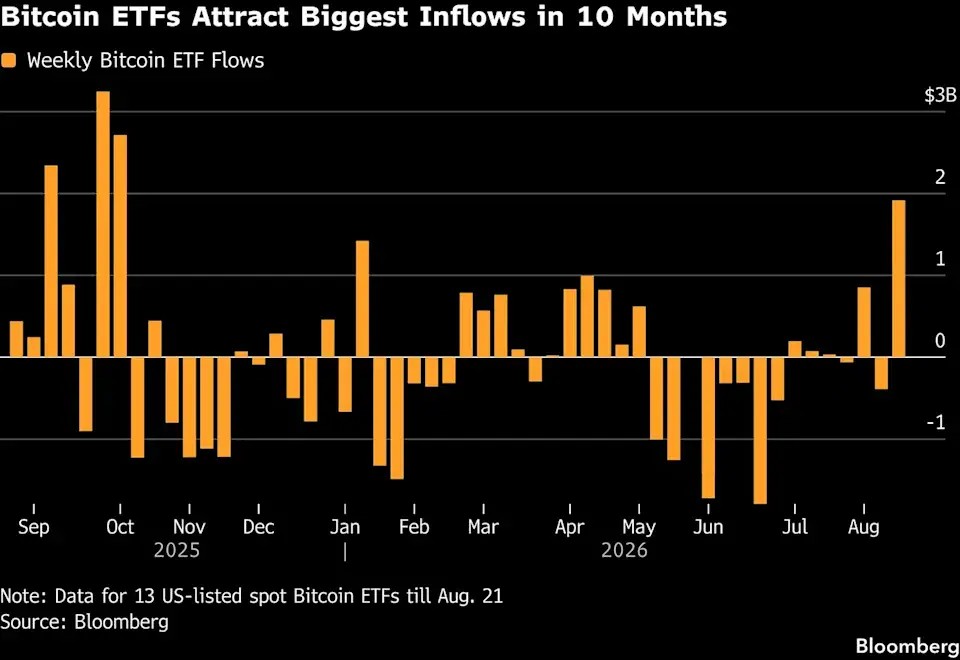
According to Bloomberg, in-kind creation is becoming increasingly common among major issuers, allowing investors to deposit Bitcoin directly into a spot ETF and receive shares in exchange. This mechanism maintains market exposure while transferring asset custody to the traditional financial system.

The most significant change is about access. In July, when this service first became available, BlackRock lowered the minimum threshold for converting Bitcoin into its ETF from $25 million to $1 million. According to Robbie Mitchnick, head of digital assets at BlackRock, his iShares Bitcoin Trust (IBIT) has already processed over $5 billion in such conversions.

"That volume is going to continue to increase as we continue to expand access," Mitchnick told Bloomberg.
Source: Bloomberg

Minimums Drop as the Process Becomes More Routine

Bitwise has followed a similar path.

For its first in-kind Bitcoin conversion, a deal of at least $100 million was required to secure support from authorized participants. That threshold later dropped to $50 million and now stands at $3 million.

Bitwise Chief Investment Officer Matt Hougan noted that while the entire process is still handled individually, it is becoming increasingly standardized.

Other issuers report sustained demand growth. At 21Shares, the average size of completed in-kind Bitcoin deals over the last three months has been around $5 million. Morgan Stanley reported that such conversions account for roughly 5% to 7% of assets in its spot Bitcoin ETF, which has about $560 million in assets under management.

The appeal of these transactions goes beyond mere convenience. Investors can reduce reliance on private keys and wallets, and depending on individual tax situations, exchanging Bitcoin instead of selling it for cash may allow them to avoid immediate taxation.

Ether and Solana Join the In-Kind Conversion Trend

This model is also expanding beyond Bitcoin. Grayscale uses in-kind transactions for its Ether-based products, and Bitwise supports conversions for both Ether and Solana.

At Grayscale, this shift has accelerated sharply. In March, 28% of gross Bitcoin creation and 57% of gross Ether creation were done in-kind. By June, those figures had risen to 62% and 63%, respectively.

The remaining obstacle is infrastructure. Transactions still require authorized participants or market makers willing to handle cryptocurrency, which increases cost and complexity.

Nevertheless, the direction is clear. As minimums drop and more intermediaries enter the market, the direct exchange of Bitcoin, Ether, and Solana for ETF shares is evolving from a private banking-style service for 'whales' into a more standardized component of institutional cryptocurrency investing.

Related Questions

QWhat is the main benefit of the in-kind conversion service for Bitcoin into spot ETFs, as described in the article?

AThe main benefit is that it allows crypto investors to transition from self-custody to exchange-traded funds (ETFs) without having to sell their digital assets first. This preserves their market exposure while moving the asset custody to the traditional financial system.

QAccording to the article, how much in Bitcoin-to-ETF conversions has BlackRock's iShares Bitcoin Trust (IBIT) processed?

ABlackRock's iShares Bitcoin Trust (IBIT) has processed in-kind Bitcoin-to-ETF conversions worth over $5 billion.

QWhat are two specific advantages for investors using in-kind conversions mentioned in the article?

ATwo advantages are: 1) Investors can reduce reliance on private keys and self-custody wallets. 2) Depending on an individual's tax situation, exchanging Bitcoin for ETF shares, rather than selling it for cash, may allow them to avoid immediate taxation.

QBeyond Bitcoin, which other cryptocurrencies are mentioned as being supported for in-kind conversions into ETFs?

ABeyond Bitcoin, the article mentions that Ethereum (ETH) and Solana (SOL) are also supported for in-kind conversions into ETFs by firms like Grayscale and Bitwise.

QWhat is identified as a remaining obstacle for the broader adoption of in-kind conversion transactions?

AThe remaining obstacle is infrastructure. Transactions still require authorized participants or market makers willing to handle the cryptocurrencies, which adds cost and complexity to the process.

Related Reads

A Crucial Event is Approaching, Pay Attention to Friday: This Could Be the Fed's Most Important Event This Year

Federal Reserve Chair Kevin Warsh is preparing to deliver one of his most significant speeches this week at the Jackson Hole symposium. Markets and Fed officials are focused on a fundamental question: Is persistently high U.S. inflation due to temporary shocks like tariffs and the war with Iran, or is the economy still too strong from a demand perspective? The answer could determine whether the Fed will raise interest rates in the coming period. Investors will scrutinize Warsh's Friday speech for clues about his economic assessment and the conditions under which he might tighten monetary policy. The outlook is interpreted through two scenarios. One suggests inflation has exceeded the Fed's 2% target for over a year due to temporary shocks and may recede spontaneously. The other warns these events mask deeper economic imbalances, where strong demand allows companies to keep raising prices, potentially necessitating rate hikes. While recent softer inflation data has eased pressure for a September rate hike, concerns remain that the Iran war, new tariffs, and a surge in AI investment could exert lasting upward pressure on prices. Divisions within the Fed are growing, with some officials pushing for further tightening, citing robust consumer spending and labor demand, while others believe price pressures may ease on their own. A notable feature of Warsh's tenure has been his reduced guidance to markets, arguing central bankers talk too much. However, this reluctance to share his own views may be making it harder to build consensus, as evidenced by three dissenting votes for a rate hike last month—the highest in nearly a decade. Market reactions are being closely watched. Following the July meeting, the yield on the 30-year U.S. Treasury note rose to its highest level since 2007, suggesting investors believe the Fed might tolerate slightly higher near-term inflation but could require more significant future rate increases. Therefore, the Jackson Hole speech is crucial not only for near-term rate expectations but also for understanding how Fed policy communication will be shaped under Warsh's leadership.

cryptonews.ru22m ago

A Crucial Event is Approaching, Pay Attention to Friday: This Could Be the Fed's Most Important Event This Year

cryptonews.ru22m ago

Trading

Spot
活动图片