Ford's stock price surged 20% in a single day: The traditional automaker is also pivoting to AI

marsbitОпубліковано о 2026-05-15Востаннє оновлено о 2026-05-15

Анотація

Ford's stock surged 20% after it announced the creation of a new subsidiary, Ford Energy, investing $2 billion to build a 20 GWh energy storage system plant. Morgan Stanley valued this business at $10 billion, betting its margins could far exceed Ford's traditional auto division. The valuation is tied to a projected 49 GW U.S. power shortage by 2028, driven by booming data center demand concentrated in four key corridors. However, the massive subsidies funding this AI infrastructure boom, like a $3.3 billion package for a Meta data center in Louisiana, face growing scrutiny. Public opposition to local data centers (70%) now exceeds that for nuclear plants due to their strain on grids, limited job creation, and high fiscal cost. Ford's $8 billion market cap gain hinges on the continuation of this ecosystem: sustained subsidies, unmet power demand, and manageable public backlash. If any of these constraints—physical power shortages, state budget limits, or voter opposition—tightens, a widespread repricing could follow.

On May 11th, Ford established its wholly-owned subsidiary Ford Energy, investing $2 billion to transform its Glendale factory in Kentucky, targeting an annual production capacity of 20 GWh for energy storage systems. The next day, Morgan Stanley analyst Andrew Percoco valued this standalone business unit at $10 billion. The market reaction was immediate: Ford's stock price rose from $11.99 to $14.48 over two trading days, adding approximately $8 billion to its market cap.

The story up to this point resembles the standard script of another "traditional automaker being repriced by AI." But a look at the supply-side ledger reveals another name: the state of Louisiana.

What is the market revaluing?

Morgan Stanley's $10 billion valuation for Ford Energy was not pulled out of thin air. Percoco's report assumed Ford Energy would achieve a 25% gross margin and $346 million in EBIT by 2028, then applied the price-to-sales multiples of leading energy storage companies to work backwards. Compared to the profit structure of Ford's existing business, this is an entirely different species.

Ford's 2024 financial report shows that its Ford Blue internal combustion engine division generated annual revenue of $145.4 billion with an EBIT of only $5.28 billion, a margin of 3.6%. Industry estimates place the per-vehicle gross margin for selling an F-150 in the 10-13% range. The energy storage industry, meanwhile, operates on a completely different scale. According to various company reports, Tesla's Megapack business boasts a 26.2% gross margin, Sungrow Power's energy storage business exceeded 28% in the first half of 2024, and pure-play system integrator Fluence sits between 12-14%. Morgan Stanley is betting that Ford's cost structure—building its own LFP battery cells and retrofitting existing EV factories—can place it within the leading range, with a per-GWh gross margin at least double that of selling an F-150.
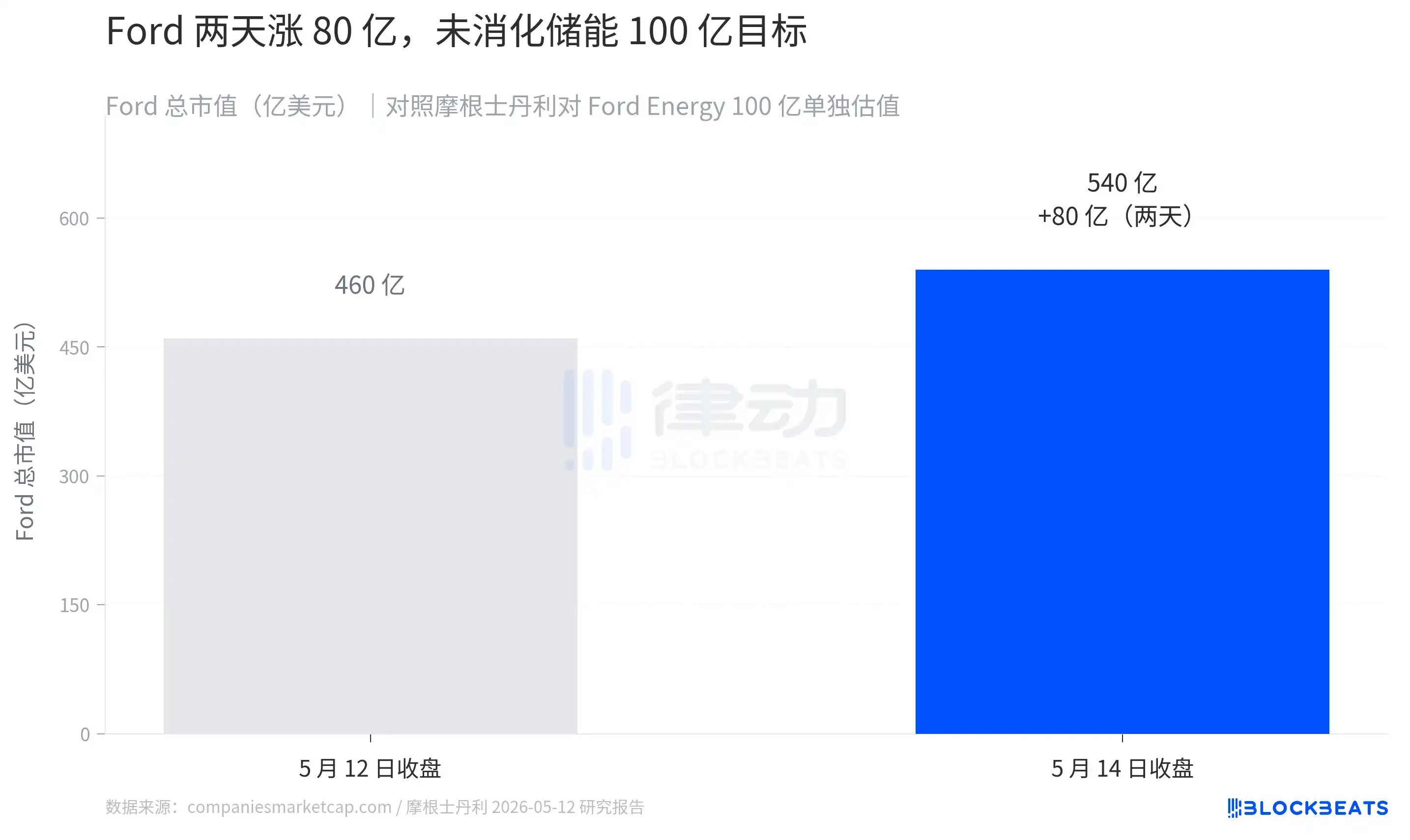
This is the reason the market is willing to pay a premium. But the market has only priced in $8 billion so far. Morgan Stanley's $10 billion target implies an additional $2 billion not yet digested. The revaluation is in its early stages.

To absorb that remaining $2 billion, Ford Energy needs to deliver on capacity, contracts, and pricing. Production capacity is expected only in the second half of 2027, while contracts depend on downstream buyers—those regions scrambling most aggressively for electricity.

The Four Corridors

In the same research report, Morgan Stanley provided another figure. U.S. data center installed power capacity was 40 GW in 2024 and is projected to reach 79 GW by 2027. By 2028, a gap of approximately 49 GW is expected between demand and supply, representing a 20% shortfall. This gap will not be evenly distributed across 50 states.

Based on currently public data center power applications, the gap is concentrated in four corridors. The APS service area in Phoenix, Arizona, has a backlog of 30 GW in its queue. Loudoun County, Virginia, has capacity either signed or nearing signature of 14.2 GW. In Abilene, Texas, the OpenAI-led Stargate project alone requires 1.2 GW. Hillsboro, Oregon, has another 0.4 GW. The figures differ in scope: Phoenix's 30 GW includes projects in utility queues yet to be finalized, while Loudoun's 14.2 GW represents actual capacity close to being contracted.
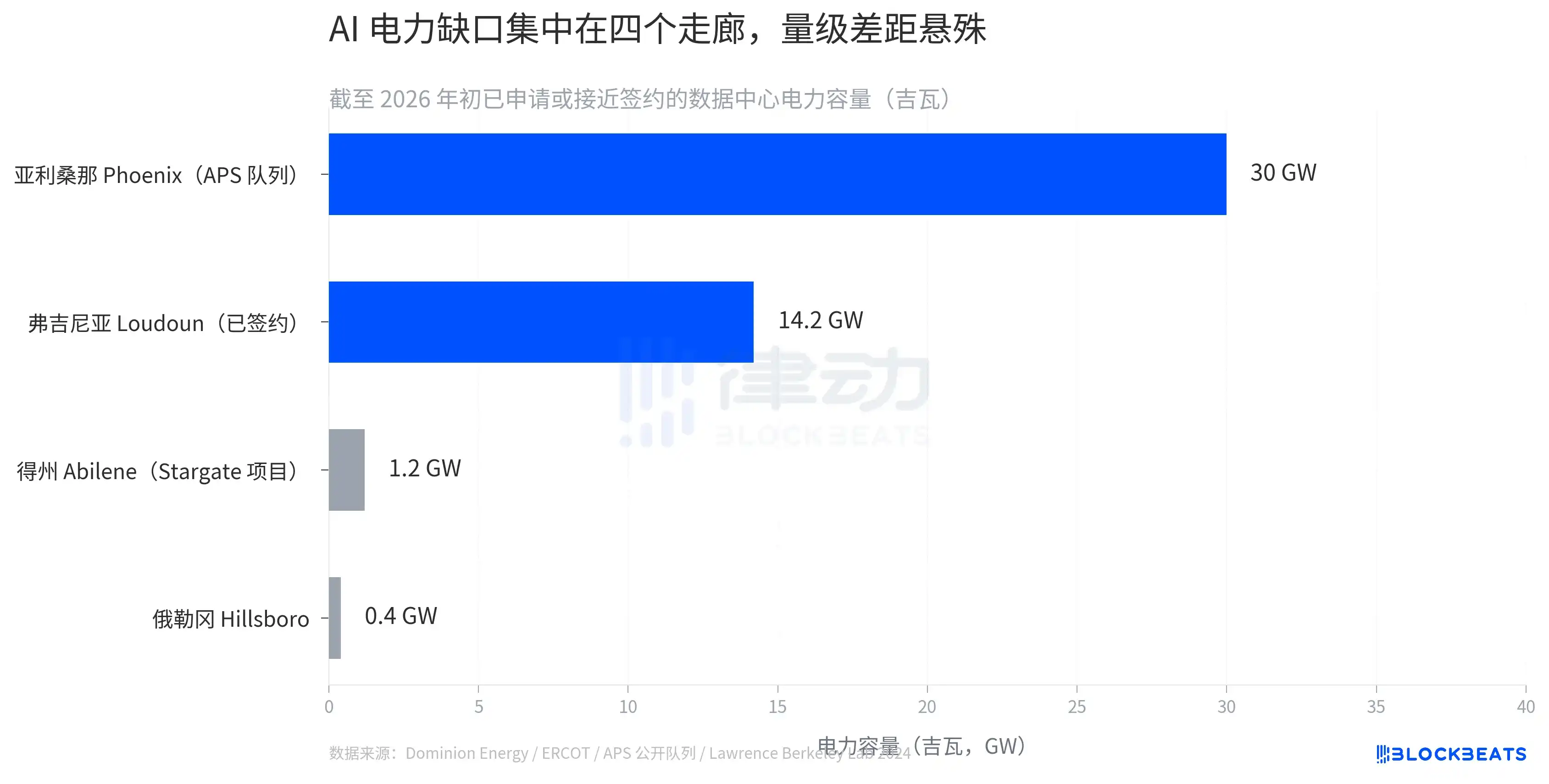
This is the demand-side foundation for Ford Energy's $10 billion valuation. When a region's grid capacity growth can't keep pace with data centers' electricity grab, space for energy storage arbitrage is created. On one side are training loads during peak hours that are almost impossible to cut, and on the other is a supply curve the grid cannot instantly respond to. In the middle lies the deterministic cash flow for energy storage providers.

But grabbing electricity comes at a cost. The question is, who pays?

The Bill Lands in Louisiana

On May 14th, Fortune's front page reported on Meta's Hyperion project in Richland Parish, Louisiana. This flagship data center, Meta's bet on "AI advantage," costs $10 billion. In July 2024, the Richland Parish Commission approved sales and use tax exemptions totaling $3.3 billion, covering 20 years.

This abatement exceeds the combined police budgets of the state of Louisiana for seven years.

Meta also secured a 60% local property tax exemption through a PILOT agreement, conditional on hiring 300 local permanent positions. This project's predicted power consumption could account for 20% of Louisiana's total electricity usage.

A more crucial comparison lies across state lines. Texas's total data center sales tax exemption losses for the 2025 fiscal year amounted to about $1 billion, making it the state's costliest industry subsidy. Virginia's was $1.02 billion in FY2024, and Illinois's was $371 million in 2023. The $3.3 billion subsidy for Meta's single project exceeds any single state's total annual data center subsidies.
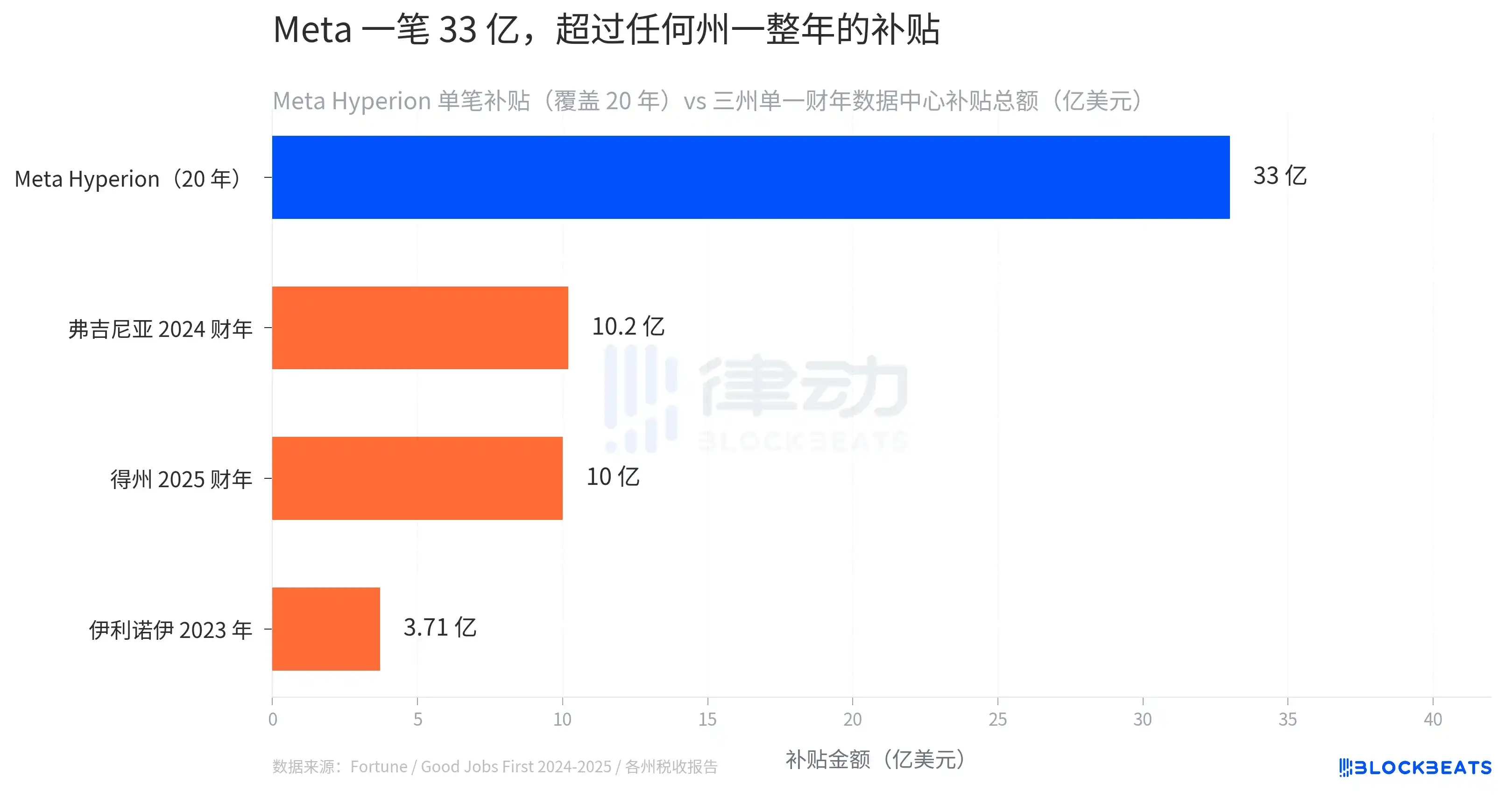
This is not an isolated case. According to Good Jobs First, at least 36 states have authorized data center sales tax exemptions through specific legislation, with only 11 publicly disclosing beneficiary company names. Official calculations in some states are more direct: for every dollar given in data center tax breaks, state coffers incur a net loss of 52 to 70 cents. The $8 billion increase in Ford's valuation is built on the implicit assumption that "this subsidy arms race will continue."

The continuation of this subsidy arms race depends on state legislators' ability to explain why an abatement exceeding seven years of police budgets is justified. This is becoming increasingly difficult.

Data Center Opposition Rates Now Exceed Nuclear Power Plants

A 2025 Gallup national survey shows 70% of respondents oppose building a data center near their homes. The opposition rate for nuclear power plants in the same survey is 53%. Data centers are now the most opposed-to infrastructure in the United States.

This is not an abstract number. Data Center Watch's database as of early 2026 shows 69 jurisdictions have halted approvals or rejected data centers through local referendums or moratorium resolutions, stalling $64 billion in planned projects. In Loudoun County, Virginia, data center tax breaks caused a $267 million loss for the public school system in 2024, a fact now entering voters' consciousness.
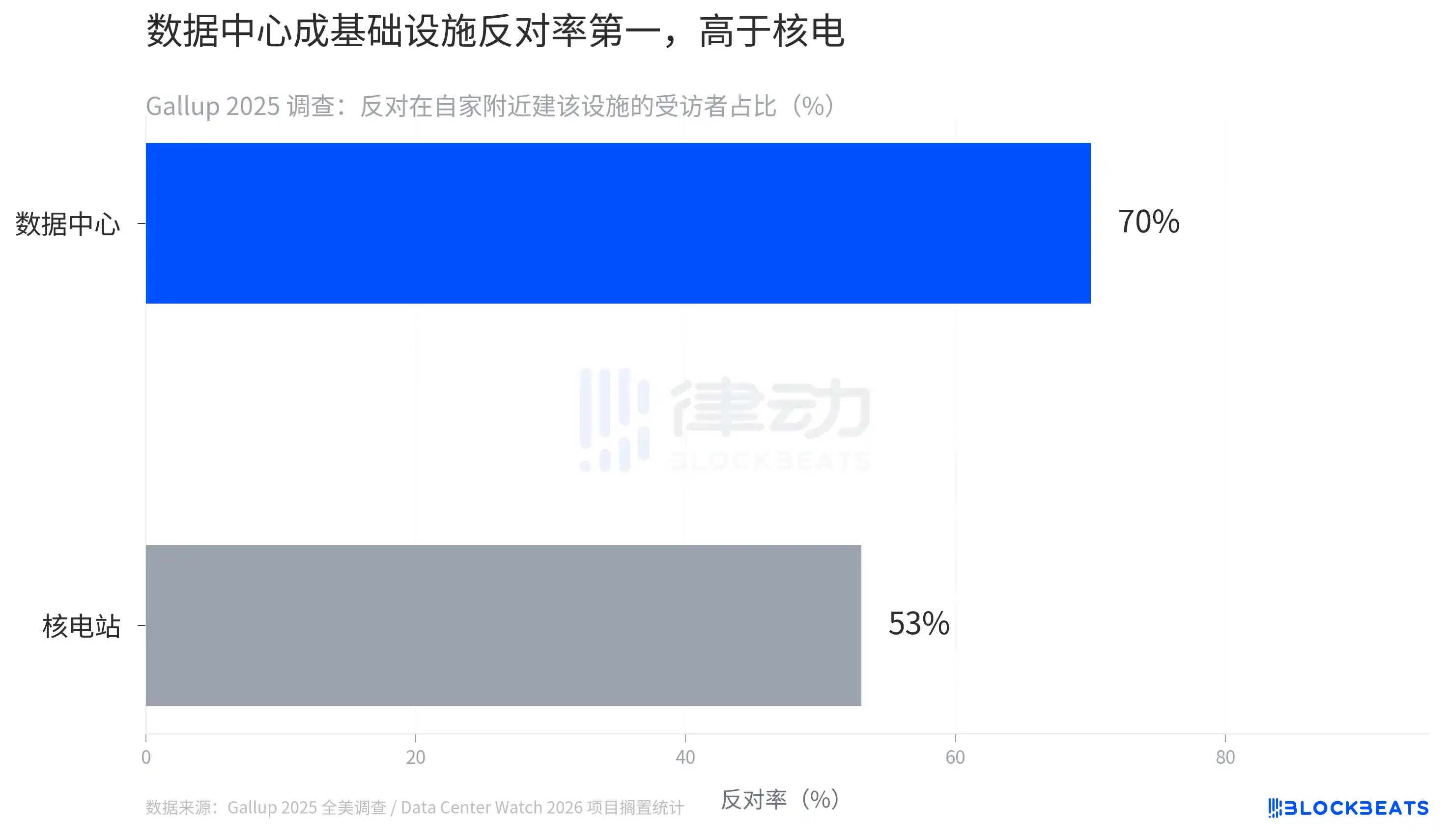
The reasons data centers are disliked are more complex than those for nuclear plants. Nuclear plants are typically tens of kilometers from residential areas, while data centers hug urban edges. They consume water for cooling, increase grid load, generate low-frequency noise, yet provide local employment mostly in the hundreds, far lower than the job density of steel mills or auto plants. Hyperion's 326 operational jobs for $3.3 billion in abatement equates to a fiscal cost of $10 million per job. The room for explanation by local governments is narrowing.

The path to realizing Ford Energy's $10 billion valuation requires this grid to keep running, subsidies to hold, the electricity grab to proceed as usual, and opposition not to translate into legal mandates. If any link weakens, repricing will follow.

Ford's $8 billion gain, Meta's $3.3 billion subsidy, Phoenix's 30 GW queue, and the 70% opposition rate are readings from four cross-sections of the same grid. They remain disparate data points for now. Once one hard constraint emerges—whether physical power shortage, state fiscal breach, or public vote—the others will be repriced simultaneously.


Пов'язані питання

QAccording to the article, what is the estimated valuation given by Morgan Stanley for Ford's new energy subsidiary 'Ford Energy', and what key assumptions underpin this valuation?

AMorgan Stanley analyst Andrew Percoco gave Ford Energy a separate valuation of $10 billion. The valuation is based on the assumptions that Ford Energy will achieve a 25% gross margin and $346 million in EBIT by 2028, and that it will be valued using the price-to-sales multiples of leading energy storage companies like Tesla.

QWhy is the energy storage business considered significantly more profitable than Ford's traditional automotive business, based on the figures provided?

ABased on 2024 financials, Ford's Blue (internal combustion engine) division had an EBIT margin of only 3.6%. In contrast, the energy storage industry shows much higher profitability: Tesla's Megapack business has a gross margin of 26.2%, and Sungrow's energy storage business exceeded 28% in the first half of 2024. Morgan Stanley estimates that the gross margin per GWh for Ford Energy could be at least double that of selling an F-150 truck.

QThe article states that a massive power supply-demand gap for data centers is projected by 2028. What is the estimated size of this gap, and where is the demand primarily concentrated?

AMorgan Stanley projects that by 2028, the power demand from US data centers will reach about 79 GW, creating a supply-demand gap of approximately 49 GW. This demand is primarily concentrated in four key corridors: Phoenix, Arizona (30 GW in the utility queue); Loudoun County, Virginia (14.2 GW nearing contract); Abilene, Texas (e.g., the 1.2 GW Stargate project); and Hillsboro, Oregon (0.4 GW).

QWhat specific tax incentives did Meta secure for its Hyperion data center project in Louisiana, and how do these subsidies compare to those in other states?

AMeta secured a combined $3.3 billion in sales and use tax exemptions over 20 years for its Hyperion project in Richland Parish, Louisiana. This single project's subsidy exceeds the total annual data center tax exemptions for any other state, such as Texas's ~$1 billion in FY2025 or Virginia's $1.02 billion in FY2024.

QWhat is the primary public sentiment towards building new data centers in the US according to the article, and what are some key reasons behind this opposition?

AA 2025 Gallup poll cited in the article shows that 70% of respondents oppose building a data center in their local area, making it the most opposed type of infrastructure (more than nuclear power at 53%). Key reasons for opposition include high water and electricity consumption, low-frequency noise, proximity to residential areas, and the perception of providing relatively few local jobs (often in the hundreds) compared to the massive scale of tax incentives received.

Пов'язані матеріали

Metrics Ventures Market Watch: The Brewing Storm

In the past month, the market has been actively trading contrasting expectations, balancing global supply chain disruptions fueling re-inflation against both actual and anticipated (Walsh) interest rate hikes. This volatility has impacted commodities and most equities, though tech has temporarily benefited from concentrated short-term liquidity. Fundamentally, as previously analyzed regarding the Strait of Hormuz situation, the US faces deep-seated balance sheet issues beyond what any single Fed chair can resolve. Hypotheses around a figure like Walsh could only materialize if AI fundamentally reshapes production relations. Until then, most non-AI-leading nations (effectively all except the US and China) risk fiscal and monetary policy collapse, rendering the identity of the Fed chair ultimately irrelevant. For crypto assets, there is currently no clear role in these dominant narratives. The market remains strongly capped by the 200-day moving average. While trends may shift from "anything but AI" to "anything but mines," this phase is dominated by the silicon vs. carbon (AI vs. traditional) dichotomy, leaving little room for crypto—though its time will come. **Market Overview & Commentary** The crypto market lacks significant catalysts beyond hype, plagued by low volume and scarce innovation, with clear technical resistance. Currently, crypto struggles for attention as global focus lies elsewhere. Assets like gold, oil, and grains are more direct hedges against supply-chain-driven inflation/stagflation. Bitcoin needs more time for capitulation and consolidation; this reset is expected to last until at least Q4 2026. Looking ahead, three factors will likely drive future market volatility: 1. Whether Walsh repeats the patterns of predecessors like Bassant or Musk, shifting stance into a new policy cycle. 2. The market underestimates the severity of global supply chain damage and the prolonged time needed for repair, which will eventually lead to recognition of acute resource shortages and price swings. 3. AI non-beneficiary, high-inflation nations (e.g., UK, Japan) will face severe fiscal and monetary crises. Rapid AI-driven displacement could trigger a collapse of existing credit and welfare systems. Ultimately, the market may realize that an AI bubble burst could spark contagious sovereign credit crises. The monetary and fiscal responses to such a scenario could serve as the ultimate catalyst for Bitcoin's next major bull run.

marsbit20 хв тому

Metrics Ventures Market Watch: The Brewing Storm

marsbit20 хв тому

Insiders Betting on Musk Are Reaping 'Historic Returns'

The largest IPO in history is imminent as SpaceX, led by Elon Musk, is set to price its offering on June 12. At a targeted valuation near $2 trillion, this event will mint new billionaires from Musk's inner circle of long-time allies, rewarding their loyalty with unprecedented returns. Key beneficiaries include Antonio Gracias, Musk's close friend and confidant, who holds a 7.3% stake potentially worth over $140 billion, making him the second-largest individual shareholder. Gwynne Shotwell, President and COO since 2002, holds shares valued at roughly $2 billion. Bret Johnsen, the CFO, holds stock worth approximately $1.4 billion. Luke Nosek, a PayPal co-founder and early investor, stands to gain about $5.3 billion. The IPO filing also reveals complex and controversial financial arrangements. SpaceX has guaranteed nearly $20 billion in payments from xAI's subsidiary to Gracias's Valor Equity Partners for AI hardware leases—deals auditors flagged as "failed sale-leaseback" transactions, forcing SpaceX to record them as debt. Despite rapid revenue growth, SpaceX is not profitable, posting a $49 billion loss in 2025 and a $4.3 billion loss in Q1 2026. Capital expenditures are soaring, with over 60% directed toward AI. Public investors will inherit these losses, significant debts, and a governance structure heavily controlled by insiders, including a provision granting Musk up to a billion additional shares if one million people live on Mars.

链捕手22 хв тому

Insiders Betting on Musk Are Reaping 'Historic Returns'

链捕手22 хв тому

Ethereum Reduced to a Chinese Concept Stock

The article titled "Ethereum Becomes a Chinese Concept Stock" presents a critical analysis of Ethereum's perceived decline in market confidence and its structural parallels to Chinese companies listed on US stock exchanges. It begins by noting significant sell-offs by early investors like Wanxiang and key figures like Bankless's Hoffman in 2026, despite Ethereum's strong fundamental activity. The piece questions the erosion of trust in Vitalik Buterin and the Ethereum Foundation (EF), arguing that while other ecosystems have faced founder controversies, Ethereum's issues stem from its internal governance model. The author draws a direct comparison to "China concept stocks," which are Chinese businesses operating globally but reliant on foreign capital and listings. Similarly, Ethereum, funded early by Chinese capital like Wanxiang, developed a strong institutional framework from its IXO to its PoS transition. The core problem, according to the article, is a leadership vacuum regarding price and direction. Vitalik's move to make the EF smaller and less active is framed as a mistake. While he advocates for ETH as a "commodity," the ecosystem lacks a clear entity to steward its price stability, creating tension within the PoS system, as seen with Lido's challenges. The narrative suggests that excessive abstraction and a hands-off approach from the EF have left the community adrift, contrasting with more proactive foundations like Solana's. The article then examines emerging technical narratives for Ethereum: privacy (ZK-proofs), AI integration, and a refocus on Layer-1. However, it observes a shift from Ethereum leading as a "world computer" to merely adapting to trends like AI, where crypto-native projects are finding success independently of Ethereum. The piece posits that Ethereum's unique value in an increasingly fragmented world may be as a permissionless, global financial testing ground—a neutral platform amid geopolitical tensions. In conclusion, it asserts that Ethereum's fate mirrors that of China concept stocks: an asset born from one region (conceptually "A"), funded by another ("B"), and dependent on "B" for exit liquidity. While Ethereum's "golden age" may be over, and selling pressure from early backers will continue, it remains positioned as a critical linkage point in a divided global landscape, standing at a new, albeit uncertain, starting point.

marsbit46 хв тому

Ethereum Reduced to a Chinese Concept Stock

marsbit46 хв тому

AI Agents Fundamentally Transform Web3 Gaming: From the Rugpull Bakery Bot Controversy to the New Agent Paradigm in 2026

AI Agents Are Redefining Web3 Gaming: From the Rugpull Bakery Bot Controversy to the 2026 Agentic Paradigm The recent controversy in Rugpull Bakery, a competitive baking game on Abstract chain, highlighted a pivotal shift. Player complaints about unfair bot automation in Season 2 led developers to not ban them, but instead formally integrate AI agents as core gameplay in Season 3, providing official guides (skill.md, agent.json). This move signals Web3 gaming's transition into the "Agentic Gaming" era, where AI agents are sovereign entities with independent strategy and economic rights, moving beyond simple automation. By 2026, AI agent integration has evolved into three core models reshaping the ecosystem: 1. **Autonomous Competitors & Economic Entities:** Agents act as independent players. Examples include TEN Protocol's poker-playing agents, AI Arena's trainable NFT fighters, Satoshi Strike Force's "Digital Athletes" trained on player data, and Somnia's "Agentic L1" blockchain providing native infrastructure for millions of autonomous agents. 2. **Modular Infrastructure & Programmable Environments:** Games like EVE Frontier enable "server-side modding," allowing AI agents to program game world logic directly into structures like smart storage, turrets, and stargates via Smart Assemblies. Coupled with standards like ERC-8183, which enables autonomous job creation and payment between agents, in-game infrastructure gains a "commercial soul." 3. **Hybrid Companions & Dynamic Adaptive Worlds:** This model focuses on human-AI collaboration. In Parallel Colony, players guide highly autonomous AI Avatars with unique personalities and goals. Illuvium plans to use AI to transform NPCs into dynamic, context-aware entities that create personalized, emergent narratives. The conclusion is clear: blocking automation is futile. The future lies in leveraging blockchain's transparency and programmability to empower AI agents as first-class citizens. Web3 gaming is shifting from inefficient human labor to efficient algorithmic interplay and emergent intelligence, creating a "post-human" digital frontier where players become commanders and symbiotic partners in a new socioeconomic experiment.

marsbit46 хв тому

AI Agents Fundamentally Transform Web3 Gaming: From the Rugpull Bakery Bot Controversy to the New Agent Paradigm in 2026

marsbit46 хв тому

Торгівля

Спот
Ф'ючерси
活动图片