Author: David, Deep Tide TechFlow
How much is a single post really worth?
At 7:05 AM EST on March 23, Trump posted a message in all caps on Truth Social. The gist of it was: The US and Iran had "very good, productive conversations" over the past two days, and he had ordered a pause on strikes against Iranian power plants and energy facilities for five days.
This post was made before the US stock market opened. But the futures market is real-time.
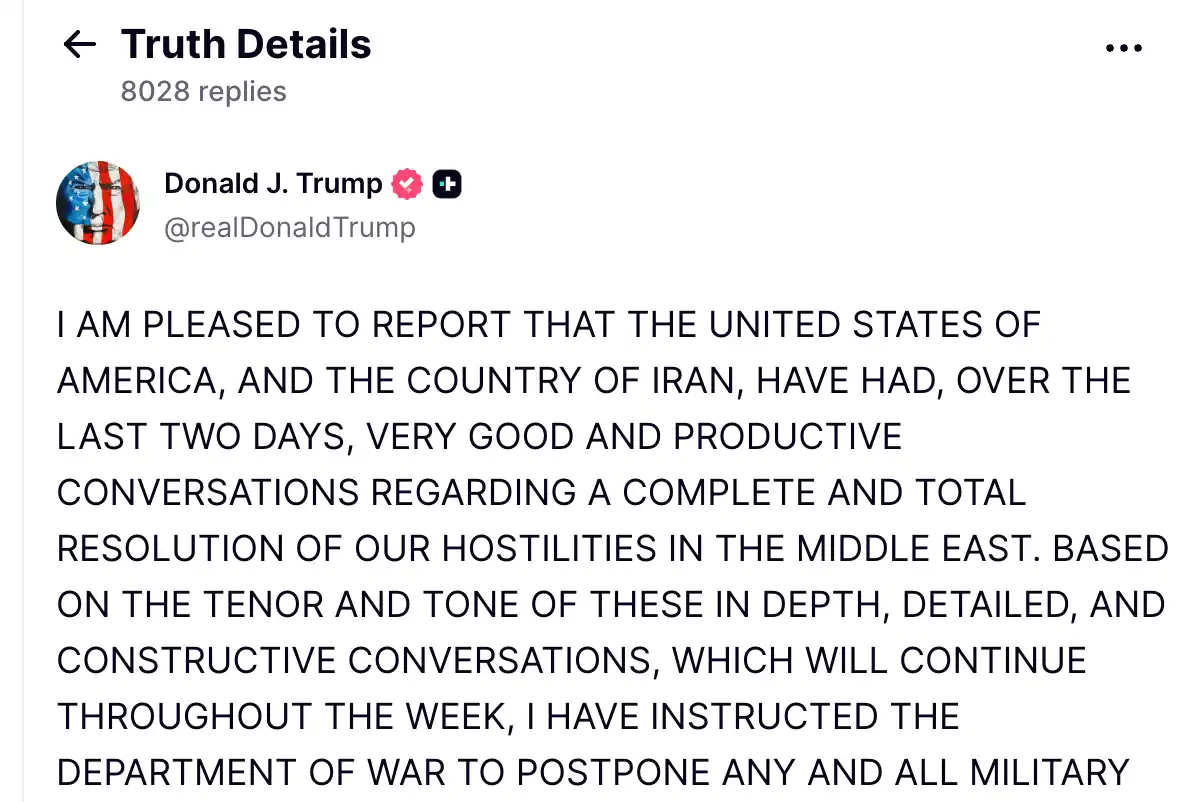
Within minutes, Dow Jones futures surged over 1000 points, and S&P 500 futures rose 2.7%. Brent crude plummeted from $113 per barrel straight down to $98, a drop of over 13%.
A reporter from the renowned foreign magazine Fortune later calculated that from the time the post was made until the market digested the news, the total market capitalization of US stocks increased by approximately $1.7 trillion.
If you were an ordinary trader and posted a message on social media about oil supply, causing global oil prices to crash by 13%, regulators would likely be at your door within 24 hours.
But if you are the President of the United States, this is called diplomacy.
Then Iran said: We haven't spoken to him.
Iran's state news agency quoted a security official stating there had been no direct or indirect dialogue between Tehran and Washington. Iranian scholar Seyed Mohammad Marandi wrote more bluntly on X:
"Every week when the market opens, Trump posts these kinds of statements to drive down oil prices. This time he even precisely set the five-day deadline to coincide with the close of the energy market trading week."
The news traveled back to the US, and the market gains were nearly halved. But by the close, the Dow was up 631 points, and Brent crude settled at $99.94, the first time it had fallen below $100 since March 11. This means the market chose to believe Trump's version, at least half of it.
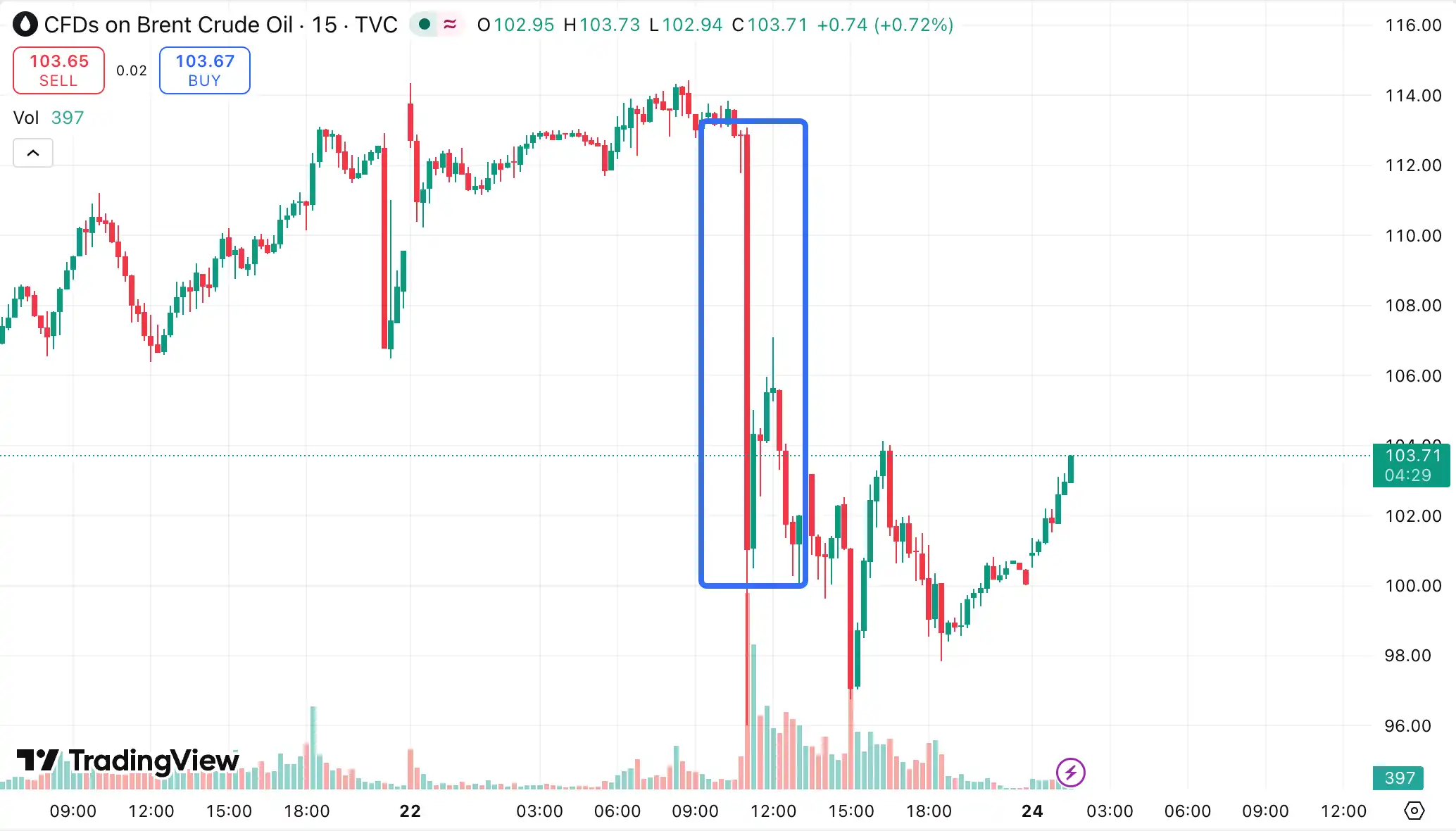
One post, one hour, trillions of dollars swinging back and forth.
This is less the President making a diplomatic statement and more the world's largest oil trader placing an order.
And the tools in his hands aren't futures contracts; they are the US military and Truth Social. Other traders use money to go long or short; he uses the switch for war.
According to CNBC, about 15 minutes before the post was made, around 6:50 AM New York time, there was a simultaneous abnormal surge in trading volume for both S&P 500 futures and crude oil futures.
In the thin liquidity of the pre-market session, this sudden, isolated spike in volume was very conspicuous.
Fifteen minutes later, the post was made, oil prices crashed, and stock indices soared. This means that whoever acted at 6:50 made money after 7:05. In the commodities market, building a position precisely ahead of major news is one of the most classic forms of insider trading.
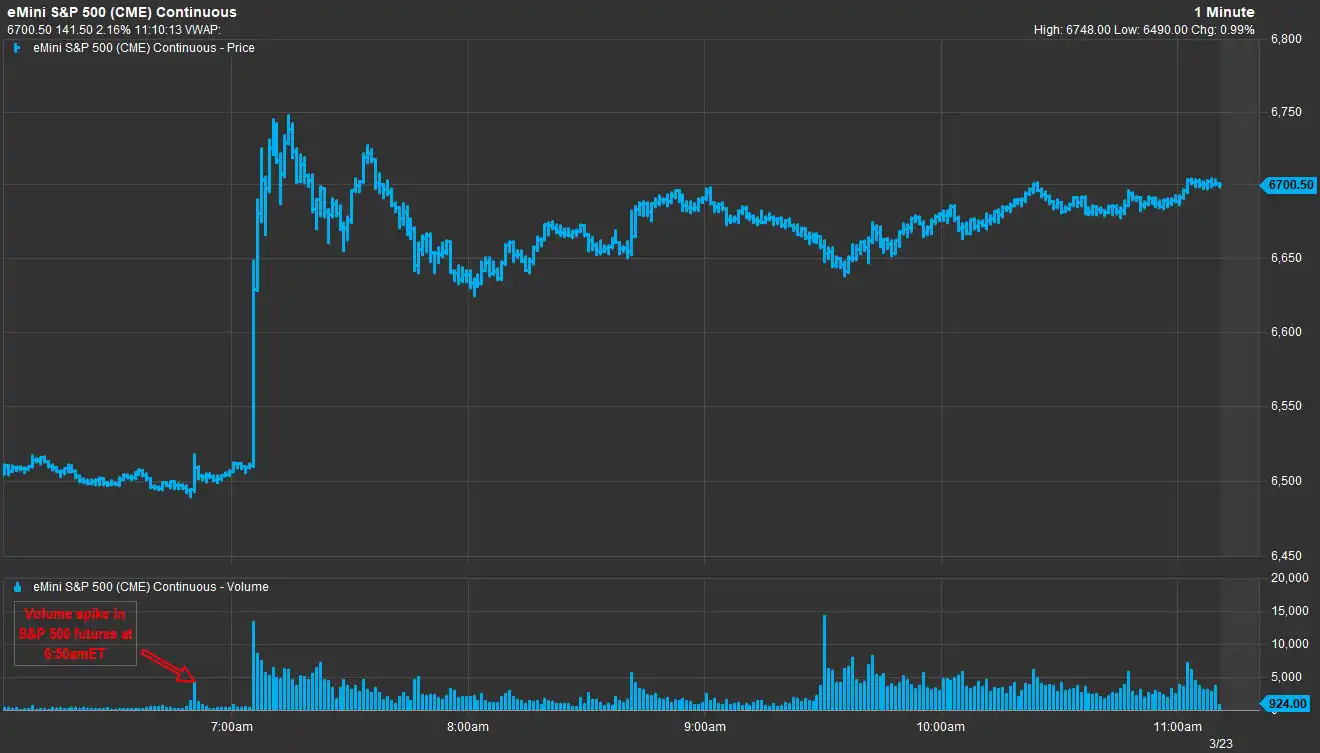
Image source: CNBC, S&P 500 pre-market trading volume spike
In April of last year, when Trump's反复变卦 (repeated flip-flopping) on tariff policy caused severe market volatility, Congressman Adam Schiff publicly questioned: Who knew what the President was going to say before he posted? No answer was given that time.
This time, CNBC contacted the SEC and the Chicago Mercantile Exchange. The response from both institutions was identical: No comment.
And this isn't the first time. Looking back, Trump moving oil prices with his mouth has been going on for nearly a decade.
The Mouth Business
Trump started talking about oil prices on social media as early as 2011, back when he wasn't president. Railing against OPEC for manipulating the market was a regular part of his content. But complaining is one thing; a real estate developer grumbling on Twitter is different from manipulating oil prices.
What truly turned him from a "commentator" into a "trader" was a deal in 2020.
Early that year, the COVID-19 pandemic erupted, the global economy ground to a halt, and oil demand fell off a cliff. Making matters worse, Saudi Arabia and Russia started a price war, increasing production to snatch market share from each other. Oil prices plunged to around $20 per barrel. US shale companies were collapsing in droves; the entire industry was in mourning.
By normal logic, low oil prices are good for consumers—gas is cheaper. A president who cares about his constituents should be happy about it.
But Trump did the opposite.
He invited a room full of oil company CEOs to the White House for a meeting. Then he personally called Saudi Crown Prince Mohammed bin Salman and Russian President Vladimir Putin, persuading them to join OPEC in massive production cuts. The goal was singular:
To push oil prices back up.
Subsequently, he posted a tweet hinting that a production cut agreement was imminent. That day, WTI crude surged 25%, marking the largest single-day gain in history.
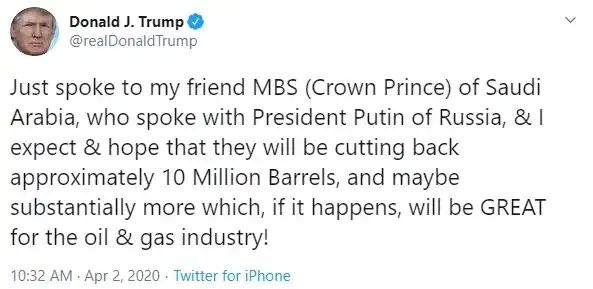
Why save oil prices? Because those shale company owners on the verge of bankruptcy were his biggest political donors.
According to public reports, oil tycoon Harold Hamm saw his personal fortune evaporate by $3 billion in a few days during the price crash and immediately lobbied Trump to intervene. NBC's headline at the time was blunt: "Trump wanted lower oil prices, now he's consulting with oil execs on how to raise them."
The essence of this deal was: Global consumers paid for higher oil prices, the profits flowed to his political donors, and he himself harvested the next round of campaign funds.
If it had ended there, it could have been categorized as "political利益交换 (quid pro quo)". But Trump did something no politician would do—he publicly admitted it.
At subsequent campaign rallies, he said more than once to his supporters:
"We got oil prices too low, had to go save the oil companies. I called OPEC, I called Russia, I called Saudi Arabia, told them the price has to come up."
The audience erupted in applause.
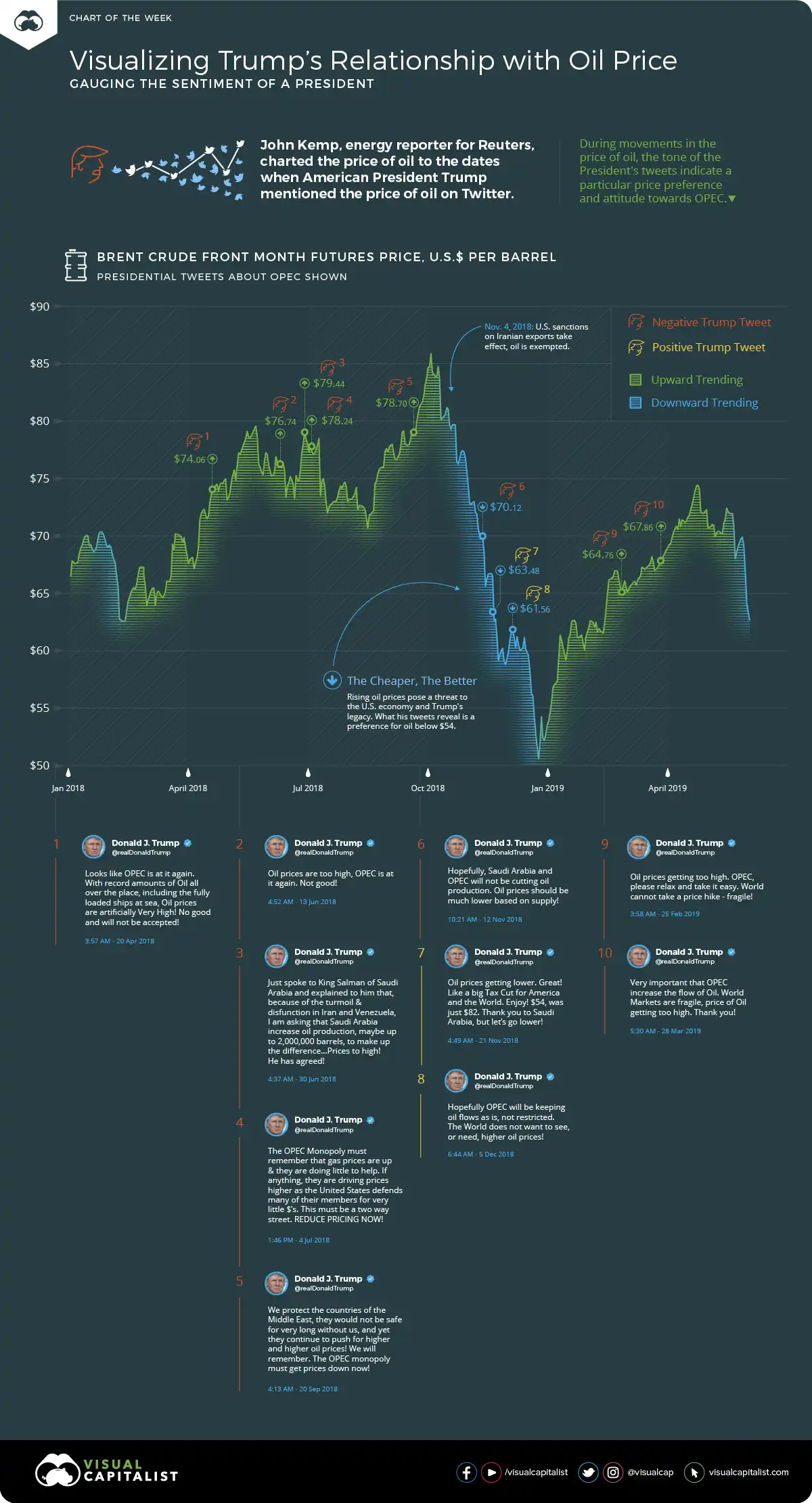
Image source: Visual Capitalist
In 2023, the academic journal "Energy Policy" published a paper reviewing all of Trump's social media posts related to oil from his announcement of candidacy in 2015 to his account suspension in 2021.
The conclusion: His tweets did have a quantifiable impact on WTI crude futures prices and significantly amplified speculative behavior in the market.
In other words, academia used data to confirm something all traders already knew: This man's mouth could move global oil prices. And the 2020 story proved that he not only could, he was willing, and his motive wasn't national interest, but his own network of interests.
From his first term to now, Trump's oil trading tools have upgraded. Twitter became Truth Social,骂OPEC (cursing OPEC) became pausing bombing Iran...
But the logic has never changed: Use the information advantage and policy power unique to the presidency to create price fluctuations in the world's largest commodity market.
From Mouth to Hand
For the past decade, Trump has earned "influence" money in the oil market.
With a word, others profit, others lose, and he himself reaps political capital. But in 2026, the nature of this business began to change.
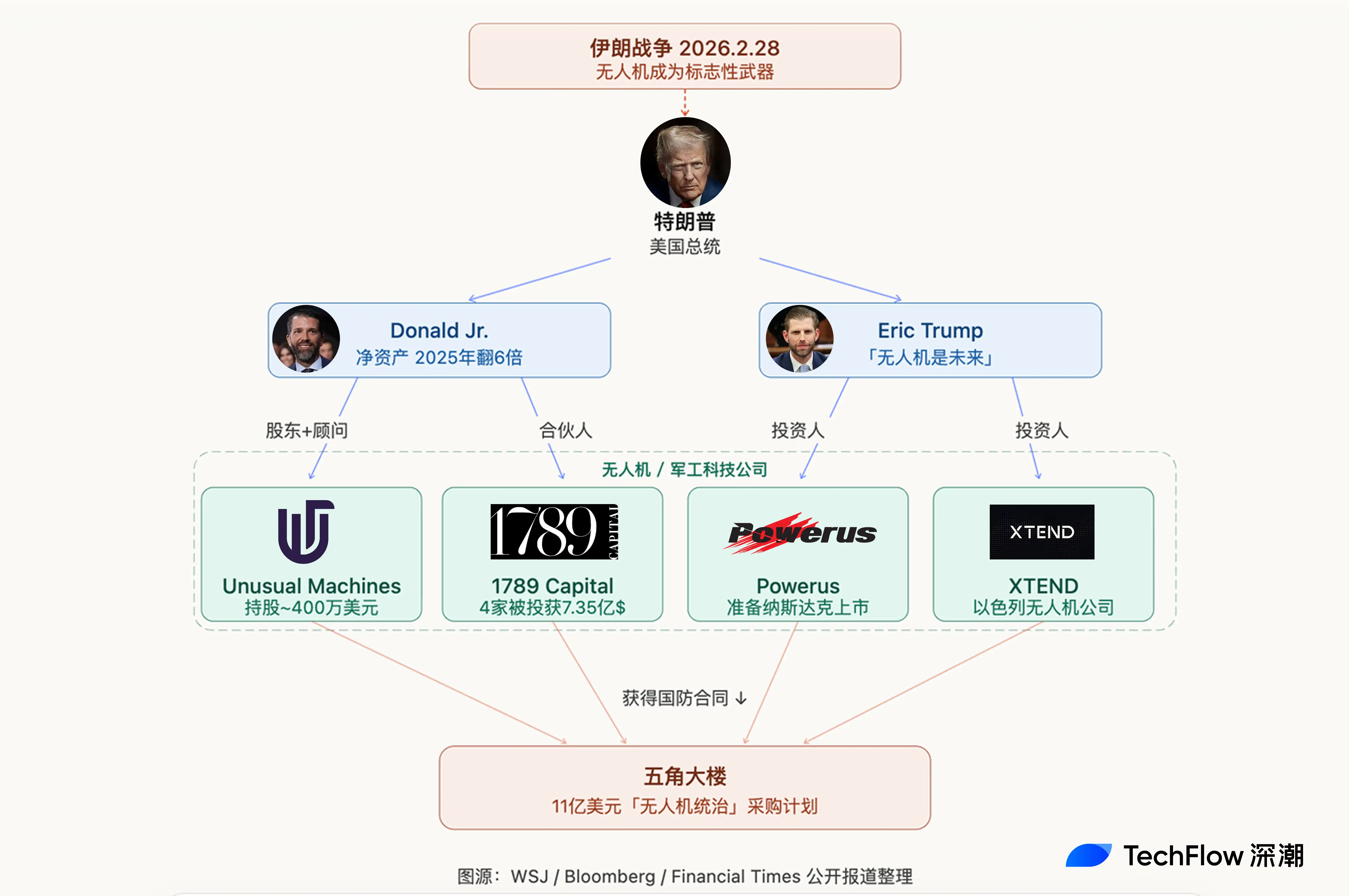
In early March this year, the Wall Street Journal and Bloomberg reported the same piece of news: Trump's two sons, Donald Jr. and Eric Trump, are investing in a military drone company called Powerus.
Donald Jr. is also a shareholder and member of the advisory board of drone component company Unusual Machines, holding approximately 330,000 shares worth about $4 million.
He joined this company in November 2024, just weeks after his father won the election. He had no prior experience in the drone or defense industry.
Unusual Machines subsequently secured a contract with the US Army to produce 3,500 drone motors, with the military indicating an additional 20,000 components would be ordered in 2026.
Donald Jr. is also a partner at venture capital firm 1789 Capital. According to Financial Times statistics, in 2025 alone, at least four portfolio companies of this VC received defense contracts from the Trump administration, totaling over $735 million.
Forbes estimated Donald Jr.'s personal net worth was around $50 million before his father's inauguration in January 2025; by the end of the year, it had sextupled.
Then, his father launched a war against Iran on February 28, 2026.
Drones are the signature weapon of this war. According to the New York Times, both sides are using drones extensively, with a unit cost only a fraction of traditional missiles. The Pentagon is advancing an $11 billion procurement plan aiming to deploy over 200,000 US-made attack drones by 2027.
A few days after the war started, his son Eric Trump posted on X: "Drones are the future."
The conflict of interest is obvious. A president's son enters the defense industry after his father takes office, invests in companies that get contracts from his father's administration, and his father is fighting a war that heavily uses the products of these companies.
It's not just oil anymore; the Trump family's business has expanded to the war itself. Oil is the money he makes with his mouth; drones are the money his son makes with his hands.
Today is the first day of the pause in strikes. In five days, either negotiations yield results, the Strait of Hormuz reopens to traffic, and oil prices continue to fall; or nothing is achieved, Iran continues to blockade the strait, and everything reverts to the way it was.
The world's largest oil trader has issued the market a five-day option. The strike price is war or peace; no one knows.
But one thing is certain: If oil prices rise, his son's drone company gets more orders; if oil prices fall, he wins again on Truth Social.
No matter the outcome, he won't lose money.