Every Vote on the CLARITY Act Will Be Scored: 3 Million Crypto Supporters Want Senators to Vote 'Yes'

cryptonews.ruPublished on 2026-07-27Last updated on 2026-07-27

Abstract

The advocacy group Stand With Crypto announced it will track and publicize U.S. senators' votes on the CLARITY Act, incorporating them into public legislator scorecards for its 3 million members to use ahead of the November elections. The group is urging a "yes" vote, stating the bill has mobilized cryptocurrency owners who seek regulatory clarity. Their pre-election survey indicates nearly 80% of crypto owners are highly likely to vote, with 70% saying a candidate's crypto stance influences their choice, and 59% identifying as swing voters—potentially making the issue decisive in tight races. The bill, which passed the Senate Banking Committee in May, now awaits a full Senate vote. However, its path is uncertain, with Galaxy Research lowering its 2026 passage odds to 30% due to timing, bipartisan support challenges, and unresolved provisions on ethics and consumer protection.

Stand With Crypto, an American cryptocurrency community advocacy organization, announced on X on July 27 that senators' votes on the CLARITY Act bill will be recorded in its public ratings on behalf of 3 million American crypto supporters.

The organization stated that each senator's vote will become part of its public legislator ratings, which cryptocurrency owners can use to compare candidates ahead of the November elections. It also urged lawmakers to vote 'yes' on this bill.
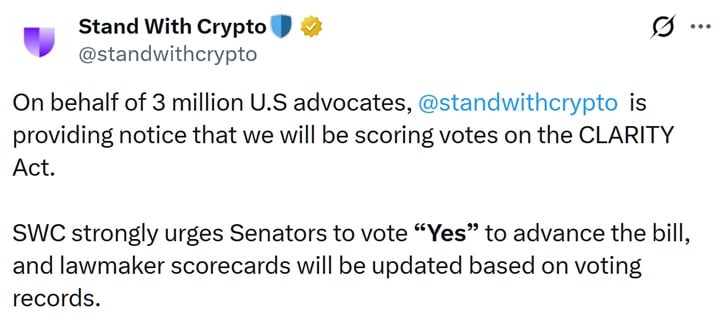
"The CLARITY Act has mobilized millions of cryptocurrency owners who eagerly await the passage of market structure legislation that will provide certainty regarding the technology they rely on," added Stand With Crypto, noting:

"Cryptocurrency-owning voters across the country are watching to see which legislators stand with them at this critical moment."

The updated ratings will record whether each senator supported advancing the bill; the vote on the CLARITY Act will be added to Stand With Crypto's existing ratings based on lawmakers' actions and public stances on cryptocurrency. The CLARITY Act vote will be one of the most prominent positions in these ratings ahead of the November midterm elections.

The organization has expanded its midterm-focused campaign, placing its scoring system at the center of efforts to transform cryptocurrency policy positions into voter-focused political achievements.

Public Scorecards Put Senators' Votes in the Spotlight

With less than 100 days until the midterm elections, Stand With Crypto's report on pre-midterm voter sentiment showed that nearly eight in ten cryptocurrency owners believe they will almost certainly vote.

Nearly 70% indicated that a candidate's stance on cryptocurrency would influence their choice, while 73% were closely following the digital asset policies legislators supported. Another 59% identified themselves as voters who do not consistently support one party, potentially giving cryptocurrency policy greater significance in tight congressional election races.

These findings reinforce the potential impact of the scorecards, especially in competitive races where politically unaffiliated cryptocurrency owners can compare candidates using their recorded positions on the CLARITY Act.

The campaign is taking place during the two-week legislative window before the August recess, with ethics provisions regarding public officials remaining a central issue in negotiations between lawmakers. Several Democratic lawmakers are pushing for stricter ethics measures and consumer protections, complicating vote counting as supporters need to secure the 60 senator votes typically required to advance a bill.

Galaxy Research lowered its assessment of the likelihood of the CLARITY Act passing in 2026 to 30%, as the Senate vote faces challenges related to timing, bipartisan support, and unresolved provisions.

Next Stage: Senate Floor

On May 14, the Senate Committee on Banking, Housing, and Urban Affairs approved the revised market structure bill with a vote of 15 to 9, sending it to the full Senate for consideration. This bipartisan committee vote reflected the outcomes of negotiations on federal oversight, investor protection, enforcement authority, and operational requirements for digital asset companies. The bill now awaits a full Senate vote.

Under the proposed framework, federal regulators would receive clearly defined authority over various digital assets, and exchanges and intermediaries would be required to comply with registration, disclosure, and customer protection requirements.

For senators, the upcoming vote carries two significant implications: it will determine whether the bill moves forward, and it will establish a result that Stand With Crypto will present to millions of supporters.


Related Questions

QWhat is the main purpose of the organization Stand With Crypto's announcement regarding the CLARITY Act?

AThe main purpose is to announce that each U.S. Senator's vote on the CLARITY Act will be recorded in their public legislator scorecards, representing 3 million American crypto supporters, to help voters compare candidates ahead of the November elections.

QAccording to Stand With Crypto's pre-midterm report, what percentage of crypto owners are 'almost certain' they will vote, and why does their vote matter for tight races?

ANearly eight in ten (almost 80%) crypto owners are almost certain they will vote. Their vote matters because 59% identify as non-straight-ticket voters, meaning crypto policy positions could significantly influence their choice in competitive congressional races.

QWhat was the outcome of the CLARITY Act vote in the Senate Banking Committee, and what is the next step for the bill?

AThe Senate Banking Committee approved the amended market structure bill with a 15-9 vote, sending it to the full Senate. The next step is a floor vote in the full Senate.

QHow does Galaxy Research currently assess the likelihood of the CLARITY Act passing in 2026, and why?

AGalaxy Research has lowered its assessment of the bill's chances of passing in 2026 to 30%. This is due to challenges with timing, securing bipartisan support, and unresolved provisions related to ethics and consumer protection.

QWhat are two key implications of the upcoming Senate floor vote on the CLARITY Act for senators, according to the article?

AFor senators, the upcoming vote has two key implications: 1) It will determine whether the bill moves forward in the legislative process. 2) It will establish a result that Stand With Crypto will present to its millions of supporters as part of their public scorecards.

Related Reads

US Calls for Restrictions on Sports Prediction Markets

The National Football League (NFL) has urged the U.S. Commodity Futures Trading Commission (CFTC) to tighten rules for prediction markets on sports events. In a July letter, the NFL argued that current proposals fail to adequately protect the integrity of games and market participants. Key demands include banning contracts on events easily manipulated by individuals (e.g., a kicker missing a field goal), clarifying definitions to prevent gambling-like contracts, and explicitly prohibiting trading based on non-public insider information. The league also called for restricted person lists, a ban on margin trading, advertising limits, stronger user protections, and a minimum age of 21. This push coincides with an ongoing jurisdictional dispute between the CFTC and several states. The CFTC claims exclusive federal oversight, classifying event contracts as swaps, while states argue these platforms violate local gambling laws. Recent legal actions in Michigan and Minnesota highlight the conflict, with a federal court temporarily blocking Minnesota from applying a new law to CFTC-registered platforms like Kalshi and Polymarket. Meanwhile, prediction markets are experiencing significant growth. In June, driven by events like the World Cup, Kalshi's trading volume exceeded $31 billion (85% from sports contracts), while Polymarket's global platform hit a monthly record of $10.8 billion. However, platforms face legal challenges, such as lawsuits from Kentucky accusing them of operating unlicensed sports betting disguised as prediction markets.

cryptonews.ru7m ago

US Calls for Restrictions on Sports Prediction Markets

cryptonews.ru7m ago

Peskov Says Russia Is Among Top Five Leaders in AI Race. What Do Global Rankings Say?

On July 27, 2026, Kremlin spokesman Dmitry Peskov stated that Russia remains among the top five countries in the global AI development race. He acknowledged Russian models still lag behind leading U.S. counterparts but claimed they have reached a "very high level," aiming to close the gap with "superhuman efforts." He highlighted the differing approaches of Russia's GigaChat, built from scratch, and Yandex, which initially used foreign technology. However, this claim is not supported by major international AI rankings. Stanford University's Global AI Vibrancy Tool (2024-25) ranks Russia 28th out of 36 countries. The top five are the U.S., China, India, South Korea, and the UK. The Stanford AI Index Report 2026 does not mention Russia's position, focusing instead on U.S. and Chinese leadership across various metrics like investments and model performance. In benchmarks, GigaChat ranks 25th on the Russian-language LM Arena. While it passed a financial analyst exam in December 2025, its business usage costs are reportedly tens to hundreds of times higher than China's DeepSeek. In related developments, President Putin signed a law on July 26, 2026, establishing a legal framework for sovereign AI models and granting developers access to state data. Previously, Russia joined 28 other nations, including China, to establish the World AI Cooperation Organization (WAICO) in Shanghai. The article notes that rankings vary due to different criteria, such as research, investment, infrastructure, or responsible AI governance. While Russian authorities are bolstering AI through legislation and international cooperation, independent analyses suggest the country faces significant challenges, including a hardware deficit for training models, which legal frameworks alone cannot resolve.

cryptonews.ru7m ago

Peskov Says Russia Is Among Top Five Leaders in AI Race. What Do Global Rankings Say?

cryptonews.ru7m ago

From Sand to Chips: Hefei's Semiconductor Alchemy

From Sand to Chips: Hefei's Semiconductor "Alchemy" On July 27, 2026, a memory chip maker from Hefei made history by surpassing the market capitalization of Industrial and Commercial Bank of China on its Shanghai Stock Exchange debut. This marks the culmination of Hefei's two-decade industrial transformation, often summarized in three strategic leaps: "Screen, Chip, Vehicle." The journey began in 2008 with a bold investment in BOE, establishing China's first 6th-generation LCD panel line. The second leap was the "Project 506" in 2016, which gave birth to ChangXin Memory Technologies (CXMT). With initial backing of 14.4 billion RMB from Hefei's state-owned investment platform, CXMT aimed to break into the global DRAM market, then over 95% controlled by three overseas giants. CXMT achieved a breakthrough in 2019 by producing China's first 8GB DDR4 DRAM chip, employing "generational leapfrog" R&D to catch up. After years of significant losses, the company turned profitable in 2025. A dramatic surge followed in 2026, driven by AI-driven demand and full capacity utilization, propelling CXMT to become the world's fourth-largest DRAM manufacturer. CXMT's success is not isolated. It anchors a dense, localized semiconductor ecosystem in Hefei. Within its vicinity are numerous supporting companies for equipment, materials, and packaging & testing. This cluster has fueled the regional economy, with Hefei's integrated circuit industry output growing over sevenfold between 2016 and 2025. The ripple effects extend beyond high-tech, revitalizing local communities with new businesses and services catering to the influx of workers. For individuals, Hefei offers competitive tech salaries at a significantly lower cost of living compared to major coastal cities, along with improved amenities and shorter commutes. Hefei's story demonstrates two decades of focused, long-term industrial policy, transforming the city from a provincial capital into a trillion-RMB GDP "Double Ten-Thousand" city (10 million people, 1 trillion RMB GDP). It shows how persistence in strategic sectors—turning sand into chips—can redefine a city's economic destiny.

marsbit36m ago

From Sand to Chips: Hefei's Semiconductor Alchemy

marsbit36m ago

Trading

Spot
活动图片