Winklevoss-Backed Zcash Treasury Company Suffers Huge Loss of $37.8 Million, Now Shifts to Making Anti-Cancer Drugs?

marsbitPublished on 2026-08-14Last updated on 2026-08-14

Abstract

The Nasdaq-traded crypto treasury company Cypherpunk Technologies, backed by the Winklevoss twins, reported a net loss of $37.8 million for the first half of 2026. Despite holding roughly $157 million worth of Zcash (ZEC), the company's market valuation is only about $74 million, trading at a significant discount to its holdings. Cypherpunk announced a strategic pivot to focus on its anti-cancer drug candidate, sirexatamab, which recently received FDA Fast Track designation but requires expensive Phase 3 trials. The company admits it will need to raise substantial capital to fund this development, as its remaining cash is limited. While the company's ZEC was acquired at an average price well below the current market rate, the token's flat price performance has not helped its financial situation. The stock has fallen 40% this year and 96% over five years. CEO Onsi indicated the company is exploring options to advance the drug candidate, potentially through a spin-off or partnership, highlighting the urgent need for new funding.

Author:Protos

Compiled by: Deep Tide TechFlow

Deep Tide Introduction: The Winklevoss-backed Zcash (ZEC) treasury company has a market value less than half its holdings and now relies on anti-cancer drugs to tell a new story. This exposes the common discount dilemma faced by listed crypto companies and also reminds ZEC investors to pay attention to corporate financing risks.

The Winklevoss-backed Zcash (ZEC) treasury company Cypherpunk Technologies announced plans to shift its focus to its anti-cancer drug candidate. The company reported a net loss of $37.8 million for the first six months of 2026.

The company admitted that unless ZEC prices rebound soon, it will need to raise significant funds to cover upcoming FDA trials.

The company projected today: "We expect to continue generating operating losses for the foreseeable future."

Cypherpunk holds ZEC worth approximately $157 million, but Nasdaq traders value the entire company at only $74 million.

This equates to a 0.47x multiple of its basic asset net value (mNAV). It's not surprising that crypto treasury stocks continue to trade below their holding value.

If pre-funded warrants and other sweeteners are included in the company's self-proclaimed enterprise value mNAV, the multiple on the front page rises to 0.96x—still below the value of its ZEC holdings.
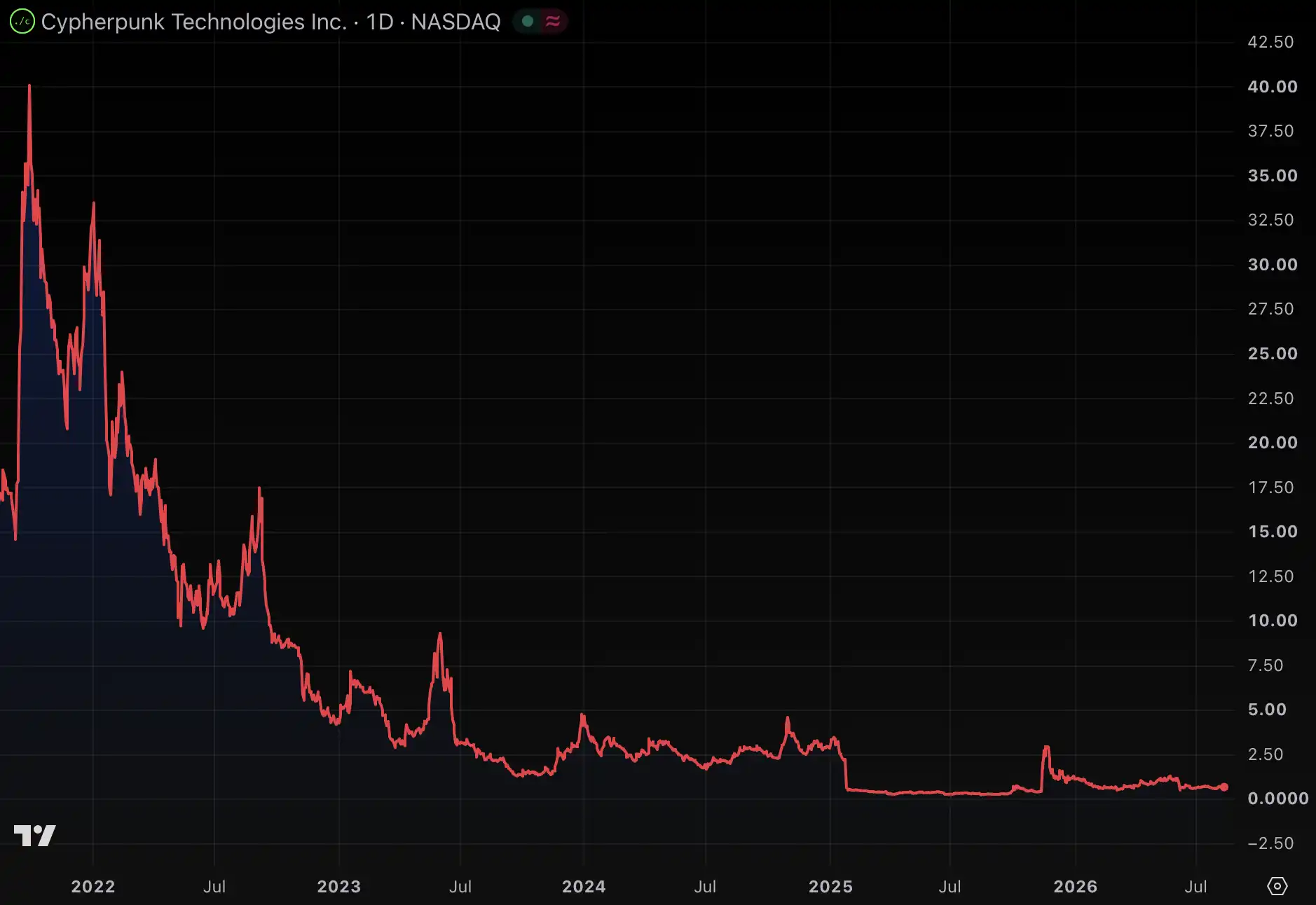
Chart: Cypherpunk Technologies five-year stock price chart. Source: TradingView

Backed by Cameron and Tyler Winklevoss

Cameron and Tyler Winklevoss are the billionaires who helped build the company's ZEC brand.

Initially, the company was successful, acquiring ZEC at an average purchase price of $341.84—well below the current market price of $486 for ZEC.

The company's stock reached $3.70 last November but has now fallen back below $0.69 per share.

Cypherpunk has lost tens of millions this year yet continues to plan an expensive FDA trial path for its anti-cancer drug. The stock is down 40% this year and 96% over the past five years.

The Winklevoss twins' controlled exchange Gemini is the custodian for the company's ZEC.

Anti-Cancer Trials Are More Costly, ZEC Can't Help

Cypherpunk's anti-cancer drug candidate is the anti-DKK1 antibody Sirexatamab. In a randomized Phase 2 study, it failed to outperform the control group in progression-free survival across all patients.

The company attributed this to insufficient power in the final analysis.

On the digital asset treasury side, ZEC prices have been flat year-to-date, so that hasn't helped either.

The FDA still granted the drug candidate Fast Track designation in May, a status that expedites regulatory review. Regulators also agreed to a Phase 3 trial protocol for colorectal cancer involving approximately 270 patients.

Onsi stated that the company is "conducting a strategic process to decide the best path forward for sirexatamab: either as a spun-out company with separate financing or moving forward with a partner equally committed to cancer patients."

In simple terms, this candidate needs more money.

Tyler Winklevoss wrote at launch: "We plan to continue accumulating ZEC rapidly, aiming for Cypherpunk to hold at least 5% of the total ZEC supply."

Nine months later, the company now holds 323,394 ZEC, representing 1.92% of the circulating supply.

As of June 30, the company had only $7.6 million in cash and cash equivalents, $500 million in accumulated deficit, ongoing loss-making operations, and an expensive path to FDA approval for an idealistic drug.


Related Questions

QWhat significant strategic shift did Cypherpunk Technologies announce?

ACypherpunk Technologies announced a strategic shift to focus on its anti-cancer candidate drug, Sirexatamab, moving away from its core business as a Zcash (ZEC) treasury.

QHow much was Cypherpunk's net loss for the first half of 2026, and what is the primary challenge linked to this loss?

ACypherpunk reported a net loss of $37.8 million for the first six months of 2026. The primary challenge is that unless the price of ZEC rebounds soon, the company will need to raise significant capital to fund upcoming FDA trials for its cancer drug.

QWhat discrepancy exists between Cypherpunk's ZEC holdings value and its market valuation on Nasdaq?

ACypherpunk's ZEC holdings are valued at approximately $157 million, but the company's total market valuation on Nasdaq is only $74 million, representing a market net asset value (mNAV) multiple of just 0.47 times its underlying assets.

QWhat role did Cameron and Tyler Winklevoss play in relation to Cypherpunk Technologies?

ACameron and Tyler Winklevoss are billionaire investors who helped establish the company's ZEC brand. Their exchange, Gemini, serves as the custodian for Cypherpunk's ZEC holdings.

QWhat is the status and challenge regarding Cypherpunk's anticancer drug candidate, Sirexatamab?

ASirexatamab failed to outperform the control group in a randomized Phase 2 study for progression-free survival, though the company attributed this to insufficient statistical power. The FDA has granted it Fast Track designation and agreed to a Phase 3 trial plan. The major challenge is that advancing this drug through FDA approval requires substantial additional funding.

Related Reads

GPT-5 Also Has Tip-of-the-Tongue Moments, Google Tested 4.5 Million Times: The Keys Are Lost

Google researchers have discovered that advanced AI models like GPT-5 and Gemini 3 experience a phenomenon akin to the human "tip-of-the-tongue" state, where they possess knowledge but fail to retrieve it. Their study, "Empty Shelves or Lost Keys?" (ICML 2026), introduces the "Knowledge Portrait" framework to analyze factual knowledge in models, distinguishing between failure to encode a fact versus failure to recall it. Testing on 13 models across 2.15 million queries from the WikiProfile benchmark revealed that state-of-the-art models successfully encode 95-98% of facts into their parameters. However, when asked directly, they fail to recall 26-34% of these known facts. Enabling chain-of-thought ("thinking") reasoning reduces this recall failure to 11-12%, recovering 40-65% of the previously unrecalled but encoded facts. The research identifies two key bottlenecks: recalling obscure ("long-tail") facts and answering reversed queries (e.g., "Who is Tom Cruise's mother?" vs. "Whose son is Tom Cruise?"). While scaling model size effectively reduces encoding failures, it does little to improve recall rates. In larger models, recall failure becomes the dominant source of factual errors, accounting for over 70% of mistakes in GPT-5.2. The findings suggest that for top models, the primary challenge is no longer storing knowledge but accessing it efficiently. Future accuracy gains may depend more on improved inference-time methods and "meta-cognitive" abilities, enabling models to recognize when they need to engage in deeper reasoning to retrieve information they already know.

marsbit14m ago

GPT-5 Also Has Tip-of-the-Tongue Moments, Google Tested 4.5 Million Times: The Keys Are Lost

marsbit14m ago

The Dollar is a Technology: Stablecoins Are Exporting U.S. Institutions to the World

This article argues that stablecoins and blockchain infrastructure are becoming a vehicle for exporting American financial systems globally. The core thesis is that the U.S. dollar, as a "technology," is increasingly embedded in blockchain rails, moving beyond a reserve currency to represent the institutional stability of the United States itself. The piece highlights three key areas where this is happening: 1. **Cross-border payments and trade finance:** Companies like Keyrails use stablecoins and blockchain to streamline and secure trade finance for emerging markets (e.g., Nigeria-China trade), offering faster, often cheaper dollar liquidity than traditional systems. 2. **Programmable collateral and credit:** Platforms like SemiLiquid allow institutions to use tokenized assets (e.g., treasuries, stocks) as "programmable collateral" for loans without moving them from custody, unlocking capital efficiency and improving transparency in institutional lending. 3. **Financing real-world assets:** Protocols like USD.AI create lending markets for productive, hard-to-finance assets like AI GPUs, connecting global stablecoin liquidity to physical capital. The author concludes that the true value of these new blockchain-based financial platforms lies not just in transaction volume, but in the deep, hard-to-replicate "context" (data, trust, operational knowledge) they build around specific economic activities like trade and asset finance. This represents crypto's evolution into an operating system for real-world capital formation, moving beyond speculation.

marsbit18m ago

The Dollar is a Technology: Stablecoins Are Exporting U.S. Institutions to the World

marsbit18m ago

Ethereum Glamsterdam Upgrade: Largest-Scale Underlying Restructuring Yet, Mainnet Date Still Undecided

The upcoming Ethereum "Glamsterdam" upgrade is viewed by core developers as the most significant protocol-level refactoring since The Merge, fundamentally altering how the network processes transactions and manages its state to advance L1 scaling. Its core goals are: accelerating processing via parallelization, increasing capacity, and enhancing sustainability through adjusted fees that better reflect long-term data storage costs. The upgrade features two headline proposals. First, **ePBS (EIP-7732)** on the consensus layer aims to formalize proposer-builder separation directly within the protocol, eliminating reliance on off-chain relayers. This built-in mechanism is designed to provide a more secure and efficient block production pipeline, extending the critical validation window to allow the network to handle more data, particularly for Layer2s. Second, **BALs (EIP-7928)** on the execution layer introduces block-level access lists. These lists specify the data each transaction will access beforehand, allowing the network to identify and safely execute non-conflicting transactions in parallel, rather than strictly sequentially. This also speeds up new node synchronization. Glamsterdam also includes配套 proposals to reprice storage costs (aiming for a predictable ~120 GiB annual state growth) and the cost of data-reading operations to better align with modern hardware costs and prevent spam. Regarding the timeline, the initial schedule targeting a mainnet activation on September 16, 2026, has likely been delayed. Following the launch of a new dedicated testnet (Plataberget), the deployments on the Sepolia and Holesky testnets are now expected in September, with the mainnet launch potentially pushed to Q4 2026 or later, as developers prioritize correctness over a fixed date.

marsbit18m ago

Ethereum Glamsterdam Upgrade: Largest-Scale Underlying Restructuring Yet, Mainnet Date Still Undecided

marsbit18m ago

Trading

Spot
活动图片