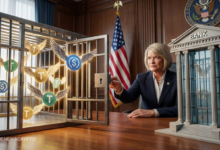
How Senate Democrats pushed CLARITY Act approval odds to 72%

ambcryptoPublished on 2026-02-05Last updated on 2026-02-05

Abstract

Following a reportedly positive and productive meeting among Senate Democrats, market optimism surged regarding the passage of the CLARITY Act, a key crypto market structure bill. Prediction market Polymarket showed approval odds jumping to 72% on February 4th. Journalists cited that the effort, once considered nearly dead, is now very much alive, with Senate Majority Leader Chuck Schumer described as "very desperate" to get the bill passed, influenced by a $193 million war chest from a crypto PAC ahead of elections. A critical White House-led negotiation is ongoing, with a end-of-February deadline set to resolve the key sticking point: stablecoin yields. If a compromise is reached, a Senate committee vote could occur in March. Market odds have fluctuated, briefly dipping to 64%, but analysts believe the bill's progress could help stabilize the crypto market.

The market appeared optimistic again that the crypto market structure bill, the CLARITY Act, would become law this year, following a recent meeting of Senate Democrats.

According to the prediction site Polymarket, the chance of such a progress shot up to 72% on the 4th of February.

This was not surprising, going by reports that the meeting was ‘positive’ and ‘productive Democrat meeting to date,’ according to journalist Eleanor Terrett, citing people present at the talks. Terrett added,

“While members still have definitive asks, the takeaway from the meeting was that the effort, thought to be on life support just a few weeks ago, is far from dead.”

Is the crypto bill back on track?

Another reporter, Sander Lutz, echoed a similar stance but singled out the crypto lobby’s influence ahead of the November elections, a key driver for pro-crypto Democrats.

Citing a Senate source, Lutz said,

“Chuck Schumer was there, and is ‘very desperate’ to get the bill over the finish line, given crypto PAC Fairshake’s announcement of a $193 million midterms war chest.”

The update follows an earlier White House-led negotiation between the crypto industry and bankers’ trade unions to restart the previously stalled discussion on the bill.

The key deal-breaker remains the stablecoin yield, and the Trump Administration gave stakeholders until the end of February to reach a compromise.

Although the specifics of the proposed ‘compromise’ remain unclear, recent developments indicate a collective effort to advance the market structure bill. At the same time, several crypto leaders have expressed optimism about the potential for meaningful progress.

According to Mike Belshe, CEO of crypto infrastructure platform and custody provider Bitgo, stakeholders should get ‘everything right’ on the bill.

“White House set an end-of-February deadline for stablecoin yield agreement. Clock’s ticking. The industry needs clear rules—and fast. Getting this right matters.”

Meanwhile, the market expectations for the bill’s passage have surged from 50/50 at the end of January to over 70% in early February.

At the time of writing, however, the odds briefly slid to 64% as the market digested details of the Senate Democrats’ meeting.

If the stablecoin yield deal is reached this month, then another Senate Banking Committee vote on the bill could be feasible in March.

That said, Nansen and Grayscale analysts believe a positive update and progress on the CLARITY Act could help stabilize the ongoing crypto rout.


Final Thoughts

  • Senate Democrats’ meeting renewed overall market optimism about the crypto bill’s chance of becoming law this year.
  • However, the stablecoin yield deal remains the key potential deal-breaker for the bill’s progress.

Related Questions

QWhat was the reported chance of the CLARITY Act becoming law on February 4th according to Polymarket?

AThe reported chance was 72%.

QWhich key issue remains the potential deal-breaker for the CLARITY Act's progress?

AThe stablecoin yield deal remains the key potential deal-breaker.

QWhat deadline did the White House set for stakeholders to reach a compromise on the stablecoin yield?

AThe White House set an end-of-February deadline.

QWhy was Senate Majority Leader Chuck Schumer described as 'very desperate' to get the bill passed?

AHe was described as 'very desperate' due to crypto PAC Fairshake's announcement of a $193 million midterms war chest, highlighting the crypto lobby's influence ahead of the November elections.

QWhat potential positive effect could progress on the CLARITY Act have on the crypto market according to analysts?

AAnalysts from Nansen and Grayscale believe progress on the CLARITY Act could help stabilize the ongoing crypto rout.

Related Reads

From Holding to Controlling: When Bitcoin Starts 'Buying Listed Companies'

From Holding to Controlling: When Bitcoin Starts "Buying Listed Companies" In a landmark event, Bitcoin has entered the capital structure of a publicly traded company as a form of capital contribution for the first time. On February 4, Nasdaq-listed insurance brokerage Tianruixiang Holdings announced that an undisclosed investor would contribute 15,000 Bitcoin in exchange for equity in the company. Valued at approximately $1.125 billion (based on Bitcoin's price of $75,000 at the time), this transaction marks a historic shift. This is not about buying a Bitcoin ETF, holding BTC, or issuing debt to purchase Bitcoin. It represents a direct exchange of Bitcoin for equity in a listed company. Over the past two years, a profound change has been underway: Bitcoin is systematically entering the balance sheets of public companies. Companies like MicroStrategy (now Strategy) have fundamentally altered traditional corporate logic. They no longer operate solely based on their core business but function as financial vehicles, continuously issuing stock and convertible bonds to raise capital for purchasing Bitcoin. This has given rise to a new type of entity: the **Bitcoin Treasury Company**. Other examples include Japan's Metaplanet, and U.S.-based firms like Twenty One Capital and Bitcoin Standard Treasury. A significant阵营 (camp) of publicly traded companies now holds substantial Bitcoin, including: * Strategy (formerly MicroStrategy): over 710,000 BTC * Major miners like MARA, Riot, and Hut 8 * Exchanges like Coinbase and Bullish * Bitcoin treasury companies * Tech and payment firms like Tesla and Block Their commonality is that they have integrated Bitcoin as a fundamental part of their capital structure. The Tianruixiang deal represents an evolution of this trend. Upon completion, the company would hold more Bitcoin than Coinbase, making it a top-tier Bitcoin treasury. Crucially, this isn't a case of "using fiat to buy Bitcoin," but rather resembles using Bitcoin to effectively "acquire a Nasdaq-listed shell company." This structure transforms the transaction from a simple investment into a form of **reverse merger by crypto assets into traditional capital markets**. Bitcoin is no longer merely held; it is being used to **restructure ownership itself**. A clear path is emerging: from MicroStrategy's massive holdings to miners, exchanges, and treasury companies, and now to direct equity-for-Bitcoin swaps, **Bitcoin is reconstructing the "public company network."** When this system becomes large enough, Bitcoin will evolve beyond a "crypto asset" into a financial infrastructure embedded within the global capital system. *Content is for informational purposes only and not investment advice. Markets are risky; investments should be made cautiously.*

marsbit8m ago

From Holding to Controlling: When Bitcoin Starts 'Buying Listed Companies'

marsbit8m ago

Don't Just Focus on Yi Lihua, These Whales' Moves During the Crash Are More Worth Watching

Amid a sharp crypto market downturn, Bitcoin fell over 15% in 24 hours, dropping below $60,000, while altcoins suffered even steeper losses. Market fear spiked, with the Crypto Fear & Greed Index hitting 9, indicating extreme fear. The article highlights key whale activities during the sell-off. Notable sellers included Aave founder Stani Kulechov, who sold 4,504 ETH, and Ethereum co-founder Vitalik Buterin, who sold 6,899.5 ETH from a planned donation. Prominent ETH bull Yi Lihua (Trend Research) sold approximately 250,000 ETH, citing risk management. Data also showed whales dumped 81,068 BTC in just eight days. On the buying side, despite the panic, some large players accumulated. "Machi Big Brother" aggressively opened leveraged long positions on ETH and other assets, though some were liquidated. MicroStrategy, a major corporate BTC holder, purchased an additional 855 BTC, reaffirming its long-term strategy and stating it would only face real threat if BTC stayed at $8,000 for years. Similarly, Bitmine, led by Tom Lee, continued buying ETH, adding over 60,000 ETH recently despite significant unrealized losses. On-chain whales were also active, with one entity withdrawing 55,483 ETH from an exchange, indicating strong accumulation during the dip. The contrast between panic selling and strategic buying underscores the divided sentiment among large holders during the market turmoil.

Odaily星球日报28m ago

Don't Just Focus on Yi Lihua, These Whales' Moves During the Crash Are More Worth Watching

Odaily星球日报28m ago

Trading

Spot
Futures
活动图片